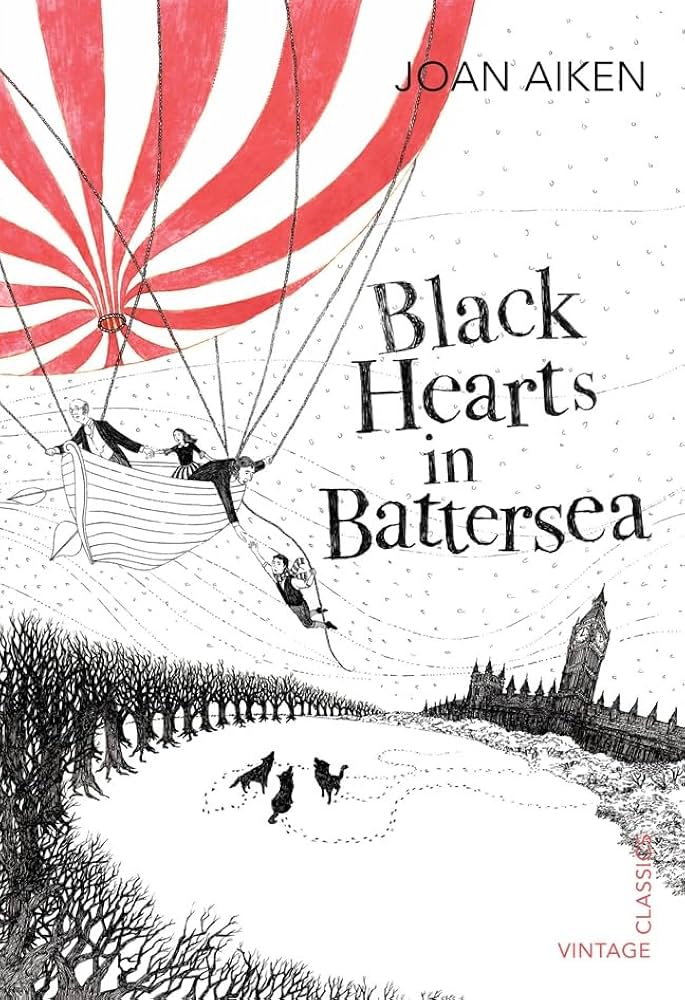
Black Hearts in Battersea by Joan Aiken – #WitchWeek2024

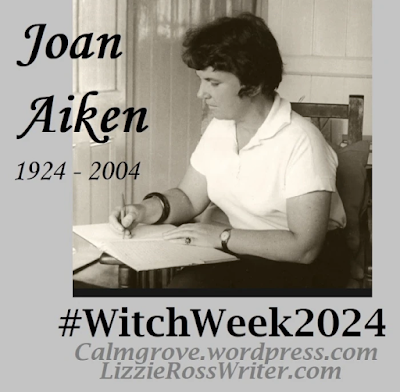
This week Chris of Calmgrove and Lizzie Ross are hosting their annual Witch Week, an event inspired by the Diana Wynne Jones book, Witch Week, and this year they are celebrating the work of Joan Aiken. I’ve had the second book in Aiken’s Wolves Chronicles series on my TBR since reading the first, The Wolves of Willoughby Chase, last year and this seemed like a perfect opportunity to pick it up.

Black Hearts in Battersea was first published in 1964 and while I would recommend reading The Wolves of Willoughby Chase first, you don’t really need to as this book would also work as a standalone story. It begins with Simon (the boy we first met living in a cave in the woods near Willoughby Chase) searching the streets of London for his friend, Dr Field. Simon is hoping to study at the Art Academy in Chelsea and Dr Field has invited him to share his lodgings in Rose Alley. However, Rose Alley proves very difficult to find, and when Simon does eventually stumble upon the right address he discovers there’s no trace of the doctor – the house is inhabited by the rather unpleasant Mr and Mrs Twite and their daughter, Dido, ‘a shrewish looking little creature of perhaps eight or nine’.

What has happened to Dr Field and will Simon manage to track him down? This is only one small part of this imaginative, action-packed novel which, like the previous book, is obviously intended for a younger audience but is still an entertaining read for those of us who are older. There are missing children and mistaken identities, kidnappings, shipwrecks and balloon rides, and a plot to kill the King – the King in this case being James III as we are in an alternate history where the Stuarts are still on the throne in the early 19th century and are the target of Hanoverian conspiracies. The other significant difference between this fictional world and the real one is that a large number of wolves have crossed from Europe into Britain and although we didn’t see much of them in Willoughby Chase, they do get alarmingly close to Simon and his friends on several occasions in this book!
Black Hearts in Battersea feels almost like a Charles Dickens novel for children, with the 19th century London setting and the array of larger-than-life characters – who include Dido and the Twite family, the eccentric Duke of Battersea, the excitable Dr Furneaux, who runs the academy Simon attends, and the book’s main villain, Eustace Buckle. I wish I had read this as a child, but as an adult I still found it a lot of fun and I’m sure I’ll read the next book in the series at some point, particularly as this one ends with Dido’s whereabouts unknown!

Book 49/50 for the Historical Fiction Reading Challenge 2024

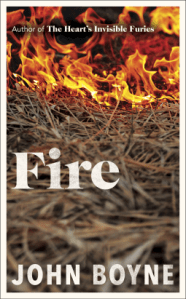
Top Ten Tuesday: Books with fire on the cover

This week’s topic for Top Ten Tuesday (hosted by That Artsy Reader Girl) is: “Covers with [Item] on the Cover (You choose the item! It can be anything at all.)”

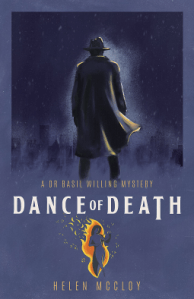
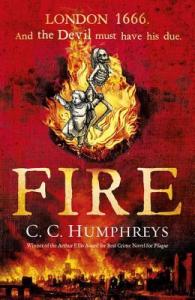
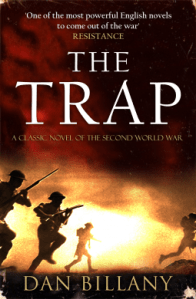
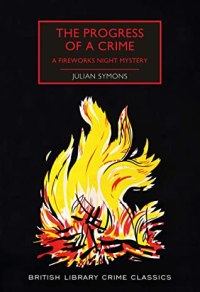
Tonight is Bonfire Night here in the UK (also known as Guy Fawkes Night or Fireworks Night), where we remember the failed Gunpowder Plot of 1605. Here are nine books I’ve read and reviewed on my blog – and another that I’m reading now and haven’t reviewed yet – which all have fire or flames on the cover.

1. Fire by John Boyne

2. Dark Fire by CJ Sansom

3. The Fire Court by Andrew Taylor

4. Dance of Death by Helen McCloy

5. Fire by CC Humphreys

6. Villette by Charlotte Brontë

7. Priestess of Ishana by Judith Starkston

8. The Trap by Dan Billany

9. There Came Both Mist and Snow by Michael Innes

10. The Progress of a Crime by Julian Symons

~

Have you read any of these? Can you find any other books with fire on the cover?

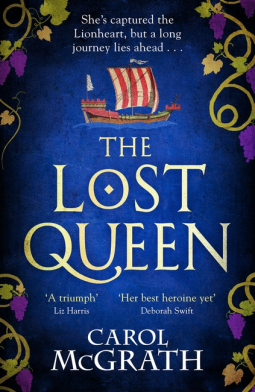
The Lost Queen by Carol McGrath

Berengaria of Navarre is one of the Queens of England I know least about and I’m sure I’m not alone in that as so little has been written about her. I’ve read novels in which she appears briefly as a secondary character, but with the exception of Martha Rofheart’s Lionheart, nothing where she takes a more central role. In The Lost Queen, Carol McGrath builds Berengaria’s story around the small amount of factual information we have about her, taking us through the early days of her marriage to King Richard I and her time spent in the Holy Land, where she accompanied Richard on the Third Crusade.

Like the other McGrath books I’ve read, there’s also a fictional heroine whose story takes place alongside the real historical one. In this case, it’s Lady Avelina of Middleton, whose husband William has disappeared after leaving for Outremer three years earlier to claim his father’s estate. William’s half-brother, Walter, is insisting that William must have become caught up in the Crusades and killed in battle, but Avelina suspects that Walter simply has his eye on herself and Middleton. Avelina is determined to prove that her husband is still alive and sets off to look for him, attaching herself to a party of nuns who are travelling to Jerusalem in search of a religious relic to bring back to their abbey.

During the journey, Avelina’s path crosses with Berengaria’s, who is on her way to her wedding with Richard. Richard’s mother, Eleanor of Aquitaine, escorts Berengaria as far as Sicily, then Eleanor’s daughter Joanna accompanies her from there to Cyprus and then the Holy Land. Avelina and the nuns join them along the way and a friendship forms between Avelina and the new queen.

Berengaria is known as the only English queen never to visit England (although it’s now thought that she may have done after Richard’s death). This means that, apart from a few chapters involving Avelina, most of the novel is set elsewhere in Europe and the Middle East. I particularly enjoyed the descriptions of all the adventures the characters have on the journey: crossing the Alps in the middle of winter; surviving assassination attempts; being shipwrecked off the coast of Cyprus and held prisoner.

As I know so little about Berengaria I can’t really comment on the accuracy of the novel. McGrath does include an author’s note, in which she explains some of her decisions and how she worked with the available information to create the story. We do know that Berengaria never had children, for example, but McGrath suggests that she may have been pregnant with Richard’s child and had a miscarriage. The Avelina chapters of the book obviously allow for a lot more invention and imagination and there are also a few sections here and there narrated by other characters such as Blondel, the troubadour, or Ursula, one of Berengaria’s ladies. I can understand why these perspectives were included, as they fill in some of the gaps, showing us things that Berengaria and Avelina don’t witness for themselves, but I didn’t feel they really added much to the story and we don’t spend enough time with these characters to form any kind of emotional connection.

The book ends before the death of Richard I and I was sorry that we didn’t continue with Berengaria’s later years as it would have been interesting to see how she dealt with being a widow and queen dowager. However, even less is known about that period of Berengaria’s life, so maybe it was the right decision for the book to end when it did. I’ll be looking out for news on which historical figure Carol McGrath is writing about next!

Thanks to Headline Accent for providing a copy of this book for review via NetGalley.

Book 48/50 for the Historical Fiction Reading Challenge 2024

Six Degrees of Separation: From Intermezzo to Murder to Music

It’s the first Saturday of the month which means it’s time for another Six Degrees of Separation, hosted by Kate of Books are my Favourite and Best. The idea is that Kate chooses a book to use as a starting point and then we have to link it to six other books of our choice to form a chain. A book doesn’t have to be connected to all of the others on the list – only to the one next to it in the chain.

This month we’re starting with Intermezzo by Sally Rooney. As usual, it’s a book I haven’t read, but here’s what it’s about:

Aside from the fact that they are brothers, Peter and Ivan Koubek seem to have little in common.

Peter is a Dublin lawyer in his thirties – successful, competent and apparently unassailable. But in the wake of their father’s death, he’s medicating himself to sleep and struggling to manage his relationships with two very different women – his enduring first love Sylvia, and Naomi, a college student for whom life is one long joke.

Ivan is a twenty-two-year-old competitive chess player. He has always seen himself as socially awkward, a loner, the antithesis of his glib elder brother. Now, in the early weeks of his bereavement, Ivan meets Margaret, an older woman emerging from her own turbulent past, and their lives become rapidly and intensely intertwined.

For two grieving brothers and the people they love, this is a new interlude – a period of desire, despair and possibility – a chance to find out how much one life might hold inside itself without breaking.

The description of Ivan as a ‘competitive chess player’ makes me think of Adam Strauss, a character in Close to Death by Anthony Horowitz (1). Adam is a chess grandmaster and he and his neighbours become suspects in the murder of Giles Kenworthy, who has been making life difficult for them all since moving into their quiet London street. This is the fifth in the Hawthorne and Horowitz series, in which the author uses himself as a character in the books.

Another author who appears as a character in his own books is Akimitsu Takagi. I loved The Noh Mask Murder (2), which I read earlier this year in a new English translation by Jesse Kirkwood. First published in 1949, this is a very enjoyable locked room mystery and I found it interesting to learn about Japan in the post-war period, as well as the different types of masks used in Japanese theatre.

Next, a simple link using a shared word in the title. The Man in the Iron Mask by Alexandre Dumas (3) is the final book in the d’Artagnan series which begins with The Three Musketeers. A lot of people go straight from the first to the last without reading the middle books, but I would recommend not skipping any of them. In The Man in the Iron Mask, d’Artagnan and his three friends, Athos, Porthos and Aramis, become involved in a plot to free a prisoner from the Bastille who closely resembles the King of France.

The word Bastille leads me straight to The Bastille Spy by CS Quinn (4), a fast-paced historical thriller set during the French Revolution and featuring a female spy, Attica Morgan. I described this in my review as ‘a cross between The Scarlet Pimpernel, James Bond and Pirates of the Caribbean’. It’s a book not to be taken too seriously and I’m sure a lot of readers will find it fun, but it wasn’t really for me and I haven’t continued with the sequel.

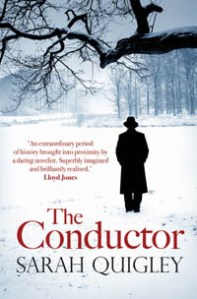
I’ve read and reviewed several other books by authors with the surname Quinn (Kate Quinn, Frances Quinn and Anthony Quinn). Apart from the Quinns, the only other author I’ve read and reviewed on my blog whose name begins with a Q is Sarah Quigley, who wrote The Conductor (5). This is a fascinating novel about the conductor Karl Eliasberg who is given the task of performing the Seventh Symphony by Shostakovich to raise morale during the Siege of Leningrad.

In Murder to Music by Margaret Newman (6), a conductor is shot dead during a choir’s performance of a new mass. Detective Superintendent Simon Hudson happens to be present in the audience and begins to investigate. However, his own girlfriend, Delia, is on the choir committee and can’t be ruled out as a suspect! This entertaining 1959 novel could have been the start of a new mystery series, but Newman changed direction and began writing romance and family sagas under other pseudonyms.

~

And that’s my chain for November. My links included: competitive chess players; authors using themselves as characters; the word ‘mask’; the Bastille; Q authors; and conductors. Intermezzo is a musical term, meaning ‘a short connecting instrumental movement’, so by finishing with Murder to Music I have managed to bring the chain full circle!

In December we’ll be starting with Sandwich by Catherine Newman.

My Commonplace Book: October 2024

A selection of quotes and pictures to represent October’s reading:

commonplace book
noun
a book into which notable extracts from other works are copied for personal use.

~

‘Yet beautiful words are the surest way past science to the real truth of life, just as beautiful paintings are,’ Blake said, watching as I began to pick up the hothouse lilies one by one, trim their stems and put them in the silver vase.

The Bells of Westminster by Leonora Nattrass (2024)

~

I shook off my moment of melancholy and determined not to think of loss. Life held sadness for us all, but there was joy too, and being of an optimistic nature, I would always choose enjoyment over sorrow.

The Lost Queen by Carol McGrath (2024)

~

Minotaur in the Labyrinth (engraving from the Medici Collection, Palazzo Strozzi, Florence)

“The evaluation of any work of fiction is to a large extent based on one’s personal preferences. I suggest we all frankly share our opinions, and from there we can discuss fully each other’s views and arrive at a joint conclusion.”

The Labyrinth House Murders by Yukito Ayatsuji (1988)

~

She wore successive states of mind like layers of petticoats picked up and put on at random, so that it was a matter of chance which one was innermost and which would show when she hitched her skirt.

God is an Englishman by RF Delderfield (1970)

~

That evening, in a whirlwind of spite, I turned out our office drawers for more paper to light the fire. Leadership Training Event, Delegation Welcome Pack, Change Management and Synergy Workshops. Was this all we’d done with our lives? It was like mining through layers of igneous rock. If I dug deep enough, perhaps I would get to the core, to the heart of the matter?

The Significance of Swans by Rhiannon Lewis (2024)

~

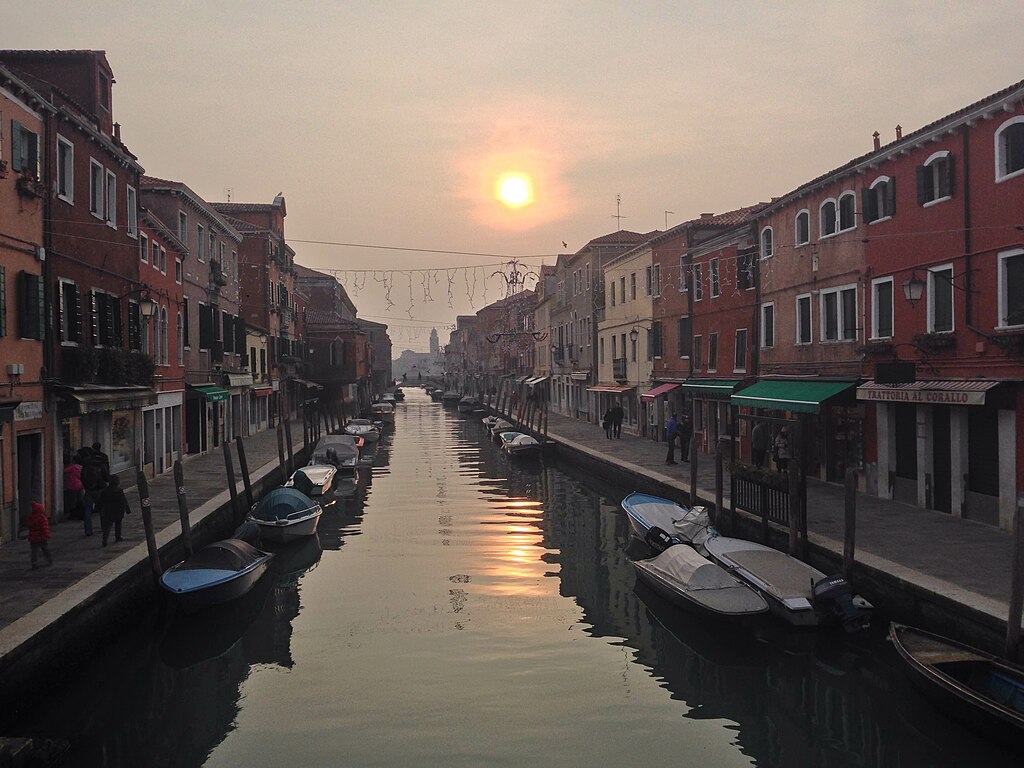
The Rio dei Vetrai, Murano (photo by Wittylama)

It was like that for some: coming out of quarantine was almost harder than being in it, When locked in, there were few decisions to make: all you could do was to wait and keep yourself alive in the meantime. Once out, suddenly there was freedom, and with it, choices.

The Glassmaker by Tracy Chevalier (2024)

~

Hadn’t she been trying to find him? Trying to find the love and closeness that had been missing between them? True, the way she had chosen to look for it was a twisted, dishonest way; childish, and childishly cruel. She would never look that way again. But there were other ways…honest, adult ways…shining, sunlit ways, strewn with bright canvases, with sawdust and splashes of paint…with laughter and gay discussion far into the night…

Don’t Go to Sleep in the Dark by Celia Fremlin (1970)

~

Politicians don’t have time to look at the world they’re living in. They see the country they’re living in and they see it as one vast electoral platform. That’s quite enough to put on their plates for the time being. They do things which they honestly believe will make things better and then they’re surprised when they don’t make things better because they’re not the things that people want to have.

Passenger to Frankfurt by Agatha Christie (1970)

~

Favourite books read in October:

God is an Englishman and Don’t Go to Sleep in the Dark

Authors read for the first time in October:

None this month

Places visited in my October reading:

England, Wales, Germany, Italy, Japan, The Holy Land

~

Reading notes: Apart from the Christie, which was a big disappointment, I enjoyed everything else I read this month. I was pleased to be able to take part in 1970 Club and to read a few more books for this year’s RIP challenge (I managed six in total during September and October). Also this month I celebrated my 15th blog birthday!

November is the busiest month in the book blogging calendar. Nonfiction November is already underway, as is Witch Week, which focuses on Joan Aiken’s work this year. There’s also Novellas in November, SciFi Month, German Literature Month, Margaret Atwood Reading Month and Norway in November – I hope I haven’t missed anything! Will I be able to take part in all of these? I doubt it, but I do have books lined up for at least some of them.

How was your October reading? What do you have planned for November?

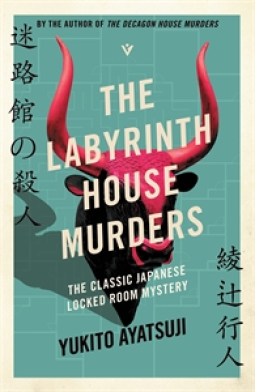
The Labyrinth House Murders by Yukito Ayatsuji

Translated by Ho-Ling Wong

This is a good example of why it’s often worth giving an author a second chance. I was disappointed with Ayatsuji’s The Decagon House Murders, finding the characters very wooden and the plot a poor imitation of And Then There Were None, so I had decided to stick with Japanese crime authors more to my taste, such as Seishi Yokomizo. Then I read lots of glowing reviews of The Mill House Murders, the second in Ayatsuji’s series to be released in a new English translation, so when I saw the third one, The Labyrinth House Murders, on NetGalley I decided to give him another try.

The Labyrinth House, we are told, is the work of the same architect who designed the Decagon House and the Mill House. As its name suggests, the house contains a labyrinth of passageways with the rooms arranged around the edges, so that to get from one room to another it’s necessary to enter the maze. The design is inspired by the Minotaur myth and all of the rooms are named after characters associated with the myth. This very unusual house is the home of the mystery writer Miyagaki Yōtarō.

Miyagaki is in poor health but, as the novel opens, he is preparing for his sixtieth birthday and has invited a group of friends and colleagues to celebrate with him at the Labyrinth House. These include four younger crime authors whom Miyagaki has mentored, a literary critic, his editor Utayama and his wife – and a friend, Shimada Kiyoshi, who is the series detective. As the guests assemble at the house, they are greeted by Miyagaki’s secretary, who gives them the shocking news that their host has committed suicide, leaving them a recorded message to listen to. The recording instructs them not to leave the house or call the police for five days and in the meantime the four authors must each use the time to write a detective story. The four stories will be judged by the other guests and the winner will inherit part of Miyagaki’s fortune.

This book was much more fun than The Decagon House Murders. Although the plot is obviously very contrived, that didn’t bother me and I found it easy enough to just suspend disbelief and accept the premise. Once the story writing competition begins, murders start to take place (in very imaginative ways) and I was completely gripped until the end. My only real criticism is that one of the clues to the solution is something that only a man would think was plausible; Ayatsuji should maybe have discussed it with a woman first before basing a key plot point around it. Sorry to be vague!

I loved the setting of the Labyrinth House and the way so many aspects of the Minotaur myth are worked into the plot. A map of the house is included to help the reader appreciate the layout of the rooms and the labyrinth (and this is where I wished I had a physical copy of the book instead of the ebook). The house has an eerie, unsettling atmosphere and I worried for the characters every time one of them went wandering off on their own! Being originally published in 1988, there are also lots of little details that set the book in that period: the way everyone smokes indoors; the word processors the authors use with floppy disks to save their work; the landline telephones that can so easily (in crime novels, anyway) become cut off from the outside world.

The characters have a bit more depth than the ones in The Decagon House, although I’m finding that characterisation doesn’t seem to be a strong point in any of the older Japanese crime novels I’ve read. Most of the book is written from Utayama’s perspective, although Shimada is the one who does the detective work – and, thankfully, explains some of his deductions to Utayama as he goes along so that the reader can follow what’s happening. And did I manage to solve the mystery? Well, no, I didn’t, but Ayatsuji conceals an important piece of information from us until the end of the book, so I don’t really consider this a fair play mystery anyway. There are also multiple plot twists and a story-within-a-story structure, just to make things even more difficult!

I’m pleased to see that the next book in the series, The Clock House Murders, is being published by Pushkin next year and also pleased that they’re sticking with Ho-Ling Wong as translator, as he’s done such a great job with this one. Meanwhile, I’ll go back and read The Mill House Murders, in the hope that for some reason it was only The Decagon House I didn’t connect with.

Thanks to Pushkin Vertigo for providing a copy of this book for review via NetGalley.

This is my sixth and final book for this year’s RIP XIX challenge.

Nonfiction November: Week 1 – My year in nonfiction

November is always a very busy time in the book blogging calendar and one of the many reading events taking place is Nonfiction November – which actually begins today, while we’re still in October, because of the way the dates fall this year.

Nonfiction has never formed a big part of my reading, but I find that taking part in this event helps me to focus on the few nonfiction books I’ve read and the many I would like to read, so it’s still worth trying to join in, I think! Each week throughout November, one of the challenge hosts (there are five) will post a different topic for us to discuss. I doubt I’ll have time to post every week, but the first topic is an easy one:

Week 1 – Your Year in Nonfiction: Celebrate your year of nonfiction. What books have you read? What were your favorites? Have you had a favorite topic? Is there a topic you want to read about more? What are you hoping to get out of participating in Nonfiction November?
(Hosted by Heather of Based on a True Story)

I’ve read even less nonfiction than usual this year, which is disappointing, although in my defence I’ve also been reading Rebecca West’s very long travelogue, Black Lamb and Grey Falcon, throughout the year in addition to the books listed below:

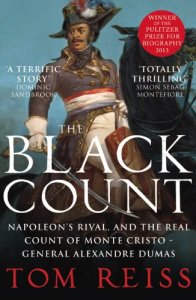
The Black Count by Tom Reiss – A biography of General Thomas-Alexandre Dumas, father of the French author Alexandre Dumas.

The Angel Makers by Patti McCracken – A book about a group of female serial killers in a Hungarian village who murdered over a hundred men between 1914 and 1929.

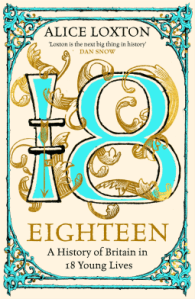
Eighteen: A History of Britain in 18 Young Lives by Alice Loxton – A fascinating look at eighteen historical figures, with a focus on how their first eighteen years shaped the rest of their lives.

Most of the nonfiction I tend to read is biography, history or true crime, so I haven’t been very adventurous this year! I enjoyed all of these books, though, particularly Eighteen and The Angel Makers.

This November I’m planning to read another true crime book, The Peepshow by Kate Summerscale.

Do you like to read nonfiction? Will you be joining in with Nonfiction November this year?