The Noh Mask Murder by Akimitsu Takagi

Translated by Jesse Kirkwood

My 20 Books of Summer reading is off to a good start with this 1949 Japanese locked room mystery, now available from Pushkin Press in a new English translation. Thanks to Pushkin, I’ve been able to try several Japanese classic crime authors over the last few years, including Seishi Yokomizo, Yukito Ayatsuji and Soji Shimada. The Noh Mask Murder is the first book I’ve read by Akimitsu Takagi and I thoroughly enjoyed it.

The novel opens with a discussion between Koichi Yanagi, a chemist who has recently returned to Japan after serving in Burma during the war, and his old school friend, Akimitsu Takagi (yes, the author himself, who appears as a character in his own novel – just like Anthony Horowitz in his Horowitz and Hawthorne series). Akimitsu explains to Koichi that he wants to write a new kind of detective novel, one based on a mystery he has solved for himself in real life:

‘I’d tackle some fiendish real-life mystery, then set down precisely how I solved it in the form of a novel. My readers would be provided with the exact same evidence as the author. They’d be able to follow the detective-narrator’s train of thought, assess the appropriateness of his actions – and even come up with their own alternatives. But I don’t imagine an opportunity like that will ever present itself…’

His opportunity comes sooner than he had imagined when Koichi stumbles upon a mystery at the Chizui family mansion, where he has been staying since returning from the war. The head of the household, Professor Chizui, who was once a friend of Koichi’s, died ten years earlier and the house is now inhabited by his two children and the family of his younger brother, Tajiro. The first sign that something is wrong within the Chizui mansion comes when an eerie figure wearing a sinister Noh mask is seen at one of the windows. Soon after this, Tajiro is found dead inside a locked room, with a smell of jasmine in the air and a Noh mask lying on the floor beside him. Akimitsu Takagi joins Koichi at the house to investigate the murder, but when they discover that someone has called the undertaker to order three coffins, it seems that there’s going to be more than just one murder to investigate!

The mystery is a fascinating one and although some time is spent discussing the mechanisms of how the locked room murder took place, the story never becomes too bogged down by the puzzle aspect; the focus is on the characters, their relationships and their motives. I did find the structure slightly confusing at times as we know we’re reading a book within a book written by Akimitsu Takagi (as both character and author), but within that there’s a journal written by Koichi and a long letter written by Hiroyuki Ishikari, the public prosecutor, so the narrative is sometimes three layers deep. There are some clever twists towards the end, however, which might not have worked if it had been structured differently.

Apart from the mystery, I found it interesting to learn about the different types of mask used in Japanese theatre and how although the Noh mask, which represents a demon, cannot change expression the actors can still use it to show various emotions by tilting the mask up and down and by the clever use of lighting. With the story being set in the post-war period, it’s also interesting to hear the characters reflect on the irony of being so concerned with the death of one person after living through a war in which millions died. If you kill a man in peacetime you’re considered a murderer, says Tajiro’s son, Rintaro, but if you kill a man on the battlefield you’re given a medal.

I really enjoyed The Noh Mask Murder, then, but be warned – in the prologue, where Takagi is discussing his plans for a detective novel, he casually spoils the solution of Agatha Christie’s The Murder of Roger Ackroyd. Not a problem for me as I’ve already read it, but I wish authors wouldn’t do that!

Thanks to Pushkin Vertigo for providing a copy of this book for review via NetGalley.

This is book 1/20 of my 20 Books of Summer 2024.

Spitting Gold by Carmella Lowkis

In Charles Perrault’s fairy tale about two sisters, Diamonds and Toads, a fairy rewards the good sister with the ability to spit gold and punishes the bad sister with the curse of spitting toads. This is the premise at the heart of Carmella Lowkis’ new novel, Spitting Gold, a tale of two very different sisters living in 19th century Paris.

It’s 1866 and Baroness Sylvie Devereux has settled into a respectable married life, but a visit from her younger sister, Charlotte Mothe, threatens to ruin both her marriage and her reputation. For several years, Sylvie and Charlotte had worked together as spiritualists, conning grieving victims out of large sums of money, but Sylvie has promised her husband that those days are behind her and her sister is no longer part of her life. Now, though, Charlotte is begging Sylvie to join her for one last job and Sylvie finds it impossible to refuse, knowing that Charlotte needs the money to pay their father’s medical bills.

Several members of the wealthy de Jacquinot family believe they are being haunted by the spirit of a great-aunt, who was brutally murdered during the French Revolution, leaving behind a hidden treasure. The Mothe sisters agree to help lay the ghost to rest and begin to use every trick and deception at their disposal to convince the family that they are making contact with the spirit. Everything seems to be going well, until the ghost appears to start targeting the sisters themselves. Is the de Jacquinot house really haunted or is there another explanation for what is happening?

There seems to be a current trend for historical novels about mediums and séances; I can think of several I’ve read just in the last year or so, including Lucy Barker’s The Other Side of Mrs Wood and Ambrose Parry’s Voices of the Dead. What makes this one different is the structure and the idea of using two sisters to give alternate views of the same story – the first half of the book is narrated by Sylvie and the second half by Charlotte. I’m not sure how well this worked for me; it was interesting to see things from two such different perspectives, but by the time Charlotte’s narrative began I had become so absorbed in Sylvie’s story I struggled to adjust to a change of narrator.

Apart from the references to the French Revolution, I felt that the book lacked the strong sense of time and place I prefer and at times I even forgot that I was reading a story set in 19th century Paris and not Victorian London. I did love the good sister/bad sister theme, though – while at first it seems obvious that Sylvie is the good one and Charlotte the bad, as the novel continues we learn that things are not that simple and that we shouldn’t rely on just one point of view to give us the full picture. As a debut novel it was quite entertaining, with some interesting twists; I’m not sure whether I’ll read more books by Carmella Lowkis, but I could be tempted!

Thanks to Doubleday for providing a copy of this book for review via NetGalley.

Book 19/50 for the Historical Fiction Reading Challenge 2024

Six Degrees of Separation: From Butter to The Land of Green Ginger

It’s the first Saturday of the month which means it’s time for another Six Degrees of Separation, hosted by Kate of Books are my Favourite and Best. The idea is that Kate chooses a book to use as a starting point and then we have to link it to six other books of our choice to form a chain. A book doesn’t have to be connected to all of the others on the list – only to the one next to it in the chain.

This month we’re starting with a Japanese novel, Butter by Asako Yuzuki. I haven’t read it and probably won’t, but here’s what it’s about:

Gourmet cook Manako Kajii sits in Tokyo Detention Centre convicted of the serial murders of lonely businessmen, who she is said to have seduced with her delicious home cooking. The case has captured the nation’s imagination but Kajii refuses to speak with the press, entertaining no visitors. That is, until journalist Rika Machida writes a letter asking for her recipe for beef stew and Kajii can’t resist writing back.

Rika, the only woman in her news office, works late each night, rarely cooking more than ramen. As the visits unfold between her and the steely Kajii, they are closer to a masterclass in food than journalistic research. Rika hopes this gastronomic exchange will help her soften Kajii but it seems that she might be the one changing. With each meal she eats, something is awakening in her body, might she and Kaji have more in common than she once thought?

Inspired by the real case of the convicted con woman and serial killer, “The Konkatsu Killer”, Asako Yuzuki’s Butter is a vivid, unsettling exploration of misogyny, obsession, romance and the transgressive pleasures of food in Japan.

Butter is a dairy product, which makes me think of Nick Davenant, a character in Bee Ridgway’s The River of No Return (1) who owns a dairy farm in Vermont and is anxiously awaiting a visit from the cheese inspector at the beginning of the book. Nick is not just a dairy farmer, however – he is also a time traveller and was once an English nobleman who fought in the Napoleonic Wars. I think this book was intended to be the first in a series, but a sequel has never appeared.

Next is a simple link to another book with ‘river’ in the title: River of Stars by Guy Gavriel Kay (2). This novel is set in an alternate world based on China during the time of the Song Dynasty. Although Kay’s books are often described as historical fantasy, there are very few actual fantasy elements in this one, apart from some mentions of the spirits and fox-women who are part of Chinese myth.

Fox spirits also feature heavily in The Fox Wife by Yangsze Choo (3), set in Manchuria in 1908. The novel follows the dual stories of an elderly private detective investigating a suspicious death and a white fox spirit who has taken the form of a human woman while she searches for the man who killed her daughter. I found this book very slow, but enjoyed the details of Chinese myth and foklore.

The title character in the Yangsze Choo novel is called Snow, so my next book is one in which snow features heavily in the plot: The Sittaford Mystery by Agatha Christie (4). The village of Sittaford is cut off by snow, making it the perfect setting for a murder mystery to unfold. This is a wonderful standalone Christie novel and I loved the heroine, Emily Trefusis.

Like my edition of The Sittaford Mystery, Benighted by J.B. Priestley (5) also has a picture of a house on the cover. A married couple and their friend get caught in a storm while driving through the Welsh countryside one night and take shelter in a crumbling old mansion inhabited by a very strange family! This was my first book by Priestley and I’m sure I’ll be looking for another one.

Benighted was published in 1927, so the final book in my chain is another published in that same year. The Land of Green Ginger by Winifred Holtby (6) is about a missionary’s daughter who is born in South Africa but comes to England to be raised by her aunts in a small rural community in Yorkshire. I’ve read nearly all of Holtby’s novels now and this is probably my least favourite, but it still explores some interesting topics.

~

And that’s my chain for June! My links have included: Dairy products, the word ‘river’, fox-women, snow, pictures of houses and the year 1927.

In July we’ll be starting with Kairos by Jenny Erpenbeck.

My Commonplace Book: May 2024

A selection of quotes and pictures to represent May’s reading:

commonplace book
noun
a book into which notable extracts from other works are copied for personal use.

~

‘I know,’ I admit. ‘But it’s how I feel. I can’t rationalize it. The truth is, I’ve always thought that if you can explain why you love someone, then you probably don’t.’

Earth by John Boyne (2024)

~

But with maturity comes the understanding that a woman must absorb the difficulties and trials of life. They will always be there. Happiness is not a gift that comes to us without pain.

A Court of Betrayal by Anne O’Brien (2024)

~

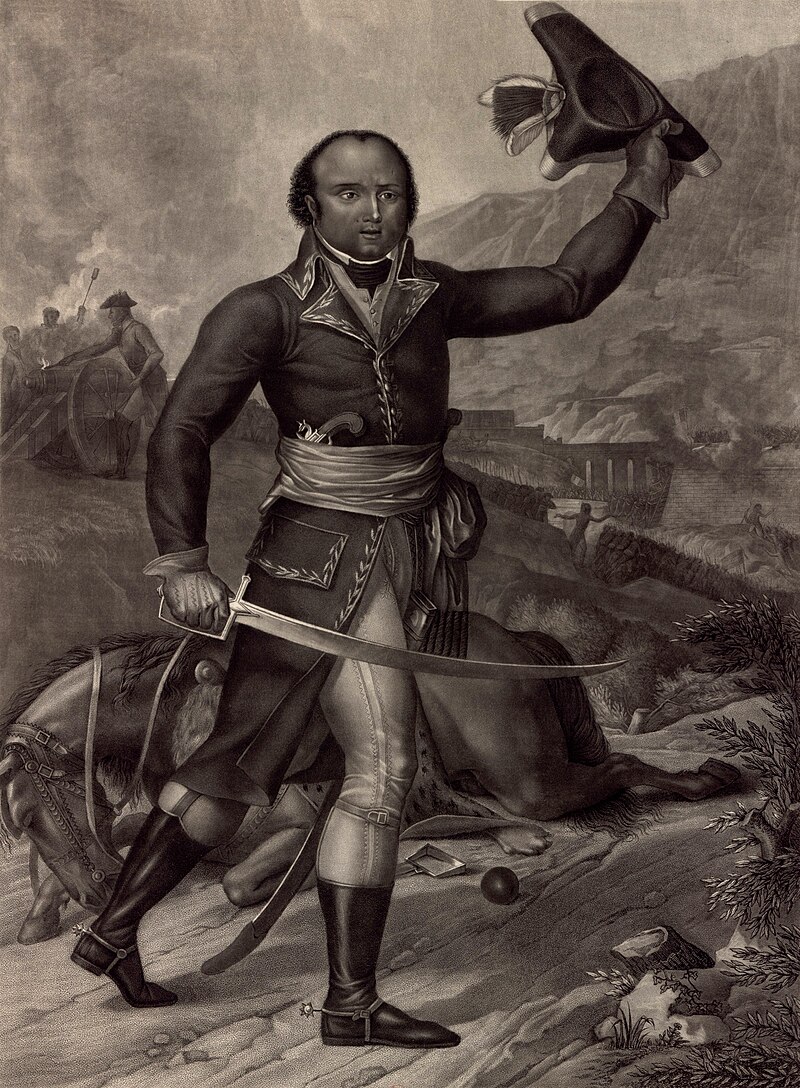
General Thomas-Alexandre Dumas – Portrait by Guillaume Guillon-Lethière, c. 1797

To remember a person is the most important thing in the novels of Alexandre Dumas. The worst sin anyone can commit is to forget.

The Black Count by Tom Reiss (2012)

~

When one looks back upon one’s time on Earth – across the span of years and decisions that have carried one from birth to wherever one is now – it is nigh impossible to point out a single particular moment and say, ‘Yes, here. This is where it all began to go wrong.’ But still one tries. One inspects the tapestry for the pattern, for the loose thread.

Spitting Gold by Carmella Lowkis (2024)

~

‘A fish and bird may fall in love, but in whose world can they live? Air or water, whichever they choose, one will surely drown.’

A Plague of Serpents by KJ Maitland (2024)

~

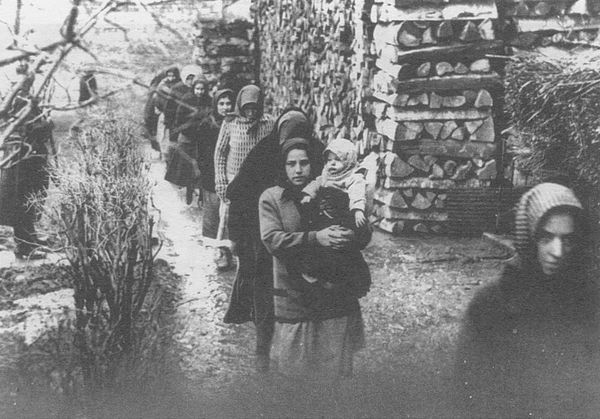
Defendants in the arsenic poisoning case of Nagyrév walking in the Szolnok prison yard

Joy always surprised her, peeking as it did through the cracks in her life. She didn’t know pleasure well enough to call it by name.

The Angel Makers by Patti McCracken (2023)

~

It was something that had never occurred to me before: we all had the power to change our pasts, our beginnings – or our perception of them, at least – but none of us could determine how our stories would end.

The House of Doors by Tan Twan Eng (2023)

~

‘Do you not know, my friend, that each one of us is a dark mystery, a maze of conflicting passions and desires and attitudes? Mais oui, c’est vrai. One makes one’s little judgements – but nine times out of ten one is wrong.’

Lord Edgware Dies by Agatha Christie (1933)

~

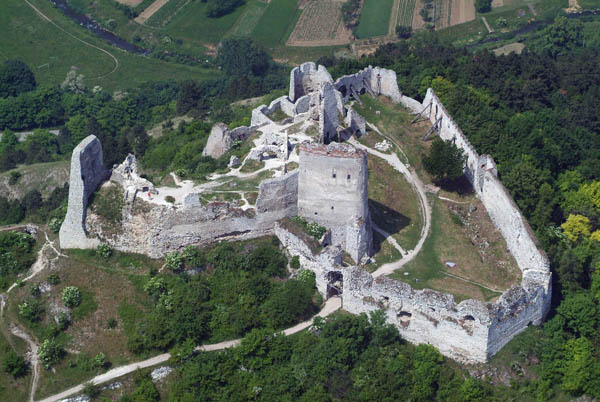
Čachtice Castle

‘There’s no use knowing how to speak Latin if the language of friendship is beyond you,’ observes the countess. ‘And you cannot profess to understand poetry, or literature, if you have not experienced the emotions that inspired the words.’

The Nightingale’s Castle by Sonia Velton (2024)

~

‘She is coming home. It’s a year since I saw her last, but really I find that nobody ever changes – that we all contain ourselves from the day we are born.’

Enlightenment by Sarah Perry (2024)

~

Finished with his task, he glanced back at her. ‘You cannot shape the world, Miss Symonds. It will always shape you, instead. How many like what remains, when the world is done with them?’

The Puzzle Wood by Rosie Andrews (2024)

~

Favourite books read in May:

A Court of Betrayal and The Angel Makers

Authors read for the first time in May:

Carmella Lowkis, Tom Reiss, Patti McCracken

Places visited in my May reading:

England, Ireland, France, Saint-Domingue, Hungary, Malaysia

~

Reading notes: I spent May catching up with books on my NetGalley shelf and also managed to fit in a Christie novel for the Read Christie challenge. In June, I’ll be focusing mainly on reading books from my 20 Books of Summer list and there’s also Mallika’s Reading the Meow week to look forward to.

How was your May? What are you planning to read in June?

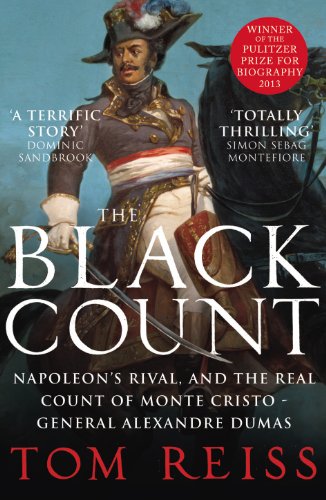
The Black Count by Tom Reiss

My second non-fiction review this month, The Black Count is a biography of General Thomas-Alexandre Dumas, father of the French author Alexandre Dumas. I’ve always loved Dumas’ novels (he’s most famous for The Three Musketeers and The Count of Monte Cristo, one of my all-time favourite books), so The Black Count appealed to me as soon as I heard about it on its publication in 2012. I’ve no idea why it has taken me so long to actually pick it up and read it!

Thomas-Alexandre Dumas, usually referred to in the book as Alex, was born in 1762 in the French colony of Saint-Domingue (now Haiti) in the Caribbean. He was the son of a French aristocrat, the Marquis Alexandre Antoine Davy de la Pailleterie, and a freed slave woman, Marie-Cesette Dumas. After the death of his mother, the young Alex, along with his three siblings, was temporarily sold into slavery by his father in order to pay their passage back to France. Eventually the Marquis bought Alex back (but not the other three children, who remained in slavery and are lost to history) and took him home to France where he was educated in fencing, horse riding and all the other skills befitting the son of a nobleman.

When the Marquis remarried, however, Alex was left to fend for himself and he joined the French military, taking his mother’s surname of Dumas. Playing an important role in the French Revolutionary Wars, he quickly rose through the ranks and by the age of thirty-two was General-in-Chief of the French Army of the Alps, commanding 53,000 men. Later, on a campaign to Egypt, Alex clashed with another powerful general, Napoleon Bonaparte, and from there his career took a downward spiral. Today, Napoleon remains one of the most well known historical figures of all time, but Alex Dumas has been largely forgotten. The Black Count is an attempt to give Dumas the attention he deserves and make his story known to a modern audience.

General Alex Dumas was clearly a fascinating man, yet I have to be completely honest and say that I was slightly disappointed by this book. It was described as a thrilling real life adventure story, as exciting as one of Dumas’ novels, which I think raised my expectations too high. For me, there was too much focus on military history, with details of campaigns, battles and tactics, along with lots of general information on the French Revolution, with Alex Dumas himself being pushed into the background for large sections of the book. Of course, other readers will find this much more interesting than I did, but military life is never going to be one of my personal favourite subjects to read about and I have read about the Revolution many times before. I did quite enjoy the chapter about the Army of the Alps, though, where Alex and his men scaled the icy cliffs of Mont Cenis to capture a mountain pass; as Reiss points out, the cold must have come as a shock to a man who grew up in the Caribbean!

All of Alex Dumas’ achievements are very impressive, but most impressive of all is the fact that he was able to rise as high as he did as a person of colour in the 18th century. In some ways it was the perfect time and place for him to succeed because it was a surprisingly tolerant period in French history; a century later racial prejudices and the removal of rights for black people would have prevented him from reaching the same heights. At the time of Alex’s arrival in France, however, a decree known as the Code Noir was in place which gave freed slaves the same rights and privileges as white people. Add to that Alex’s renowned strength, courage and leadership skills and it’s easy to see how he was able to accomplish so much and even rival Napoleon for a while.

Tom Reiss occasionally tells us about his visits to museums and archives where he saw documents and paintings which informed his writing of the book. He also draws on a large number of other sources, which are listed at the end in a bibliography, the most notable being the writings of Alexandre Dumas (the author), who wrote about his father in his memoirs and several of his other non-fiction books. Reiss also suggests that some famous scenes from Dumas’ novels were based on his father’s adventures – for example, in 1799 Alex was captured and thrown into a dungeon in the Kingdom of Naples for two years, something which surely inspired the imprisonment of Edmond Dantès in The Count of Monte Cristo.

Although I expected to love The Black Count more than I did, I do feel that I’ve learned a lot from it, both about France in the second half of the 18th century and about Alex Dumas himself. He was an amazing man and deserves to be better known; I’m sure this book, in the twelve years since it was published, will have gone some way towards achieving that.

Hungry Ghosts by Kevin Jared Hosein

This is a book I would probably never have chosen to read if it hadn’t been nominated for this year’s Walter Scott Prize, but although I didn’t love it, for reasons I’ll explain below, it’s a book I’m glad I’ve read. For a start, it’s set in Trinidad and I’ve only ever read one other novel set there – Fortune by Amanda Smyth, which was also shortlisted for the same prize a few years ago – and it was good to have the opportunity to learn more about the history and culture of that country.

The story takes place in the 1940s in and around Bell Village in central Trinidad. Thirteen-year-old Krishna Saroop lives with his parents in a sugarcane estate barrack, a ramshackle building with a leaking roof that is home to four other families. On a hill above the village is the Changoor farm where Dalton Changoor and his wife Marlee live in comparative luxury and where Krishna’s father, Hansraj – known as Hans – works on the land. When Dalton disappears without explanation one day, Marlee feels uneasy about being alone and asks Hans to stay on the estate overnight as a night watchman – and Hans agrees, grateful for the extra money she offers him in return. But as the days go by with no sign of Dalton coming home, Hans finds himself becoming increasingly attracted to Marlee and spending less and less time with his own wife and son.

Kevin Jared Hosein uses the disappearance of Dalton Changoor to explore the stories of Hans and Marlee and also Krishna and his mother Shweta, left behind in their squalid home while Hans spends his nights on the farm. Shweta is dreaming of a better life and at first is happy for Hans to take Marlee’s money in the hope that they can use it to buy a house of their own, but she changes her mind as she discovers that her husband is slipping away from her. However, Marlee is only one part of the problem; the relationship between Shweta and Hans has already been strained by the death of their first child, the ‘hungry ghost’ of the title.

If you think this sounds like a bleak novel, that’s because it is. I found it relentlessly miserable. Everyone has had an unhappy childhood, an unhappy marriage or both. We see people being abused, assaulted, blackmailed, murdered…even the animals don’t escape unscathed; there are some very graphic descriptions of the death of Dalton Changoor’s abandoned dogs, so be warned. I don’t usually have a problem reading books that tackle uncomfortable or challenging subjects, but I do like there to be at least a glimmer of hope and optimism and this particular book didn’t seem to have any. I don’t think there was a single character in the book that I actually liked.

Although I struggled to cope with the misery and sadness, obviously other people have enjoyed this book much more than I did and I would agree that it’s beautifully written. Kevin Jared Hosein was born in Trinidad and brings his island to life through his descriptions of the landscape, the birds and animals, the food, clothing and housing. He also captures the language and the speech patterns of the Trinidadian people and through the story of the Saroop family, who are of Indian descent, he explores the differences between the Hindu and Christian communities on the island. I can understand why it was shortlisted for the Walter Scott Prize and the fact that I didn’t like it probably means it’s going to win!

Book 18/50 for the Historical Fiction Reading Challenge 2024

20 Books of Summer – 2024

20 Books of Summer, hosted by Cathy at 746 Books, is a very simple idea: make a list of twenty books (there are also ten and fifteen book options) and read them during the months of June, July and August. However, it’s not as simple as it sounds and despite taking part every year since 2017, I’ve never been able to complete it! I often do read twenty books during that period, but not necessarily the books on my list.

This year’s 20 Books of Summer starts on 1st June and finishes on 1st September. I have listed below the books I would like to read. Most of these are either upcoming NetGalley review copies or books for various other challenges and projects I’m taking part in.

1. Three Act Tragedy by Agatha Christie (Read Christie 2024)
2. N or M? by Agatha Christie (Read Christie 2024)
3. Finn Family Moomintroll by Tove Jansson (Moomin Week)
4. Thomasina by Paul Gallico (Reading the Meow)
5. In the Upper Country by Kai Thomas (Walter Scott Prize project)
6. The Noh Mask Murder by Akimitsu Takagi
7. The Meiji Guillotine Murders by Futaro Yamada
8. The King’s Witches by Kate Foster
9. The Ballad of Jacquotte Delahaye by Briony Cameron
10. The Burial Plot by Elizabeth Macneal
11. The Cautious Traveller’s Guide to the Wastelands by Sarah Brooks
12. A Woman of Opinion by Sean Lusk
13. Babylonia by Costanza Casati
14. The King’s Mother by Annie Garthwaite
15. A Case of Mice and Murder by Sally Smith
16. The Hazelbourne Ladies Motorcycle and Flying Club by Helen Simonson
17. The Lost Queen by Carol McGrath
18. The Trouble with Mrs Montgomery Hurst by Katie Lumsden
19. The Briar Club by Kate Quinn
20. Cabaret Macabre by Tom Mead

Alternatives

I have listed four of the shorter books remaining on my Classics Club list as alternatives in case I don’t feel like reading some of the books above when the time comes.

1. The Black Lake by Hella S. Haasse
2. The Silver Branch by Rosemary Sutcliff
3. The Elusive Pimpernel by Baroness Orczy
4. The End of the Affair by Graham Greene

~

Are you taking part in 20 Books of Summer this year? What do you think I should read first?