My Commonplace Book: May 2023

A selection of words and pictures to represent May’s reading:

commonplace book
noun
a book into which notable extracts from other works are copied for personal use.

~

One had no right to play about with people’s lives. One should not interfere with their emotions. A word, a look, a smile, a frown, did something to another human being, waking response or aversion, and a web was woven which had no beginning and no end, spreading outward and inward too, merging, entangling, so that the struggle of one depended upon the struggle of the other.

The Scapegoat by Daphne du Maurier (1957)

~

Miniature of the Empress Matilda

‘You think only men can run estates, yet many widows do, and women must when their men are at war. And all you want from us is male heirs. Too many men with power. Too many women without.’

The Stolen Crown by Carol McGrath (2023)

~

You can deal with a mood – a mood is bound to pass, and the more violent it is, the more complete the reaction to it will be. But a calm and reasonable determination is very different, because it’s been arrived at slowly and isn’t likely to be laid aside.

Unfinished Portrait by Mary Westmacott (1934)

~

‘It isn’t so easy, is it, to change who we are by changing where we are. The past has a nasty habit of following us around. I believe it’s called regret.’

‘My father said we should always look forward, not back, that you can’t change the past, but the past can change the future, if you want it to.’

The Last Lifeboat by Hazel Gaynor (2023)

~
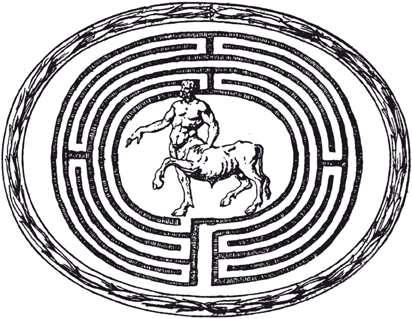
Engraving of the minotaur in the labyrinth – Palazzo Strozzi, Florence

The things you found in the mud went inevitably into Murdstone’s hands, but he could never take away the things you nurtured inside. Your memories. Your gifts.

Once a Monster by Robert Dinsdale (2023)

~

Favourite books read in May:

The Scapegoat

Authors read for the first time in May:

Robert Dinsdale

Places visited in my May reading:

France, England, the Atlantic Ocean

~

Reading notes: I didn’t manage to finish many books in May, for various reasons, but I’m pleased that I at least found time to re-read The Scapegoat, which I’ve wanted to do for years. 20 Books of Summer starts tomorrow and I’m still not sure which book I’ll be picking up first but I’m looking forward to everything on my list. I’m also planning to take part in Reading the Meow later in the month.

How was your May? What are you hoping to read in June?
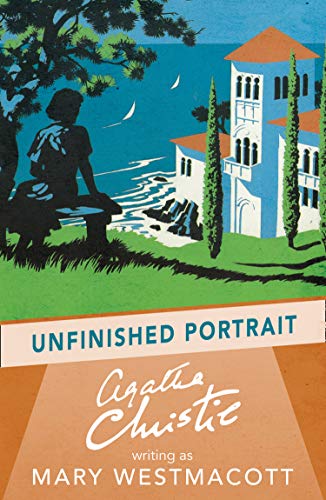
Unfinished Portrait by Mary Westmacott

May’s theme for the Read Christie 2023 challenge is ‘betrayal’ and the suggested title this month is Unfinished Portrait, a 1934 novel which is one of six books Christie published under the pseudonym of Mary Westmacott. Although I haven’t managed to take part in the challenge every month so far this year, I was particularly keen to join in with this one as I’ve previously only read one Westmacott novel – Giant’s Bread – and have been looking forward to reading more of them ever since.

Unfinished Portrait begins by briefly introducing us to Larraby, a portrait painter who is visiting an unnamed island when he comes across a woman sitting alone in a garden. Sensing that something is wrong, Larraby engages her in conversation and discovers that he is correct – she is intending to commit suicide. Not wanting to leave her alone, he accompanies her back to her hotel and listens as she tells him the story of her life and explains the sequence of events that have put such desperate thoughts into her head.

The woman’s name is Celia – at least that’s what Larraby calls her, as he doesn’t know her real name – and her story forms the main part of the novel. A lot of time is spent on Celia’s sheltered childhood, growing up in the late Victorian period in a comfortable home with servants and a nanny until the family’s financial position is affected by the early death of Celia’s father. I only know the basics about Agatha Christie as a person, but apparently Unfinished Portrait is semi-autobiographical, drawing on her own childhood memories to create Celia’s tales of inventing imaginary friends, time spent abroad due to her father’s poor health, the close relationships she had with her mother and grandmother and her first attempts at writing books. Later, Celia finds herself trapped in an unhappy marriage to Dermot, a man who is insensitive, controlling and eventually unfaithful – which again is based on Agatha’s own marriage to Archie Christie. If I’d been more familiar with Christie’s own life I would have appreciated the autobiographical element of the book a lot more, which would probably have added to my enjoyment of it, but I still found Celia’s story compelling in its own right.

After finishing the book, I could see how it fits the challenge topic for this month, exploring the theme of betrayal from several different angles: Dermot betrays Celia with another woman, Celia herself betrays a previous lover, and later in life she feels she has betrayed her daughter. All of these betrayals combine to cause the deterioration in Celia’s mental state that leads to her feeling so unhappy the day she meets Larraby. It’s a sad and emotional story – even sadder knowing that it was how Christie felt about her own situation at that time. Of course, the book was published in the 1930s and so it’s an ‘unfinished portrait’, leaving a lot of things in Celia’s life (and Christie’s) unresolved and incomplete.

I found this book quite different from Giant’s Bread, the only other Westmacott book I’ve read, and I think I preferred that one overall. I’m definitely more of a Christie fan than a Westmacott fan, but these are still great books and I’m looking forward to reading the other four.

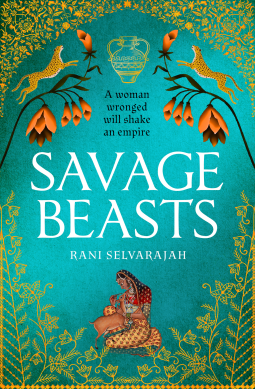
Savage Beasts by Rani Selvarajah

The Greek myth of Medea is transposed to 18th century India in Rani Selvarajah’s debut novel, Savage Beasts. Although I haven’t read very much about Medea – except where she has appeared as a secondary character in other novels I’ve read, such as Madeline Miller’s Circe – it was actually the Indian setting that attracted me to this book rather than the Greek myth aspect and I expect it will have equal appeal to readers of historical fiction and those who enjoy mythology retellings.

The novel opens in 1757 in Calcutta (now known as Kolkata). The East India Company, under the leadership of Sir Peter Chilcott, are advancing on Bengal and war seems inevitable, but James Chilcott, Sir Peter’s nephew, has arrived in Calcutta ready to make a bargain. He is prepared to betray the company and reveal their plans, he says, but he wants something from the Nawab of Bengal in return. Although the Nawab isn’t convinced, his daughter, Meena, is captivated by the handsome young Englishman and agrees to help him. When things go wrong, James and Meena are forced to flee Bengal, leaving a scene of death and devastation in their wake.

So far, I could see the parallels with mythology – Meena in the role of Medea, daughter of King Aeëtes of Colchis, and James as Jason, who comes to Colchis on the Argo in search of the Golden Fleece. When Meena and James leave Bengal, they encounter Meena’s aunt, Kiran, whom I quickly identified with Circe. The later parts of the myth are less familiar to me, but as far as I could tell the novel continued to follow the basic outline, with one or two nice twists towards the end.

What let this novel down for me was the writing. I hate to be too critical of an author’s first novel, but I did find some of the word choices odd or inappropriate. Characters ‘smirk’ all the time, on almost every page – that’s when they’re not ‘sneering’ or ‘scoffing’. I lost count of how many times these words were repeated. I also struggled to believe in Meena as a convincing woman of her time. It seemed unlikely that the daughter of a Nawab (a Mughal ruler of similar status to a prince) would have the freedom to hang around the docks of Bengal on her own, as Meena does in the opening chapter, and her subsequent actions feel more and more anachronistic.

I did like the basic concept of moving the Medea story to 18th century India and the idea of James/Jason as part of a colonial power coming to take what they can from Bengal/Colchis is an intriguing one. For this to work, though, there really needed to be a stronger sense of time and place, but sadly, I couldn’t think of the characters as anything other than modern people in historical costume. Despite my negativity, I stuck with the book to the end and did occasionally become drawn into the story; it’s been receiving a mixture of reviews, including plenty of four and five star ones, so evidently other readers have enjoyed it more than I did. Give it a try if it appeals – and please let me know if there are any other retellings of the Medea myth you can recommend!

Thanks to HarperCollins UK, One More Chapter for providing a copy of this book for review via NetGalley.

This is book 21/50 read for the 2023 Historical Fiction Reading Challenge.

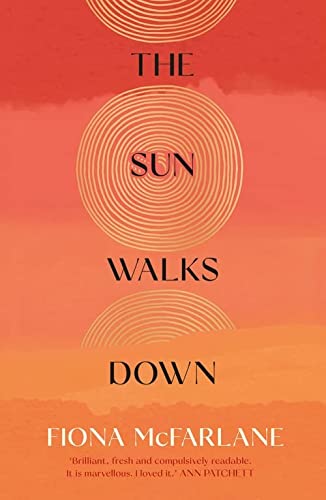
The Sun Walks Down by Fiona McFarlane

The Sun Walks Down by Australian author Fiona McFarlane is not a book I had considered reading until it appeared on this year’s shortlist for the Walter Scott Prize for Historical Fiction. Attempting to read all the shortlisted books for the prize is one of my ongoing personal projects and this is the third I’ve read so far from this year’s list (the others are Act of Oblivion and These Days).

The novel is set in South Australia and takes place over a period of seven days in September 1883. On the first day, a dust storm sweeps through the small town of Fairly in the Flinders Ranges and after it has passed, six-year-old Denny Wallace is found to have gone missing. As the whole community becomes caught up in the search for him, McFarlane introduces us to each resident of the town in turn, exploring their lives and the ways in which they are touched by Denny’s disappearance.

As well as Denny’s parents and siblings, we also meet a Pashtun cameleer, a Ramindjeri tracker, a Swedish painter and his English wife, a pair of newlyweds and an assortment of farmworkers and housemaids. Each has their own story to be told and some are given their own chapter, written in the form of a dream, a confession, a prayer or a set of notes. In this way, McFarlane looks at various aspects of life in colonial Australia and the relationships between the Indigenous people and the European newcomers. Although I did find this interesting (I’ve read shamefully little about 19th century Australia) I felt that there were too many characters in the book and the viewpoint changed from one to another too quickly, preventing me from forming a strong connection with any of them. I would also have preferred a tighter focus on the search for Denny as this seemed to get pushed aside for long periods.

I did love the beautiful descriptions of the Flinders Ranges and the way McFarlane uses colours to bring to life images of the sun, sky and clouds. 1883 was the year when Krakatoa erupted and caused a ‘volcanic winter’ with unusually vivid sunsets:

The sky burns and leaps, it gilds and candles – every drenched inch of it, until the sun falls below the ranges. Then the sky darkens. The red returns, stealthy now, with green above and lilac higher still. It deepens into purple. Here’s the strange new cloud, hovering in its own grey light. Then night comes in, black and blue and grey and white, and the moon in its green bag swings heavy over the red nation of the ranges.

I think I would describe The Sun Walks Down as a book that I admired rather than one that I particularly enjoyed. I can see why other people have given it glowing reviews and why it’s being nominated for awards, but it just wasn’t for me. That probably means it will win the Walter Scott Prize this year – not long until we find out!

This is book 20/50 read for the 2023 Historical Fiction Reading Challenge.

20 Books of Summer – 2023

20 Books of Summer, hosted by Cathy at 746 Books, is a very simple idea: make a list of twenty books (there are also ten and fifteen book options) and read them during the months of June, July and August. However, it’s not as simple as it sounds and despite taking part for the last six years, I’ve never been able to complete it! I usually do read twenty books during that period, but not necessarily the books on my list – although last year I came very close and managed to read nineteen of them.

This year’s 20 Books of Summer starts on Thursday 1st June and finishes on Friday 1st September. I have listed below the books I would like to read:

NetGalley books
1. The Graces by Siobhan MacGowan
2. The Witching Tide by Margaret Meyer
3. Disobedient by Elizabeth Fremantle
4. Fair Rosaline by Natasha Solomons
5. Learned by Heart by Emma Donoghue
6. A Lady’s Guide to Scandal by Sophie Irwin

Read Christie 2023
7. Death Comes as the End by Agatha Christie

Classics Club
8. Strangers on a Train by Patricia Highsmith
9. Fire from Heaven by Mary Renault
10. The New Magdalen by Wilkie Collins

Reading the Meow at Literary Potpourri
11. The Cat Saw Murder by Dolores Hitchens

‘Summer’ books
12. The Summer Tree by Guy Gavriel Kay
13. A Song for Summer by Eva Ibbotson

Others
14. The House with the Golden Door by Elodie Harper
15. The Ionian Mission by Patrick O’Brian
16. The Embroidered Sunset by Joan Aiken
17. Throne of Jade by Naomi Novik
18. Wonder Cruise by Ursula Bloom
19. The Reckoning by Sharon Penman
20. Atlas: The Story of Pa Salt by Lucinda Riley and Harry Whittaker

~

Have you read any of these? Which do you think I should read first? And are you taking part in 20 Books of Summer this year?

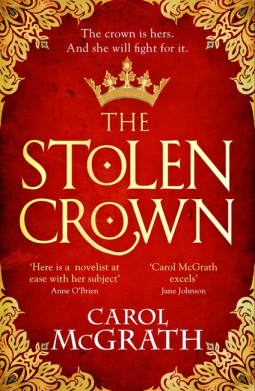
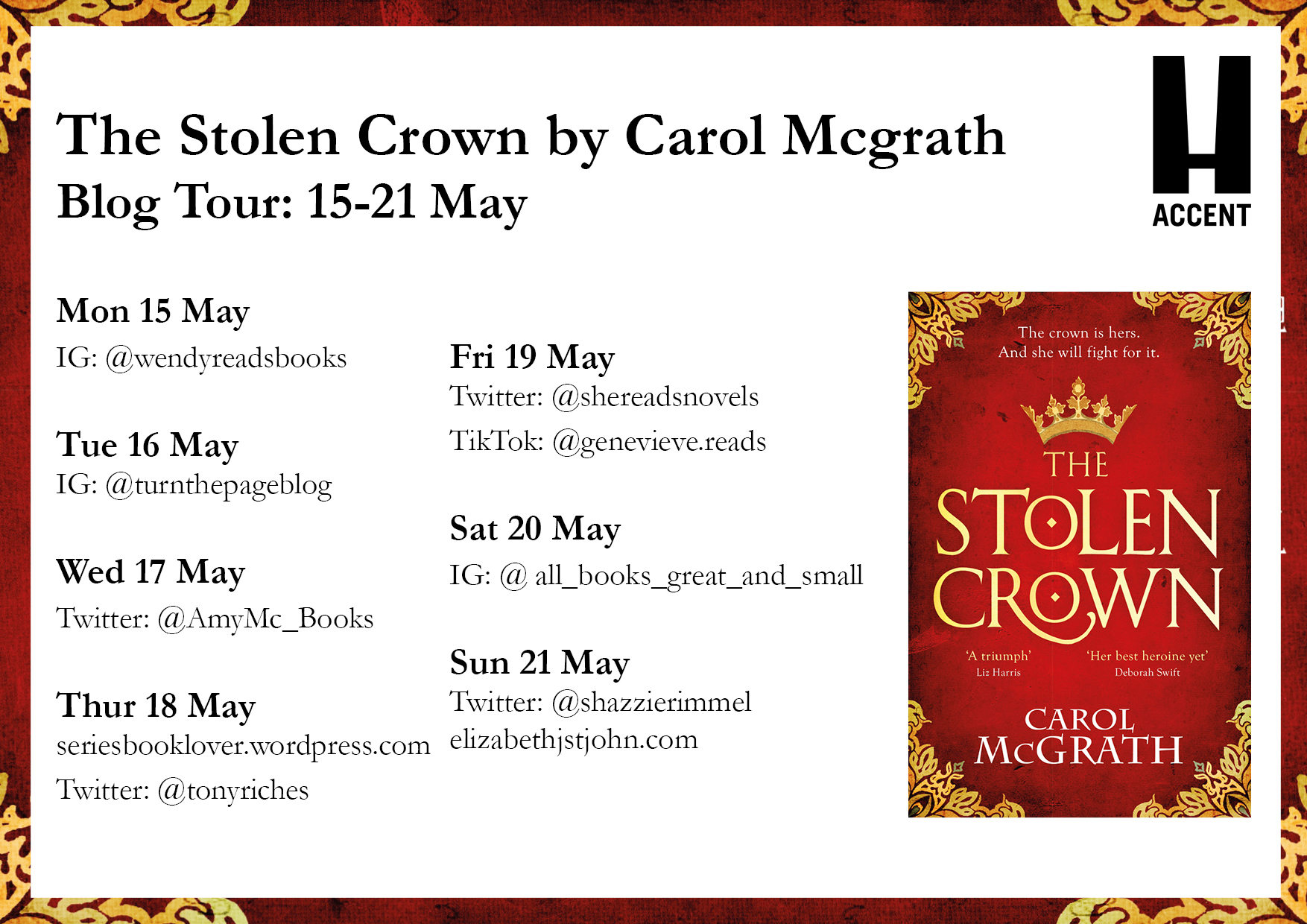
The Stolen Crown by Carol McGrath

When Henry I of England dies in 1135 leaving no legitimate male children, he names his daughter, Maud, as heir to the throne. Through her marriage to the late Holy Roman Emperor, the Empress Maud, as she still calls herself, is used to wielding power, yet she is unable to gain the support of the nobility and clergy of England and the throne is taken instead by her cousin, Stephen of Blois. Maud, however, refuses to give up her claim and so a battle begins between the cousins that will become known as ‘the Anarchy’ – a period of civil war lasting for almost two decades.

Carol McGrath’s new novel, The Stolen Crown, tells Maud’s story, exploring her marriage to Geoffrey of Anjou, the years of conflict with Stephen and her relationships with her half-brother Robert of Gloucester and with Brien FitzCount, her most loyal supporter. Although Maud (sometimes known as Matilda) was never actually crowned Queen of England and was referred to instead as ‘Lady of the English’, she left an important legacy as the eldest of her three sons with Geoffrey would go on to become Henry II, the first of the great House of Plantagenet.

The novel is written largely from Maud’s own perspective and she is portrayed as a strong, courageous and determined woman, but also one who makes mistakes, ignores advice and acts impulsively at times – in other words, a believable human being who comes to life on the page. We follow Maud throughout her adult life, beginning with her marriage to Geoffrey, a husband she didn’t choose and didn’t want, but with whom she eventually settles down to start a family in Anjou. When Stephen seizes the throne, Maud leaves her husband and children behind to travel to England and fight for what she believes is rightfully hers. Some sections of the book are also written from the point of view of Maud’s illegitimate half-brother Robert, which was a good decision as it allows us to see Maud through the eyes of someone else close to her, as well as filling in the gaps when Maud is not directly involved in the action. I’ve always liked Robert when I’ve come across him in historical fiction and it’s interesting to think of the sort of king he would have made had he been a legitimate heir.

I knew from the other Carol McGrath books I’ve read (The Silken Rose, The Damask Rose and The Stone Rose, a trilogy of novels about three queens who were labelled ‘she-wolves’) that she also likes to include fictional characters in her stories. In this book, we meet Alice, a young woman from a family of entertainers – musicians, jugglers and puppeteers. Alice has a storyline of her own, including a romance with a young knight, Sir Jacques, but she also fits seamlessly into Maud’s story, spying and carrying messages between the Empress and Brien FitzCount. Although I found Maud much more interesting to read about, Alice’s inclusion in the book gives us an insight into medieval life away from the royal courts.

The Anarchy is a fascinating part of English history, often overshadowed by later conflicts such as the Civil War and the Wars of the Roses, so I’m pleased that McGrath has chosen to give some attention to this period and to Maud. I’m looking forward to seeing who and what she writes about next.

Thanks to Headline for providing a copy of this book for review via NetGalley.

This is book 19/50 read for the 2023 Historical Fiction Reading Challenge.

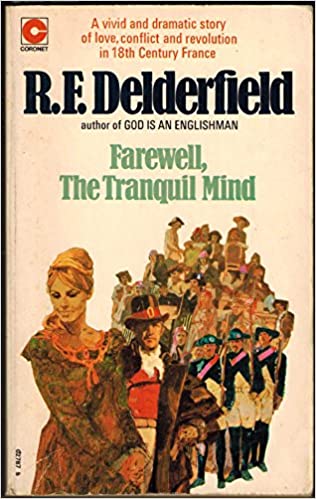
Farewell, the Tranquil Mind by RF Delderfield

Farewell the tranquil mind! Farewell content!
Farewell the plumed troops and the big wars
That make ambition virtue! O, farewell!

These lines from Othello inspired the title of Ronald Frederick Delderfield’s 1950 novel about a period of history that was anything but tranquil – the French Revolution. Having loved Delderfield’s A Horseman Riding By trilogy (which begins with Long Summer Day), I’ve been keen to read more of his books. This one wouldn’t necessarily have been my first choice – it’s currently out of print and with very few reviews online – but I came across a copy in a charity shop and thought I would give it a try.

Farewell, the Tranquil Mind is narrated by David Treloar, a young man from a family of Devon smugglers. From an early age, David has been different from the other male Treloars; while his brothers work with their father, bringing in shipments of contraband cargo, David stays at home and helps his mother run the family farm, Westdown. He is also the only one who has learned to read and write, having been taken under the wing of the agent, Saxeby, who introduces him to French politics through Thomas Paine’s Rights of Man. However, when a smuggling operation goes wrong and an exciseman is shot dead, the blame falls on David and he is forced to flee England.

Arriving in France in the middle of the Revolution, he is befriended by André Lamotte, the nephew of a Parisian wigmaker and perfumier known as Papa Rouzet. It is through his friendship with André and the Rouzet family that David becomes involved with various revolutionary groups including the Brissotins and the Cordeliers – and falls in love with Charlotte, Rouzet’s niece. With the situation in France becoming increasingly dangerous, David and Charlotte consider escaping to England – but not only is David still wanted for the murder of Exciseman Vetch, the English also now suspect him of being a French spy.

I found this book interesting, but certainly not as enjoyable as the Horseman Riding By trilogy, and I can see why it hasn’t been reissued like most of his other novels. The blurb made it sound quite exciting – and it is, in places, but in between there’s lots of exposition and political detail and this slows the plot down, making it less entertaining than I’d expected. Despite having read other books set during the French Revolution, I had to concentrate to keep track of all the different groups and who was on which side. It wasn’t just a case of royalists versus republicans; within the republican movement there were many separate factions – as well as the two I’ve mentioned above, there were Jacobins, Girondins, Montagnards, Dantonists and several others, each with their own ideas on the goals of the Revolution and how the country should be run.

I liked David, but I felt that Charlotte’s role in the book was too small and understated for me to get a clear sense of who she was or what she was like and this meant that I didn’t feel fully invested in the romance element of the book. It’s disappointing when I think of how well defined even the minor characters were in the other books of Delderfield’s I’ve read. This novel was written very early in his career, though, which maybe explains why it doesn’t feel as accomplished. It’s worth hunting down and reading if you’re particularly interested in learning more about the political side of the French Revolution, but otherwise probably not the best place to start with Delderfield! I’m still looking forward to reading more of his books and would welcome any suggestions as to which one I should read next.

This is book 18/50 read for the 2023 Historical Fiction Reading Challenge.