Historical Fiction Virtual Book Tour: The Chalice by Nancy Bilyeau

The Chalice Today I’m taking part in a blog tour for Nancy Bilyeau’s new novel, The Chalice. This is the second in a series of historical thrillers set in the Tudor period and featuring Joanna Stafford, a former novice nun. Last year I read the first book, The Crown, and since then have been eagerly awaiting more of Joanna’s adventures.

In the previous book, the dissolution of the monasteries by Henry VIII meant that Joanna was forced to leave Dartford Priory before she had the opportunity to finish her period as a novice and become a full nun. It’s now 1538 and Joanna has had to rejoin the secular world where she is hoping to lead a peaceful life raising her cousin’s little boy, Arthur, and establishing her own tapestry business. But when she learns of a prophecy in which she plays an important role, she becomes caught up in a plot to overthrow the King and restore the Catholic religion in England.

Although this is the second Joanna Stafford book I don’t think it’s completely necessary to have read the previous novel before this one, but readers of The Crown will enjoy learning more about Joanna’s background and her past as both the daughter of one of Katherine of Aragon’s ladies and as a novice Dominican nun. Joanna is a great narrator, so easy to like and to sympathise with as she struggles to reconcile all the different sides of her character: her faith and her religious beliefs, her loyalty to her friends and her powerful connections as a member of the Stafford family. As she learns more about the prophecy and the international plot surrounding it, she has some difficult choices to make. How should she interpret what she has heard? And once she has listened to the prophecy is it her responsibility to ensure it is fulfilled whatever the cost?

Because Joanna is a Stafford and the niece of the late Duke of Buckingham, it’s believable that despite the life she has tried to choose for herself, she will inevitably come into contact with rich and powerful people, both close to the King and in opposition to him. In these dangerous times, filled with political intrigue and rebellion, Joanna (and the reader) is never quite sure who can and cannot be trusted, and this adds a lot of drama and suspense to Joanna’s story. Among the real historical people she encounters are her cousins Henry and Gertrude Courtenay (the Marquess and Marchioness of Exeter), the young Catherine Howard, and her old adversary Stephen Gardiner. She also meets the nun and prophet Sister Elizabeth Barton and a few other fascinating historical figures who I won’t name here so as not to spoil the surprise.

Joanna’s two love interests from The Crown are back again too – the former friar, Brother Edmund Somerville, and the constable, Geoffrey Scovill – and her relationships with both of these men are developed further in this book. I do enjoy Joanna’s interactions with Edmund and Geoffrey, who are both great characters, but the romantic aspect of the book never becomes too dominant and is well balanced by the mystery/thriller aspects.

Another area in which I think Nancy Bilyeau really excels is in the way she captures the atmosphere of Tudor England, with all its sights, sounds and smells. She also does a good job of portraying the political and religious tensions of the period, especially what it was like for the nuns and monks whose religious houses had been destroyed or closed down and who were now facing the difficulties of either building a new life for themselves or secretly trying to continue to lead their religious lives in any way they can.

I did find this book a bit confusing at first because unlike the previous book, in which Joanna’s mission was clear – to search for the legendary crown of Athelstan – this time I found it harder to follow what was happening and exactly what Joanna was expected to do. Once I got into the story, though, and the plot began to take shape, it had all the excitement and the page turning qualities I remembered from The Crown. I hope there will be more Joanna Stafford books, but if not I will still be looking forward to any future novels from Nancy Bilyeau.

The Chalice Tour Banner FINAL

I am the first stop on this blog tour – for more reviews, interviews, guest posts and giveaways see the tour schedule.
The Forgotten Queen by D.L. Bogdan

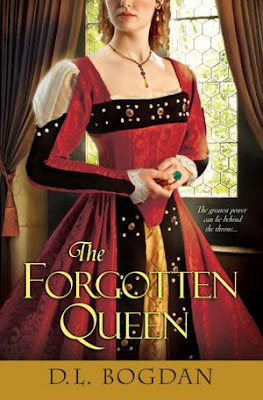
The Forgotten Queen Of all the royal women of the Tudor period, one we tend not to hear much about is Margaret, the elder sister of King Henry VIII and grandmother of Mary, Queen of Scots. And yet Margaret was not only a princess of England, but she also became a queen at the age of thirteen when she married King James IV of Scotland. In this historical fiction novel aptly titled The Forgotten Queen, D.L. Bogdan tells Margaret Tudor’s story.

James IV is much older than Margaret and given that this was a marriage made for political reasons, she is fortunate that James proves to be a kind and gentle husband – although not a very faithful one. In time Margaret comes to love him and is devastated when he is killed at the Battle of Flodden in 1513. Their young son succeeds to the throne and is crowned James V, but as he is not yet old enough to reign on his own, Scotland is ruled by a series of regents. Margaret marries again, this time to a man of her own choice, but as she learns more about her second husband – Archibald Douglas, the Earl of Angus – she begins to wonder if she has made a terrible mistake.

With her ties to both England and Scotland, it’s inevitable that eventually Margaret will have to choose between the country of her birth and her adopted country and must decide where her allegiances lie. It’s often unclear to the reader and even to Margaret herself what her true loyalties are, but the one thing that is obvious is that she wants whatever is best for the young James V, who is in a vulnerable position at the mercy of the various advisors, regents and noblemen who surround him. And while she fights to secure her son’s throne, Margaret never forgets her father Henry VII’s dream that through her Scotland and England could one day be united.

I knew absolutely nothing about Margaret Tudor before reading this book so, for me, she really is ‘the forgotten Queen’. It made a nice change to read a book set during the Tudor period that chooses to focus on somebody other than Henry VIII and his six wives and I did learn a lot about Margaret’s life. Unfortunately though, Margaret herself comes across as a very unsympathetic character: immature, selfish and stubborn. She makes some very bad decisions, often failing to take advice from other people, and she expects more from her friends than she is prepared to give in return. However, there were still times when I could feel some compassion for her, as she did seem to have a very difficult and tragic life. Only two of her children survived past infancy – James and her daughter with Angus, Margaret Douglas – and her second and third marriages were both very unhappy (although having said that, I felt that Margaret did nothing to make them any happier).

In addition to learning about Margaret’s life I enjoyed learning more about this period of Scottish history in general, for example the aftermath of Flodden, but I found the author’s attempt at handling Scottish dialect very irritating. To indicate that a character is Scottish she substitutes the words ‘dinna’ and ‘canna’ for don’t and can’t but doesn’t make any real effort to use any other Scottish words. This made the dialogue feel very unconvincing and artificial. Also, as the book covers such a long period of time, it would have been helpful if dates had been provided in the chapter headings or whenever the story jumps forward by a few years. It was hard to tell how much time had passed between one chapter and the next, or sometimes even between one paragraph and the next. Just a small thing but it would have made the story so much easier to follow!

This was a fairly light read, as you can probably tell from the title and cover. I think if I had been looking for a more in-depth book about Margaret Tudor I would have been disappointed, but as an introduction to her story it was enjoyable enough and has left me wanting to know more about this forgotten queen.

The Queen’s Promise by Lyn Andrews

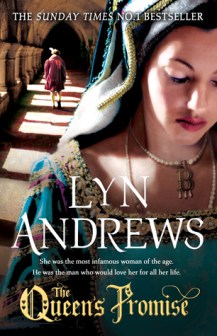
The Queens Promise Everyone knows that Anne Boleyn was one of the six wives of Henry VIII, but did you know that before her marriage to the King, Anne was secretly betrothed to another Henry – Henry Percy, son and heir of the 5th Earl of Northumberland? The Queen’s Promise is the story of Anne and Henry’s relationship.

When you try a new author for the first time you can never be quite sure what to expect. Until I read The Queen’s Promise I was unfamiliar with Lyn Andrews’ work, but after doing some research I discovered that she has written many bestselling family sagas which, although they have obviously been very successful, don’t look like books that would appeal to me. The Queen’s Promise seems to be a new genre for Andrews; I think this is her first historical fiction novel and based on this one, I hope she writes more. I’ll admit that when I first started to read it I thought it would be just another Tudor court romance – an impression not helped by the title and cover of the novel which do absolutely nothing to set the book apart from others of this type – but I was pleased to find that although there was certainly a romantic aspect to the story, it also had a detailed and well-researched historical background with almost as much attention given to the history and politics of the period as to the romance between Anne and Henry Percy.

Anne’s marriage to Henry VIII and the events leading to her death have been well documented in both fiction and non-fiction. However, in this novel there is actually more focus on Henry Percy than there is on Anne, which was the right choice in my opinion. Anne is such a popular subject for historical fiction and there’s not much that can be said about her that hasn’t been said before, but Henry Percy, on the other hand, is a historical figure who is less well known and Andrews does go into quite a lot of depth on not just his relationship with Anne, but also his life before and after Anne.

As so much of Henry’s life was spent in Northumberland, we are given a lot of information about the Border Reivers, who raided both sides of the English/Scottish border, and Henry’s role as Lord Warden of the Marches. Life in the borders was wild and dangerous in those days and it was not easy to maintain law and order there. We see how difficult it was to keep the peace between Northumberland’s feuding families and protect the people from outlaws while always being aware that there could be an attack from the Scottish side of the border at any time. I’m always looking out for books set in Northumberland as I’m from the North East myself and it was interesting to read about so many places I know – Alnwick, Hexham, Prudhoe, Warkworth – and to have the chance to add to my knowledge of the region’s history.

I really liked the way Henry Percy is portrayed as being refreshingly different to most of the other young men at the Tudor court – loyal, sincere and honest, but also quiet, cultured and sensitive, qualities which sadly make him a disappointment to his father, the Earl. It’s not a happy story for Henry – he also has to fight a recurring illness and to come to terms with being forced into a loveless marriage to Mary Talbot, the Earl of Shrewsbury’s daughter – and of course it isn’t a happy story for Anne either. I did like the young Anne we meet in the earlier chapters of the book, though after she begins her rise to becoming Queen she becomes much harder and a less sympathetic character.

Much of Henry’s and Anne’s story is seen through the eyes of Henry’s friend and squire, Will Chatton, who joins Henry’s household as a boy of eleven and later becomes a successful merchant. Will and his family are purely fictitious characters but they add another interesting angle to the story. As well as allowing us to observe Henry and Anne from a third perspective, the inclusion of the Chatton family gives us the chance to explore another side of Tudor society, away from life at court.

I enjoyed this book, after my initial concerns had proved to be unfounded. It was interesting, very readable and the focus on Henry Percy makes it slightly different from other Anne Boleyn-based historical fiction. It also raises the intriguing question of whether, if Anne and Henry had been allowed to be together as they wished, what impact would this have had on the future of the royal family and the whole course of history?

The Queen’s Confidante by Karen Harper

One of the things I like about Karen Harper’s books is the fact that although she writes about a period of history that has been covered many times before – the Tudor and Elizabethan era – she manages to find new and original ways to approach the subject. The first book I read by Harper, The Queen’s Governess, told the story of Kat Ashley, who was governess to Elizabeth I and an important part of the Queen’s life, but who is usually reduced to just a brief mention in other historical novels. Her next book, Shakespeare’s Mistress, was the story of Anne Whateley (probably a fictitious character) and her relationship with William Shakespeare. This latest novel, The Queen’s Confidante, is set in 1501 and follows the adventures of a young woman with her own candle making business who becomes embroiled in two historical mysteries.

Her name is Varina Westcott and she’s a candlemaker who specialises in making angel-shaped candles for funerals and who also has a talent for carving wax likenesses of real people. When Queen Elizabeth of York, wife to Henry VII, hears about Varina she secretly commissions her to make effigies of her dead children and also of her two younger brothers, the Princes in the Tower, who it is rumoured were murdered by Richard III. Elizabeth has always wanted to learn the truth behind the disappearance of her brothers, but if she delves too deeply into the mystery will she discover something she would rather not know?

Meanwhile, Elizabeth and Henry’s eldest son, Prince Arthur, has just married the Spanish princess, Catherine of Aragon. When Arthur dies suddenly of a mysterious illness, Elizabeth asks Varina to investigate on her behalf. Varina has lost a child of her own so she understands the Queen’s suffering and agrees to help. She is joined in her investigations by Nick Sutton, a courtier whose family fought against Henry VII at the Battle of Bosworth and who is now trying to prove his loyalty to the new King.

The story is told in two alternating narratives, Varina’s and the Queen’s, though Varina’s forms the largest part of the book. I could see why it was necessary to have the Queen narrate some of the story because it allowed us to see things from another viewpoint and filled in some information that Varina did not have access to, but I think I would have preferred to stay with Varina for the whole book as I thought her character was better written than Elizabeth’s. I particularly enjoyed learning about Varina’s work as a candlemaker in the early 1500s. As a woman, Varina is not allowed to join the Worshipful Guild of Wax Chandlers and although she owns her own business, she is at the mercy of decisions made by men – she is even prevented from selling her beautiful angel candles until the guild members decide how to price and distribute them. Yet another example of how frustrating and difficult it must have been for a woman trying to make an independent living for herself in the 16th century!

The theory Harper suggests which explains the mystery of the Princes in the Tower was satisfactory enough. Considering nobody knows what actually happened or who was responsible for the disappearances, I found it no less believable than any other I’ve read. But the book’s other mystery, the death of Prince Arthur, is something I don’t know as much about – I’ve never given any thought to whether he could have been murdered and have always assumed he died of natural causes. Nothing I read in this book did anything to convince me that Arthur really had been murdered, though it was interesting to read Karen Harper’s comments on this in her author’s note.

I’ve enjoyed all three of the books I’ve read by Harper, but this one is my least favourite. I just found it too hard to accept the idea of the Queen of England asking a candlemaker to act as an undercover detective. Also, as someone who believes Richard III has been unfairly treated by history, I didn’t like the fact that he and his supporters are viewed as villains by most of the characters in the story and this meant I enjoyed the book less than I might otherwise have done. I admit that I’m biased though, and this probably wouldn’t be a problem at all for readers less familiar with the period than I am and who haven’t already formed their own opinions of the historical figures involved!

Note: The US title of this book is Mistress of Mourning.

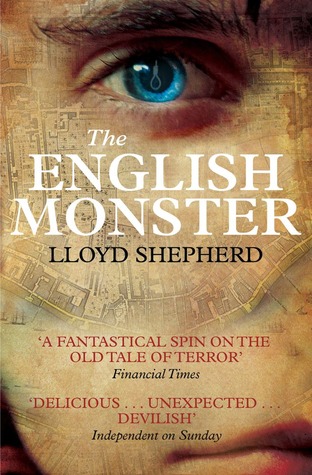
The English Monster by Lloyd Shepherd

Well, this was one of the most unusual books I’ve read for a long time! It got off to a great start and after reading the first few chapters (in which we witness six pirates being hanged at London’s Execution Dock, go on a midnight journey through the dark streets of 19th century Wapping, and meet a sea captain at an inn in Plymouth) I was beginning to feel very excited about this book. It seemed destined to become one of my favourites of the year, although by the time I finished it, I did feel a little bit less enthusiastic about it.

The novel consists of two alternating stories set in different time periods, but while they may appear to be entirely separate at first, there is in fact a link between the two of them. The way in which they are linked is not immediately obvious so I’ll leave you to discover the connection for yourself.

The first story, set in the Regency period, is based on a true crime which involved the killing of members of two different families in the Wapping area of London in December 1811. These deaths became known as the Ratcliffe Highway Murders. There was no official police force in England at that time and the way the case was handled was amateurish and incompetent. The English Monster introduces us to John Harriott, the magistrate of the Thames River Police Office, and Waterman-Constable Charles Horton as they attempt to investigate the murders.

The second thread of the novel, beginning in October 1564, is a good old fashioned swashbuckling adventure story following Billy Ablass, a young man who decides to go to sea to make his fortune and finds himself aboard a ship owned by Queen Elizabeth I, ready to embark on England’s first official slaving voyage. Or at least, I thought I was reading a good old fashioned adventure story – until I came to a very surprising and dramatic twist that made it obvious this was definitely not going to be a conventional historical fiction novel or a conventional murder mystery either. And of course I’m not going to tell you what the twist is – you’ll have to read the book yourself to find out.

When a novel has multiple timelines, I usually find I’m drawn to one period more than the other but with this book I think I can honestly say I enjoyed them both equally. The Ratcliffe Highway story was fascinating, especially the insights we are given into how useless and inadequate the investigation was. I found Charles Horton a very interesting character: a ‘detective’ working in an era when modern methods of detection were almost non-existent. I believe Horton and the magistrate John Harriott are going to reappear in Lloyd Shepherd’s next book and I’m looking forward to meeting them again.

The Billy Ablass sections of the novel were very compelling too, although some of the scenes that dealt with the cruelty and brutality of the slave trade were uncomfortable to read, as you might expect. Unfortunately though, slavery is part of our history and we can’t ignore the fact that it happened. A lot of real historical figures make an appearance throughout these chapters, such as Francis Drake (who is usually thought of as an Elizabethan hero but was also involved in the slave trade), the Welsh pirate Henry Morgan, the notoriously violent buccaneer L’Ollonais, and John Hawkyns, captain of England’s first slave ship. At the end of the book there’s an interesting note from the author in which, among other things, he explains how much of his portrayal of these characters is based on fact and how much is purely fiction.

As a first novel, I thought The English Monster was very impressive. I’m not sure I wouldn’t have preferred the straightforward historical fiction novel the book had initially seemed to be and that’s why some of my enthusiasm faded slightly as I got further into the story, but there’s no doubt Lloyd Shepherd has come up with something very different and very imaginative here. I’m already looking forward to the sequel, The Poisoned Island.

Thanks to Simon & Schuster for sending me a review copy of this book

In a Treacherous Court by Michelle Diener

There are already so many historical fiction novels set in the Tudor court that for a book to stand out from the others the author really needs to find a new way to approach the subject. Michelle Diener’s In A Treacherous Court is refreshingly different because it features two interesting but little-known historical figures – John Parker and Susanna Horenbout – both of whom really existed, yet aren’t characters that you would usually find in Tudor novels. Despite having read a lot of books set during this period, I had never come across either of these people until now.

Susanna Horenbout is a Flemish artist who travels to the court of Henry VIII in 1525 to become the king’s illuminator. During the journey to England, a man dies on board the ship and Susanna is at his side as he whispers his dying words, a secret message that he wants her to deliver to the King. It seems that someone is afraid of what Susanna may have learned, because as soon as she arrives in England an attempt is made on her life. One of the King’s most trusted courtiers, John Parker, Yeoman of the Crossbows, has been sent to meet the ship and after discovering how much danger Susanna is in, he vows to protect her while at the same time trying to unravel a plot that could threaten Henry’s throne.

In a Treacherous Court is the first in a series and after reading this one, I think both Susanna Horenbout and John Parker have a lot of potential as characters. As historians know so little about their lives, it gives the author some freedom to create exciting adventures for them without being too restricted by what really happened (the story does stick to the historical facts where possible though, and there is an author’s note at the end of the book that explains which parts of the novel are based on truth and which are purely fictional). I did find the romance between Susanna and Parker a bit hard to believe as it all seemed to happen so quickly, but who can say whether or not their relationship might really have developed the way it did in the novel?

The plot is very fast-paced with lots of action in every chapter which makes the story fun to read, although I thought the constant murder attempts and attacks on Susanna did become a bit repetitive. This book is definitely at the lighter end of the historical fiction spectrum, but it’s certainly an entertaining read with some original ideas that give it a different feel from most of the other Tudor court novels I’ve read.

I received a review copy of In a Treacherous Court from Simon & Schuster

Thoughts on finishing the Lymond Chronicles

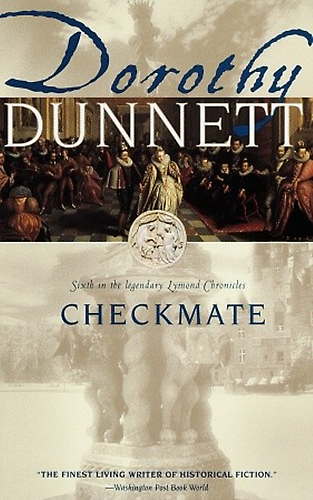
I apologise for abandoning my blog this week – I’ve been very busy both at work and at home, and any spare time I did have was devoted to finishing Dorothy Dunnett’s Lymond Chronicles. Because I read the final two books, The Ringed Castle and Checkmate so close together, rather than posting separate ‘reviews’ I decided to combine both books into the same post, along with some comments on the series as a whole.

Let’s start with the fifth book in the series, The Ringed Castle. After all the praise I’ve bestowed on the first four books it’s difficult to find new words to describe how I felt about this one, so suffice to say that it was as wonderful as the others. Russia is one of my favourite settings for historical fiction so I liked that aspect of the book, though I was equally interested in the chapters set at the Tudor court.

As with the previous novels, there’s a lot of history in this book – in the Russian sections we learn about Ivan IV, the Cossacks and the Crimean Tartars, and in the English sections we find ourselves at the centre of the conspiracies and political intrigue surrounding Queen Mary I and the future Elizabeth I. We also meet John Dee, the famous astrologer and mathematician, who is always interesting to read about, as well as another historical figure I knew nothing about: the explorer Richard Chancellor. Chancellor’s work with the Muscovy Company and as a navigator form quite a big part of the plot and I’m glad I’ve been able to learn something about his life and career. The final voyage of the Edward Bonaventure was so sad and one of the most memorable parts of the book for me.

Oh, and I loved the scene in the Hall of Revels, which finally led to the ‘Anvil Moment’ Aarti has been telling me about. And yes, it was worth waiting for!

When I started Checkmate, it was with a mixture of excitement at finding out how Lymond’s story would end and also sadness at the thought of reaching the end of the series. I was hoping to make the final book last as long as possible, but of course I couldn’t and it actually took less time to read than any of the others. In a series of unputdownable books, I found this one the most unputdownable of them all! I admit to having to cheat once or twice and flip forward a few pages, which is something I usually try not to do, but knowing from the previous books that Dorothy Dunnett had no qualms about killing off major characters, sometimes the suspense was just too much to bear.

Having said that, this wasn’t my favourite of the six books. There were parts that I loved – the chase through the streets of Lyon, the hilarious Hotel de Ville banquet, as well as finally learning the truth about Lymond’s birth – but overall I enjoyed some of the earlier books more. Still, I thought Checkmate was a great conclusion to the series and it was good to see so many of the characters from the previous books brought together in this one, including the return of Jerott, Marthe and one of my favourites, Archie Abernethy. And after The Ringed Castle, in which Lymond becomes more isolated than ever from his family, I was glad that Sybilla and Richard played such a big role in this book (it’s been fascinating to follow all the ups and downs of the relationship between Richard and Francis).

I’d like to finish by saying that I agree with all the Dorothy Dunnett readers who have been commenting on my previous Lymond posts – this is the best series of historical fiction novels I’ve ever read and I can see why so many of you have been re-reading them for decades because I’m sure I’ll be doing the same. And for anyone who has yet to read these books, I can promise you that although they’re not the easiest of reads, it’s definitely worth making the effort and getting to know Francis Crawford of Lymond, one of the most complex, charismatic, fascinating characters you’re ever likely to meet in literature. Working through the six books of the Lymond Chronicles has been one of the greatest experiences in my lifetime of reading.