Mary of Carisbrooke by Margaret Campbell Barnes

Mary of Carisbrooke Margaret Campbell Barnes is an author I’ve been curious about for a while, since some of her historical fiction novels started appearing in my recommendations on Goodreads. Not really knowing anything about the author or her books, I chose Mary of Carisbrooke (originally published in 1956) because most of her others are set in the Tudor period and I wanted something a bit different, having read a lot of Tudor novels recently. This book is set in the 1640s at the end of the English Civil War, which is a period I’ve read about less often.

The ‘Mary’ of the title is seventeen-year-old Mary Floyd, whose father is a sergeant in the military garrison stationed at Carisbrooke Castle on the Isle of Wight. Over on the mainland, the Civil War is coming to an end, having resulted in victory for Oliver Cromwell and his Parliamentarians; for the islanders, separated from the rest of England by several miles of water, the drama is just beginning. The defeated King Charles I has fled to the island to take refuge in Carisbrooke Castle, hoping that the Governor, Robert Hammond, will be sympathetic. Unfortunately, Hammond feels it is his duty to inform Parliament and so the King finds himself a prisoner in the castle.

Many of the people in and around the castle, including Mary Floyd, still have Royalist sympathies and the rest of the novel follows their numerous attempts to help the King escape from Carisbrooke. If you know your English history you will know whether or not he does escape and what his eventual fate will be, but even if you do think you know how the story ends Barnes still manages to create some suspense and has us hoping that the islanders’ latest scheme will be a success!

I watched a BBC documentary, Castles, a while ago and remember a mention of Carisbrooke and one particular escape attempt involving a barred window; I kept waiting for this incident to appear in the book, which it does, but it is only one small episode. The King and his supporters have lots of other plans in store, and through the character of Mary, conveniently placed within the castle walls, we are right at the heart of the action as preparations are made, secret messages are sent and letters are smuggled in and out.

And yet, despite all the secrecy and intrigue, I found Mary of Carisbrooke quite a boring book. Mary is a likeable enough character, but a bit too good to be true – too nice, too generous, too kind, too courageous, and lacking the flaws and complexity I prefer my heroines to have. There’s a romantic subplot for Mary, as she becomes involved with two of the King’s men who have joined him on the island, but again, there was a lack of passion here. I did love the sections of the novel told from the King’s perspective and wished there had been more of these! His character is written very well, making him not just a King but also a father and a husband wanting to be reunited with his family, a human being we can identify with and understand.

It’s rare to find a book set on the Isle of Wight so I enjoyed that aspect of the story. It was interesting to see how the islanders felt about being suddenly thrust into the middle of the action after being used to feeling distant and removed from what was going on over in mainland England. However, I did wish that the author had spent more time setting up the story and explaining the background. I felt that we were introduced to a lot of characters all at once and I struggled to keep track of who they all were and which side they were on – which wasn’t helped by the fact that some of them seemed to have divided or ambiguous loyalties.

I would be happy to try another of Margaret Campbell Barnes’ books, but I’m not desperate to do so. I’m curious to know whether all of her books would leave me feeling the same way or if I’ve just picked the wrong one to start with.

The Glassblower of Murano by Marina Fiorato

The Glassblowers of Murano Since reading Marina Fiorato’s Beatrice and Benedick last year, I’ve wanted to try another of her books. There were three on the shelf in the library, so I had a choice to make!

Two years ago, I visited Venice for the first time and, like many tourists, took a vaporetto to the island of Murano and went into one of the famous glass factories to watch a demonstration of glass blowing. It’s not surprising, then, that I was drawn to this particular book by the title, The Glassblower of Murano.

The novel follows Nora Manin as she undertakes a journey very similar to my own, visiting Murano and entering a glass workshop. Nora is not just a tourist, though – she is planning to start a new life in Venice and is hoping to get a job blowing glass. As the descendant of one of the most famous glassblowers in Venetian history, Corradino Manin, and a talented glass artist in her own right, Nora easily convinces the factory owner to employ her. However, as Nora begins to settle into her new job she learns something about her ancestor that she would rather not have known.

Alternating with Nora’s story is the story of Corradino, set in 1681. Like all glassblowers, Corradino is closely watched by the sinister Council of Ten and forbidden to leave Venice in case he gives away his glassmaking secrets, but one day he is approached by a Frenchman who makes a very tempting offer. Whether or not Corradino does betray the secrets of the glass is something Nora needs to discover if she is to restore not only her ancestor’s reputation but her own.

I enjoyed The Glassblower of Murano. It wasn’t perfect and it did feel like a first book (this was Marina Fiorato’s debut novel and having also read her newest one, Beatrice and Benedick, I think her writing has improved a lot over the years) but it was still an interesting, entertaining read and just what I was in the mood for. I loved the setting, of course, and could feel the author’s own love for Venice shining through on every page. The descriptions of glassblowing techniques are fascinating as well; I’ve never really given any thought as to how mirrors were made, so it was interesting to read about Corradino’s methods. I did wonder whether Corradino was based on a real person, but it seems that he’s an entirely fictional character – although the author’s portrayal of the 17th century world in which he lives feels real and convincing.

Usually when a book has dual time periods, I find that I have a preference for one over the other and this was no exception – the historical storyline was my favourite – but I did find the contemporary strand quite compelling too. I was so caught up in the stories of Nora and Corradino that I was almost (but not quite) able to overlook the flaws with the book, such as the implausible coincidences, the subplots that were started but never developed, and the fact that all of the characters apart from the two main protagonists lacked depth.

I had some problems with The Glassblower of Murano, then, but I thought it was an enjoyable book overall and I’m looking forward to reading her others. Her other novel set in Venice, The Venetian Contract, sounds appealing so maybe I’ll try that one next.

Don Quixote by Miguel de Cervantes

Don Quixote Reading Don Quixote has been a year-long project for me in 2014. After reading Clarissa over a twelve month period as part of a readalong in 2012 and then War and Peace in 2013 I decided to tackle another of the very long, intimidating classics on my Classics Club list, this time on my own. Now that I’ve finished I don’t know why I had ever been intimidated by it. Yes, it’s long (over 1,000 pages in most editions) and old (originally published in two parts in 1605 and 1615) and a translation, but I didn’t find it difficult to read at all. It’s fun and imaginative and entertaining – and I loved it.

Don Quixote is the story of a gentleman of La Mancha who has spent so many years reading books of chivalry and romance that he has come to believe the tales they tell are true. Inspired by the heroes of his favourite books, he decides to become a knight errant and go out into the world in search of adventures. Renaming himself Don Quixote and his horse Rocinante, he convinces a neighbouring peasant, Sancho Panza, to join him as his squire. With Sancho at his side, Don Quixote sets out to right wrongs, fight duels and rescue damsels in distress, in the hope that his valiant deeds will win him the love of the beautiful (and largely imaginary) Dulcinea del Toboso.

As Don Quixote and Sancho travel across Spain they have one adventure after another, each one headed with a long and intriguing chapter title such as “Of the strange adventure which befell the valiant Don Quixote with the bold Knight of the Mirrors” or “Which deals with the adventure of the enchanted head, together with other trivial matters which cannot be left untold”. As you read on, however, it soon becomes obvious that these ‘adventures’ are not quite as amazing as they sound and usually have a logical explanation.

Many people, even without reading the book, will have heard of the famous ‘tilting at windmills’ episode. There are many, many other similar episodes in the novel but this one appears near the beginning which is probably why it’s the best known. If you’re not familiar with it, on approaching some windmills in a field Don Quixote becomes convinced they are giants and attacks them with his sword:

“What giants?” said Sancho Panza.

“Those thou seest there,” answered his master, “with the long arms, and some have them nearly two leagues long.”

“Look, your worship,” said Sancho; “what we see there are not giants but windmills, and what seem to be their arms are the sails that, turned by the wind, make the millstone go.”

“It is easy to see,” replied Don Quixote, “that thou art not used to this business of adventures; those are giants; and if thou art afraid, away with thee out of this and betake thyself to prayer while I engage them in fierce and unequal combat.”

This is a pattern that is repeated over and over again throughout the novel: Don Quixote mistakes inns for castles and flocks of sheep for armies – and even when Sancho points out the truth he still insists that he is right. The castles and the armies must have been enchanted by great wizards, he says, so that they appear to be inns and sheep. As the story progresses, Don Quixote’s fame spreads and he is thought of as insane and Sancho as an idiot. The response of some of the people they meet can be very cruel and it’s quite sad to see how Don Quixote and Sancho are ridiculed, scorned and made the target of elaborate practical jokes. I wouldn’t describe this as a sad book, though; in fact, it’s a very funny one. The humour doesn’t always work (being four hundred years old and in translation, maybe that’s not surprising) but at times it’s hilarious!

As well as the adventures and the humour, there are lots of songs, poems and ballads interspersed with the prose. There are also lots of stories-within-stories – almost everyone they meet on their journey has a long and tragic story of their own to tell – and many of these have no relevance to the rest of the novel. For example, a lot of time is devoted to the tale of a Christian who was held captive by Moors in Algiers and has escaped back to Spain – nothing to do with Don Quixote, but apparently based on Cervantes’ own experiences. This is why the novel is so long and why you need to have some patience with it! Reading this book over a period of several months was the perfect strategy for me as the episodic nature of the story meant that I could leave it for a few weeks and still get straight back into it when I picked it up again. Breaking it up into small sections kept it feeling fresh and interesting so that I never felt bored or overwhelmed.

A quick note on the translation now. There have been many English translations of Don Quixote over the years but not really having any idea which to choose, I started reading the 1885 John Ormsby translation (in the public domain so free to download from Project Gutenberg and other websites) and I found it perfectly readable so decided just to stick with it. I wouldn’t necessarily recommend that translation to everyone as it does use some archaic terms and feels ‘old’ but that’s what I prefer when I’m reading an old book so it wasn’t a problem for me. Whichever may be closest to the literal translation, Ormsby’s description of Don Quixote as “Knight of the Rueful Countenance” just sounds better to me than, for example, Edith Grossman’s “Knight of the Sorrowful Face”. It’s a matter of personal taste, though, so it’s probably a good idea to look at a few different translations and find one that suits you before you embark on such a long novel!

Much as I enjoyed this book it did sometimes feel as if I was never going to finish it, so I was pleased to reach the end. I’m going to miss Don Quixote and Sancho, though, after spending so much time with them this year!

Bitter Greens by Kate Forsyth

Bitter Greens Since reading Kate Forsyth’s Brothers Grimm-inspired The Wild Girl last year, I have been looking forward to Bitter Greens, another novel with a Grimm connection. I’m sure most of us know, or have at least heard of, the fairy tale Rapunzel. Although this fairy tale was included in the Grimm Brothers’ 1812 collection, Children’s and Household Tales, it was actually based on a much earlier story, Persinette, which was published in 1698 and written by a woman called Charlotte-Rose de Caumont de La Force. In Bitter Greens, Kate Forsyth combines a re-telling of the Rapunzel story with a fascinating account of the life of Charlotte-Rose.

The novel begins in 1697, on the day that Charlotte-Rose is banished from the court of Louis XIV and sent to a convent. With her sharp tongue, sense of humour and spirited personality, it seems that Charlotte-Rose has been the cause of too much scandal for the Sun King’s liking and is now receiving her punishment. After the lively and opulent court of Versailles, Charlotte-Rose finds it very difficult to adapt to life in a strict and austere nunnery. The only thing that makes her days bearable is her friendship with one of the nuns, Soeur Seraphina, who entertains her with a story about a little Italian girl called Margherita…

Accused of stealing a handful of bitter greens from a witch’s garden, Margherita’s parents are forced to make a bargain with the witch: she will not report them for the theft if they agree to hand over their daughter as soon as she reaches the age of seven. And so Margherita finds herself taken from her parents and locked in a high tower by Lake Garda – a tower which can only be accessed when Margherita throws her long red hair from the window to form a ladder.

Margherita’s story unfolds slowly, a few chapters at a time, and alternates with the story of Charlotte-Rose who is looking back on her life, her love affairs and her time at court. There is also a third strand to the novel and in this we learn the history of Selena Leonelli, the witch of the fairy tale, who was once a Venetian courtesan known as ‘La Strega Bella’ and a model for the artist Titian. These three women lead lives which are in some ways very different but in others quite similar. Each has been touched by sadness and tragedy, but each woman proves herself to be strong and resilient in the end.

There’s just so much packed into this novel: the scandals and intrigues of the 17th century French court, a version of Rapunzel much darker and more compelling than the one I remember from my childhood, a vivid depiction of Renaissance Italy, magic and witchcraft, religious persecution, stories within stories, and much more. I was never bored, no matter which of the three women I was reading about. Charlotte-Rose is a wonderful character and I’m surprised that more authors of historical fiction haven’t used her as a subject for their novels. This is the first time I’ve had the pleasure of reading about her and I think it’s sad that she seems to have been largely forgotten by history.

Much as I loved Charlotte-Rose, though, I always found myself looking forward to returning to Margherita in her tower. She and Selena never felt quite as real to me as Charlotte-Rose did (which is maybe not surprising as they are supposed to be fairy tale characters, after all!) but I really enjoyed revisiting the Rapunzel story, which I hadn’t read or even thought about for such a long time. There were elements of fantasy and magical realism within Margherita’s tale that worked well alongside the more realistic narrative of Charlotte-Rose and I thought the balance was perfect. I loved Bitter Greens and would highly recommend both this book and The Wild Girl.

Bitter Greens_Blog Tour Banner_FINALv2 I read Bitter Greens as part of the Historical Fiction Virtual Book Tour. For more reviews, interviews and guest posts please see the tour schedule.

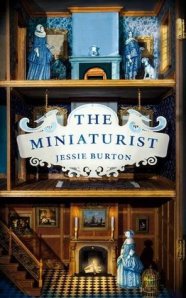
The Miniaturist by Jessie Burton

The Miniaturist In October 1686, eighteen-year-old Petronella (Nella) Oortman travels from Assendelft to Amsterdam to join the household of her new husband, Johannes Brandt. Johannes is a merchant with the VOC – the Dutch East India Company – and spends a lot of time away from home, leaving his young wife in the company of his sister, Marin, and their two servants, Cornelia and Otto. Disappointed with the lack of affection from her husband and confused by Marin’s cold, unwelcoming reception, Nella quickly finds that married life is certainly not what she had hoped and expected it would be.

Unable, for various reasons, to give Nella the attention she deserves, Johannes presents her with a special wedding gift to help her pass the time: a cabinet containing a dolls’ house that resembles the Brandts’ own home. The little rooms are empty and it is up to Nella to decide how to furnish them. Responding to an advertisement by a ‘miniaturist’, she sends a letter with her requests, but when the tiny items and figures begin to arrive, Nella is amazed by how accurately they reflect life within the real Brandt household. How can the miniaturist possibly know so much about Nella and her family?

I was drawn to The Miniaturist by its striking cover and although the book itself didn’t quite live up to my expectations, it was certainly an unusual and intriguing story. I have seen comparisons with Tracy Chevalier’s Girl with a Pearl Earring and it’s easy to see why, as both books tell the story of a young woman living in 17th century Holland, but apart from this I don’t think the two novels really have a lot in common. While I found that Girl with a Pearl Earring felt realistic and true to life, The Miniaturist has an element of magical realism that makes it very different – and this supernatural aspect was possibly the reason why I didn’t love the book as much as I wanted to. I thought the mystery of the miniaturist’s creations was a great idea, but I felt that it was never sufficiently explained or resolved, which left me wondering if I’d missed the point.

I found a lot to like about The Miniaturist, though, particularly the setting – not a common one in historical fiction, but very interesting to read about. I learned a lot about Amsterdam in the 1600s and the world of trade and commerce in which Johannes Brandt and his fellow merchants operate. It’s quite an atmospheric novel too, and a bit darker than I’d expected; bad things happen to some of the characters in the story and not everyone gets a happy ending. Nella herself is a character who grows and changes, from an innocent, nervous young girl at the beginning of the book to a strong, mature woman at the end. And I must mention Marin, secretive and hostile, but with much more depth than is obvious at first.

I had assumed this was a purely fictional story, so I was surprised to find that Petronella Oortman was a real person and her miniature house can be seen in the Rijksmuseum in Amsterdam. As for the true story behind the house and its contents, who knows?

I received a copy of this book for review via NetGalley

Secrecy by Rupert Thomson

Secrecy Secrecy is set in 17th century Florence and tells the story of Gaetano Zumbo, a sculptor famous for creating gruesome wax models depicting the human body in various stages of decay. Zumbo (or Zummo, as he is usually referred to in the novel) arrives in Florence in 1691, having fled from his home in Sicily for reasons which are revealed later in the book. The Grand Duke of Tuscany, Cosimo III de’ Medici, is an admirer of Zummo’s work and commissions a very special sculpture from him – one which must be kept a secret between the two men.

After settling into his new home, the House of Shells, and getting to know his landlady, her young daughter, and another lodger, a French acrobat, Zummo concentrates on creating the Grand Duke’s special wax model. But when he falls in love with the apothecary’s niece, Faustina, and makes an enemy of Stufa, a monk and advisor to the Grand Duke’s mother, Zummo’s life suddenly becomes a lot more complicated.

Gaetano Zumbo was a real person, although I didn’t know anything about him or his work before reading this book. If you’re curious and not too squeamish, you can find plenty of images online showing his various plague scenes, dismembered bodies and rotting corpses. Apparently some examples of his work are displayed in Florence’s Museum of Zoology and Natural History, but I have to admit I don’t have any desire to go and look at them as they sound a bit too grotesque for my liking!

There’s no doubt, though, that Zumbo is an unusual and intriguing subject for historical fiction. The setting is fascinating too. I don’t think I’ve ever read about this particular period of Italian history before and I enjoyed reading about Florence under the rule of Cosimo III – portrayed here as a corrupt and dangerous place. The novel has a dark, unsettling atmosphere and the theme of secrecy is woven into the complex plot in several different ways.

But the interesting protagonist and atmospheric setting were not quite enough to make me love Secrecy. I found the characters, even Zummo himself, difficult to fully connect with and never really managed to engage with any of them on an emotional level. I also thought the narrative style was slightly confusing as it was sometimes not immediately obvious when Zummo was dreaming or remembering something that had happened in his past.

Still, if you enjoy historical fiction set in Italy and are in the mood for something a little bit different, this book could be just what you’re looking for.

I received a copy of this book via NetGalley for review.

Plague by C.C. Humphreys

Plague I’ve always been fascinated by the Great Plague of 1665. I know that probably makes me sound morbid, but it’s true – with my interest in the history of medicine, I love reading about the theories suggested by 17th century people to explain what was happening to them, the weird and wonderful ‘cures’ they came up with and the impact of the epidemic on English society. So when I saw a novel called Plague in my library’s ebook catalogue, I was immediately intrigued, especially as it’s by C.C. Humphreys, an author I’ve been wanting to try since I saw Audra’s review of one of his other books, Jack Absolute.

Plague, I quickly discovered, is not simply a novel about the plague (although it’s always there in the background affecting the lives of all our characters in one way or another) but it’s also an action-packed historical mystery set in Restoration London.

In 1665, England is still recovering from the aftermath of the recent Civil War which had resulted in the execution of King Charles I. Although his son, Charles II, has now been restored to the throne, lots of former royalists are still struggling after losing everything in the war. One of these is Captain William Coke, who has had to resort to highway robbery to survive.

One night, Coke is surprised to find that his shouts of “stand and deliver” have no effect on the approaching carriage. The reason: the driver and the passengers have all already been brutally murdered. Coke takes an expensive necklace from the neck of one of the bodies before running away, but leaves one of his pistols behind in his hurry to escape. This is found by the thief-taker, Pitman, who becomes determined to capture Coke and receive the reward for bringing him to justice. We, the readers, know that Coke is innocent – but who is the real killer?

Two women also become embroiled in the mystery. One of them, Lucy Absolute, is the sister of a wartime comrade of Captain Coke’s. She is now an actress at a London theatre – and the mistress of the notorious Earl of Rochester. The other woman is Lucy’s friend, Sarah Chalker, another actress. When Sarah’s husband goes missing, the unlikely pairing of Coke and Pitman must work together to investigate his disappearance…and meanwhile, plague is continuing to spread through London. As the novel’s subtitle tells us, ‘murder has a new friend’.

Although the story deals with serious subjects such as murder, illness, robbery and treachery, and can be quite graphic at times, Plague is an entertaining novel that I found fun to read. Humphreys’ writing style is clear and engaging and I knew from the first page that this was a book I was going to enjoy. It’s always a relief when that happens! It’s a very atmospheric novel too, taking us from the dark, dirty cells of Newgate Prison and the squalid, claustrophobic homes of the plague victims to the splendour of the royal court and the drama of the theatrical world. Each location is brought to life vividly and realistically and the author doesn’t shy away from describing some of the less pleasant sights, sounds and smells of the period!

We meet lots of interesting characters in Plague, including some real historical figures such as Charles II and the fascinating Earl of Rochester. But my favourite was Captain Coke. He’s a complex, flawed character and I liked him from the beginning, even though we first see him as a highwayman and a thief. I enjoyed watching his relationship with Pitman develop from hunter and prey to unlikely partners. One aspect of the book I was less happy with, though, was the inclusion of a conspiracy plot involving a religious sect called the Fifth Monarchists. I think this sort of thing is overused in historical crime and I’m starting to get a bit bored with it. Other than that, I really enjoyed this book. The ending sets things up nicely for a sequel; I don’t know if there will be one, but I would like to have the chance to meet some of these characters again.