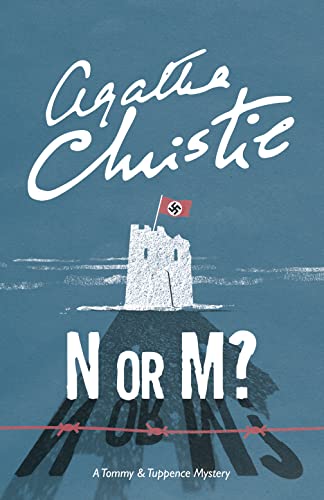
N or M? by Agatha Christie

This month – and in August and September – the Read Christie challenge is moving on to books published in the 1940s and 1950s. I have several unread Christies from those decades to choose from, but I decided to start with N or M?, a Tommy and Tuppence novel from 1941. I enjoyed the first two T&T books, The Secret Adversary and Partners in Crime, and this is the third in the series.

I think this is a series best read in order as, unlike Poirot and Miss Marple, Tommy and Tuppence age almost in real time; they were in their early twenties in 1922’s The Secret Adversary and when we join them at the beginning of N or M? they are over forty. Their advancing age has become a source of frustration to them now that the world is at war and it seems that they are too old to make any meaningful contribution. Then, Mr Grant, a secret agent, arrives with an intriguing proposition for Tommy. He must travel undercover on behalf of the Secret Service to a boarding house on the south coast of England in search of two German spies, one male and one female, known only by the initials N and M. The mission must be kept secret from everyone, including Tuppence, who is told that Tommy is being sent to Scotland to take up a boring office job. However, Tuppence is already one step ahead and determined not to miss out on the excitement!

N or M? is more of a thriller/espionage novel rather than a traditional detective novel, which made a nice change from my last two Read Christie selections, which have both been Poirot mysteries. One of the good things about diving into Christie’s books more or less at random as I have been doing over the last few years is that there’s enough variety within her body of work that you never really get bored. However, there’s still a mystery to be solved here – the mystery of the true identities of N and M – and plenty of clues to look out for. I found it very easy to identify one of the spies (and was frustrated that Tommy and Tuppence didn’t work it out as quickly as I did), but I didn’t guess the other one so there were still some surprises in store for me.

With most of the novel being set in and around the Sans Souci boarding house, this means all of the suspects are together in one place, giving Tommy and Tuppence plenty of opportunities to observe them. The most obvious is Carl von Deinim, a German refugee and research chemist, but is he too obvious? The other guests include a larger than life Irishwoman, a retired Major, an invalid and his wife, and a young mother with her two-year-old daughter. Literally anybody could be a spy and Christie does a great job of capturing the sense of danger, mistrust and paranoia. I was quite worried for Tommy and Tuppence at times, even though I knew they must survive as there are more books in the series!

I’ve found that the other Christie novels I’ve read that were published during this same time period barely mention the war, if at all, so it was unusual to find one in which the war is such a central part of the plot and affects the lives of the characters in so many ways. I really enjoyed it and am looking forward to reading the next Tommy and Tuppence book, By the Pricking of My Thumbs – although not just yet, as it’s published in 1968 and we’ll be staying in the 40s and 50s for the next two months.

This is book 11/20 of my 20 Books of Summer 2024.

The Noh Mask Murder by Akimitsu Takagi

Translated by Jesse Kirkwood

My 20 Books of Summer reading is off to a good start with this 1949 Japanese locked room mystery, now available from Pushkin Press in a new English translation. Thanks to Pushkin, I’ve been able to try several Japanese classic crime authors over the last few years, including Seishi Yokomizo, Yukito Ayatsuji and Soji Shimada. The Noh Mask Murder is the first book I’ve read by Akimitsu Takagi and I thoroughly enjoyed it.

The novel opens with a discussion between Koichi Yanagi, a chemist who has recently returned to Japan after serving in Burma during the war, and his old school friend, Akimitsu Takagi (yes, the author himself, who appears as a character in his own novel – just like Anthony Horowitz in his Horowitz and Hawthorne series). Akimitsu explains to Koichi that he wants to write a new kind of detective novel, one based on a mystery he has solved for himself in real life:

‘I’d tackle some fiendish real-life mystery, then set down precisely how I solved it in the form of a novel. My readers would be provided with the exact same evidence as the author. They’d be able to follow the detective-narrator’s train of thought, assess the appropriateness of his actions – and even come up with their own alternatives. But I don’t imagine an opportunity like that will ever present itself…’

His opportunity comes sooner than he had imagined when Koichi stumbles upon a mystery at the Chizui family mansion, where he has been staying since returning from the war. The head of the household, Professor Chizui, who was once a friend of Koichi’s, died ten years earlier and the house is now inhabited by his two children and the family of his younger brother, Tajiro. The first sign that something is wrong within the Chizui mansion comes when an eerie figure wearing a sinister Noh mask is seen at one of the windows. Soon after this, Tajiro is found dead inside a locked room, with a smell of jasmine in the air and a Noh mask lying on the floor beside him. Akimitsu Takagi joins Koichi at the house to investigate the murder, but when they discover that someone has called the undertaker to order three coffins, it seems that there’s going to be more than just one murder to investigate!

The mystery is a fascinating one and although some time is spent discussing the mechanisms of how the locked room murder took place, the story never becomes too bogged down by the puzzle aspect; the focus is on the characters, their relationships and their motives. I did find the structure slightly confusing at times as we know we’re reading a book within a book written by Akimitsu Takagi (as both character and author), but within that there’s a journal written by Koichi and a long letter written by Hiroyuki Ishikari, the public prosecutor, so the narrative is sometimes three layers deep. There are some clever twists towards the end, however, which might not have worked if it had been structured differently.

Apart from the mystery, I found it interesting to learn about the different types of mask used in Japanese theatre and how although the Noh mask, which represents a demon, cannot change expression the actors can still use it to show various emotions by tilting the mask up and down and by the clever use of lighting. With the story being set in the post-war period, it’s also interesting to hear the characters reflect on the irony of being so concerned with the death of one person after living through a war in which millions died. If you kill a man in peacetime you’re considered a murderer, says Tajiro’s son, Rintaro, but if you kill a man on the battlefield you’re given a medal.

I really enjoyed The Noh Mask Murder, then, but be warned – in the prologue, where Takagi is discussing his plans for a detective novel, he casually spoils the solution of Agatha Christie’s The Murder of Roger Ackroyd. Not a problem for me as I’ve already read it, but I wish authors wouldn’t do that!

Thanks to Pushkin Vertigo for providing a copy of this book for review via NetGalley.
This is book 1/20 of my 20 Books of Summer 2024.

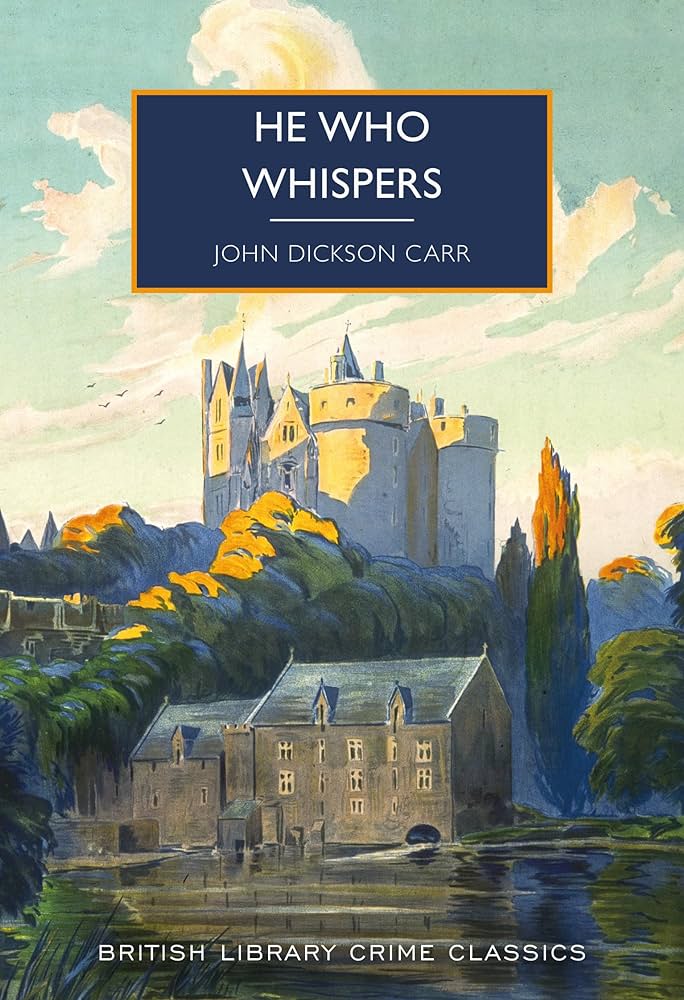
He Who Whispers by John Dickson Carr

He Who Whispers is one of John Dickson Carr’s Dr Gideon Fell mysteries, originally published in 1946 and recently reissued as a British Library Crime Classic. I read another in the series, The Black Spectacles, earlier this year and loved it, so I had high hopes for this one.

The book is set in the aftermath of World War II and is written from the perspective of Miles Hammond, a Nobel Prize winning historian who has just inherited his uncle’s estate, which includes a house in the New Forest containing a large collection of books. As the novel opens, Miles is in London looking for a librarian to assist with his uncle’s collection, and while there he accepts an invitation to attend a meeting of the Murder Club, a group who get together regularly to try to solve true crime cases. On arriving at the venue, Miles is surprised to find that nobody else is there apart from a young woman, Barbara Morrell, and tonight’s speaker, Professor Rigaud.

Despite only having an audience of two, Rigaud proceeds to tell them the story of a crime which took place in France before the war and is both unsolved and seemingly impossible. It involves the murder of a wealthy Englishman, Howard Brooke, found stabbed with his own sword-stick while apparently alone on top of a high tower with witnesses on three sides and the fourth unreachable as it overlooks the river. Fay Seton, Brooke’s secretary, is suspected of the crime for the dubious reason that she is believed to be a vampire – and only a creature that can fly through the air could have reached the top of the tower!

Miles is intrigued by Rigaud’s story and when Fay Seton turns up in London, he offers her the job of librarian so that he can find out more. Heading for his uncle’s house in the New Forest with Fay and his sister Marion, Miles finds that he is becoming increasingly fascinated by the suspected vampire – but when Marion has a terrifying experience while alone upstairs in her bedroom, does this mean Fay has struck again or is there another explanation for the strange occurrences? Luckily, Gideon Fell arrives that same night and begins to investigate!

I enjoyed He Who Whispers, but not nearly as much as I enjoyed The Black Spectacles and I’m not really sure why this particular book is considered one of Carr’s best (apparently even by Carr himself). Yes, the solution is very clever, but I felt that we, the reader, are given very little chance of solving it ourselves, particularly as we don’t really see any of Fell’s thought processes during the novel. He reveals everything in the denouement at the end, but until then we’re as much in the dark as Miles Hammond. There was also too much focus on the vampire storyline for my taste; I thought the mystery was interesting enough without the supernatural element, but I expect other readers will love that aspect of the plot.

Carr captures the feel of post-war Britain very well; a surprising number of 1940s crime novels barely refer to the war at all, but in this one it’s an integral part of the story. Several of the characters in the novel have served in the war, there are mentions of rationing and bombed-out streets and of the effect all of these things have had on people’s mental health. There’s quite a small cast of characters and Carr takes the time to flesh each of them out, but I never really warmed to our protagonist, Miles – he has two possible love interests throughout the novel and although his final decision could have gone either way, I felt that he made the wrong choice in the end!

I want to read more of the Gideon Fell mysteries, so if you’ve read any of them please let me know which ones you particularly enjoyed.

Random Harvest by James Hilton

“Sometimes I have a feeling of being — if it isn’t too absurd to say such a thing — of being half somebody else. Some casual little thing — a tune or a scent or a name in a newspaper or a look of something or somebody will remind me, just for a second — and yet I haven’t time to get any grip of what it does remind me of — it’s a sort of wisp of memory that can’t be trapped before it fades away…”

After enjoying Lost Horizon and Goodbye, Mr Chips, I decided that the next James Hilton book I read would be his 1941 novel Random Harvest. I knew very little about it except that it was very popular at the time it was published and that the film starring Greer Garson and Ronald Colman is one of my mother’s favourites. I haven’t seen it, but I think reading the book first was the right decision anyway, for reasons I’ll explain later.

The novel opens in 1937 with our narrator, Mr Harrison, falling into conversation with a stranger, Charles Rainier, whom he meets on a train to London. Rainier is now a successful businessman and politician, but he confesses to Harrison that since returning from fighting in World War I twenty years ago a whole chunk of memory has been lost to him. He remembers being injured in the trenches of France in 1917 and he remembers waking up in Liverpool one day in 1919, but can recall nothing at all of what happened in between – a period of two years which are now a complete blank to him.

When the train arrives at the station, the two men go their separate ways, but their paths soon cross again and Rainier offers Harrison a job as his secretary. As they get to know each other better, Rainier tells his new friend the story of his life since that day in Liverpool and gradually his earlier memories begin to return, with surprising results.

This book wasn’t quite what I’d expected; I thought it was going to be more of a romance, but although it does have a very moving love story at its heart, there’s much more to Random Harvest than that. It can be considered an anti-war novel, with it’s theme of loss that runs through the story from beginning to end – not just the obvious loss of memory, but also lost opportunities, lost or broken relationships, lost innocence and, on a wider scale, a way of life that has been lost forever as the world moves on from one war and heads straight for another:

It all depended whether one were tired or eager after the strain. Most of us were both — tired of the war and everything connected with it, eager to push ahead into something new. We soon stopped hating the Germans, and just as soon we began to laugh at the idea of anyone caring enough about the horrid past to ask us that famous question on the recruiting posters — ‘What did you do in the Great War?’ But even the most cynical of us couldn’t see ahead to a time when the only logical answer to that question would be another one — ‘WHICH Great War?’

The book has an unusual structure, divided into five long sections with no chapter breaks and moving backwards and forwards in time, piecing together Rainier’s memories as they begin to flood back. However, it’s always easy enough to follow what’s happening. The plot never becomes confusing and the story is structured the way it is for a good reason, allowing Hilton to obscure whole episodes in Rainier’s life from the reader and also from Rainier himself until it’s the right time to reveal them. And when the final revelation comes, right at the end of the book, I was taken completely by surprise as I hadn’t seen it coming at all. Apparently the film is structured differently, with the truth obvious from the beginning instead of being saved for the end, which is why I’m so glad I’ve read the book first and could experience everything as Hilton intended it.

This is a great book, possibly even better than Lost Horizon, and I’ll definitely be looking for more by James Hilton.

This is book 39/50 read from my second Classics Club list.

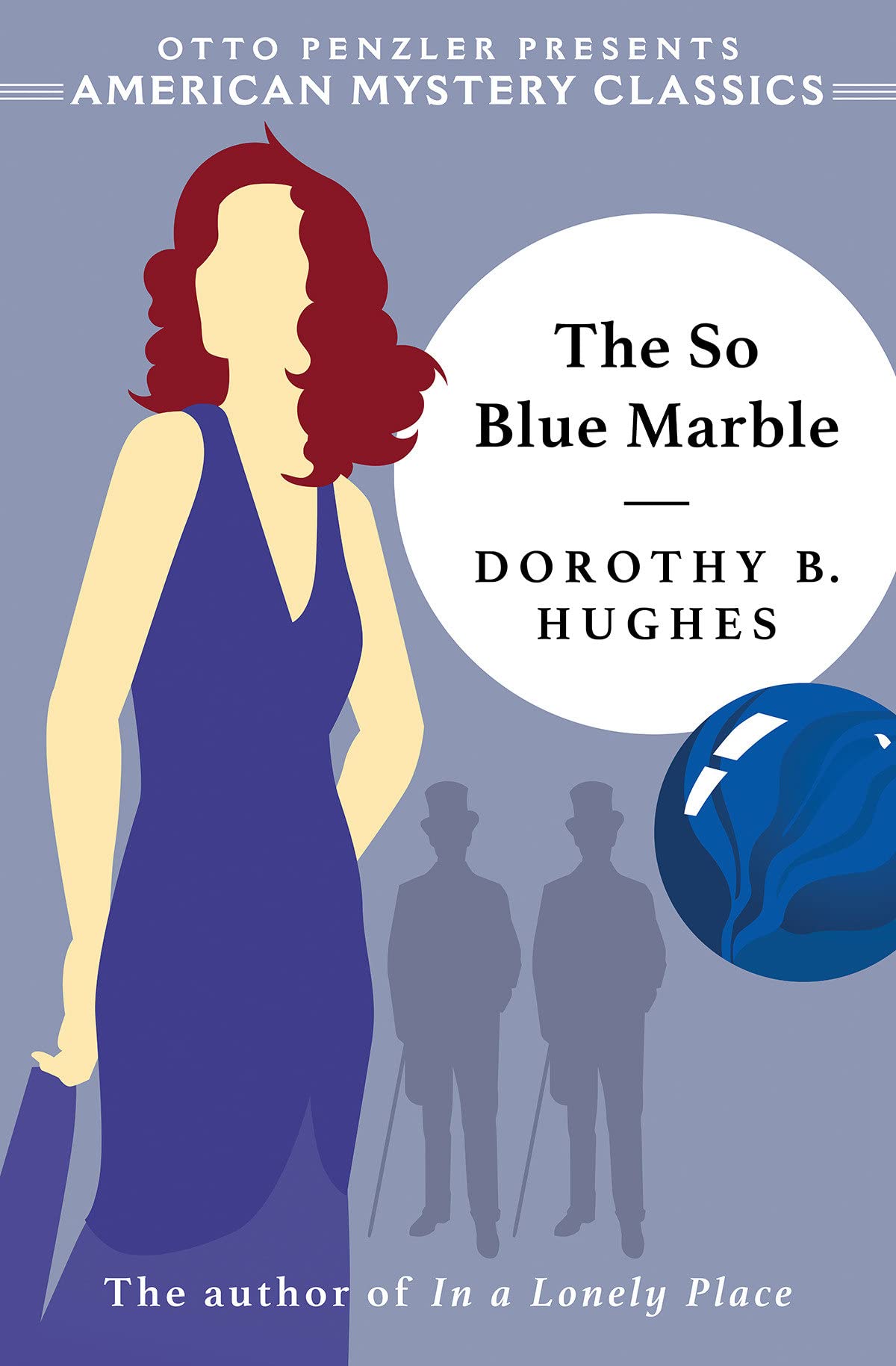
The So Blue Marble by Dorothy B. Hughes – #1940Club

I’ve read and loved three books by Dorothy B. Hughes – The Expendable Man, Ride the Pink Horse and In a Lonely Place, all of which featured on my books of the year list in the respective years in which I read them – so when I was looking for possible titles to read for Karen and Simon’s 1940 Club my eye was immediately drawn to The So Blue Marble. Published in 1940 (obviously), this was Hughes’ first novel and although it doesn’t feel as elegant and polished as her later ones, it’s still very enjoyable.

Twenty-four-year-old Griselda Satterlee has abandoned a promising career as an actress and returned home to New York to start a new life as a costume designer. Walking along Fifth Avenue one night on her way back to her ex-husband Con’s apartment, where she is staying in his absence, she is accosted by two young men who force their way into the apartment with her. The men, whom she later learns are twins Danny and David Montefierrow, seem to know all about Griselda, although she’s sure she’s never met them before. However, it’s not Griselda herself that they are interested in – all they are looking for is a blue marble, which they insist must be somewhere inside the apartment.

Griselda has no idea why they are so desperate to find the blue marble – the very blue marble or the so blue marble, as they always describe it – but she is determined that, whether it’s in Con’s apartment or not, it must not fall into the hands of the twins. But David and Danny are equally determined to obtain it and will stop at nothing to get hold of it, including murder.

This book doesn’t seem to be very highly thought of by Hughes readers – there are lots of one and two star reviews on Goodreads – and I can understand why, but I did still enjoy it. It’s true that the plot is ridiculous, yet I don’t think it’s intended to be taken too seriously and if you go into the book prepared to accept it for what it is, The So Blue Marble is a lot of fun to read. It’s also quite creepy in places – the Montefierrow twins, identical but for their different coloured hair and eyes, who charm everyone else around them and move in the highest circles of society, make very sinister villains, as does Missy, Griselda’s teenage sister, who arrives from Paris and becomes caught up in the search for the marble.

Although I would describe this book as more of a thriller, there’s still a sense of mystery surrounding the importance of the very blue marble and why so many people are so keen to find it. Once these questions have been answered, I felt that things began to fall apart slightly and the story lost some of its impetus. Still, there’s plenty of suspense from beginning to end, some unexpected plot twists and some characters who are not quite what they seem, all of which makes this a very entertaining read.

If you’re new to Hughes, don’t start here – start with one of the other three books I’ve mentioned instead, but if you’re ready to explore some of her lesser known work this one is definitely worth reading. I’ve discovered that Hughes also wrote a second novel featuring Griselda Satterlee, The Bamboo Blonde, which I’ll have to look for at some point.

On Monday I reviewed The Bird in the Tree by Elizabeth Goudge.

And here’s my list of previous 1940 reads.

The Bird in the Tree by Elizabeth Goudge – #1940Club

This week Karen of Kaggsy’s Bookish Ramblings and Simon of Stuck in a Book are hosting another of their very popular clubs in which we all read and write about books published in the same year. It’s 1940 Club this time and I’ve decided to start with a book by an author I already know and love – Elizabeth Goudge. The Bird in the Tree is the first in her trilogy of books about the Eliot family who live at Damerosehay, a house on the south coast of England.

It was the widowed Lucilla Eliot who had first chosen to make her home here, in this little shipbuilding village in Hampshire, but Damerosehay has now become a sanctuary for the whole family. As the novel opens, in the autumn of 1938, Lucilla’s son George has separated from his wife and their three young children have been sent to stay with their grandmother. Lucilla’s maid and beloved companion Ellen, her middle-aged daughter Margaret, and two very different dogs – Pooh-Bah and the Bastard – complete the household, while nearby lives Lucilla’s son, Hilary, the village parson.

At the beginning of the novel, the family are awaiting the arrival of another of Lucilla’s grandsons, twenty-five-year-old David. David’s father, Lucilla’s favourite son, died at the end of the Great War and he and his grandmother have always been very close. George’s children love David too and are excited about their cousin coming home to Damerosehay. However, David’s visit is destined to be an unhappy one this time. He has fallen in love with George’s ex-wife, Nadine – his aunt by marriage – and plans to marry her. David is dreading breaking the news to Lucilla, let alone his three little cousins, and knows he will be forced to choose between his feelings for Nadine and his love for his home and family.

Although this is a book for adults, Goudge writes about children with a lot of depth and understanding. In this book, we have nine-year-old Ben, gentle, sensitive, with a vivid imagination; his younger brother, the robust and mischievous Tommy, his complete opposite in every way; and five-year-old Caroline, a quiet, withdrawn child who sucks her thumb and wants only to feel loved by her mother. The adult characters are equally well drawn. I particularly liked Lucilla’s two unmarried children, Margaret and Hilary, dismissed by their mother for being a ‘dowdy frump’ and ‘stout and bald’, respectively, but who have both decided that even though their lives haven’t gone quite the way they had hoped, they’re going to make the best of things and find happiness wherever they can. Nadine is another character who interested me; she is also disapproved of by Lucilla for being too independent and worldly, but the two begin to find some common ground by the end of the book.

Goudge’s descriptive writing is always beautiful and in this novel she brings the fictional Hampshire village of Fairhaven to life with details of local customs, history and legends, basing it on the real village of Buckler’s Hard on the banks of the Beaulieu River. She makes the setting feel almost dreamlike, especially as there are a few elements of the story that are nearly, but not quite, supernatural. Several of the family members, including Lucilla, David, Ben and Caroline, have such a close affinity with Damerosehay and Fairhaven that they begin to experience visions and ghostly encounters, but these appear to be within their imaginations rather than real. There’s also a recurring motif of birds, particularly blue birds, which explains the novel’s title.

This novel, like Goudge’s others, feels very sentimental and quite dated, especially in its views on subjects like divorce and marriage, but I enjoyed it anyway. Towers in the Mist is still my favourite of her books – I loved the beautiful depiction of Elizabethan Oxford – but I’m looking forward to reading the other two books in this trilogy, The Herb of Grace and The Heart of the Family.

The Winter is Past by Noel Streatfeild

Noel Streatfeild is an author I loved as a child but I’ve never tried any of her adult books until now. There are plenty to choose from but I decided on her 1940 novel The Winter is Past (although here in the UK, winter is currently very much with us – we’ve had snow, ice and freezing temperatures all week, where I am!). It occurred to me after I started reading that I should probably have saved this book for next year’s 1940 Club – it’s worth keeping this one in mind if you’re wondering what to read for that event.

Anyway, The Winter is Past begins by introducing us to the Laurence family, who have lived at Levet, a beautiful English country house, since the 18th century. The current head of the family, Bill Laurence, has brought his new wife, Sara, home to Levet for the first time, but it immediately becomes clear that she’s not going to fit in. Nannie, who nursed several generations of Laurence children and is still an important part of the household, disapproves of Sara’s background as an actress – and when Bill’s upper-class mother Lydia comes to stay, Sara feels even more out of place. After suffering a miscarriage, she decides that her marriage is not working and that she needs to get away for a while, but with the outbreak of World War II she is forced to stay at Levet and make the best of things.

Another family whose lives have been thrown into turmoil by the war are the Vidlers. While Mr Vidler stays at home in London, his wife and their three young children – Rosie, Tommy and baby Herbert – are evacuated and taken in by the Laurences. Life at Levet comes as a culture shock for the working-class Vidlers, but they do their best to adapt, with varying success! When the cold weather arrives and the house is cut off from the village by snow, this disparate group of people will have to work together to get through the winter.

I loved this book; it’s very character-driven but with just enough plot to keep the story moving forward. I always find it fascinating to read books set during the war that were actually written before the war was over – it puts a very different perspective on things, when neither the characters nor the author have any idea how long it will last or how bad things are going to get. What little plot there is deals with the events of the winter of 1939-40 and although the book ends with another five years of war still to come, there’s already a sense that the lives of the characters have changed irrevocably and the way of life each of them has always known is disappearing forever.

My favourite characters were Mr and Mrs Vidler who, despite not leading a privileged life like the Laurences, possess things that money can’t buy – love, happiness and contentment – and rather than feeling inferior to Sara, Lydia and the others, look on them with sympathy and pity. The children, in the countryside for the first time, have more mixed emotions; they aren’t too pleased about the regular baths and formal mealtimes, but Tommy is captivated by the thought of making things grow in the garden and Rosie is amazed to discover that real ducks don’t wear sailor suits like Donald! It’s not surprising that Streatfeild writes about children so convincingly, considering she’s better known as a children’s author, but her adult characters are well developed too, even if some of them are difficult to like. She does come close to stereotyping with the maid Irene who has what we would probably call learning difficulties today, but that’s my only criticism and she does make up for it by giving Irene a heart of gold.

This was the perfect book to read in December, with snow on the ground outside, and I’m looking forward to reading more of Streatfeild’s adult novels next year. If you’ve read any of them let me know which ones you would recommend!