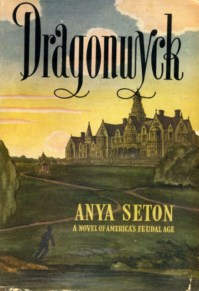
Dragonwyck by Anya Seton

Dragonwyck - Anya Seton Sorry for neglecting my blog recently…I’ve had a busy two weeks at work and haven’t had much time or enthusiasm for blogging. Luckily I have a week off now and will be able to catch up on telling you about all the books I’ve been reading, beginning with this one, Dragonwyck, which I read for the R.I.P challenge.

I had been looking forward to reading this book for a long time, having been a fan of Anya Seton’s for years and also being a lover of both historical fiction and gothic novels. Dragonwyck is a combination of both – it includes some typical gothic elements (mysterious deaths, a mansion with haunted rooms and an old servant who tells tales of ghosts and curses) but it also has a fascinating and thoroughly researched historical background.

One day in 1844 Abigail Wells, wife of a Connecticut farmer, receives a letter from her rich cousin, Nicholas Van Ryn, offering to take one of her daughters into his home as a governess for his own young daughter, Katrine. Eighteen-year-old Miranda is the one who is chosen and she is thrilled to be given this opportunity to improve her situation in life. Nicholas is the Patroon (landowner) of a large estate called Dragonwyck in Hudson, New York, and after growing up on her parents’ farm the naïve and romantic Miranda is immediately captivated by the handsome Nicholas, his luxurious home and his aristocratic lifestyle.

Soon she becomes aware that she is falling in love with Nicholas and is sure he feels the same way – the only problem is, Nicholas is married. When tragedy strikes at Dragonwyck, Miranda’s life is transformed again, but this time she begins to uncover some of the house’s dark secrets and to learn the truth about her mysterious cousin Nicholas. As Anya Seton explains in her author’s note introducing the story: “All Gothic magnificence and eerie manifestations were not at that time inevitably confined to English castles or Southern plantations…”

As a gothic novel I didn’t find Dragonwyck particularly creepy – although it’s certainly a very dark book, with an oppressive, unsettling atmosphere. But the real attraction of this book for me was its wonderful historical setting that gave me some fascinating insights into areas of American history I hadn’t read about before. We learn about the Patroon system, for example, which began when landholders in the Dutch colony of New Netherland were given power over large areas of land, similar to the feudal system in medieval Europe. This led to an uprising of the tenants known as the Anti-Rent War and this forms a large part of Dragonwyck’s historical backdrop. We also learn about the Astor Place Riot during William Charles Macready’s performance in Macbeth and about the steamboat captains who would race each other on the Hudson River with total disregard for the safety of their passengers, sometimes with fatal consequences.

There are also a few brief appearances by real historical figures, most notably Edgar Allan Poe, but these felt as if they had been woven naturally into the story rather than name-dropping for the sake of it (in fact, the Poe episode does have a significance to the plot which only gradually becomes apparent later in the story). The main focus though, is on the three main fictional characters – Miranda, Nicholas and the doctor, Jeff Turner – and you’ll notice I haven’t said much about any of those three, because to attempt to explain why I liked or disliked each character would risk giving away too much of the story.

I did enjoy Dragonwyck but not as much as some of Anya Seton’s other novels (and I don’t think it really comes close to the brilliance of Jane Eyre or Rebecca, two books that it has been compared with). I do love reading ‘older’ historical fiction novels like this one though, as they seem to somehow have a completely different feel from modern ones. This book was published in 1944 and there’s a film too from 1946 with Gene Tierney and Vincent Price. I haven’t seen it, so I’d be interested to know what it’s like and how faithful it is to the book.

As well as this book, I have now read Katherine (one of my favourite historical fiction novels), Green Darkness, The Winthrop Woman, Avalon and Devil Water. If there are any of her others that you think I should look out for, please let me know which ones!

Thoughts on finishing War and Peace

War and Peace

To study the laws of history, we must change completely the object of observation, leave kings, ministers, and generals alone, and study the uniform, infinitesimal elements that govern the masses.

I wasn’t expecting to start writing this post until the end of December! At the beginning of the year I signed up for a year-long readalong of War and Peace hosted by Iris and Amy, attracted by their reading schedule which looked very realistic and manageable. I did stick with the schedule for the first few months and was enjoying being part of the group read (thank you, Amy and Iris!) but somewhere in the middle of the book I discovered that the pace wasn’t really working for me anymore. I found that I was finishing the month’s reading then forgetting about the book for a few weeks, which made it difficult to get back into the story again when I eventually picked it up to read the next month’s section. Once I abandoned the schedule and found a pace I was happy with, I flew through the rest of the book and really enjoyed it.

I didn’t think War and Peace was a particularly difficult book to read (I’m actually finding writing about it much more difficult!) and while it was certainly long, I have read other books of similar length. And yet it’s still a book that has always sounded very intimidating to me, so I felt a real sense of achievement when I reached the final page – especially after persevering through that Second Epilogue (if you’ve read it I’m sure you’ll know what I mean). If you’re wondering what War and Peace is actually about, I’m afraid I’m not going to tell you much about the plot because I don’t even know where to begin! It’s about war, of course – specifically the French invasion of Russia during the Napoleonic Wars – and the way it affects the members of several families of Russian aristocrats, not just in the army but also at home, in their domestic lives and in their interactions with each other.

I loved the ‘peace’ parts of War and Peace and getting to know Natasha, Marya and Sonya, Pierre, Nikolai and Andrei. The ‘war’ sections, however, were much more challenging for me as I often tend to struggle with battle scenes and find discussions of military tactics difficult to follow. This wasn’t helped by the fact that I had absolutely no previous knowledge of the Russian involvement in the Napoleonic Wars and to make things worse, from my point of view, there are lots of long philosophical passages in which Tolstoy spends a lot of time musing on war and its causes; for me to feel involved in what’s happening, I need to be actually ‘on the battlefield’ seeing things through the eyes of our protagonists, otherwise I just feel like a passive observer. Still, some of the book’s most moving and powerful moments occur during the war chapters. I included the following quote in one of my monthly readalong posts, but I’m copying it again here as I thought it really captured the shift from Nikolai’s view of war as something abstract and romantic to something real and harsh:

“Who are they? Why are they running? Can it be they’re running to me? Can it be? And why? To kill me? Me, whom everybody loves so?” He remembered his mother’s love for him, his family’s, his friends’, and the enemy’s intention to kill him seemed impossible.

Now, a note on the format and translation that I read. After reading mixed opinions on the various translations of War and Peace, I decided on the Kindle version of the Vintage Classics edition translated by Pevear and Volokhonsky (I wanted to avoid the Maude translation as I didn’t get on with their translation of Anna Karenina at all – though I know other readers recommend that one, so it’s just a matter of personal taste, I suppose). This P&V translation was very readable and I didn’t have any big problems with it, apart from, as I mentioned in another of my readalong update posts, not liking the way they chose to present the speech impediment of one character, Denisov. It distracted me so much I found it impossible to concentrate on what Denisov was actually saying! Also, I should point out that there’s a lot of French in War and Peace and in this edition, it is left untranslated in the dialogue with translations given at the end of each chapter. This was good as it gave an accurate understanding of how widely French was spoken by the Russian aristocracy and how its use gradually decreased as the war with France progressed, but it did mean a lot of turning back and forth was needed – and this was much more inconvenient with the Kindle than it would have been with a physical book.

Finally, some advice based on my experience with War and Peace: Reading with a friend or with other bloggers can be helpful and is a good way to stay motivated, but it’s important to find a pace you feel comfortable with. Read regularly and don’t leave the book unread for too long. If, like me, you know nothing about this period of Russian history, you might want to think about doing some background reading first to help put things into context – I didn’t and wished I had! And keep a list of the characters beside you as you read…as you would expect from a book of this length, there are a huge number of characters and it can be hard to remember who they all are. Be aware though that searching for character lists online can lead you to see spoilers you might prefer not to know about!

If you’ve read War and Peace too I would love to know what you thought of it – and if you have any more tips for future War and Peace readers please share them with us!

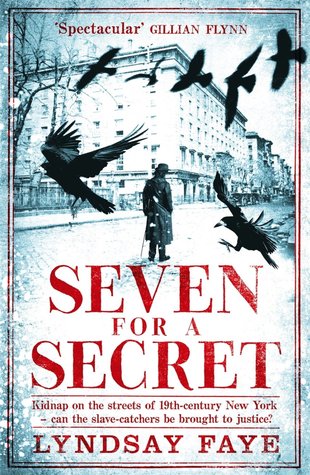
Seven for a Secret by Lyndsay Faye

Seven for a Secret One of the most surprising books I read last year was The Gods of Gotham by Lyndsay Faye. Surprising because it didn’t really sound like my type of book, yet once I started reading I loved it from the first page. Seven for a Secret is the second in the series and just as good as the first. While I like discovering new authors and meeting new characters, there is something comforting about reading a book that is the second or subsequent in a series and returning to a world you’re familiar with and characters you already know.

This series is set in 19th century New York City and follows the adventures of Timothy Wilde, a ‘copper star’ with the newly formed New York Police Department (the name comes from the copper stars the officers are required to wear for identification). After Timothy’s crime-solving skills in The Gods of Gotham brought him to the attention of Chief George Washington Matsell, he has now been given a special position as one of the department’s first detectives. In Seven for a Secret, Timothy is on the trail of a gang of ‘blackbirders’ (people employed to catch runaway slaves and return them to slavery in the South). The gang have captured the family of Lucy Adams, who insists that they are free New Yorkers and not slaves. Timothy promises to help and with the assistance of his brother Valentine sets out to investigate the crime.

Some of the characters we met in the previous novel are back again in this one including Julius Carpenter, Gentle Jim, Bird Daly and Silkie Marsh, but there are plenty of new characters too, from six-year-old chimney sweeps to corrupt Democratic Party members. But one of my favourite things about this series is the relationship between the two Wilde brothers, Timothy and Valentine. Tim continues to be torn between admiration for Val and disgust with his less savoury habits; Val continues to be the exasperated but protective older brother. I love them both, but I have to say I think Val is a wonderful creation and the more interesting character of the two.

The thing that really sets this series apart from other historical mystery novels I’ve read is the setting and the plots that arise from that setting. Before discovering these books I had virtually no knowledge at all of the early days of policing in New York or the work of the ‘copper stars’. And although I have read quite a lot of novels that deal with the subject of slavery, I hadn’t read anything that looked at this particular aspect of slavery. But much as I love Timothy Wilde and think he’s a great narrator, I did sometimes feel that his attitudes towards slavery and other issues raised in this book seemed more like the reactions of someone living in 2013 rather than the 1840s. Other than that, the atmosphere of 19th century New York is completely believable; as in the first novel, the feeling of authenticity is enhanced by the inclusion of ‘flash’, a sort of slang used mainly by criminals but also spoken by both Wildes. There’s a useful flash dictionary at the front of the book to help translate any unfamiliar words, but in most cases it’s easy enough to work out what is being said.

If you’re new to this series you could certainly enjoy Seven for a Secret without having read The Gods of Gotham first, but I would still recommend reading them in the correct order if you can. And really, they are both so good I’m sure whichever one you read first you will want to read the other anyway. I really hope there are going to be more books in this series as I can’t wait to see what the future has in store for Tim and Val!

A Hero of Our Time by Mikhail Lermontov

A Hero of Our Time - Lermontov

Again, you’ll tell me, no man can be as bad as that; and I’ll ask you why, if you have believed in the possibility of the existence of all the villains of tragedy and romance, you should not believe in the reality of Pechorin? If you have admired inventions far more terrible and monstrous, why does this character, even as an invention, not deserve your mercy? Could it be because there is more truth in him than you would like?

A Hero of Our Time is described as one of the first great Russian novels, though I have to confess that until recently I had never even heard of it or Mikhail Lermontov. Having read the biographical information about the author included in this book, it seems Lermontov’s life was almost as unusual and interesting as his fiction! A Hero of Our Time was published in 1840, just before he was killed in a duel at the age of twenty six.

This is not a novel with a chronological structure or a conventional plot with a beginning and an end. Instead it consists of five separate stories, some very short and some much longer. Together they create a portrait of Grigory Pechorin, a young army officer – though as the author tells us in the preface, it’s also “a portrait built up from the vices of our whole generation, in all the fullness of their development”.

Far from being the hero suggested by the title, Pechorin is actually much more of an anti-hero, selfish, cruel, manipulative and motivated by boredom and disillusionment. He is not a likeable character at all and isn’t supposed to be, but as the novel unfolds and we are given his own version of events as well as seeing him from the perspective of others, we come to understand him better. By the end of the book I found I didn’t hate Pechorin as much as I thought I would at first and for all his faults and flaws I thought he was a fascinating character.

In the first story, an unnamed narrator is travelling through the Caucasus where he is joined by an army captain, Maxim Maximich. As they travel together, the captain tells the narrator about his friendship with Pechorin. In the second story the narrator briefly meets Pechorin and the final three stories are entries from Pechorin’s own journal. With each of these five chapters we learn a little bit more about Pechorin’s life and follow him through a series of adventures, romances and even a thrilling duel. Despite the disjointed and episodic feel of the book it’s fast-paced and never boring. I was also pleased to find that although the main characters are soldiers, the story concentrates on their personal lives and there are no long battle scenes or detailed descriptions of military tactics to struggle with – though there are some great descriptions of the landscape of the Caucasus, where the novel is set.

I really enjoyed A Hero of Our Time. Of all the Russian novels I’ve read, I found this one by far the easiest to read, despite it being written in the early 19th century. This Oxford World’s Classics edition is translated by Nicolas Pasternak Slater (the nephew of Boris Pasternak who wrote Dr Zhivago) and I think it’s an excellent translation; it flows so effortlessly it hardly feels like a translation at all. It’s a very short novel too (the actual story is less than 140 pages long – the rest of the book is made up of the introduction, notes, maps and other additional material) so could be a good choice if you want to read some Russian literature but feel intimidated by Tolstoy or Dostoyevsky.

This edition also includes a piece of writing by Alexander Pushkin entitled A Journey to Arzrum in which Pushkin describes his own travels through the Caucasus. It’s really more of a travelogue or journal than a story but it works as an interesting companion to Lermontov’s novel.

Have you read this book? Which other Russian classics would you recommend?

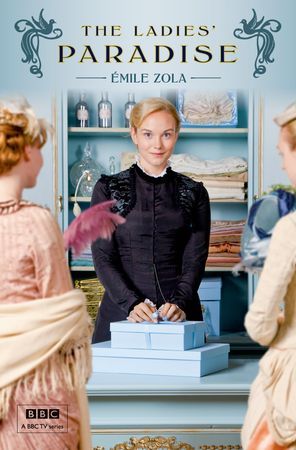
The Ladies’ Paradise by Émile Zola

The Ladies' Paradise The Ladies’ Paradise is only the second book I’ve read by Zola; my first was Thérèse Raquin and the two are very, very different. Au Bonheur des Dames, to give it its French title, was published in 1883 and is the story of a Paris department store, based on the real-life Le Bon Marché.

At the beginning of the novel, Denise Baudu arrives in Paris with her two younger brothers, hoping to find work in her uncle’s draper’s shop. She is disappointed to discover that he is unable to offer her a job because his shop, along with the other small shops in the street, is losing business to a new department store, the Ladies’ Paradise. The new store is able to offer a larger selection of products at cheaper prices all under one roof, and none of the smaller traders can hope to compete. Still, Denise desperately needs to earn money to support her brothers so although she understands how her uncle feels, she is pleased when she is offered a job at the Paradise.

Denise quickly finds that life as a salesgirl at the Paradise is not easy but she’s determined to succeed and overcome whatever obstacles are put in her way. And when she catches the eye of the owner of the Paradise, Octave Mouret, he soon discovers that she is a woman with morals and principles; it’s obvious that she is not going to give him any encouragement – but this only makes him want her more.

I was hoping to love this book as much as Thérèse Raquin but that didn’t happen. The Ladies’ Paradise is a book that I enjoyed, but not one that I loved. It offers some fascinating insights into both Parisian life and the rise of the department store in the late 19th century – and of course, the idea of a larger, cheaper store putting all the small, independent shops out of business is still very relevant today – but I disliked most of the characters and while the long descriptions of the silks, satins and other fabrics sold at the Paradise were beautifully detailed I did get a bit bored after a while. Maybe I just don’t like shopping enough!

However, I did find it fascinating to read about the way the Paradise was run and what it was like to work there. In some ways working at the Paradise was a very different experience from working in retail today, one of the biggest differences being that the salesgirls employed by the Paradise lived and ate on the premises and were treated almost like servants. But from a selling and marketing perspective, I was surprised to learn how modern and sophisticated Mouret’s methods were; a lot of the ideas he had for running the store, advertising its products and attracting customers are still used today (though I didn’t really like the implication that women are so easy to trick and tempt into parting with their money).

The only character I really liked was Denise. I had sympathy with all the ordeals she faced after starting her new job: having trouble fitting in with the other women, feeling that her clothes and hair weren’t right, being bullied by other employees, and worrying about making enough money to take care of her two younger brothers. I found it harder to like or care about any of the other characters (Denise’s brother, Jean, particularly annoyed me – surely he was old enough to take more responsibility for himself and his actions), though I did admire what Mouret had achieved in making the Paradise such a success.

I don’t want to sound too negative about this book because I still found a lot of things to enjoy about it, but I’m hoping the next Zola novel I read will be more to my taste than this one. Any suggestions are welcome!

The Poisoned Island by Lloyd Shepherd

The Poisoned Island In June 1812 the Solander returns to London from a voyage to Tahiti financed by Sir Joseph Banks of the Royal Society. The ship is carrying a cargo of rare and exotic plants destined for the Kew Gardens. But why is Banks so interested in one particular specimen? Could there have been another motive behind the voyage?

When one of the Solander’s crew is found dead under suspicious circumstances, the magistrate John Harriott and Constable Charles Horton of the Thames River Police begin to investigate. Soon more murders take place – and when he learns that all of the victims were members of the crew, Horton must find out how the deaths could be connected with the recent trip to Tahiti.

I’ve been looking forward to this since I read Lloyd Shepherd’s first novel, The English Monster, last year. When you loved an author’s debut novel there’s always the worry that their next book might be a disappointment, but that was definitely not a problem here because I thought The Poisoned Island was even better than The English Monster! Both novels are complete stories in themselves and it’s not necessary to read them in order, but they do have a few things in common. They each explore the darker side of the British Empire, trade and colonialism (it seemed clear to me that one of the messages of The Poisoned Island is a warning against the dangers of exploiting a country for its resources), they both involve the Royal Society, and there are also some recurring characters, including Harriott and Horton of the River Police.

It’s interesting to see how Horton uses methods of crime-solving that in 1812 are new and innovative. Instead of merely watching and observing or relying on witness statements, he is actively investigating the crimes, looking for clues, searching for evidence, interviewing suspects and trying to find motives. This arouses the suspicion and dislike of London’s other police constables and magistrates but Harriott has faith in him and can see the value of his detection methods. Horton’s wife, Abigail, makes a few brief appearances in the novel too and I thought she had the potential to be a great character. The fact that Abigail was so underused was the only thing that disappointed me about this book; she’s intelligent, courageous and with her interest in natural science I had expected her to play a bigger part in the story.

Interspersed with the main storyline are some chapters set in Tahiti (or Otaheite as it was known at the time) following the adventures of a young Tahitian prince and showing us what happened to the island when Europeans first arrived bringing guns, alcohol and disease with them. But while The English Monster was a dual time period novel with alternating chapters set in different centuries, The Poisoned Island concentrates on Horton and Harriott’s London with only a few flashbacks to an earlier time. Although the murder mystery forms the central plot, there’s also a lot of historical detail that helps to bring the Regency period to life. And I enjoyed learning about the Kew Gardens, the process of collecting and studying botanical specimens, and the work of Joseph Banks’ librarian, the botanist Robert Brown. I’m hoping there will be more Harriott and Horton novels, but if not I will still look forward to whatever Lloyd Shepherd writes next.

I received a review copy of The Poisoned Island from the publisher

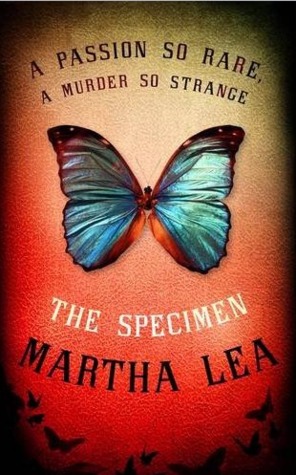
The Specimen by Martha Lea

The Specimen The Specimen sounded like the type of book I usually love. A Victorian setting, a murder mystery, exotic locations, interesting and unusual female protagonists – these are all things I love in a novel, so I had high hopes for this one.

The story begins in 1866 with Gwen Carrick on trial for the murder of the naturalist Edward Scales who has been found dead at his home in London. The narrative then takes us back in time to show us how Gwen first meets Scales and the events that lead up to his death and the murder trial.

Seven years earlier, in 1859, Gwen is living with her sister Euphemia in their remote home in Cornwall. Both women are unmarried and are leading unconventional lives for the time period – Gwen is an artist who is fascinated by natural sciences and loves to draw butterflies, beetles and other insects, while Euphemia is a spiritualist with a talent for mimicking voices. The sisters have little in common and their relationship is a difficult one. When Gwen meets and falls in love with Edward Scales she leaves her sister behind and accompanies him to Brazil to study and illustrate specimens of the flora and fauna there, but on their arrival in South America she starts to discover that Scales is not quite the person she thought he was. Why did Scales really invite Gwen on the trip to Brazil? What is he hiding from her? And is Gwen guilty of his murder?

Sadly, despite sounding so promising, this book didn’t live up to my expectations. I struggled to engage with the characters (Edward Scales is particularly unlikeable) and the Brazilian setting never really came to life. But my biggest problem was that I found the plot so difficult to follow and even after reaching the final page I wasn’t sure I’d understood what had happened. I do like books that encourage the reader to think, but this one was just too confusing for me. This is probably a book that would benefit from a re-read as it’s the type of story that has lots of clues buried in each chapter, which don’t necessarily have a lot of meaning until you get to the end and can see the whole picture. I didn’t like the book enough to want to read it more than once but I do think that might be the only way I would be able to fully appreciate it!

I do like to read about women who were involved in the sciences during the Victorian period and it was interesting to read about Gwen’s interest in studying and drawing insects. Gwen does not always behave the way a Victorian woman is expected to behave; she values her independence and is struggling to find a place for herself and her work in a nineteenth century society dominated by men. Euphemia was an interesting character too, though again, I found her storyline confusing (and often bizarre) and I don’t think I completely understood what was going on with her.

The Specimen is full of fascinating ideas and themes, so I’m sorry I can’t be more positive about it. I think as long as you’re aware that you need some patience and concentration and don’t go into this book expecting the gripping melodrama promised by the blurb, you might enjoy it more than I did.

I received a review copy of this book from the publisher via Netgalley