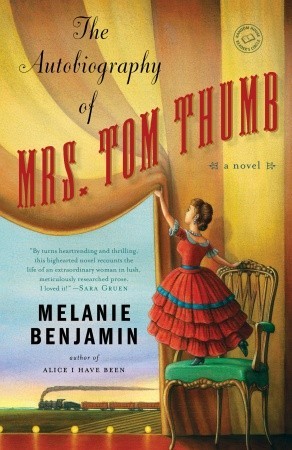
 Despite the title, this is not a real autobiography, but a fictional account of the life of Mercy Lavinia Warren Bump. Measuring only two feet eight inches tall, Vinnie is described as ‘a perfect woman in miniature’. Not content to spend her life living on her family’s farm in Middleborough, Massachusetts, she works briefly as a schoolteacher before leaving home to perform with Colonel Wood’s riverboat show. Wood, who claims to be a cousin, promises to make Vinnie famous as an entertainer but it soon becomes obvious that he has other plans for her and she returns home disillusioned.
Determined not to give up on her dreams, Vinnie contacts the great showman P.T. Barnum and soon becomes a celebrity, travelling the world and meeting presidents and royalty. Her wedding in 1863 to another small person, Charles Stratton, known as General Tom Thumb, captures the imagination of both the press and the public. But when her younger sister Minnie, who is even smaller than herself, is also drawn into the world of show business, Vinnie fears it could all end in tragedy.
I enjoyed Melanie Benjamin’s previous novel, Alice I Have Been, which told the story of the girl who inspired Lewis Carroll’s Alice’s Adventures in Wonderland, so I’ve been looking forward to reading more of her work. And I enjoyed this book too. There were plenty of things to admire about Vinnie – she had lots of courage, lots of confidence and dignity, and lots of ambition. Instead of staying in the safety of her home which would certainly have been the easiest thing to do, she wanted to get out and see the world, to have new experiences and to build a successful career for herself. I’ve never really stopped to think about how difficult – and even dangerous – everyday life can be for a person smaller than average in a world built for much taller people. Such simple things as opening a door, getting into bed, climbing up stairs and even walking through a crowded room were a challenge for Vinnie and I was impressed with how well she dealt with the situations she found herself in.
However, as the story continued I began to dislike Vinnie more and more. She was obsessed with fame and fortune, she had a very superior attitude and appeared to consider almost everyone else, including her husband and sister, to be less intelligent than herself. I found her relationship with Charles particularly sad to read about as it had the feel of a professional business arrangement rather than a happy marriage and Vinnie seemed to have very little affection or respect for him. Luckily, though, my dislike of Vinnie didn’t stop me from loving the book; it was still one of the most fascinating and original historical fiction novels I’ve read for a long time.
While Vinnie’s personal story is the main focus of this book, there are also lots of interesting facts of American history scattered throughout the novel. Vinnie lived through an eventful period that included the Civil War and the abolition of slavery, as well as the arrival of some exciting new inventions such as the electric light and the telephone. Information on all of these things and many others are provided in the form of short news articles during the ‘Intermissions’ between chapters. Some of these facts are relevant to the chapter that follows, while others are seemingly unrelated pieces of trivia – these don’t do anything to move the story forward, but they all give fascinating insights into the period.
I knew nothing about Lavinia Warren before reading this book so I can’t comment on the historical accuracy of the story, but it did appear to be very well researched. The real Vinnie never actually wrote an autobiography, but she left behind some travelogue-style journals and essays which Melanie Benjamin read as part of her research for the novel. She also includes some interesting photographs in the book, though I was disappointed that there weren’t more pictures illustrating some of the characters who appeared in the story. I was able to find some for myself online and seeing photos of Vinnie, Charles, P.T. Barnum and the others really helped bring the story to life!