Review: The Woman in White by Wilkie Collins

There, in the middle of the broad bright high-road – there, as if it had that moment sprung out of the earth or dropped from the heaven – stood the figure of a solitary Woman, dressed from head to foot in white garments, her face bent in grave inquiry on mine, her hand pointing to the dark cloud over London, as I faced her.

I first read The Woman in White in 2006 – it was the first Wilkie Collins book I ever read and the one that turned me into a huge fan of his work. I just wish I had discovered him sooner!

The Woman in White was the most popular book of the 1860s; when it was originally serialised in Charles Dickens’ periodical All The Year Round large crowds gathered outside the newspaper offices every time the latest edition went on sale; you could buy Woman in White perfume, bonnets and shawls and dance the Woman in White waltz…and all of this was 150 years before Harry Potter!

So what is it about? I won’t go into the plot in too much detail, as I don’t want to spoil the fun for those of you who haven’t read it yet. The story begins with drawing master Walter Hartright’s meeting on a lonely London road with a mysterious woman dressed all in white who has escaped from an Asylum. The next day Walter takes up a teaching position at Limmeridge House in Cumberland where he finds that one of his students, Laura Fairlie, bears a striking resemblance to the woman in white…

The novel follows an epistolary style, meaning it is narrated by several different characters in turn, sometimes in the form of journal entries or letters. I love the way Collins gives each of his narrators a unique ‘voice’ – he really makes the characters come alive. Another thing I love about Wilkie Collins’ writing is his sense of humour…some of the scenes involving Laura’s hypochondriac uncle Mr Fairlie are hilarious!

Marian Halcombe, Laura Fairlie’s sister, is one of my favourite female characters in literature. Contrary to the usual portrayal of 19th century women, she is a brave, intelligent, courageous person who on several occasions puts herself in danger in order to protect her sister Laura. Another great character is Count Fosco. One of the most unusual and memorable villains I’ve ever encountered in any book, he’s an old, fat, opera-loving Italian completely devoted to his pet canaries and white mice. I remember being surprised when I first read the description of Fosco, as he wasn’t what I had been expecting at all!

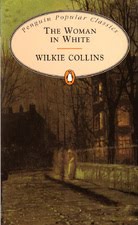
The Woman in White is an example of the genre known as sensation fiction – including elements such as forgery, identity theft and insanity. Although it was written in the 19th century it’s as exciting and gripping as a modern day thriller – even when reading the book for the second time and knowing what was going to happen! It’s a long book (569 pages in my Penguin Popular Classics version) but there’s enough tension and suspense to keep the reader interested right through to the end.

There are some classics that are a struggle to read but you persevere with them simply because they’re classics and you feel as if you should. The Woman in White does not fall into that category – yes, it’s a classic but it’s also one of the most readable and enjoyable books I’ve ever read.

If you liked this book I would recommend you read The Moonstone, Armadale or No Name next. As I mentioned at the start of this review, I am a big fan of Wilkie Collins so you can expect to see more of my reviews of his work coming soon!

Highly Recommended

Genre: Classics – Sensation Fiction/Pages: 576 pages/Publisher: Penguin Popular Classics/Year: Originally published 1859/Source: Purchased new from Amazon.co.uk

This review is part of my Great Books series.

Review: Les Miserables by Victor Hugo


“…there comes a point moreover, where the unfortunate and the infamous are grouped together, merged in a single, fateful word. They are les miserables – the outcasts, the underdogs. And who is to blame? Is it not the most fallen who have most need of charity?”

How do you begin to review a book like this one? Les Miserables is one of the longest books I’ve ever read (and I’ve read a lot of long books) and as someone with very little knowledge of French history, it was also one of the most challenging. Of course, I could have bought an abridged version but I make a point of never doing this as I prefer to read a book the way the author intended.

If you’re unfamilar with the plot, here is a brief summary:

Jean Valjean has just been released from prison after nineteen years (he had been sentenced to five years for stealing a loaf of bread to feed his starving family, and then a further fourteen years for making several attempts to escape). As an ex-convict arriving in the town of Digne, Valjean finds himself rejected by everybody he approaches until the kindly Bishop Myriel takes him in and gives him shelter for the night. However, Valjean repays him by stealing his silverware. When the police catch him and take him back to the bishop’s home, the bishop tells them they’ve made a mistake – he had given the silverware to Valjean as a gift. He then tells Valjean to “never forget that you have promised me to use this silver to become an honest man”. The bishop’s simple gesture of kindness has a profound effect on Valjean, filling him with the determination to be a better person.

After establishing himself as a successful factory owner and becoming mayor of Montreuil-sur-Mer, Valjean promises a dying woman that he will take care of her daughter, Cosette. The rest of the book follows Valjean’s attempts to escape the investigations of Inspector Javert and to build a new life for himself and Cosette. Along the way we meet a gang of criminals, a group of revolutionary students, and a greedy innkeeper called Thenardier.

Most of the characters are very well developed and Hugo spends a considerable amount of time introducing us to them. In fact, he spends the first 50 pages of the book describing the personality of the Bishop of Digne. This is not vital to the plot and could quite easily have been shortened to just a few pages, yet it helps the reader understand why Jean Valjean was so touched by the bishop’s kindness and compassion and why it was a life changing experience for him. However, I didn’t find the characters of Marius and Cosette very interesting, despite their central roles in the book – I thought some of the secondary characters were much stronger, such as the street urchin Gavroche and the Thenardiers’ eldest daughter Eponine.

I did find my attention wandering in places because of all the lengthy digressions on the Battle of Waterloo, life in a convent, the July Revolution of 1830, the Paris sewer system etc (thankfully my edition took a couple of these out and placed at the end in an appendix). Although these pages are often interesting and informative and contain some beautiful writing, they have very little direct relevance to the plot and interrupt the flow of the story. However, this is really the only negative thing I can say about the book. It’s worth persevering through all the social commentary, politics and history to get to the actual story itself – and the wonderful, moving, thought-provoking, suspenseful story is why I loved Les Miserables.

Highly Recommended

Genre: Classic/Pages: 1232/Publisher: Penguin Classics – translated by Norman Denny/Year: 1862/Source: My own copy bought new

18th and 19th Century Women Writers Reading Challenge

I signed up for this challenge today. Here are the rules:

18th and 19th Women Writers Reading Challenge
Hosted by Becky of Becky’s Book Reviews
Minimum 2 books;
All of 2010

Read books written by women authors that were written and/or published between 1700 and 1900. Contemporary historical books set in this time period do not count towards this challenge! The challenge is to encourage you to read some classics.

Books read for this challenge (updated 8 April 2010 – I have now read enough books to satisfy the minimum requirements of the challenge)

1. The Tenant of Wildfell Hall by Anne Bronte
2. The Doctor’s Wife by Mary Elizabeth Braddon