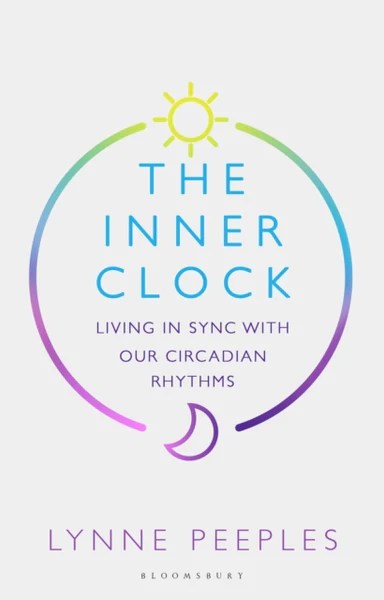
 I’m someone who often has trouble sleeping so when I came across Lynne Peeples’ book, The Inner Clock: Living in Sync with Our Circadian Rhythms, I decided to read it in the hope of getting some tips and advice. It turned out to be more of a science book than a self-help book, but I found it absolutely fascinating.
Lynne Peeples is a writer and journalist based in Seattle and goes to impressive lengths in order to carry out her research for this book. In the first chapter, she describes how she spent ten days in an underground bunker in Arkansas with no access to clocks or any natural light at all as part of an experiment to see if she could guess the time of day based only on her own body’s circadian rhythms. The circadian clock is the part of the brain that controls our sleep-wake cycle, hunger, metabolism, hormone production and other important functions; we also have other local clocks in almost every organ and tissue of the body and sometimes these clocks can get out of sync with each other which causes all sorts of problems. Peeples’ experiment helps her to understand the natural patterns of her own clocks and how they can be affected by light, food and drink, activity and other factors. This forms the basis of the rest of the book.
Peeples gives most attention to the effects of light, both natural and artificial – not just the amount of light we’re exposed to, but the type and quality of the light. The ‘bad’ kind of light, as we all know, is the blue light from phones and laptops, which is one of the reasons we’re told to limit their use before bedtime. However, we can counteract the effects of screens and artificial lights later in the day by making sure we get plenty of natural light throughout the day. Working in an office with windows is good for your circadian clock, but Peeples suggests that your distance from the window and even the angle of your desk can also make a big difference. Of course, sometimes a lack of daylight or exposure to too much artificial light is out of our control and there’s an interesting section where she discusses the inequalities experienced by people living in urban areas compared to rural ones.
If you’re looking for lots of practical advice on managing your circadian rhythms and improving your sleep, I think there are probably better books you could choose than this one. She does give some tips, based on things she herself discovered throughout her research, such as going for a walk in the morning rather than the evening, narrowing the window of time between your first meal of the day and your last, and waiting 90 minutes after waking before drinking tea or coffee. Most of the book, though, is spent exploring the science behind these things. I got bored at times, such as when she goes into a long discussion of photoreceptors in the eyes, but mostly it’s all very readable and often quite gripping. I was particularly fascinated to learn that fruit and vegetables have their own circadian clocks, even after being harvested, and storing them under bright lights can disturb their rhythms, affecting their nutritional value.
The main conclusion Peeples comes to is that not everyone’s circadian rhythm is the same and people’s internal clocks can run slightly differently (some of us are night owls and some are morning larks). We need to find routines and schedules that work for us, but unfortunately the way society is structured can make that difficult, particularly if you’re someone who struggles to wake up early in the morning. Peeples also looks at disruptions to these routines, such as jet lag, and considers evidence of sports teams performing better or worse depending on the direction in which they’ve had to travel through time zones.
The Inner Clock is a long book and contains a lot of information, but I’m sure most readers will find at least some of it useful and interesting, regardless of whether or not you have any problems with your sleep.


I definitely used to have sleeping issues – especially on Sundays! Periodically I’d also get 2-3 days of partial insomnia until I was tired/exhausted enough to overwhelm it. I think a big part of that (as opposed to ‘simple’ work related stress) was that I was existing in opposition to my natural circadian rythms.
I’ve LONG known that I’m a natural night-owl. I’m fully awake at 10pm and only really start to get tired around 11pm or later. When at work, because I had to get up reasonably early, I had to go to bed still barely tired and then get up before I was fully awake. A 9-5 job isn’t really built to accommodate people like me! When I retired my bedtime crept later and later – as did my ‘get out of bed’ time. So, in the last 6+ years I’ve almost had no sleep issues as well as not being tired *all* the time! Its one of the biggest benefits of retirement I can think of (plus not having had a cold since the Spring of 2020).
A 9-5 work life coupled with the 24 hour attention economy certainly doesn’t encourage good sleep habits – which are much more personal than most people think. Fortunately with things like flexible working and increasing knowledge of what prolonged sleep deprivation can do to people we can each (as much as possible) tailor our lives so that they mesh more easily with our *natural* rhythms. This can only be a good thing!
Lynne Peeples talks a lot in her book about the problems night owls face with so much of society being structured around needing to be up early in the morning. A 9-5 schedule definitely isn’t suitable for everyone and she interviews people who have managed to find jobs that fit their own sleeping patterns, but obviously that’s not really an option for most of us.
I’m glad things have improved for you since your retirement!
fruit and vegetables have their own circadian rhythm!
Yes, I was really surprised to read that. Their clocks keep ticking even when they’re on the supermarket shelf!
poor little things
The most frequent advice I read is not to do anything unsleep-related in bed, like reading. I completely fail in that category!
I fail in that one too – although I find it harder to get to sleep if I haven’t read for at least a few minutes first.
I always appreciate a good, honest review: ” think there are probably better books you could choose than this one”
I always try to be honest in my reviews! I didn’t find much practical advice in this book, but as a science book it was fascinating.
What’s this about waiting 90 minutes after waking before drinking tea or coffee? Who is this lady with these strange ideas. Haha. No. I have trouble with sleep too but the kettle still goes on as soon as I arrive downstairs in the morning:)
I certainly don’t wait 90 minutes before putting the kettle on either and am not even tempted to try it to see if it works!
Haha. Nor me.
Books about circadian rhythms and such used to be all the rage at one time, didn’t they, along with circular slide rules that supposedly allowed you to calibrate and observe your different body clocks. I do spend/waste a lot of time on my phone and laptop but I also go outside for walks and switch off long before bedtime and – so far! – manage around seven hours of rarely disturbed sleep, so I can’t be getting things too wrong!
It sounds like you’re already doing everything right! I found this book fascinating but I have to admit I haven’t yet tried any of the advice she gives in it.
Im sorry this wasn’t what you hoped for but I’m glad you found it interesting overall. It does sound like it contains a lot of information that would be new to me too, although like you when it gets into the particularly scientific parts my mind would probably wander a little. I’d never have guessed that evening walks could affect sleep in a negative way. I’d have thought they’d help you wind down a bit if anything 🙈
Yes, I was surprised by that too. I’m sure walking in the evening still has benefits for our health, but apparently we need to get lots of natural light in the morning and not as much closer to bedtime. This was a fascinating book and I learned a lot from it.
This does sound interesting! One of my history colleagues works on the history of sleep and is just starting a big project on night shifts.
Yes, it’s a fascinating book. She has quite a lot to say about night shifts and the impact they can have on our health.