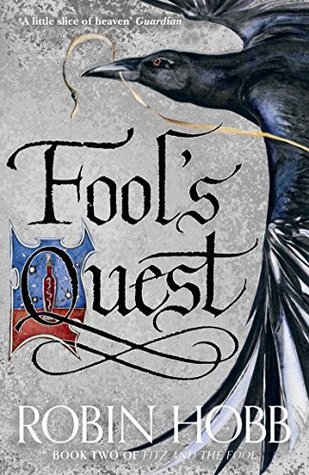
Fool’s Quest by Robin Hobb

Although I don’t read a lot of fantasy, I do love Robin Hobb’s books and would count her as one of my favourite authors. I’ve now read fifteen of her novels, all from the various trilogies and quartets that make up the larger sequence known as the Realm of the Elderlings. After this book, I’ll only have one more to read and then I’ll be finished.

Fool’s Quest is the second book in the final trilogy, Fitz and the Fool. If you’re new to Hobb, I think it’s quite obvious that you won’t want to start here – and I certainly wouldn’t recommend it! Begin with Assassin’s Apprentice instead and then continue from there. There may be spoilers in the rest of this post that you would prefer to avoid, so keep reading at your own risk!

Anyway, Fool’s Quest opens with FitzChivalry Farseer back at Buckkeep Castle, helping to heal the Fool, having unintentionally stabbed his old friend at the end of the previous book, Fool’s Assassin. Unknown to Fitz, in his absence a group of mysterious and menacing strangers have attacked his country estate of Withywoods and abducted his young daughter, Bee. It will be a while before Fitz receives this devastating news, but meanwhile another momentous event takes place in his life – something which I had been hoping would happen for a very long time!

The story moves forward at a very slow pace while we’re waiting for Fitz to discover what has happened to Bee – and even once he becomes aware, he still doesn’t set off in pursuit immediately but waits until he has gathered more information and made his preparations. This is a change from the more impetuous young Fitz we knew in the earlier books (and slightly frustrating for the reader) but at the same time, the slow pace didn’t bother me and I was never bored. While Fitz is at Buckkeep, Hobb continues to develop his relationships with long-standing characters such as Chade, Kettricken, Dutiful and Nettle, as well as introducing some new ones, including Chade’s latest apprentice assassin, Spark, and Motley the talking crow! We don’t hear as much from Bee herself as we did in the previous book – only a few chapters are written from her perspective, but what we do hear gives us an idea of the nature of her abductors and the plans they have for her.

Later in the novel, strong connections with the other trilogies and quartets in the sequence begin to emerge and I understood why other Hobb readers had recommended not skipping the Liveship Traders and Rain Wild Chronicles books. I was so glad that I’d read all of those books; not only do they add to an understanding of the world Hobb has created (particularly the role of dragons), but being reacquainted with characters like Malta and Reyn Khuprus or Rapskal the dragon keeper would have meant nothing to me. And as well as the appearances from the Liveship and Rain Wild characters, I was delighted to see Fitz reconnect with a long-departed character from the earlier Farseer novels.

By the end of the book, Fitz and the Fool are on their way to far-off Clerres in search of Bee and her captors and although I’m sure Robin Hobb could have brought us to this point in half the number of pages, I enjoyed every minute of this slowly-unfolding story. Once I’ve finished my 20 Books of Summer reading I’m looking forward to moving on to Assassin’s Fate and finding out what Hobb has in store next for Fitz and his friends.

This is book 12/20 from my 20 Books of Summer list.

The Flight Portfolio by Julie Orringer

After making such good progress with my 20 Books of Summer list in June and July, I seem to have slowed down a lot in August. Some of the books on my list have turned out to be a lot longer than I expected, including this one, which has almost 600 pages in the new UK paperback edition published today. I really enjoyed Julie Orringer’s 2011 novel The Invisible Bridge, about a Hungarian-Jewish student who leaves Budapest to study architecture in Paris during World War II, so I was looking forward to reading The Flight Portfolio – but I have to say, it really did feel like a 600 page book and I think it could easily have been a lot shorter!

The plot is quite a fascinating one, set in the same period as The Invisible Bridge, but this time based on the true story of a real historical figure: Varian Fry, an American journalist who helped thousands of Jewish refugees to escape from Occupied France. I knew nothing about Fry before starting this book, so it was interesting to read about the rescue network he created in Marseille – part of the Emergency Rescue Committee – where he and a group of other volunteers had an intricate system in place to provide people with fake documents and then to smuggle them across the border into Spain and from there to America.

However, the people Fry and the ERC rescue are not just anyone – they are what Fry describes as ‘the intellectual treasure of Europe’, famous artists, writers and philosophers, chosen based on their talent. This bothered me from the beginning – while I can understand the desire to save the life of someone who could potentially go on to provide pleasure and inspiration for millions of others, surely the lives of people without those particular talents have just as much value – so I was pleased that the characters do eventually begin to question and discuss the moral issues their work raises. It was also nice to come across Heinrich and Golo Mann as two of the refugees being rescued (Thomas Mann’s brother and son, who appeared in another of my recent reads, The Magician by Colm Tóibín). I love finding connections like that between books I’ve read and it was interesting to see Heinrich and Golo from the perspective of the person coordinating their escape, rather than just hearing about their adventures after they’d already reached safety, as we did in The Magician.

I felt that this book was much less exciting than it could have been, though. I never really got a true sense of the danger these people were in, which was disappointing as I’d expected a thrilling, suspenseful story. Maybe this is because the book concentrates mainly on the administrative side of the rescue scheme – obtaining visas, offering bribes, dealing with the US Consul and the Marseille police – or maybe there were just too many different writers, artists and intellectuals appearing in the story, making it difficult for me to become emotionally invested in any of them. A bigger problem for me was the amount of time Orringer devotes to a fictional romance between Fry and an old friend from Harvard, Elliot Grant. There seems to be some controversy over whether or not the real Varian Fry had homosexual relationships (we do know that he was married to Eileen Hughes, editor of Atlantic Monthly); however, although I don’t mind the author inventing a love story for Varian, it did seem that it became the main focus of the story for large sections of the book and the important work he was doing with the ERC was pushed into the background.

The Flight Portfolio wasn’t quite what I’d hoped it would be, but it was good to learn a little bit about Varian Fry and as I did love The Invisible Bridge, I would be happy to read more Julie Orringer books in the future.

Thanks to Little, Brown Group UK for providing a copy of this book for review via NetGalley.

This is book 11/20 from my 20 Books of Summer list.
This is book 41/50 read for the Historical Fiction Reading Challenge 2022.

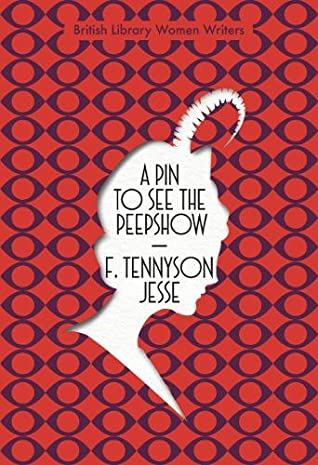
A Pin to See the Peepshow by F. Tennyson Jesse

I first came across a mention of the 1922 Thompson–Bywaters case when I read The Paying Guests by Sarah Waters several years ago and discovered that it was part of the inspiration for the novel. F. Tennyson Jesse’s A Pin to See the Peepshow was listed in the acknowledgments and I immediately wanted to read it. However, that was 2014 and it has taken me until 2022 to actually do it! The good thing about waiting this long is that the book has recently been reissued by the British Library as part of their Women Writers series and that’s the edition I read, complete with a very insightful new afterword by Simon Thomas of Stuck in a Book.

A Pin to See the Peepshow was first published in 1934 and begins just before the First World War. Julia Almond is sixteen years old and a typical schoolgirl, infatuated with one of her teachers, fiercely protective of her beloved dog, Bobby, and longing for some excitement to brighten up her humdrum existence. Starting work in a fashionable dress shop after leaving school gives her a glimpse of the sort of world she would like to inhabit, but it also makes her situation at home, where she is forced to share a bedroom with a much younger cousin, seem even more unbearable. Rushing into marriage with her parents’ friend, Herbert Starling, in the hope of finding the freedom she craves, Julia quickly discovers that she has made a terrible mistake. She doesn’t love Herbert and knows she never will, but divorce seems to be out of the question and she can see no other way of escape.

Several years into her marriage, Julia meets the much younger Leonard Carr and at last experiences the passion and romance she has always dreamed of. The two begin an affair and soon Leonard – or Leo, as Julia prefers to call him – is putting pressure on her to prove that she loves him and leave her husband. Julia knows that Herbert will never let her go and that she can’t afford to lose the security her marriage provides, but Leo won’t accept this and eventually decides to take matters into his own hands…

I loved this book, although I had expected the crime element to play a bigger part; the section of the novel based on the events of the Thompson-Bywaters case only takes up around 100 pages out of 464. The rest of the book is really a character study of Julia Almond and an exploration of the world in which she lives. Jesse spends a lot of time building this up, but I never felt that a word was wasted – every detail seemed necessary in order for us to understand the circumstances that led to the actions of the characters later in the book. Julia herself is not a particularly likeable character, but it would be difficult not to have at least some sympathy for her as her only ‘crime’ is to be constantly striving towards a happier life for herself and dreaming of things that are always just out of reach. This is illustrated by the metaphor of the toy peepshow she stares into as a schoolgirl and finds herself glimpsing a fantasy land:

The walls and lid of the box gave to it the sense of distance that a frame gives to a picture, sending it backwards into another space. Julia stared into the peepshow, and it was as though she gazed into the depths of a complete and self-contained world, where she would go clad in snow-shoes and furs, and be able to tame savage huskies and shoot bears; a world of chill pallor, of an illimitable white sky, both only saved from a cruel rigour by the rosy all-pervading light.

The events that unfold towards the end of the book are tragic for everyone involved, but are particularly unfair for Julia, who is judged by the standards of the time. Her position in society places her at a disadvantage and as Jesse points out, if Julia had only belonged to either a higher class or a lower one, her situation could have been very different. This is a fascinating novel and now I’ll have to read E.M. Delafield’s Messalina of the Suburbs, which is based on the same case!

This is book 10/20 from my 20 Books of Summer list.

This is also book 30/50 from my second Classics Club list.

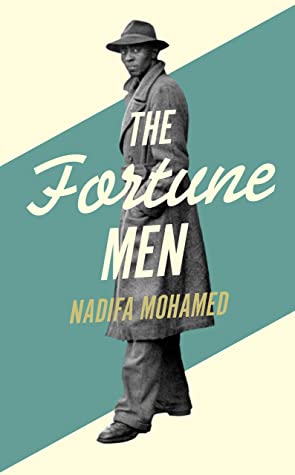
The Fortune Men by Nadifa Mohamed

The next book I’ve read from my 20 Books of Summer list is Nadifa Mohamed’s third novel, The Fortune Men. I enjoyed her previous book, The Orchard of Lost Souls, and was looking forward to this one, particularly as it has been so highly acclaimed, being shortlisted for the 2021 Booker Prize and Costa Novel Award and longlisted for the 2022 Walter Scott Prize for Historical Fiction. It’s based on a true story – the trial of a Somali man accused of murder in 1950s Wales. If you don’t already know all the details of the trial and its outcome, I would recommend not looking them up until you’ve finished the book. I’ve tried to avoid spoilers in this review!

I found the opening chapters of the novel slightly overwhelming, as we are introduced to a large number of characters of various nationalities and backgrounds, switching quickly from one viewpoint to another, but in hindsight I think this was probably intentional, designed to throw the reader straight into the bustling, multicultural heart of Cardiff’s Tiger Bay as it would have been in 1952. After a while, the focus tightens to concentrate on two main characters: the murder victim and the man accused of the murder. His name is Mahmood Mattan, a Somali sailor who has settled in the dockland area of Tiger Bay.

Things are not going well for Mahmood at the beginning of the novel – he has separated from his wife, Laura, a Welsh woman who lives nearby with their three sons, and he is staying in a boarding house with several other men, none of whom make him feel very welcome. He’s struggling to find work and is drifting into a life of petty crime and theft, with any money he does have being spent on gambling. However, when Violet Volacki is found dead on the floor of her shop, her throat slit and a large sum of money missing from the safe, Mahmood is blamed just because the victim’s sister and young niece – Diana and Grace – reported seeing a Somali man standing in the shop doorway just before the murder took place. Even when Diana and Grace say that Mahmood was not the man they saw, the police are adamant that they’ve caught the right man and that he will hang for what he’s done.

Although we know Mahmood is not a murderer, he is not a particularly easy character to like either. He’s a thief, a gambler and often his own worst enemy, as we see during his arrest and trial, when his attitude rubs everyone up the wrong way and makes things worse for himself. But he’s also a loving husband and father and despite feeling that she couldn’t go on living with him, Laura has not given up on their relationship and vows to help him in any way she can. In the middle of the book, we are given Mahmood’s backstory, with some insights into his childhood in British Somaliland (as it was known then), his days working as a ship’s stoker, and how he came to live in Wales and to marry Laura. While I think this information could have been worked into the story more gradually, it was good to learn more about Mahmood’s past and to discover what made him into the man he became.

We also get to know Violet Volacki and her widowed sister Diana – but I’m not sure how much of this part of the novel was based on fact and how much was fictional, because Violet Volacki was not the real name of the murder victim (it was Lily Volpert, apparently changed at the request of a family member). Still, it was interesting to see some of the story from a different perspective, although I thought Diana disappeared from the novel too soon after Violet’s death – I would have liked to have seen more of how she was coping in the aftermath of the murder and how she felt about Mahmood being blamed.

This is a powerful novel and becomes quite emotional as the full scale of this terrible miscarriage of justice is revealed. I can’t really say that it’s a book I loved, but it’s one that I’m glad I’ve read.

This is book 9/20 from my 20 Books of Summer list.
This is book 37/50 read for the Historical Fiction Reading Challenge 2022.

At Bertram’s Hotel by Agatha Christie

July’s theme for Read Christie 2022 is ‘a story which takes place on holiday’; I didn’t take part in last month’s read as I’d already read the suggested title (Murder in Mesopotamia), but decided to join in this month with At Bertram’s Hotel.

This late Christie novel, first published in 1965, begins with Miss Marple arriving for a two-week stay at Bertram’s Hotel in London courtesy of her nephew who thought she might like to get away from the village of St Mary Mead for a while. The hotel is one that Miss Marple remembers fondly from her youth and, having heard that it has changed very little over the years, she is looking forward to staying there again. However, it turns out not to be quite the relaxing break she expected; first an elderly hotel guest, Canon Pennyfather, goes missing, then Miss Marple’s attention is drawn to the unusual behaviour of two more guests – the notorious Lady Sedgwick and her estranged teenage daughter, Elvira. It seems that something is not quite right about Bertram’s Hotel, but can Miss Marple help the police to discover exactly what is going on?

I enjoyed this book, although I don’t think it’s one of Christie’s best. There’s no central mystery to be solved – there’s the murder of a minor character which takes place late in the novel, but otherwise we hear about crimes that have happened ‘off the page’ rather than witnessing them ourselves. The sequence of events surrounding the disappearance of the absentminded Canon Pennyfather was fascinating, but again more of a subplot than the main focus of the story. What we do get is a growing sense of unease and a feeling that something is wrong without knowing precisely what it is.

I loved the portrayal of Bertram’s Hotel, which at first appears to be a quaint, old-fashioned establishment that has deliberately tried to preserve its Edwardian charm with the sort of atmosphere, furnishings and food that will appeal to a certain age and class of guest. As the story progresses, Miss Marple’s pleasure at finding the hotel just as she remembered it turns gradually to disappointment as she discovers that you can never really go back and that things don’t stay the same forever, no matter how much you want them to.

Sadly, Miss Marple herself doesn’t have a very big role to play in this novel. Chief Inspector Davy – known as ‘Father’ because he’s close to retirement age – is the person responsible for carrying out the investigations and we see more of him than we do of Miss Marple. However, as usual, she is the one who provides the vital clues and observations that enable the crimes to be solved and the culprits to be caught.

August’s Read Christie theme is a book ‘set in a hot climate’, if anyone wants to join in!

This is book 8/20 from my 20 Books of Summer list.

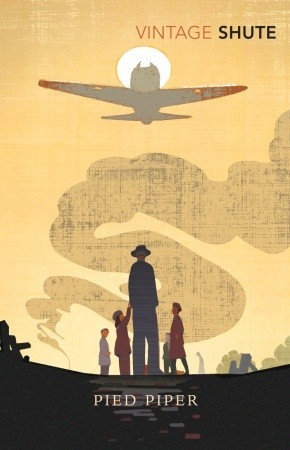
Pied Piper by Nevil Shute

Nevil Shute is an author I’ve been intending to try for a long time. His 1942 novel, Pied Piper, is on my Classics Club list and I decided to also put it on my 20 Books of Summer list to give me some extra motivation to pick it up and read it sooner rather than later! I have no idea whether this was the best Shute novel to begin with – A Town Like Alice and On the Beach are probably better known; however, it turned out to be a good choice for me.

The ‘pied piper’ of the title is John Sidney Howard, an elderly Englishman who goes to France in the spring of 1940 to spend some time fishing, relaxing and trying to come to terms with the death of his son whose plane came down in the Battle of the Heligoland Bight. It may seem a strange time to be taking a holiday in Europe, but Howard believes the situation in France is stable and that he won’t be in any danger. However, when the Nazis begin to advance much more quickly than he expected, Howard decides to return home immediately. His departure is delayed when an English couple staying in the same hotel ask him to take their two young children with him to the safety of England, but soon Howard, accompanied by little Sheila and Ronnie, is boarding the train to Paris for the first stage of his journey.

Of course, things don’t go according to plan and Howard and the children find themselves facing one obstacle after another, including sickness, cancelled trains and German bombing raids. Along the way, Howard collects more lost or orphaned children and together they try to avoid the rapidly advancing German army and make their way to safety.

I usually enjoy novels with World War II settings, but I find it particularly interesting when they were actually written during the war itself. It makes a book feel very different when you know that at the time of writing, the author had no idea what would happen next or how the war would eventually end. It’s intriguing to think of how a 1942 reader may have viewed a book like this compared to those of us who are reading it today with the benefit of hindsight and a knowledge of history.

Another thing which makes Pied Piper different from a lot of other wartime novels is that Shute’s protagonist is so ordinary – not a soldier or a spy or a romantic young lover, but a quiet, unassuming old man who becomes a hero unintentionally through a mixture of circumstance and his own basic decency and humanity. The only link between Howard and the sinister ‘Pied Piper of Hamelin’ (apart from the obvious connection with children) comes when we see Howard making whistles from hazel twigs for his young companions to play with.

Although Howard and the children witness and experience some terrible things during their journey, they also encounter several people who offer kindness and generosity, so the novel shows us both the best and the worst of human nature. The book is structured using a framing narrative where Howard is relating the story of his adventures in France to a friend in a London club during an air raid several weeks into the future. This means we know almost from the first page that Howard has survived to tell the tale, yet there’s still plenty of suspense and I was genuinely afraid for him and for the children at various points throughout the novel!

Which of Nevil Shute’s books should I read next?

~

This is book 7/20 from my 20 Books of Summer list.

~

This is also book 29/50 from my second Classics Club list.

Godmersham Park by Gill Hornby

I enjoyed Gill Hornby’s previous novel, Miss Austen, about the life of Jane Austen’s sister Cassandra. Her new one, Godmersham Park, is also inspired by the Austens, telling the story of Anne Sharp, who became one of Jane’s closest friends after taking up the position of governess to her niece, Fanny.

We first meet Anne in 1804 on the day of her arrival at Godmersham Park, the estate in Kent that is home to Edward Austen Knight, his wife Elizabeth and their many children. (If you’re in the UK and have a current £10 note to hand, Godmersham Park is the house depicted on the back beside the portrait of Jane Austen). At thirty-one years old, Anne has no experience of teaching or caring for children, but following the death of her mother she has found herself in need of employment and somewhere to live. This change of circumstances comes as a shock to Anne and it takes her a while to settle into her new job and way of life.

When Anne’s eleven-year-old charge, Fanny, shows her the letters she has been receiving from her Aunt Jane (yes, that Jane), Anne finds them charming and immediately decides that Jane is her ‘favourite Austen’. Anne will have to wait a long time for her chance to meet this mysterious letter-writer, but first she makes the acquaintance of another Austen – Jane and Edward’s brother Henry, who comes to stay at Godmersham Park and quickly befriends the new governess.

This is a lovely novel and, like Miss Austen, although it doesn’t self-consciously try to recreate the style of Jane Austen’s work, the language still transports you back to the early years of the 19th century. There are no glaring anachronisms that I noticed and it even feels like the sort of story Austen herself could have written. The pace is slow and apart from a subplot involving a mystery surrounding the whereabouts of Anne’s father, nothing very dramatic happens, yet I was drawn in by the characters and the setting and found it quite absorbing. It was particularly interesting to read about Anne’s experience of working as a governess and how she struggled to find her place within the household, not being fully accepted either as one of the family or one of the servants.

The novel is inspired by the diaries kept by Fanny Austen Knight, letters exchanged between Anne Sharp and Jane and Cassandra Austen, and a first edition of Emma that Jane signed for Anne. All of these things add to our knowledge of Anne’s life and personality and provide evidence of her close friendship with Jane Austen. However, almost nothing is known of Anne’s background before she arrived at Godmersham Park and Gill Hornby explains in her author’s note that she had to use her imagination to create a backstory for Anne. The overall result is a convincing blend of fact and fiction, which I really enjoyed.

Thanks to Century for providing a copy of this book for review via NetGalley.

This is book 6/20 from my 20 Books of Summer list.

This is book 31/50 read for the Historical Fiction Reading Challenge 2022.