Some Luck by Jane Smiley

Some Luck This is the first volume of a trilogy following the lives of the Langdon family across a period of a century. Beginning in 1920 and ending in 2020 (although Some Luck only takes us up to 1953), we will get to know several generations of the family over the course of the three novels, watching as the children grow up, get married and have children of their own, sharing their hopes and dreams, and accompanying them through some of the events which shaped the last one hundred years of American history.

At the heart of the story are Walter and Rosanna Langdon, a young married couple who, as the novel opens, are settling into life on the farm they have recently bought in Iowa. Rosanna has just given birth to their first child, Frank, and in the first few chapters, not only do we see things through the eyes of the two adults, but also through the baby’s, to whom everything in the world is new and strange. As the years go by, four more sons and daughters follow: quiet, gentle, animal-loving Joey; the sweet and angelic Lillian; Henry, who loves reading; and Claire, the youngest and her father’s favourite. Frank himself is handsome, clever and adventurous – and the contrast between his personality and Joey’s adds an interesting angle to the dynamics of the Langdon family.

The novel is carefully structured so that each chapter is devoted to one year and this keeps the story moving forward at a steady pace. However, it also gives the book an episodic feel; each time a new chapter begins and we find that we’ve jumped straight into the following year, there’s a sense that there are some gaps in the story and that things may have changed without our knowledge in a way that wouldn’t happen with a more fluent narrative. Also, as is true in all of our lives, some years are more eventful than others, which means that some chapters are more interesting than others.

Really, though, this is not a book you would choose to pick up if you were looking for a thrilling, action-packed read. Some Luck is a quiet, low-key story about ordinary people leading ordinary lives. Much of the novel is concerned with farming and all it involves: planting and harvesting crops, shearing sheep, trying to cope with summer droughts and winter snowdrifts. It reminded me in this respect of other farm-based novels I’ve read – Willa Cather’s My Antonia and, of course, Little House on the Prairie.

There are some dramas in the lives of the Langdons, but they are relatively small ones – the sort of things that could happen to any of us. Historical events are experienced mainly as the effects filter through to their remote Iowa farm – advances in farming methods, such as the replacement of horses with tractors, cause a lot of excitement and controversy – but occasionally a family member decides to leave the farm and see more of the world. Frank enlists in the army during the Second World War and is sent to North Africa, Rosanna’s sister Eloise moves to Chicago and marries a communist, and Lillian…well, I won’t say too much about what Lillian does except that it’s the one thing I found hard to believe.

Some Luck is the first book I have read by Jane Smiley. I’m aware that A Thousand Acres was her Pulitzer Prize-winning novel and might have been a better choice for me to start with, but I did still enjoy this one and am planning to continue with the trilogy soon. I have the next two books – Early Warning and Golden Age – ready to read.
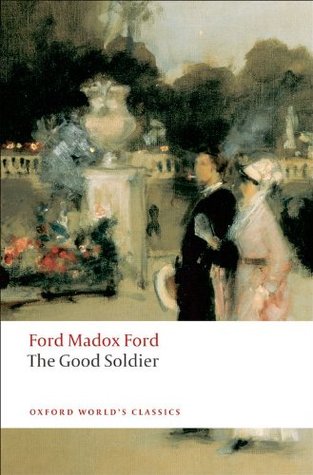
The Good Soldier by Ford Madox Ford

The Good Soldier I seem to have been under a bit of a misconception with this book; based on the title and the fact that it was published in 1915 I thought it would be a book about war. It isn’t, of course. I expect everyone else already knows that and I’ve just made myself sound stupid, but it’s really not a book I’ve ever considered reading or paid any attention to until recently. That’s my excuse! What is The Good Soldier actually about, then? Well, it’s a tale of marriage and adultery, of love and betrayal, and it reminded me of something F. Scott Fitzgerald might write (although Fitzgerald’s books would come several years later).

The Good Soldier is a deceptively simple story of two seemingly respectable couples who meet and get to know each other at a spa town in Germany in 1904. John Dowell, our narrator, is an American who has come to Bad Nauheim with his wife, Florence, whom he tells us has a weak heart. The other couple – Edward Ashburnham, another heart patient, and his wife Leonora – are British. Seen through John Dowell’s eyes, the story of these four people and the relationships between them slowly unfolds and we gradually discover that there is more to each of them than meets the eye.

I don’t think I really need to say much more about the plot – and to do so would run the risk of spoiling the book for future readers. This is a story built around lies, deceptions and secrets, things which are only revealed when John Dowell decides to reveal them. It’s an interesting structure, consisting of a series of memories and flashbacks told in non-chronological order, moving backwards and forwards in time. Interesting, but not very easy to follow, at least on a first read! This is the sort of book you would really need to read more than once to be able to fully appreciate it, but I don’t think I’ll be reading it again – at least not in the near future – because, although I did like the book, I didn’t like it enough for a re-read.

It’s a clever and intriguing novel, though, with a narrator who is certainly not a reliable one. We can never be sure how much of what Dowell says is true, as he often makes a statement or describes a sequence of events only to contradict himself later in the book. I was constantly having to change my mind about the characters and reassess what I thought I knew about them. The question is whether Dowell is deliberately trying to mislead us or whether he himself is deluded or confused. Even the opening line is curious: “This is the saddest story I have ever heard”. Why does he say it’s a story he’s ‘heard’ when he is one of the main participants in the story? This is a book that left me with many more questions than answers!

Have you read anything by Ford Madox Ford? I think I would like to try Parade’s End at some point.

Stoner by John Williams

Stoner Stoner was published in 1965 and is considered to be an American classic but I have to admit I hadn’t even heard of it until quite recently when it started to appear on some of the blogs I follow. It didn’t really sound like the sort of book I would usually choose to read, but when I saw a copy in the library I thought I would try it. I liked it much more than I’d expected to; it’s a quiet, reflective book about a university professor whose life is marked by disappointments and unfulfilled potential, but it’s beautifully written and surprisingly gripping at times.

William Stoner is the son of a poor farmer from Missouri. Sent to the University of Missouri in 1910 to study agriculture, William discovers that his true passion is for literature and changes his degree course without telling his parents. After graduating, Stoner decides not to return to the family farm and stays on at the university to teach English Literature where he remains for the next forty years. During those forty years he marries, but the marriage is not a happy one, has a daughter whose life also turns out to be quite miserable, and faces problems at work with students and colleagues. When he retires in 1956 and dies soon afterwards, most of those who knew him quickly forget he ever existed.

This is certainly not an exciting, action-packed novel, but that was obvious from the very first page which sums up Stoner’s whole life in one paragraph (I haven’t spoiled anything above by telling you when he dies) and then continues with:

“An occasional student who comes upon the name may wonder idly who William Stoner was, but he seldom pursues his curiosity beyond a casual question. Stoner’s colleagues, who held him in no particular esteem when he was alive, speak of him rarely now; to the older ones, his name is a reminder of the end that awaits them all, and to the younger ones it is merely a sound which evokes no sense of the past and no identity with which they can associate themselves or their careers.”

The story of Stoner’s life is a mediocre and uneventful one and yet somehow, despite that, it’s fascinating to read. It’s proof of the quality of John Williams’ writing that he could make me feel so interested in the boring life of a man I didn’t even always particularly like. Probably the most dramatic part of the novel, if you can describe any of it as dramatic, is when Stoner tries to fail an incompetent student and finds himself opposed by the student’s tutor, who happens to be the head of the English department. I was completely engrossed by this section of the book, where Stoner tries to do what he believes is right despite the attempts of the other professor to make things as difficult as possible for him.

The character I was most intrigued by was Edith, Stoner’s wife. Her behaviour is very difficult to understand and I’m not sure what conclusions we are supposed to make about her character. She seems to be suffering from a form of mental illness which is never specified and while it is hinted that she may have been abused by her father, this is never explained in any detail either. She was a mystery to me from beginning to end and I never felt that I (or even Stoner) ever really got to know her at all, which was the one thing that disappointed me about this book.

I know I’ve probably given the impression that Stoner is a very sad and bleak story, but it’s actually not quite as depressing as it sounds and I do recommend reading it, especially if you enjoy novels with an academic setting. Now I’m curious about John Williams’ other books – if you’ve read any of them please let me know what they’re like.

Dominion by C.J. Sansom

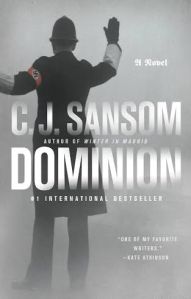
Dominion C.J. Sansom is probably best known for his Shardlake novels, a mystery series set in Tudor England. Dominion, however, is set in the twentieth century – but not the twentieth century that you and I are familiar with. Before we even finish reading the first chapter, we know that something is very wrong. In Sansom’s alternate world, Britain surrendered to Nazi Germany in 1940, changing the course of history as we know it.

As the novel opens in November 1952, we begin to see what a high price Britain has paid for peace with Hitler. Yes, the war was brought to a premature end, avoiding more deaths and devastation, but now the Gestapo are established in central London, Britain’s Jews are being rounded up and removed from the cities, and Winston Churchill, who never actually managed to become Prime Minister, has gone into hiding as the leader of the British Resistance.

The story is told from the perspectives of four characters, all with different backgrounds and beliefs. The first of these is David Fitzgerald, one of many people who are unhappy with the way things are in Britain. When he is approached by the Resistance movement, David agrees to use his position as a civil servant to provide them with confidential information. He decides to protect his wife, Sarah, by not telling her that he is working as a spy…but he is also hiding another, equally dangerous secret – one that nobody must ever discover.

Sarah Fitzgerald, David’s wife, has been a pacifist for many years, like her father and sister. She has always believed that signing a peace treaty in 1940 was the right thing to do in order to avoid more lives being lost. However, Sarah’s views are now beginning to change.

We also meet Frank Muncaster, a scientist and an old friend of David’s from university. Frank is now in a mental hospital after pushing his brother, Edgar, through a window during an argument. The Resistance believe that before they began to fight, Edgar – another scientist – may have given his brother some shocking information about his work in America. Finally, there’s Gunther Hoth, a German who is in London on a secret mission. Could Frank Muncaster have the information he needs?

Dominion is a chilling and thought-provoking novel, all the more frightening because the world C.J. Sansom describes is so realistic and believable. In many ways, the Britain of Dominion is not greatly different from the real Britain, but as the story unfolds we begin to see more and more subtle differences, more and more ways in which authoritarian rule has replaced the freedoms we take for granted.

As well as being an alternate history, this is also an exciting thriller. After a slow start I found it became very gripping and suspenseful, with some cliff hanger chapter endings and a few moments when I feared for the fates of some of the characters. The Great Smog of 1952 is incorporated into the novel and really adds to the oppressive atmosphere. There were some parts of the story, though, that felt superfluous and had little relevance to the main plot and this made the book feel longer than it really needed to be.

My favourite character was Frank Muncaster, who through no fault of his own finds himself at the centre of the conflict between the Germans and the British Resistance. We are given lots of flashbacks to Frank’s childhood when, as a shy and lonely boy, he was bullied at school, leaving him suffering from low self-esteem and finding it difficult to make friends. Of all the characters in the novel, I thought Frank was particularly well-written and I found myself warming to him in a way I never really did to any of the others.

Dominion is a disturbing and unsettling novel with a sinister vision of what our lives could have been like had just one or two different decisions been made at crucial moments in history. I thoroughly enjoyed this book, but when I reached the final page it was good to know that the world I was returning to was not quite the same as the one I had just finished reading about!

Dominion tour

I read Dominion as part of the Historical Fiction Virtual Book Tour. For more reviews, interviews and giveaways, please see the tour schedule.

Less Than Angels by Barbara Pym

Less Than Angels I’ve never read anything by Barbara Pym until now, despite feeling sure that I would enjoy her books, so Barbara Pym Reading Week seemed a good time to start. Less than Angels is not a book that I’ve heard much about so I was worried that it might not be a good one to begin with, but it’s the only one I actually own so it made sense to read it first. Luckily I did enjoy it and it has left me wanting to read more of Pym’s books as soon as I can!

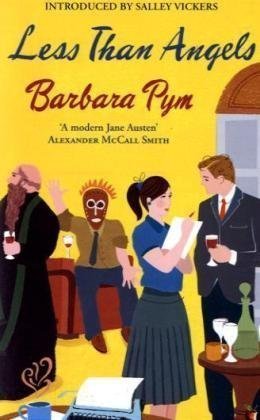
Less than Angels revolves around a group of anthropology students, their professors, families and neighbours. Catherine Oliphant is a writer of romantic fiction and articles for women’s magazines. Her boyfriend, Tom Mallow, is an anthropology student who has recently returned home from being ‘in the field’ in Africa and is now working on finishing his thesis. Despite having very different personalities and not really understanding each other’s work, Tom and Catherine seem to have settled into life together – until Tom meets Deirdre Swan, a younger student who is just beginning to study anthropology.

While the relationships between Tom, Catherine and Deirdre form the central thread of the novel, another storyline centres around money for research grants which the rich widow Minnie Foresight has promised to give to Professor Mainwaring’s department. Among the students hoping to receive these grants are Deirdre’s friends, Mark and Digby, who provide a lot of the book’s humour. We meet lots of other great characters too, including Deirdre’s mother, Mabel, and her unmarried Aunt Rhoda. And there’s also Alaric Lydgate, an eccentric anthropologist who lives next door and can often be seen wearing an African mask around the house (and secretly wishes he could wear it all the time).

My first impression after reading Chapter One was that I liked Barbara Pym’s writing but was completely overwhelmed by the number of characters we were introduced to in that first chapter and the way the viewpoints changed from one to another so rapidly. Fortunately, after a couple of chapters things settled down and we could concentrate on getting to know one character at a time.

I thought Catherine was a lovely person and although she and Deirdre could be seen as rivals, Catherine’s mature attitude to the whole situation made it easy for me to like Deirdre too. It was interesting to read the contrasting descriptions of Catherine’s solitary but independent life in London, and Deirdre’s life in a middle-class suburban household, living with her mother, brother and aunt. I thought it was funny when one of Deirdre’s fellow students, a Frenchman called Jean-Pierre, visits the family to study a typical English Sunday! I liked the idea that there’s as much for an anthropologist to study in English habits and traditions as there is in the customs of African tribes, and I was also interested in the comparison of the insights writers have into human life as opposed to the views anthropologists have.

I loved Mark and Digby too. One of my favourite scenes was the one where they take Miss Clovis and Miss Lydgate to a restaurant and spend the whole time worrying about the cost and trying to choose the cheapest things on the menu. I also liked the part where Professor Mainwaring invites four of the competing research grant applicants to his house in the countryside for the weekend. Near the end of the book, the story takes a more dramatic turn which I thought felt a bit out of place with the rest of the novel. Apart from this, I enjoyed Less than Angels and am excited about reading more of her books.

Barbara Pym Reading Week

Doctor Zhivago by Boris Pasternak

Doctor Zhivago Do you ever find that after finishing a book you’re still not sure what you thought of it and couldn’t even say whether you had actually enjoyed it or not? That’s the way I felt about Doctor Zhivago. I’m glad I’ve finally read it as it’s a book I’ve been curious about for a long time, but while I didn’t dislike it I didn’t love it either. Thankfully I don’t even attempt to rate books on my blog but I do on Goodreads and wavered between three and four stars for a long time before settling on three. Doctor Zhivago is a long book and definitely not a light, easy read, so I was disappointed that I couldn’t rate it more highly after investing so much time and effort in it.

Doctor Zhivago was published in 1957 and Pasternak was awarded the Nobel Prize for Literature a year later. The novel is set in Russia and follows the life of Yuri Zhivago, a doctor and poet. Yuri’s mother dies when he is still a young child and he is raised by his Uncle Kolya. After studying medicine at university, he marries his childhood friend, Tonya, and they have a son together but Yuri and Tonya are separated when Yuri joins the army as a doctor. Recovering in a field hospital after being wounded, he is drawn to another woman, Lara, who is working there as a nurse and over the years that follow he is torn between his loyalty to Tonya and his love for Lara. But this is more than just Yuri’s story…it’s also the story of Russia itself and the events that shaped the country throughout the first half of the twentieth century.

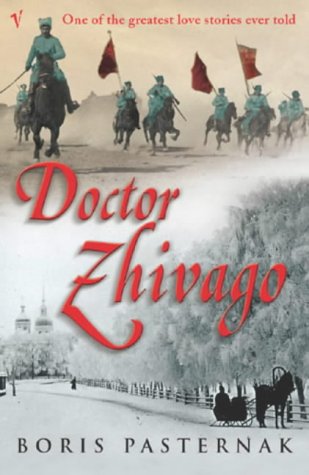
I have to admit that before I started reading this book I had absolutely no idea what it was about, though I think I must have had the impression it was a romantic historical epic set against a backdrop of beautiful snowy landscapes. Although I’ve never actually watched any of the film or television adaptations of this book it seems that they have chosen to focus more on the love story aspect, which is probably why I had this misconception of what the book would be like. This particular edition of the book does nothing to dispel that idea, with the claim on the cover that this is “one of the greatest love stories ever told”. It isn’t. Not in my opinion, anyway. After reaching the end of the book it seemed to me that the romance had only formed a minor part of the story, taking second place to the Russian history and politics, though whether this is a good thing or a bad thing depends on your personal preference, of course!

Doctor Zhivago was originally written in Russian and the translators of this edition are Max Hayward and Manya Harari. I hadn’t looked into which other translations are available – I just picked the book up on a whim when I noticed it on the library shelf because I’ve been interested in reading it for a while. Maybe there are other translations that are better, but I didn’t have any problems with this one; I thought the writing flowed well and was easy enough to read (although the story itself is disjointed, almost episodic). There are some beautiful, moving passages, and yes, some wonderful descriptions of snowy Russian landscapes too. But what did make this book very challenging for me was my complete lack of knowledge of most of the history involved: the February and October Revolutions, for example, and the Civil War between the Reds and the Whites. If you’re planning to read Doctor Zhivago and know nothing about the historical context I would strongly recommend doing some background reading first – I wish I had as I’m sure it would have made the story a lot easier to understand and follow!

The parts of the book that I did enjoy were excellent – I particularly loved the penultimate chapter, Again Varykino, and its atmospheric descriptions of a deserted town surrounded by howling wolves – but I was disappointed that I never managed to form any kind of emotional connection with any of the characters. Although Yuri, Lara and Tonya found themselves in situations that I could sympathise with, I thought their characters felt underdeveloped. They never felt like real people to me, so their stories didn’t affect me as much as they should have done.

I wish I had been able to write a more intelligent, articulate review but I think I’ll have to leave that to other people as I’m aware that a lot of the political and philosophical aspects of the story just went over my head. To fully appreciate this book I would have to read it again and I don’t think that’s something I’ll ever want to do! I do usually like Russian literature in general – I loved Mikhail Bulgakov’s The Master and Margarita, I enjoyed Anna Karenina and am currently taking part in a group read of War and Peace – so I have to conclude that Pasternak and Doctor Zhivago are just not for me.

Turn of the Century Salon: The Painted Veil by W Somerset Maugham

The Painted Veil Despite the attempts of her mother to arrange a good marriage for her, Kitty Garstin is in no hurry to find a husband. She’s too busy enjoying herself at parties and dances, and it’s only when she’s still unmarried at the age of twenty-five and discovers that her younger sister has become engaged to a baronet that she begins to panic. She agrees to marry Walter Fane, a bacteriologist, and moves to Hong Kong with him. Walter is shy, clever and serious and to the pretty, frivolous Kitty, he seems very cold and aloof. Although he is in love with her, she doesn’t love him in return and soon begins an affair with the charming, charismatic Assistant Colonial Secretary, Charles Townsend.

Eventually Walter learns the truth about Kitty and Charles and confronts Kitty with an ultimatum. She can either accompany him into the interior of China where he has volunteered to deal with a cholera epidemic, or he will allow her to divorce him – but only if Charles agrees to divorce his wife and immediately marry Kitty. When Kitty goes to discuss the situation with Charles, she is cruelly disillusioned by her lover and is left with no other option than to travel to Mei-tan-fu with Walter. Kitty is convinced that Walter is taking her there in the hope that she will die, but it’s here in this remote cholera-ridden city that Kitty finally begins to grow as a person and to make some discoveries about both herself and her husband.

This book was such a surprise. I think I must have formed a preconceived idea that I wouldn’t like Somerset Maugham without ever having tried any of his books or knowing anything about him, because I really didn’t expect to love this as much as I did. I’m so pleased to find that I was wrong! The Painted Veil is one of the best books I’ve read so far this year. I found Maugham’s writing much easier to read than I had thought it might be, but also filled with beauty, poignancy and emotion.

This is quite a short novel but both main characters have a lot of depth and complexity. I disliked Kitty at first – she’s selfish, spoiled and immature – but the fact that she is so flawed and makes such terrible mistakes is what makes her so human. Kitty is changed by her experiences in Mei-tan-fu and we see her mature and gain in wisdom and insight. By the end of the book, I still didn’t like her but I had a better understanding of her and I wanted her to be happy. I had more sympathy for Walter, but because we are viewing him through Kitty’s eyes, we don’t really have a chance to see the other side of his personality that we hear about – when the nuns in the convent tell Kitty how much they admire him, for example, and how tender and loving he can be with the orphaned babies there. Kitty barely knows or understands her husband at all and when she finally begins to do so, we are made to wonder whether it’s going to be too late.

There aren’t a lot of long, descriptive passages in this book but 1920s China is still portrayed beautifully and I loved this description of Kitty watching the rooftops emerging from the mist on her first morning in Mei-tan-fu:

But suddenly from that white cloud a tall, grim, and massive bastion emerged. It seemed not merely to be made visible by the all-discovering sun but rather to rise out of nothing at the touch of a magic wand. It towered, the stronghold of a cruel and barbaric race, over the river. But the magician who built worked swiftly and now a fragment of coloured wall crowned the bastion; in a moment, out of the mist, looming vastly and touched here and there by a yellow ray of sun, there was seen a cluster of green and yellow roofs. Huge they seemed and you could make out no pattern; the order, if order there was, escaped you; wayward and extravagant, but of an unimaginable richness. This was no fortress, nor a temple, but the magic palace of some emperor of the gods where no man might enter. It was too airy, fantastic, and unsubstantial to be the work of human hands; it was the fabric of a dream.

Turn of the Century Salon - March I read The Painted Veil for Katherine’s Turn of the Century Salon. This book was published in 1925 and with its portrayal of society in 1920s colonial Hong Kong and an era when many girls were still raised with the sole aim of making a good marriage, this was an ideal choice for the Salon. If you read it I would also recommend reading Shelley’s sonnet Lift Not The Painted Veil and Oliver Goldsmith’s An Elegy on the Death of a Mad Dog.