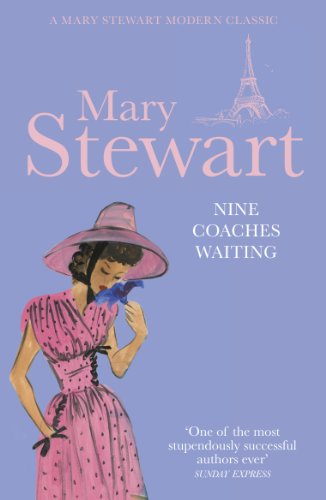
Nine Coaches Waiting by Mary Stewart

I can’t believe this is the first Mary Stewart book I’ve read! Looking at other reviews of Nine Coaches Waiting it seems almost everyone else discovered her when they were a teenager and it’s so annoying to think that I’ve missed out on all these years when I could have been reading her books. Anyway, better late than never!

Nine Coaches Waiting is the story of Linda Martin, a half French/half English orphan who arrives in France to take a job as governess to young Philippe de Valmy. Philippe is also an orphan and heir to his father’s title and estates, but as he is only nine years old he is living under the guardianship of his Uncle Leon and Aunt Heloise at the family chateau in the Haute-Savoie region of France.

As soon as Linda arrives at the chateau it becomes obvious that something isn’t right and we are immediately thrown into an atmosphere of mystery and suspense. The de Valmys had insisted that their nephew’s new governess should be an English girl, so Linda decides not to admit that she speaks fluent French. But why is this important? Do Leon and Heloise have something to hide? When Leon’s dark, handsome son Raoul comes to visit, Linda finds herself falling in love with him – but does Raoul know what his father is planning and could he be part of the de Valmys’ wicked schemes?

To discuss any more of the plot details would be unfair to any future readers, so that’s all I’m going to say as I would like everybody to be as gripped by the story as I was. Throughout the entire book I found myself worrying about Linda, worrying about little Philippe, and wondering who they could and could not trust. And we are kept guessing right until the end. The tension rises and rises during the final chapters and although there were a couple of different ways the book could have concluded, I got an ending that I was happy with.

It’s not surprising that I enjoyed this book so much, because it has everything I love in a novel: mystery, suspense, romance, memorable characters and even some gothic undertones. It also had the beautiful setting and haunting atmosphere of a Daphne du Maurier novel and would be a perfect book for readers who like stories that are dark and thrilling without actually being scary. The book was written in the 1950s and is set in the 50s too, I think, but the story has a timeless feel and if not for the references to cars and planes it could have been set in a much earlier period.

Nine Coaches Waiting is one of the best books I’ve read this year. It’s maybe not the most life-changing or the most original, but certainly one of the most enjoyable and exciting. My only regret is that I didn’t curl up with it on a quiet weekend with no distractions, rather than starting it during a busy working week when I didn’t have much time to sit down and read. It’s great to have found a potential new favourite author and now I’m looking forward to exploring the rest of her work.

We Have Always Lived in the Castle by Shirley Jackson

I’ve heard so much about this book since I started blogging, particularly around this time of year when it seems such a popular choice for Halloween or the dark winter nights. Yet somehow I had managed to avoid reading any detailed summaries of the plot and so when I finally picked this book up to read it for myself, I was able to go into it with very little knowledge of what it was about. I would hate to spoil things for any future readers, so I’ve deliberately tried to keep my summary here as vague as possible.

The book is narrated by eighteen-year-old Mary Katherine Blackwood, or ‘Merricat’, who lives with her sister Constance, their Uncle Julian, and Jonas the cat in a big house on the edge of town. Near the beginning of the story we see Merricat walking home with some shopping, being taunted and chanted at by everyone she passes. It seems the Blackwoods are very unpopular, but at first we don’t know why.

When Merricat returns home, it becomes even more apparent that something is wrong. Merricat herself does not seem like a normal eighteen-year-old – she likes to bury things in the grounds of the Blackwood house and believes that using magic words and rituals will protect her home and family. Constance is agoraphobic and afraid to walk any further than the garden. Uncle Julian, confined to a wheelchair, is obsessed with the book he’s writing about a tragedy that occurred six years earlier. And what exactly has happened to the rest of the Blackwood family?

We Have Always Lived in the Castle is a great book and now that I’ve read it I can see why it’s considered a modern classic. Something that impressed me about it was the way the story was cleverly constructed so that the truth about Merricat and her family was only revealed very slowly. We know from the first page that something is not right but we’re not quite sure what it is. As we read on we start to form some suspicions, though we’re made to wait a while to find out if we’ve guessed correctly or not.

This is a very disturbing and unsettling book with its portrayal of the claustrophobic world behind the locked doors of the Blackwoods’ house and the cruel, hostile atmosphere of the town outside. Some of the sense of unease comes from the fact that the book is narrated by Merricat, who clearly lives in a world governed by her own rules and superstitions. The reader becomes trapped inside her mind and is made to share her unusual outlook on life. And yet although there’s something slightly sinister about her, Merricat is also very child-like and both she and Constance have a vulnerability that made me concerned for them, locked away in the isolation of their ‘castle’.

The ending was not quite what I had expected and I was left with questions that still hadn’t been answered, but having thought about it, maybe it was a suitable ending for such a strange and powerful book. This was my first experience of Shirley Jackson’s work and now I’m looking forward to reading The Haunting of Hill House.

The Land of Green Ginger by Winifred Holtby

The Land of Green Ginger is the second Winifred Holtby book I’ve read, the first being South Riding, which I read (and loved) in February. This one was published a few years earlier than South Riding, in 1927.

It’s the story of a missionary’s daughter, Joanna Burton, who is born in South Africa but raised in England by her aunts. As a young woman, Joanna is a lively, high-spirited person who dreams of travelling and visiting faraway lands. Then during the First World War she falls in love with Teddy Leigh, a young man on his way to fight in the trenches in France, and they get married.

When Teddy returns from the war to their home in Yorkshire, he is in poor health and Joanna finds herself caring for an invalid husband, managing a farm, and trying to look after their two small children, Patricia and Pamela. Life is hard for Joanna and the only person she can rely on for help is their Hungarian lodger, Paul Szermai. But Joanna has never been popular with the neighbours and when people begin to gossip about her relationship with Szermai, things become even more challenging for the Leigh family.

There are some interesting subplots too, including the tale Paul Szermai shares with Joanna of his life in Hungary and other parts of Europe and how it was affected by war and communism. We also see the attitudes of the local people to the group of immigrant workers who have been employed in Joanna’s village and for whom Szermai is acting as interpreter. Holtby does a good job of portraying a small rural community who are suspicious of outsiders and of anything that might change their way of life.

Although I found Paul Szermai and Teddy Leigh difficult to like, Holtby still managed to make me feel some sympathy for all of her main characters: Szermai, because of his tragic history; Teddy, frustrated by the sickness that is keeping him confined to his bed; and of course, Joanna who has had to abandon all her earlier dreams and ambitions, yet still shows a lot of naivety and innocence. Joanna seems to be unaware of how she is perceived by other people and as a result she never quite manages to fit into life in a small village where everybody knows everybody else’s business.

So The Land of Green Ginger is a dark and emotional book, but the ending leaves us feeling more hopeful. It doesn’t have the same depth and scope as South Riding, but I really like Winifred Holtby’s writing and this is still a compelling story. And finally, I want to mention how much I love the covers of the new Virago editions of Holtby’s books!

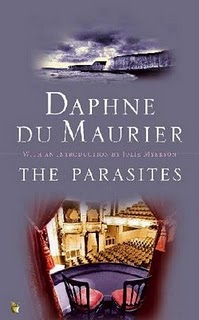
The Parasites by Daphne du Maurier

After reading the first few chapters of Daphne du Maurier’s The Parasites I had a feeling I wasn’t going to enjoy this book. I was finding the story very difficult to get into and I didn’t like any of the characters. But because Du Maurier is one of my favourite authors I decided I didn’t want to give up on the book just yet…and guess what? I ended up loving it! I should have known Daphne wouldn’t let me down.

The Parasites is a study into the lives of the Delaney family: Mama, a famous dancer, and Pappy, a successful singer, and their three children, Maria, Niall and Celia. The story begins one day in the 1940s when Niall and Celia, now adults, are spending the weekend at the home of Maria and her husband, Charles. It’s Charles, losing his temper with them, who refers to the three siblings as ‘parasites’…

“You always have been and you always will be. Nothing can change you. You are doubly, triply parasitic; first, because you’ve traded ever since childhood on that seed of talent you had the luck to inherit from your fantastic forebears; secondly, because you’ve none of you done a stroke of ordinary honest work in your lives, but batten upon us, the fool public who allow you to exist; and thirdly, because you prey upon each other, the three of you, living in a world of fantasy which you have created for yourselves and which bears no relation to anything in heaven or on earth.”

He then leaves the house in a rage, and Maria, Niall and Celia are left alone to wonder what his words meant and if it’s true that they really are ‘parasites’. Through a series of flashbacks and memories, the Delaneys spend the rest of the novel looking back at their childhoods and the things that turned them into the adults they are today.

One of the striking things about this book was the lack of one distinct narrator. Sometimes the three siblings seem to be narrating together, all speaking with one single voice, which was very unusual. It’s difficult to explain, but if you read the book you’ll see what I mean! As I read, I couldn’t help thinking that Maria, Niall and Celia must represent three different sides to Daphne du Maurier’s own personality; she writes so convincingly about all three characters and really gets inside their heads. And of course, her own father was the actor Gerald du Maurier and her mother the actress Muriel Beaumont, so she would have known what it was like to be the child of famous parents and could bring some of her personal experiences into this novel.

Maria, who becomes a famous actress, and Niall, who finds success as a songwriter, are stepbrother and stepsister and have a very strong bond. In her introduction to the book, Julie Myerson compares Maria and Niall with Cathy and Heathcliff from Wuthering Heights. I don’t think this would have occurred to me, but after it was pointed out I could definitely see the parallels.

Celia is half-sister to the other two, sharing a mother with Niall and a father with Maria. Although she also has a strong bond with them both, Celia often feels left behind. Despite her own talent for drawing and writing, she puts other people before herself and stays at home while her brother and sister go off to pursue their dreams. Of the three main characters in the book Celia was the only one who I liked and understood; some of the chapters where she takes a central role are very moving. I really disliked both Maria and Niall, who seemed to me to be very selfish characters who only ever thought about themselves. I found it difficult to feel any sympathy for either of them.

The Parasites may sound like a very serious novel, but there’s actually a good balance of drama and comedy. Some of the scenes are quite funny – in one of my favourite chapters, the Delaney family visit Charles and his parents at their country estate for the first time after Maria’s wedding and completely embarrass themselves! It was nice to see du Maurier’s sense of humour really shining through in this novel.

There are other du Maurier books that I’ve enjoyed more than this one, but after a slow start The Parasites turned out to be much better than I expected. It reminded me a lot of I’ll Never Be Young Again, one of her earlier novels, which was also very character-driven and personal. If you prefer her gothic, suspense-filled novels you may be disappointed, but if you want to try a different type of du Maurier book then hopefully you’ll enjoy this one as much as I did.

Rule Britannia by Daphne du Maurier

I love Daphne du Maurier; whenever I pick up one of her books I know I’m guaranteed a good read. Although this one was not as good as some and I can certainly understand why it’s one of her less popular books, it still kept me gripped for all 300+ pages. I’m pleased I can say that because, having read other opinions on this book, I was concerned that it might be the first du Maurier novel that I wouldn’t like.

Published in 1972 her final novel, Rule Britannia, imagines that the UK has broken away from Europe to form an alliance with the US. This new nation will be known as USUK. The first twenty-year-old Emma knows about this is when she wakes up one morning to find that the tranquil corner of Cornwall where she lives is now under American occupation – there’s an American warship in the harbour, American marines stationed in the area and roadblocks on the routes leading in and out of the town. Already the Queen is visiting the White House and the President is preparing to come to Buckingham Palace. Despite reassurances from the government that the formation of USUK is essential for Britain’s economic and military stability, Emma’s family, friends and neighbours begin to grow increasingly concerned about the exact nature of the alliance and the effect it will have on their previously peaceful lives.

It can’t happen here, thought Emma, it can’t happen here, that’s what people in England have always said, even in wartime when they were bombed, because they were all together on their own ground. Not any more.

Although the story unfolds from Emma’s perspective, the real heroine of the story is her seventy-nine-year-old grandmother, Mad (short for Madam – unless I missed it, we aren’t told her real name), who is a retired actress. Mad and Emma live together with Mad’s six adopted boys whose ages range from three to nineteen, all of whom have suffered some form of tragedy in their early lives. Mad, even in her old age, is a strong-minded, independent woman who is determined to defend her home and family no matter what, and she plays an important part in Cornwall’s resistance to the occupying forces. But although Mad and her family believe they have been invaded, I should point out that we’re told the majority of British people are very happy with the alliance and that it’s only a small percentage of the population who are rebelling against it.

As with most Daphne du Maurier novels, this one does have some suspenseful and unsettling moments. I know from my past experience of her work that nothing is ever quite as it seems and I was wondering what surprises and twists she might have in store for the reader – but unfortunately I found the way the book ended slightly disappointing because I felt there was a lot more she could have done with the story. Another thing I didn’t like was the fact that one of Mad’s adopted sons, three-year-old Ben who happens to be black, appeared to have been included simply as an excuse to make racist jokes. The book was a product of the 1970s I suppose, but these comments are offensive rather than funny. These negative points, along with the overall strangeness of the book, stopped me from enjoying it as much as I’ve enjoyed her other books. It doesn’t compare to her best work and if you’re new to Daphne du Maurier I would suggest starting somewhere else.

The Master and Margarita by Mikhail Bulgakov

I’d been wanting to read The Master and Margarita for a long time but had always felt too intimidated to pick it up. I expect there are probably other people who feel the same, so I want to reassure you that there’s really no need to be scared! Yes, it’s Russian literature, but it’s a lot easier to read and understand than I thought it would be. After just a couple of pages I could tell I was going to love it – isn’t it great when that happens?

It’s best if you know as little as possible before you begin, so to put it as simply as I can, The Master and Margarita imagines that the devil, in the guise of Professor Woland, arrives in Soviet Moscow and proceeds to wreak havoc on the city’s literary world. Woland is accompanied by a retinue of memorable characters including his assistant, Koroviev – a tall, skinny man in a jockey’s cap and broken pince-nez glasses – and a giant, talking black cat known as Behemoth. This storyline is interwoven with the story of Pontius Pilate, giving us an insight into Pilate’s thoughts and feelings in the period leading up to the crucifixion of Jesus Christ. A third thread of the novel, closely connected to the other two, features a romance between the writer of the Pontius Pilate story, a mysterious man who is referred to only as ‘The Master’, and his lover, Margarita.

This was a fantastic book – it was breathtakingly different and original, with so many different layers to it. There were some scenes that were so surreal and bizarre I had to read them twice to make sure I hadn’t misunderstood. I’m sorry I can’t give any examples of what I mean, but I don’t want to spoil any of the fun for you! Admittedly there were a few parts of the book where the story seemed to lose its way for a while, but the engaging writing, weird and wonderful characters and the dark humour all helped to keep me interested. There were some excellent set pieces too: the séance in the theatre, Margarita’s moonlight flight, the Great Ball at Satan’s, to name just a few that have stuck in my mind.

A quick note on the translation: the version I read was the Pevear and Volokhonsky translation which, as far as I can tell from reading other reviews, may not be the best one. Personally I didn’t have any complaints about this translation, though obviously I can’t compare it with the others because I haven’t read them.

This is a book that I would definitely like to read again in the future; I might not find it as stunning the second time round but I’m sure I’ll be able to pick up on lots of little details that I missed the first time. I hope I’ve convinced you to give it a try too!

Ann Veronica by H.G. Wells

I’ve never read anything by H.G. Wells before and never thought he would be an author I would enjoy. In fact, I hadn’t even realised he had written anything other than the science fiction books he’s famous for (The War of the Worlds, The Invisible Man, The Time Machine etc) and as I’m not a lover of science fiction, none of those have ever really appealed. So when I noticed this one in the library, sounding entirely different to the books I’ve just mentioned, I was intrigued and decided to give it a try.

The story is set in the early years of the 20th century and the title character is twenty-one-year-old biology student Ann Veronica Stanley. Tired of being locked in a constant battle of wills with her father, a strict and conservative solicitor who has very strong opinions about women and their place in society, she decides to run away to London to start an independent life of her own. In London, she is exposed to a range of influences and experiences (including the suffragette movement), becomes involved with several different men, and discovers that life can be difficult for a young single woman living on her own.

I wouldn’t recommend this novel to people who are looking for something with lots of action but if you’re in the mood for a slower, more character-driven story this is a very interesting read. And as a book about feminism written by a male author, I’m sure it must have caused controversy when it was first published in 1909. The book wasn’t perfect though – the main character started to irritate me after a while and at times it felt less like a novel and more of a vehicle for Wells to express his views on feminism, politics and science.

The first half of the book is concerned mainly with Ann Veronica’s struggle to gain independence from her father. She considers it unreasonable that he won’t let her go to a party in London with her friends and that he refuses to let her attend Imperial College to study for her science degree. And yet Ann Veronica’s father clearly loves his daughter and is not trying to be unkind to her – he truly believes women should behave in a certain way and it puzzles him that Ann Veronica doesn’t want to conform.

After a promising beginning, the second half of the book was dominated by a romantic storyline which became very sentimental and started to bore me. And although I can’t say too much because I don’t want to spoil the story for anyone, I was quite disappointed with the way the book ended and felt confused as to exactly what point Wells was trying to make. So, although I was left with mixed feelings about this book, at least it’s taught me not to have pre-conceived ideas about certain authors. I do feel happier about maybe trying one of his science fiction books now.

The version I read was the Penguin Classics one, but for those of you who like to collect Virago Modern Classics it has also been published as a VMC (and is one of the few written by a man).