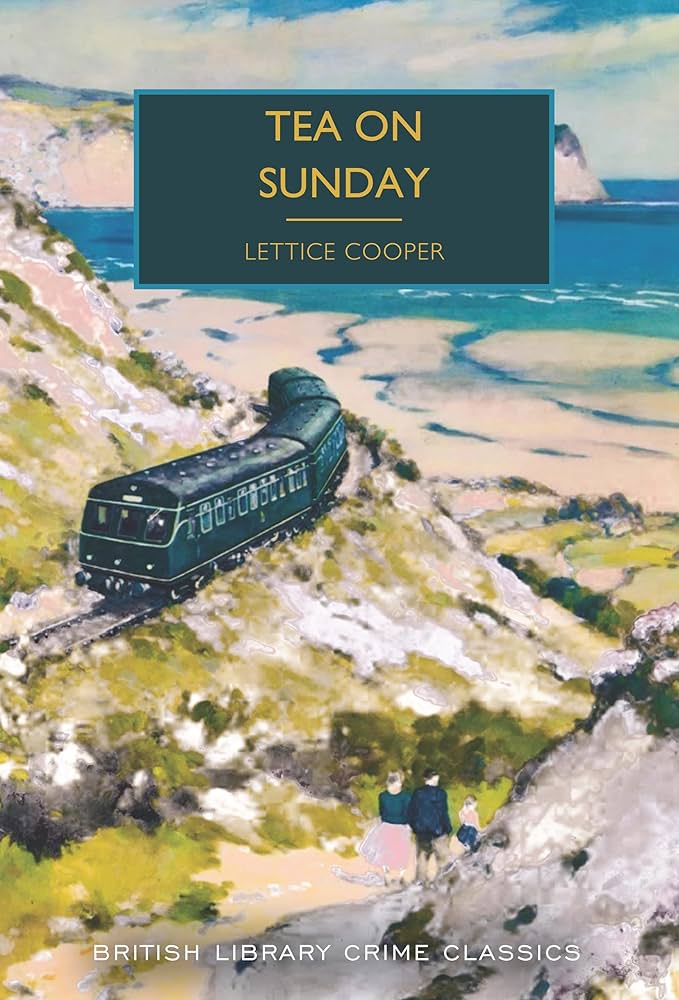
Tea on Sunday by Lettice Cooper

Lettice Cooper is a new author for me. I’m aware that two of her books from the 1930s, National Provincial and The New House, have been published by Persephone, but I haven’t read either of them yet. Tea on Sunday, her only detective novel, sounded appealing, though; it was published in 1973, very late in her life, but has the feel of a Golden Age mystery and has recently been reissued as a British Library Crime Classic.

The plot is quite a simple one. On a snowy winter’s day, Alberta Mansbridge invites eight guests to a tea party at her home in London. The guests include her family doctor, her ‘man of business’, an old friend, the manager of her late father’s engineering company, her nephew Anthony and his wife, and two young men she has taken under her wing – an Italian and an ex-prisoner. As the group gather outside her door that Sunday afternoon, they become concerned when their knocking goes unanswered. Eventually the police are called and force open the door to find that Alberta has been strangled while sitting at her desk.

There’s no real mystery regarding how the murder took place. The doors and windows had been locked and there’s no sign of a burglary, so the police are satisfied that the killer must have been someone Alberta knew and let into the house – probably one of the eight guests who arrived early, committed the murder, then left again to return a few minutes later with the others. But which of the eight was it and why did they want Alberta dead?

Tea on Sunday is a slow paced novel where, once the murder is discovered, not much else actually happens. Most of the focus is on Detective Chief Inspector Corby interviewing the various suspects one by one and delving into Alberta’s personal history to see if the answer lies in her past in Yorkshire. Despite the lack of action, I still found the book surprisingly absorbing and that’s because of Cooper’s strong characterisation. Any of the eight could be the culprit as none of them have alibis and this means Corby has to learn as much as he can about each person and whether or not they have a motive.

Corby is a likeable detective and it’s a shame he only appears in this one book by Lettice Cooper as she could probably have built a whole series around him. Although a few of his comments about women are questionable, I could make allowances for the period in which the novel was written and in general he’s respectful towards the people he interviews and doesn’t judge until he’s heard all the facts. It would be easy, for example, for him to pin the blame on Barry Slater, the former prisoner Alberta met through her charitable work and who runs away as soon as the police are called to the scene, but he doesn’t do this and waits to form his own opinion.

Of the eight suspects, the characters who stand out the most, in my opinion, are Anthony Seldon and his wife, Lisa. As the dead woman’s nephew and the only direct family member invited to the tea party, Anthony naturally comes under suspicion, so a lot of time is spent on his background, painting a picture of a young man who disappointed his aunt by refusing to go into the family business and by marrying a woman she dislikes quite intensely. Another interesting character is Myra Heseltine, Alberta’s close friend who lodged with her until discovering that Alberta’s latest protégé, Marcello Bartolozzi, whom Myra distrusts, may be moving in as well.

It’s Alberta Mansbridge herself, however, whose character comes across most strongly. Despite being murdered so early in the book, she is brought to life through the words and memories of those who knew her: a woman proud of her family’s legacy, stubbornly resistant to change and progress, who interferes in other people’s business but at the same time is generous and giving. At first it’s difficult to see why so many people may have wanted her dead, but gradually motives emerge for almost all of the suspects.

The actual solution to the mystery is disappointingly simple and there are no clever twists along the way, like we would expect from Agatha Christie, for example. I felt let down by the ending, but it was still an enjoyable read up to that point and as the first book I’ve completed in 2025 it means my reading for the year is off to a good start.

Third Girl by Agatha Christie

This is the final book I’ve read for this year’s Read Christie challenge. I had intended to read it in November, but didn’t have time. I’m glad I’ve still managed to fit it in before the end of the year because, although I don’t think it’s one of Christie’s absolute best, I did enjoy reading it.

Norma Restarick is the ‘third girl’ of the title. The term refers to the practice of two girls who are living together in rented housing advertising for a third girl to take the spare room and share the rent with them. Norma crosses paths with Hercule Poirot when she approaches him for help because she thinks she may have committed murder – but after meeting Poirot in person, she flees, saying she’s made a mistake and he is too old to be of assistance.

Concerned – and insulted – Poirot tries to find out the reason for Norma’s visit to him and learns that the girl is acquainted with his friend, the mystery writer Ariadne Oliver. This makes it possible for Poirot, with Mrs Oliver’s help, to track down Norma’s family at their home in the country and the two girls she lives with in London. But Poirot is still confused. Norma says she thinks she has tried to poison her stepmother because a bottle of weed killer has been found in her room, yet she has no memory of actually doing it. It’s also not the only time Norma has experienced gaps in her memory. Convinced he doesn’t have all the facts and that the murder Norma originally referred to was not the attempted one she’s now confessing to, Poirot begins to investigate.

A common theme in Christie’s later books seems to be that society is changing and the world is moving on and she doesn’t like or understand it. Published in 1966, this book is firmly set in the 1960s and the older characters take every opportunity to complain about the fashions (particularly men with long hair), the music, the culture and what they see as rampant drug use amongst young people. I found this interesting as it gives the book a very different feel from the earlier Poirot novels. I think Poirot, like Christie herself, probably felt much more at home in the 1930s!

Third Girl is also unusual because for most of the book we don’t know if a murder has actually been committed and if so, who the victim is. This makes it less of a conventional detective novel and more of a psychological study of Norma Restarick. As we learn more about Norma’s past, there’s a real sense of her vulnerability and how she could be being manipulated by other people. Even when the true nature of the crime that needed to be investigated became clearer, I still didn’t correctly guess who the culprit was – and to be honest, I thought it was quite an unconvincing solution, which relied on several of the characters being very unobservant.

What I did love about this book is that Ariadne Oliver plays such a big part in it from beginning to end. She is often said to represent Christie herself and gives her a chance to comment on the writing of detective novels! It’s always nice to see her pop up in a Poirot mystery and I wish she was in more of them. In Third Girl, Mrs Oliver adds some humour to the book, as well as inadvertently providing Poirot with some of the key clues. Poirot is also present from the beginning of the book, rather than appearing halfway through as he often does.

I’m pleased to have completed eight of the twelve monthly reads for the 2024 Read Christie challenge. I’m looking forward to joining in again in 2025!

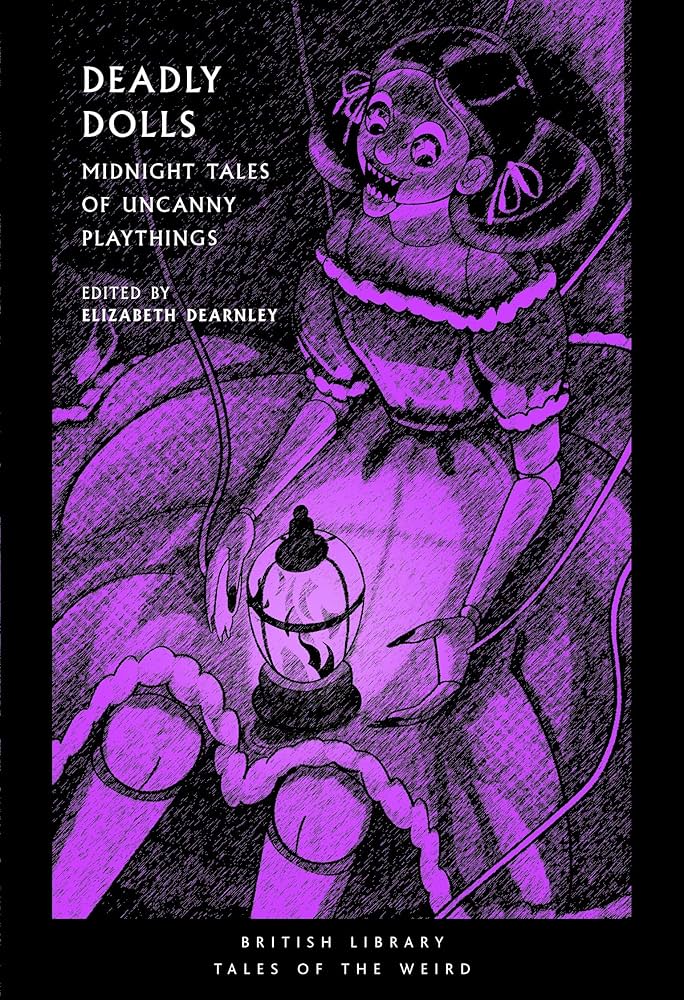
Deadly Dolls: Midnight Tales of Uncanny Playthings edited by Elizabeth Dearnley

Earlier this year I read Doomed Romances, a short story collection from the British Library’s Tales of the Weird series. I found it very mixed in quality – some great stories and some much weaker ones – but I was still interested in trying another one and I’m pleased to say that Deadly Dolls is much more consistent. As November is German Literature Month, I had initially planned to read the first story in the collection for now, which happens to be a German translation – ETA Hoffmann’s The Sandman – and leave the rest for later, but I then got tempted by the second story and read the whole book last weekend. The stories are all quite short, which made it a quick book to read!

This selection of fourteen stories is edited by Elizabeth Dearnley and as the title suggests, there’s a shared theme of dolls and toys. The Sandman, published in 1817 – and the story on which the ballet Coppélia was based – is the oldest story in the book, with the others spread throughout the 19th, 20th and 21st centuries. It’s a dark story – the Sandman of the title is a mythical character who steals the eyes of human children and takes them back to his nest on the moon to feed to his own children, an image which terrifies our young protagonist Nathanael so much that it haunts him for the rest of his life. I enjoyed it (my only other experience of Hoffmann is the entirely different The Life and Opinions of the Tomcat Murr) but I felt that others in the collection were even better.

A particular favourite was The Dollmaker by Adèle Geras, an author completely new to me. A dollmaker, known to the village children as Auntie Avril, opens a dolls’ hospital, repairing and restoring broken dolls. When three of the children notice that their dolls have been returned to them with alterations that seem unnecessary, they begin to question Auntie Avril’s motives. It seems Geras has been very prolific, writing many books for both children and adults, and I’m surprised I’ve never come across her before. I also enjoyed The Dancing Partner by Jerome K. Jerome (this time an author I know and love), in which a maker of mechanical toys decides to find a solution to the lack of male dance partners reported by his daughter and her friends. Although this is an entertaining story, it does have a moral: that we shouldn’t interfere with nature and try to play God.

At least two of the other stories have a similar message, despite having completely different plots. Brian Aldiss’ fascinating 1969 science fiction story, Supertoys Last All Summer Long, is set in a dystopian future where the rate of childbirth is controlled by the Ministry of Population. Meanwhile, in Ysabelle Cheung’s The Patchwork Dolls, a group of women literally sell their faces to pay the bills. Published in 2022, this is the most recent story in the book and I did find it interesting, if not quite as strong as most of the others. It’s one of only two contributions from the 21st century in this collection – the other is Camilla Grudova’s The Mouse Queen, an odd little tale that I don’t think I really understood and that I don’t feel belonged in this book anyway as it has almost nothing to do with dolls.

Joan Aiken is an author I’ve only relatively recently begun to explore, and as I’ve so far only read her novels it was good to have the opportunity to read one of her short stories. Crespian and Clairan is excellent and another highlight of the collection. The young narrator who, by his own admission, is ‘a very unpleasant boy’, goes to stay with an aunt and uncle for Christmas and becomes jealous when his cousin receives a pair of battery-operated dancing dolls. He comes up with a plan to steal the dolls for himself, but things don’t go quite as he expected! If I’d never read Aiken before, this story would definitely have tempted me to read more! The same can be said for Agatha Christie, whose The Dressmaker’s Doll is another one I loved. This story of a doll that appears to come to life when nobody is watching is maybe not what you would expect from Christie, as it’s not a mystery and there are no detectives in it, but it’s very enjoyable – as well as being very unsettling!

Unlike Doomed Romances, where the stories appeared in chronological order, adding to the unbalanced feel of the book, this one has the stories arranged by subject, which I thought worked much better. For example, two stories which deal with people in love with dolls are paired together – Vernon Lee’s The Doll and Daphne du Maurier’s The Doll. The latter is one I’ve read before (in du Maurier’s The Doll: Short Stories) but I was happy to read it again and be reminded of how good her work was, even so early in her career. There’s also a group of stories featuring dolls’ houses and of these I particularly enjoyed Robert Aickman’s The Inner Room, in which a girl is given a Gothic dolls’ house by her parents and develops an unhealthy fascination with it. In both this story and MR James’ The Haunted Dolls’ House, the houses and their inhabitants seem to take on a life of their own, but in different ways.

I think there are only two stories I haven’t talked about yet, so I’ll give them a quick mention here. They are The Loves of Lady Purple by Angela Carter and The Devil Doll by Frederick E. Smith. I’m not really a big Carter fan, but I’m sure those of you who are will enjoy this story about a puppeteer and his puppet, Lady Purple. I loved The Devil Doll, though. It’s a great story about a ventriloquist whose assistant suffers a terrible fate and is one of the creepier entries in the collection.

This is a wonderful anthology, with only one or two weaker stories, and if you’re interested in trying a book from the Tales of the Weird series I can definitely recommend starting with this one.

Passenger to Frankfurt by Agatha Christie – #1970Club

My second book for this week’s 1970 Club (hosted by Karen and Simon) also counts towards the Read Christie challenge where, for the final three months of the year, we are focusing on Agatha Christie books from the 1960s and 70s. I was a bit dubious about reading Passenger to Frankfurt as it seems to be widely considered one of her worst novels, but I want to read all of her books eventually anyway, so this seemed as good a time as any.

The novel begins with Sir Stafford Nye being delayed at Frankfurt Airport on his way home to England from a diplomatic mission in Malaya. When he is approached by a young woman who tells him that her life is in danger, Sir Stafford finds himself agreeing to lend her his passport and cloak so she can safely board the next flight to London in disguise. This is to be the first of several encounters Sir Stafford has with this woman; after he returns to London himself, having claimed to have been the victim of a theft, he places an advertisement in the newspaper in the hope of tracking her down, and their paths soon cross again.

None of this may seem particularly plausible, but at least it’s fun. Once Sir Stafford begins to learn more about his new acquaintance and her mission, however, things start to go downhill. He is pulled into a web of espionage and intrigue, which should be exciting but unfortunately isn’t, partly because there’s not much action – instead there are lots of long passages in which various people hold meetings and conferences to discuss the rise in youth movements and rebellions around the world. There are discussions of fascism, neo-Nazis, student protests, anarchy, drugs and weapons; Christie was eighty years old when this book was published and it seems that her view of the future was a very bleak one, in particular regarding the role young people would play.

This could still have been interesting, but Christie doesn’t manage to balance her political commentary with any kind of coherent plot, so all those conversations about youth unrest do become very repetitive and tedious, especially as the various conspiracy theories that arise are too outlandish to take seriously. There’s also a large number of characters, many of whom are introduced and then disappear again a few pages later. Apart from Sir Stafford and his mysterious female friend, the only one who really stands out is Sir Stafford’s Aunt Matilda, one of those no-nonsense old ladies Christie writes so well. Intriguingly, Matilda has an assistant, Amy Leatheran, who I assume is the same character who appeared in Murder in Mesopotamia, although no reference is made to her earlier adventures!

I often enjoy Christie’s thrillers and spy novels (They Came to Baghdad and The Man in the Brown Suit are favourites), but this one was a big disappointment and certainly the weakest of all the Christie novels I’ve read so far. I don’t regret reading it for 1970 Club, though, because, as I’ve said, I was going to read it at some point anyway. Definitely one for completists, in my opinion, and not the place to start if you’re new to Christie’s work.

Ordeal by Innocence by Agatha Christie

The September choice for the Read Christie 2024 challenge is Ordeal by Innocence, a book which, along with Crooked House, Christie herself named as one she felt most satisfied with. It was first published in 1958 and is a standalone novel, with no Poirot, Miss Marple or any of Christie’s other recurring characters.

The novel begins with Dr Arthur Calgary visiting the Argyle family at their home, Sunny Point, to give them what he hopes will be some very welcome news. Two years earlier, Jacko Argyle was found guilty of the murder of his adoptive mother. Although he claimed to have an alibi, he was unable to prove it and was sentenced to life imprisonment. Now, Dr Calgary has come forward to confirm that he was with Jacko at the time of the murder, therefore he couldn’t have committed the crime. Calgary seems to have a valid reason for not speaking out sooner – a head injury affecting his memory, followed by a long trip to the Antarctic – but it’s now too late to help Jacko, who has died of pneumonia in prison. Still, Calgary hopes his belated evidence will bring some comfort to the family. However, it has the complete opposite effect…because if Jacko didn’t kill Mrs Argyle, who did?

This is a novel driven by characters, personalities and motives rather than one with a lot of plot. Most of the book is made up of conversations between various members of the Argyle household as they discuss amongst themselves and with Superintendent Huish the events that took place the night of Mrs Argyle’s murder and who they think could be responsible. There’s the dead woman’s husband, Leo Argyle, who is now planning to marry his secretary, Gwenda; there are the other four adopted Argyle children, Mary, Micky, Tina and Hester, all now adults who have had one reason or another to resent their adoptive mother; and Kirsten Lindstrom, their Swedish nurse who has been with the family for many years. It (unbelievably) doesn’t seem to occur to Dr Calgary, until it is pointed out to him, that by clearing Jacko’s name he has simply cast suspicion on the rest of the family again, but this becomes a major theme of the book – the idea that only the guilty person knows the truth, therefore it’s the innocent who suffer the most:

“The family would come under suspicion,” he said, “and it might remain under suspicion for a long time – perhaps for ever. If one of the family was guilty it is possible that they themselves would not know which one. They would look at each other and – wonder… Yes, that’s what would be the worst of all. They themselves would not know which…”

Another theme Christie tackles in this book is adoption and the question of nature vs nurture. Sadly, her opinion of adoption seems to be quite a negative one, with several characters stating that the relationship between a child and their adoptive mother can never be as strong as with their biological mother. It’s also strongly implied that some of the Argyle children have criminal tendencies because they’ve inherited those traits from their birth parents and are destined to be bad people regardless of how much love and attention they receive from their adoptive parents. These are not views I agree with, but clearly they are subjects Christie was interested in and wanted to explore in this novel.

As a standalone, I think this book suffers from not really having a character who does any ‘detecting’. Dr Calgary does take on this role eventually, wrapping things up for us in the final chapter, but otherwise we don’t see much of Superintendent Huish and the only member of the Argyle household who shows any interest in trying to solve the crime is Mary Argyle’s husband, Philip. There’s not much action until very late in the book, so most of the focus is on the characters discussing their memories of Mrs Argyle and what they were doing at the time of her death. In this respect, the book reminded me of Five Little Pigs, another Christie novel which deals with a mystery from the past.

Next month, and for the rest of the year, the Read Christie challenge will be moving on to books published in the 1960s and 1970s. I have plenty of those still to read!

I’m counting this as my first book towards this year’s RIP challenge.

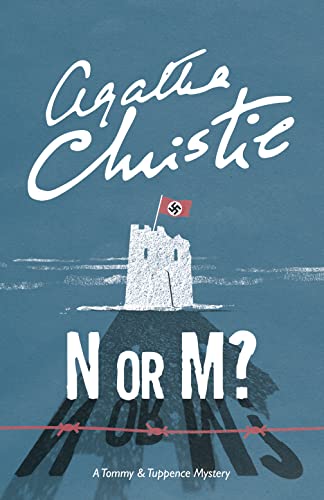
N or M? by Agatha Christie

This month – and in August and September – the Read Christie challenge is moving on to books published in the 1940s and 1950s. I have several unread Christies from those decades to choose from, but I decided to start with N or M?, a Tommy and Tuppence novel from 1941. I enjoyed the first two T&T books, The Secret Adversary and Partners in Crime, and this is the third in the series.

I think this is a series best read in order as, unlike Poirot and Miss Marple, Tommy and Tuppence age almost in real time; they were in their early twenties in 1922’s The Secret Adversary and when we join them at the beginning of N or M? they are over forty. Their advancing age has become a source of frustration to them now that the world is at war and it seems that they are too old to make any meaningful contribution. Then, Mr Grant, a secret agent, arrives with an intriguing proposition for Tommy. He must travel undercover on behalf of the Secret Service to a boarding house on the south coast of England in search of two German spies, one male and one female, known only by the initials N and M. The mission must be kept secret from everyone, including Tuppence, who is told that Tommy is being sent to Scotland to take up a boring office job. However, Tuppence is already one step ahead and determined not to miss out on the excitement!

N or M? is more of a thriller/espionage novel rather than a traditional detective novel, which made a nice change from my last two Read Christie selections, which have both been Poirot mysteries. One of the good things about diving into Christie’s books more or less at random as I have been doing over the last few years is that there’s enough variety within her body of work that you never really get bored. However, there’s still a mystery to be solved here – the mystery of the true identities of N and M – and plenty of clues to look out for. I found it very easy to identify one of the spies (and was frustrated that Tommy and Tuppence didn’t work it out as quickly as I did), but I didn’t guess the other one so there were still some surprises in store for me.

With most of the novel being set in and around the Sans Souci boarding house, this means all of the suspects are together in one place, giving Tommy and Tuppence plenty of opportunities to observe them. The most obvious is Carl von Deinim, a German refugee and research chemist, but is he too obvious? The other guests include a larger than life Irishwoman, a retired Major, an invalid and his wife, and a young mother with her two-year-old daughter. Literally anybody could be a spy and Christie does a great job of capturing the sense of danger, mistrust and paranoia. I was quite worried for Tommy and Tuppence at times, even though I knew they must survive as there are more books in the series!

I’ve found that the other Christie novels I’ve read that were published during this same time period barely mention the war, if at all, so it was unusual to find one in which the war is such a central part of the plot and affects the lives of the characters in so many ways. I really enjoyed it and am looking forward to reading the next Tommy and Tuppence book, By the Pricking of My Thumbs – although not just yet, as it’s published in 1968 and we’ll be staying in the 40s and 50s for the next two months.

This is book 11/20 of my 20 Books of Summer 2024.

Three Act Tragedy by Agatha Christie

This month for the Read Christie challenge we are reading Christie novels published in the 1930s and I have chosen Three Act Tragedy from 1934. The book was also published in the US as Murder in Three Acts and that’s not the only difference – apparently the motive for one of the murders was also changed for the US edition. I’m not sure if there are any other Christie novels with significant differences between editions or if this is the only one.

Three Act Tragedy is a Poirot mystery but also features one of Christie’s other recurring characters, Mr Satterthwaite, who appears in The Mysterious Mr Quin and Murder in the Mews. At the beginning of the novel, Satterthwaite and Poirot are both attending a dinner party hosted by the stage actor Sir Charles Cartwright at his home in Cornwall. When one of the other guests, the Reverend Babbington, suddenly drops dead after taking a sip of his cocktail, several people suspect murder – yet there are no traces of poison in his glass. Soon afterwards, another death occurs under similar circumstances at a party attended by many of the same guests, but this time the victim is confirmed to have died from nicotine poisoning. Are the two deaths connected and if so, did the same person carry out both murders?

This is another entertaining Christie novel; maybe not one of her strongest plots, but the motive for the first murder is very unusual and I didn’t guess either that one or the motive for the second murder. I did start to suspect who was responsible, but not until much later in the book, so I can’t claim to have solved the mystery. We don’t see very much of Poirot himself as this is one of the books (like Lord Edgware Dies, which I read last month) where he sits at home and waits for other characters to provide him with information, rather than going out to interview suspects and search for clues himself. Instead, the deaths are investigated by Mr Satterthwaite and Sir Charles, with help from Miss Lytton Gore, affectionately known to her friends as Egg.

I would have liked Poirot to have played a bigger part in the story as although I like the elderly Mr Satterthwaite, he’s not very skilled at detecting, and I never really felt fully engaged with either Sir Charles or Egg. There’s an interesting cast of supporting characters, such as Muriel Wills, who writes plays under a male pseudonym, but I felt that some of these weren’t really used to their full potential. This wasn’t a favourite Christie, then, but I did still enjoy it – and it was good to see Poirot sharing a little bit of his personal history in a conversation with Satterthwaite, as he usually reveals very little about himself.

Next month for the Read Christie challenge (and for August and September as well) we are moving on to the 1940s and 1950s. There are plenty of books I still have to read from those decades, but one I definitely have lined up is N or M?, the third in the Tommy and Tuppence series. I’m hoping to make that one a July read.

This is book 5/20 of my 20 Books of Summer 2024.