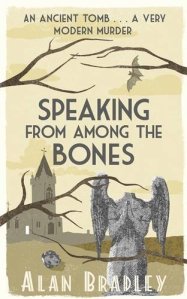
Speaking from Among the Bones by Alan Bradley

Speaking from Among the Bones Speaking from Among the Bones is Alan Bradley’s fifth novel featuring the wonderful Flavia de Luce. Flavia’s intelligence, her passion for chemistry (particularly poisons), and the fact that she is still only eleven years old makes her one of the most fascinating and unusual detectives in fiction. The series is set in the 1950s in the small English village of Bishop’s Lacey where Flavia lives with her father and two sisters, Ophelia and Daphne, at the family’s ancestral home, Buckshaw. In each book Flavia investigates a murder mystery, torments (and is tormented by) her sisters, conducts experiments in her chemical laboratory, and desperately searches for information about the mother she has never known.

Flavia’s fifth adventure begins as she excitedly awaits the removal of St Tancred’s bones from his tomb in the church crypt to commemorate the five-hundredth anniversary of his death. She is hoping to be the first person in Bishop’s Lacey to see the saint’s bones, but what she eventually discovers when the tomb is opened is something quite different: the body of the church organist, Mr Collicutt, who had disappeared a few weeks earlier. Who murdered him and what was their motive? And why is he wearing a gas mask? These are the questions Flavia must try to answer – hopefully before Inspector Hewitt solves the mystery first! Accompanied by her trusty old bicycle, Gladys, Flavia begins to search for clues, but as well as making some discoveries regarding the organist’s death and the possible identity of his killer, she also starts to uncover some of the secrets of her mother’s past.

I’ve enjoyed every book in the series so far, but I think this one might be my favourite (either this or the Christmas-themed one, I am Half-Sick of Shadows). As I’ve mentioned in my previous Flavia reviews, I love this series because I love Flavia, the supporting characters, and the setting of Bishop’s Lacey. The actual murder mysteries are not usually very complex or difficult to solve and are not the attraction of these books for me, but I thought this was an improvement on the previous ones. It was tightly plotted with lots of clues, suspects and red herrings and during her investigations Flavia finds herself crawling through underground tunnels, entering secret locked rooms, encountering a wooden effigy that appears to have started weeping blood in the church, and discovering that she is not the only amateur detective in Bishop’s Lacey!

While Flavia is still just eleven and has only aged slightly over the course of the series, I do think we’ve seen her grow up and mature since the first book. There has been development with some of the other characters too, particularly Ophelia (Feely) and Daphne (Daffy), Flavia’s two sisters, who are not quite as horrible to Flavia in this book as they have been previously – or maybe Flavia is just learning to deal with them better. Also in this book, their father is continuing to have financial difficulties, forcing him to consider putting Buckshaw up for sale and this shared trauma helps to bring the whole family together for once. By ‘family’ I’m including the servants, Mrs Mullet and Dogger. Dogger is a great character and a true friend to Flavia – I like him more and more with every book!

If you’re new to this series, beginning with book five probably wouldn’t be a problem, but if possible I would recommend starting with the first one, The Sweetness at the Bottom of the Pie, and enjoying all of Flavia’s adventures in order. This is the only one to finish with a cliffhanger ending, which means I now can’t wait to read the sixth book, The Dead in Their Vaulted Arches!

I am Half-Sick of Shadows by Alan Bradley

I hope everyone had a great Christmas! I don’t usually read a lot of Christmas-themed books but the one I’m posting about today, I am Half-Sick of Shadows, was a perfect seasonal read.

I know not everyone will be familiar with Alan Bradley’s books, so for those of you who need some background information I can tell you that I am Half-Sick of Shadows is the fourth in a series of mystery novels set in the 1950s and featuring eleven-year-old amateur detective and chemistry genius, Flavia de Luce. Flavia lives with her father and her two older sisters Ophelia (Feely) and Daphne (Daffy), at Buckshaw, their family estate near the small English village of Bishop’s Lacey. Other recurring characters include the de Luces’ two servants, Mrs Mullet and Dogger, as well as the local vicar, the doctor, Inspector Hewitt and several more of the villagers.

At the beginning of this fourth instalment, Flavia’s father is having financial difficulties and in an attempt to bring in some money, he allows the cast and crew of Ilium Films to move into Buckshaw to do some filming over the Christmas period. While the snow falls outside, the people of Bishop’s Lacey gather at Buckshaw to watch the two stars, Phyllis Wyvern and Desmond Duncan, give a special charity performance of Romeo and Juliet. Things go badly wrong, however, and a murder takes place. With the de Luce family and all their neighbours snowed in overnight, there’s a long list of suspects. Flavia begins to investigate, but before she can concentrate on identifying the murderer she needs to finish working on a special project of her own: a trap to catch Santa Claus on his way down the chimney!

I have enjoyed all three of the previous books in this series, but I think I am Half-Sick of Shadows could possibly be my favourite so far. It took a long time (almost half the book) before the murder took place and the actual mystery began – and it was probably the weakest mystery in the series too – but that wasn’t a problem for me at all. I don’t read these books for the murder mystery plots; I read them because I love Flavia and love reading about her adventures.

As well as being shorter than usual, this book has a different feel to the first three because it is set entirely within the confines of Buckshaw. This means we get to see more of Flavia’s interactions with her family members and we also have the chance to learn more about Dogger, one of the most interesting characters in the series. I’ve mentioned before that I was starting to get impatient with Feely’s and Daffy’s nastiness towards their younger sister, but there seemed to be a slight change in Daffy’s relationship with Flavia in this book and I almost liked her at times! There was also a hint that maybe Feely didn’t really hate Flavia and that there might be another reason for her cruel behaviour. I’m still hopeful that the three of them will be friends by the end of the series, but we’ll have to wait and see – I’m already looking forward to the fifth book to find out if there are any further developments.

I’m glad I was able to find time to read this book last week as it really was perfect for the Christmas season. Oh, and in case you’re wondering, the title comes from the poem by Tennyson, The Lady of Shalott.

A Red Herring without Mustard by Alan Bradley

A Red Herring without Mustard is the third book in Alan Bradley’s Flavia de Luce mystery series. I loved the first two books in the series (The Sweetness at the Bottom of the Pie and The Weed that Strings the Hangman’s Bag) and I was pleased to find that this one is as good as the others.

A Red Herring without Mustard, like the previous books in the series, is set in 1950s England, in the village of Bishop’s Lacey. Flavia de Luce is an eleven-year-old girl who lives with her father and sisters on their family estate, Buckshaw. Flavia has a passion for chemistry and a talent for solving murder mysteries, despite the attempts of Inspector Hewitt to stop her becoming involved. Away from her detective work, Flavia enjoys riding her trusty bicycle, Gladys, spending time in her chemical laboratory and thinking up ways to get revenge on her two sisters, Ophelia and Daphne, who are forever torturing her.

In this book a gypsy woman, Fenella Faa, is brutally attacked while camping in The Palings, part of the de Luce estate. As Flavia begins to investigate the assault, a bizarre murder takes place in the grounds of Buckshaw. The two must be connected, but how? And why is there always a smell of fish at the scene of the crime?

I thought the mystery in this book was slightly more complex than the previous ones, but for me, the real charm of this book (and the series as a whole) is not the mystery plot but the character of Flavia herself and her interactions with the people around her. In this third instalment of the series there’s a lot of focus on Flavia’s family history and in particular, the story of her mother, Harriet, who died when Flavia was younger. I enjoyed learning more about the de Luce family and it seemed that there was some development with not only Flavia’s character but also of her father and sisters, Feely and Daffy. I would like to know exactly why Feely and Daffy are both so horrible to Flavia though, and I’m hoping their relationship will improve by the end of the series!

As well as Flavia’s family, there are a large number of other recurring characters who we meet again in this book including the de Luce servants, Mrs Mullet and Dogger. We are also introduced to a new character, Fenella’s granddaughter, Porcelain Lee. I don’t know if Porcelain will appear in any future books but I hope she does as I would like Flavia to have a friend.

The other thing I love about this series is the old-fashioned feel and the setting of Bishop’s Lacey, a small village community where everybody knows everybody else. It was also interesting to explore some of the hidden corners of Buckshaw, Flavia’s home.

If you’re new to Flavia de Luce, you could probably start reading at any point in the series but I would recommend beginning with the first one and reading them in order. If you’ve enjoyed either or both of the previous novels there’s a good chance that you’ll like this one too as it’s really very similar. And the good news for Flavia fans is that the fourth book, I am Half-Sick of Shadows is out now!

The Weed that Strings the Hangman’s Bag by Alan Bradley

The Weed that Strings the Hangman’s Bag is the second book in Alan Bradley’s Flavia de Luce mystery series. I read and loved the first one, The Sweetness at the Bottom of the Pie, last year but it’s taken me so long to find time to read this one that the third book has also now been released and is waiting patiently on my shelf.

For those of you who are new to the series, the novels are set in the small English village of Bishop’s Lacey during the 1950s and feature Flavia de Luce, an eleven-year-old detective and chemistry genius. The mysteries are not particularly complex but Flavia’s unique narrative voice makes the books a lot of fun to read.

The Weed that Strings the Hangman’s Bag begins shortly after the previous book ended, but if you haven’t already read The Sweetness at the Bottom of the Pie I don’t think it would matter too much. And if you have read The Sweetness… you’ll find that this book is really very much the same: Flavia is still conducting experiments in her laboratory, her sister Daffy is still obsessed with books, her other sister Feely is still obsessed with her appearance, Father is still collecting stamps. But the tone of this book is slightly darker than its predecessor and I enjoyed the mystery more as there were a lot of possible suspects and the villain wasn’t immediately obvious – at least not to me!

This time Flavia investigates a murder that takes place during a puppet show in the village hall and begins to connect this death with the hanging of a little boy in Gibbet Wood several years earlier. As a detective, the advantage Flavia has is that being an eleven-year-old girl she can ask questions that the police can’t ask and can convince the local people to tell her things they might not tell an adult. Being an expert in poisons helps too, of course!

Flavia hasn’t changed a lot between the first book and this, but she does feel that little bit older and her sense of humour seems sharper. I’m hoping her character is going to develop further as the series goes on. The thing I love about Flavia is that she is somehow both a believable and an unbelievable character at the same time. She has a vocabulary like no eleven-year-old I’ve ever met and both her chemical and general knowledge are exceptional even by adult standards, but despite this she still feels real to me. She also has fears and insecurities (usually covered up by her tough exterior) and this book continues to explore her difficult relationships with her sisters and father, as well as introducing another family member, Aunt Felicity.

I love the old-fashioned, innocent feel of this series, which reminds me so much of the Enid Blyton books I grew up reading. Hopefully it won’t be too long before I can let you know what I think of A Red Herring Without Mustard!

Review: The Sweetness at the Bottom of the Pie by Alan Bradley

After hearing so many good things about Alan Bradley’s Flavia de Luce mysteries, I had high hopes for this book – and I wasn’t disappointed. It was every bit as enjoyable and delightful as I had been told it was.

Eleven year old Flavia de Luce, who wears her hair in pigtails and rides a bike called Gladys, most be one of the most unusual detectives in fiction. Her biggest passion is for chemistry – and more specifically, for poisons. She loves nothing more than spending time conducting experiments in her own fully equipped laboratory and her heroes include famous chemists such as Marie Paulze Lavoisier, Robert Bunsen and Henry Cavendish.

When a dead bird with a rare stamp impaled on its beak is found on the de Luces’ doorstep, Flavia is puzzled by the effect the discovery has on her father. Later, Flavia finds something much more sinister in the cucumber patch and when her father is accused of murder, she becomes determined to clear his name.

Although this wasn’t a particularly complex mystery, it was an interesting one, involving magic tricks, a sheet of Penny Black stamps and a slice of custard pie. There were parts of it that I could figure out quite easily but others that took me by surprise. I don’t often read mysteries anymore, but this book reminded me of exactly why I used to love them! However, the mystery itself is only one element of this book. I think due to the characters and the setting (which includes all the little period details that place the story firmly in 1950 and perfectly capture a small village atmosphere), this series could appeal even to non-mystery lovers.

The main reason I enjoyed this book so much was Flavia herself. She really is a wonderful character, innocent and lovable one minute, ruthless and vengeful the next (at the beginning of the book she runs away in tears when her sisters Ophelia and Daphne taunt her by pretending she’s adopted – and then proceeds to inject poison ivy into Ophelia’s lipstick). The chemistry aspect of the book particularly interested me as I have a degree in chemistry myself – although I was never as passionate as Flavia about the subject! She seems to have a PhD level grasp of the subject already. And her sphere of knowledge also encompasses literature, history, film and music. She’s so incredibly clever and independent that it’s easy to forget she’s only supposed to be eleven. There’s no way you would expect a real child of that age to speak or behave the way Flavia does – and yet somehow, in a strange way, I was able to overlook the fact that she’s so unrealistic and could accept her as a plausible character.

I’ve seen comparisons with Nancy Drew and Harriet the Spy, but while I was reading this book I was also reminded of Enid Blyton’s Five Find-Outers series, which was also set in a small English village in the 1940s/50s and featured a group of children who always solved the mystery before the village policeman. I have no idea if Alan Bradley would have been inspired by those books at all, but there are definitely some similarities.

I loved this book and now I can’t wait to read The Weed that Strings the Hangman’s Bag!