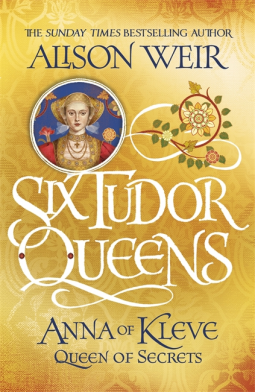
 This is the fourth book in Alison Weir’s Six Tudor Queens series which aims to retell in fictional form the stories of all six of Henry VIII’s wives. I enjoyed the previous three – on Katherine of Aragon, Anne Boleyn and Jane Seymour – but I was particularly looking forward to reading this one, on Henry’s fourth wife, Anne of Cleves. Before I began, all I really knew about Anne was that Thomas Cromwell was instrumental in arranging her marriage to Henry, that the King was disappointed when he saw her in the flesh as she didn’t live up to the Hans Holbein portrait he had seen, and that after their divorce she lived in comfort and was given the honour of being described as the King’s ‘beloved sister’. I knew there must be more to Anne’s story than this and I hoped to learn more about her from this new novel.
Alison Weir refers to Anne as Anna, so I will do the same for the rest of this post. She also uses the spelling Kleve rather than the Anglicised version, Cleves, and tells us that this should be pronounced to rhyme with ‘waver’. The duchy of Kleve, in what is now Germany, is the setting for the first section of the novel, which describes Anna’s life prior to her marriage. Her journey to England and brief time as Henry’s wife follows, and finally an account of the period after the divorce, taking us all the way through to her death in 1557 at the age of forty-one.
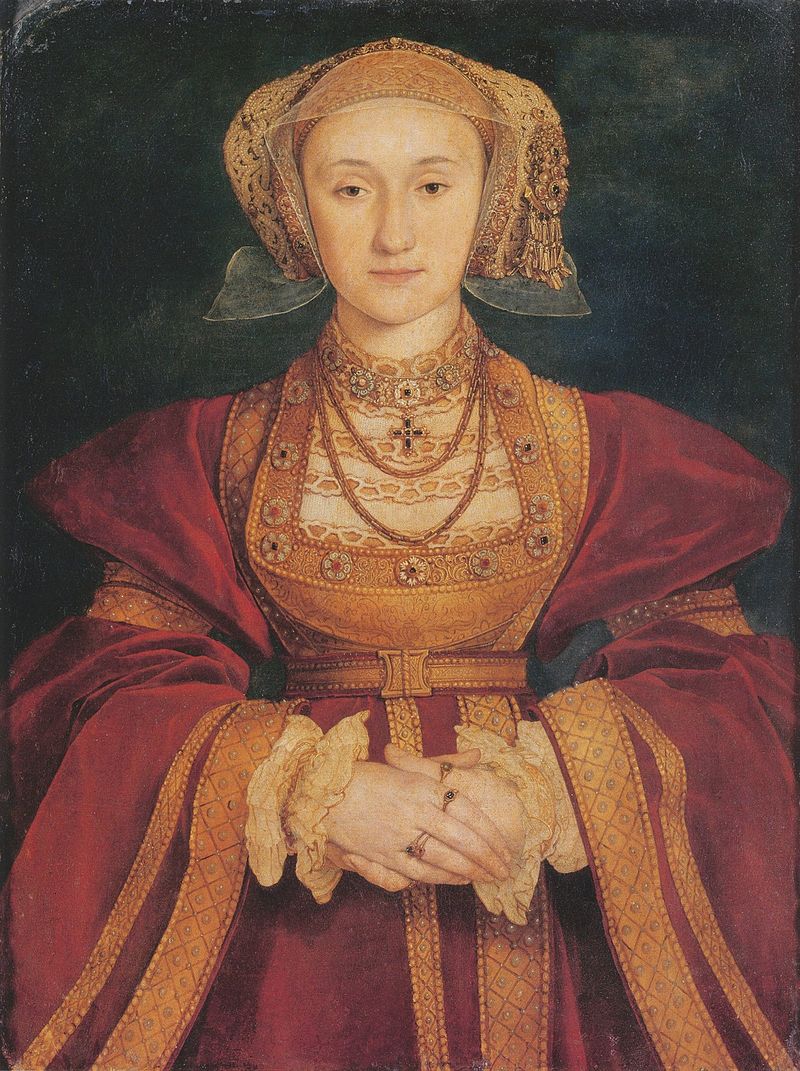
Anne of Cleves, by Hans Holbein the Younger
Bearing in mind that this is a novel with around 500 pages and that there isn’t really a lot of factual information available on Anna von Kleve, I felt that there was too much padding and at times I found the book quite tedious and repetitive. Because Weir takes us right up to the time of Anna’s death, towards the end of the book a lot of attention is given to the next two queens, Katheryn Howard and Catherine Parr, as well as various incidents and plots that took place during the reigns of Edward VI, Lady Jane Grey and Queen Mary. Unfortunately, by this point Anna is living away from court on her various estates, so she has little personal involvement and most of these events are described from afar which made them less exciting to read about than they should have been.
To flesh out Anna’s story and make it more interesting, Weir has imagined a romance for her in Kleve before she marries the king and this has repercussions that affect the rest of her life. I won’t go into too much detail, but looking at other reviews of this book, some readers liked this imaginary storyline while others hated it. It’s not beyond the realms of possibility as Henry did allegedly tell people that he ‘doubted Anna’s virginity’, but that could have just been an excuse for not consummating the marriage and demanding a divorce. However, even if it was true, there is no evidence to suggest who her previous lover may have been, so this aspect of the novel is entirely fictional.
Although this is my least favourite book in the series so far, I have a copy of the next one, Katheryn Howard, the Tainted Queen, on my NetGalley shelf and am anticipating a more entertaining read – and hopefully, given Katheryn’s much more dramatic life, one that needs to rely less heavily on fiction.
Thanks to Headline for providing a copy of this book for review via NetGalley.

 She Reads Novels