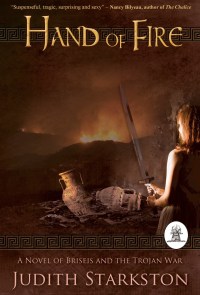
Hand of Fire by Judith Starkston

perf6.000x9.000.indd In this wonderful combination of historical fiction and Greek mythology, Judith Starkston reimagines events from the Iliad, telling the story of the Trojan War through the eyes of Briseis, a woman who plays an important role in Homer’s epic despite being only briefly mentioned. In Hand of Fire, Briseis is finally given the attention she deserves.

At the beginning of the novel, Briseis is a young priestess of the healing goddess Kamrusepa, but is sadly unable to prevent her own mother from dying. There is more sadness to follow for Briseis when she is married off to Mynes, a prince of Lyrnessos, and finds him to be a violent and abusive man. Sustained by the compassion of her elderly nurse, Eurome, and by visions of the handsome, half-immortal Greek warrior, Achilles, the turning point comes when the city of Lyrnessos falls to the Greek army and Briseis is taken captive. How can she reconcile her love for Achilles with her new position as slave?

Hand of Fire surprised me; I really didn’t expect to enjoy it quite as much as I did. I love reading historical fiction but tend not to choose books set in the ancient world. I often find that I have trouble identifying with the characters – I sometimes feel that even the non-mythological ones seem more like mythological beings than real people. That was not a problem here: this is a very human story with characters I could love and care about. Briseis herself is a great protagonist and I liked her from the beginning. She has great strength and resilience, all the more impressive when you consider everything she has to endure – the loss of her mother, marriage to a man who treats her badly, personal tragedy in the face of war, life as a captive slave, and her tumultuous relationship with Achilles.

Achilles is more difficult to understand. His personality is complex and conflicted; in battle he is a fierce, mighty warrior gripped by an unstoppable rage, but when he is alone with Briseis we see the gentler, more sensitive side of his nature. Of the secondary characters, there are two in particular that I found very well developed and memorable. One is Eurome, Briseis’ elderly maid, a caring, warm-hearted person and a devoted friend Briseis can trust and rely upon. The other is Patroklos, the beloved companion of Achilles, the only person apart from Briseis who is able to quell his rage.

This is a novel that has been thoroughly researched, which is evident from Judith Starkston’s author’s note in which she describes her reasons for writing this story, the things she discovered during the writing process and the decisions she needed to make. She does an excellent job of drawing on her knowledge of the period to create a convincing picture of what life may have been like for a woman who lived during the Bronze Age. The history of medicine is something I’ve always found very interesting, so I enjoyed the parts of the book that describe Briseis’ work as a healer (which consists mainly of using herbs and magical rituals as unlike her brother, Iatros, she is unable to study to be a physician).

Even for a reader like myself who only has a limited knowledge of Ancient Greece and hasn’t actually read the Iliad, I found this novel very accessible and easy to follow. I appreciated the fact that the author takes the time to flesh out the background to the story and doesn’t just assume that every reader will be familiar with the time period and the mythology. I was also pleased to find that there’s not too much emphasis on the battle scenes! This is Briseis’ story and the focus is on her personal life and on her relationships with Achilles, Mynes and the others. I really enjoyed spending time in her world and will be looking out for more novels from Judith Starkston in the future.

Hand of Fire tour graphic I read Hand of Fire as part of a Fireship Press Virtual Book Tour. You can find the tour schedule here.
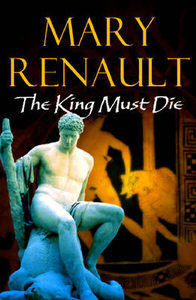
The King Must Die by Mary Renault

The King Must Die After my post on The Odyssey last Friday, I’m staying with an Ancient Greece theme again this week – but in the form of historical fiction this time.

Beginning with his childhood in Troizen, The King Must Die tells the story of Theseus, a story which I’m sure will already be familiar to many readers. Theseus lives with his mother but has never known the true identity of his father, believing him to be the god Poseidon. When he succeeds in raising a boulder to reveal his father’s sword, Theseus learns that he is actually the son of Aigeus, the King of Athens, and sets off for Athens to find him. After an eventful journey during which Theseus becomes King of Eleusis, he arrives in Athens and meets his father at last. But when King Minos of Crete demands that fourteen young people are sent to him to train as bull-dancers, Theseus makes the decision to become one of the fourteen…and finds himself facing the Minotaur in the Labyrinth of the Palace of Knossos.

Mary Renault is an author I’ve been wanting to read for a long time and I became even more interested when I noticed that on the back covers of my Vintage editions of the Lymond Chronicles by Dorothy Dunnett, it says that Dunnett’s writing ‘inspires comparisons with Mary Renault and Patrick O’Brian’. I’ve now read some of Patrick O’Brian’s books and enjoyed them (though not as much as Dunnett) so it seemed a good idea to try Mary Renault too. However, I’ve been hesitant because, as I explained in my Odyssey post, mythology and Ancient Greece are not subjects that really appeal to me. It was finally making it to the end of The Odyssey a few weeks ago that gave me the motivation to pick up The King Must Die at last.

I was curious to see how this book could be described as historical fiction, as a story with a plot involving Poseidon and the Minotaur sounded more like mythology to me. Having read the novel, I now understand that The King Must Die is not simply a re-telling of the Theseus myth but a more realistic recreation of his life, portraying Theseus as a real human being rather than a character from Greek mythology. Most of the essential elements of the myth are here, but they are cleverly incorporated into the historical setting and given logical, plausible explanations.

My favourite part of the book was the section describing Theseus’s adventures in Knossos as a bull-dancer, learning new skills and techniques, and bonding with the other members of his team. I also enjoyed learning about the different customs and rituals of the various cultures and communities Theseus visits on his journey, including the Hellenes, the Minyans and the Cretans. There’s a fascinating author’s note at the end of the book in which Mary Renault explains how she was able to link parts of the Theseus legend to historical fact.

While I did enjoy this book, I do feel disappointed that I didn’t love it as much as I had hoped to. There was nothing specific that I disliked about the book or that I could say didn’t work for me; I certainly couldn’t fault the quality of the writing or the amount of research that must have gone into recreating Theseus’s world. It’s probably just that, as I’ve mentioned, I’m not particularly drawn to this subject or setting. I do still want to read the second half of Theseus’s story in the sequel, The Bull from the Sea!

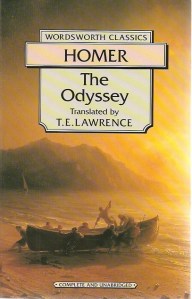
The Odyssey – translated by T.E. Lawrence

The Odyssey - Homer Ten years have passed since the Trojan War ended but Odysseus has still not returned home, having been held captive by the nymph Calypso, who has fallen in love with him. At home in Ithaca, his wife, Penelope, has found herself besieged by a large group of suitors who are hoping to persuade her to marry one of them. The suitors have taken over Odysseus’s palace and are helping themselves to his food and drink; his son, Telemachus, is desperate for them to leave but doesn’t have the courage to throw them out.

The Odyssey tells the story of Odysseus and his journey home to Ithaca – a journey involving encounters with the one-eyed Cyclops, the witch Circe, the sea monster Scylla, and the tempting music of the Sirens. But it’s also the story of Telemachus and his quest to find out what has happened to his father; of Penelope, faithfully waiting for her husband to return; and of the Greek gods and goddesses who try to help or hinder Odysseus on his travels.

I’m so happy to have finally read The Odyssey as it was one of the least appealing books on my Classics Club list, not necessarily because I was intimidated by it (well, maybe a little bit) but because I’m just not very interested in mythology. I can’t really explain why I’m not a fan; I did enjoy reading Greek myths as a child, but since then my reading has taken me in other directions. I know that probably puts me in a minority as most people seem to love mythology and have a lot more knowledge of the subject than I do!

I’ve started to read The Odyssey before but didn’t finish it so this is the first time I’ve actually read it from beginning to end. I did already know most of the story, partly from school and partly because this is the sort of story that I think many people will have at least some familiarity with even if they’ve never read it in its entirety. There were some things I wasn’t aware of, though – for example, I was surprised by how little time is actually devoted to Odysseus’s journey. This section of the epic, in which Odysseus describes his adventures and the monsters and mythical beings he outwits, is by far the most well-known section, but it actually only takes up four of the twenty-four books that make up The Odyssey. The rest of the time is spent on the suitors, Telemachus and Penelope, and what Odysseus does after he eventually returns to Ithaca.

There are lots of different themes and ideas contained in The Odyssey – storytelling, disguise and deception, temptation, and the relationship between mortals and gods are a few that I noted and I’m sure there are others that I missed. There is also a lot of focus on hospitality. It seemed a weary traveller would be made welcome wherever they went, offered food, a bath and a bed for the night.

There are many different editions and translations of The Odyssey, some in verse and some in prose, but the book I read was the Wordsworth Classics edition pictured above from 1992 with a 1932 prose translation by T.E. Lawrence (better known as Lawrence of Arabia). There was no special reason why I decided to read this version, other than that I happened to have it on my shelf (I can’t remember where I got it from). I’m not sure if you can even still buy this particular translation in this edition anymore. However, this turned out to be a perfect translation for me. I know I’ve probably missed out on a lot of the beauty of The Odyssey by reading a prose version, but I don’t get on very well with narrative poems – apart from The Epic of Gilgamesh which I loved in verse form – so reading it in prose was probably a much better choice for me personally.

I have no idea how technically accurate Lawrence’s translation might be, but all I was really hoping for was something enjoyable and reasonably easy to read, and that’s what I got. I was surprised by how exciting and readable it actually was; I wonder if the fact that Lawrence himself had such an eventful life was an influence here in helping him to convey the drama of Odysseus’s adventures in such a compelling way.

I’m sorry about the lack of insight and analysis in this post. It doesn’t seem right to just ‘review’ an epic like The Odyssey as I would any other book, but that’s what I’ve had to do as I really don’t feel that there’s much I can add to everything that’s already been said about it over the centuries. It’s actually been a lot harder to write about The Odyssey than it was to read it!

Have you read The Odyssey? If I read it again, is there a translation you would recommend?

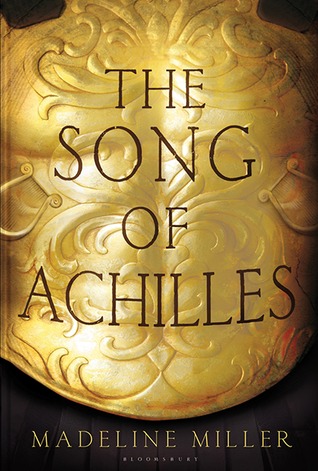
The Song of Achilles by Madeline Miller

The Song of Achilles is a retelling of the Iliad, told from the perspective of Patroclus, Achilles’ best friend and lover. Patroclus, the son of Menoetius, is only a child when he is exiled and sent to Phthia to live with King Peleus and his son, Achilles. Achilles is destined to become the greatest warrior of his generation and when he goes to Mount Pelion to receive training from the centaur, Chiron, Patroclus joins him there. As the years go by the bond between Achilles and Patroclus strengthens and their friendship develops into love, despite the attempts of Achilles’ mother, the sea goddess Thetis, to separate them.

The Trojan War begins when Helen, the wife of Menelaus of Sparta, is abducted by Paris of Troy. Both Achilles and Patroclus are part of the Greek army who set out to defeat the Trojans and return Helen to her husband. I’ll stop there because if you already know the story, you’ll know what happens to Patroclus and Achilles – and if you don’t, then I won’t spoil it for you.

I used to be fascinated by Greek mythology as a child but as the years have gone by I’ve read very little on the subject, so I began this book hoping that it would be good enough to reawaken my interest in it. I haven’t read The Iliad and could only remember a few basic facts about the Trojan War that I learned at school, so I was worried I might find it difficult to follow the plot. Well, this wasn’t a problem because Madeline Miller made it all very accessible and understandable. I was surprised to find that I actually knew more than I thought I did and recognised the names of a lot of the heroes and gods who appeared in the novel. But although the Trojan War and the events leading up to it are an important part of the story, the real focus is on the relationship between Achilles and Patroclus. Their love story was really beautifully written and filled with emotion and although the second half of the book didn’t sustain my interest as well as the first half did, I thought the final few chapters were particularly moving.

Achilles and Patroclus each have qualities that the other comes to value and admire. Achilles is handsome, talented and brave; Patroclus is quiet and loving. They both also have flaws: Patroclus often feels insecure while Achilles is sometimes too proud. It’s perhaps because they’re so different that they complement each other so well. I thought writing from the viewpoint of Patroclus was a good choice because it allowed us to see Achilles through the eyes of someone who loved him and also because, as a sensitive and observant narrator, he could give us interesting insights into the other characters as he met each of them for the first time, including Agamemnon, Briseis, Thetis, Ajax and my favourite, Odysseus.

I would recommend this novel to people like myself who only have a basic knowledge of Greek mythology (or none at all) as well as people who have already read The Iliad and are much more familiar with the story than I am. The Song of Achilles has something to offer both groups of readers. I’m still not sure that this is a subject I’m ever going to be passionately interested in, but after reading this book I do feel more enthusiastic about reading other novels based on Greek mythology.

The Song of Achilles was the winner of this year’s Orange Prize. I haven’t read any of the others on the shortlist because none of them really appealed to me, but having read this one I’m sure it was a deserving winner.