Marble Hall Murders by Anthony Horowitz

I’ve been waiting for this book for five years and here it is at last: the third (and it seems, final) book in Anthony Horowitz’s Susan Ryeland series. Apparently we have the actress Lesley Manville to thank for the fact that it’s been written at all – after starring as Susan in the recent BBC adaptations of Magpie Murders and Moonflower Murders, she told Horowitz she was desperate for a chance to play the character for a third time! If you haven’t read the previous two books I would recommend at least reading Magpie Murders before this one (there’s a note at the start of the book to warn us that it does contain spoilers).

In Marble Hall Murders, Susan is back in England having separated from Andreas and left him behind in Crete. Now working as a freelance editor, she attends a meeting with the publisher of Causton Books, Michael Flynn, who suggests an exciting new project to her. Three new continuation novels of the Atticus Pünd mystery series have been commissioned and as Susan had worked on the original novels with the late author Alan Conway, she’s the obvious choice to edit the new books as well. She agrees to take the job, but when she hears that Eliot Crace will be writing the novels, she’s less enthusiastic. Eliot’s previous novels were failures and the man himself she remembers as unpleasant and unreliable. That was a long time ago, though, so maybe things have changed.

When Susan receives a manuscript from Eliot containing the first part of the first continuation novel, Pünd’s Last Case, it’s much better than she expected and perfectly captures Alan Conway’s writing style. However, Susan quickly spots another similarity. Like Alan before him, Eliot appears to be putting coded messages into the book: anagrams, characters based on his own family members – and maybe even clues to a twenty-year-old real life crime.

Pünd’s Last Case is set in 1955 in the South of France where private detective Atticus Pünd and his assistant, James Taylor, are investigating the death of Lady Margaret Chalfont, an Englishwoman who drank poisoned tea just before her lawyer was due to arrive to discuss her will. The culprit seems obvious, but Pünd is sure there’s more to the situation than meets the eye. As Susan reads the manuscript and watches Pünd’s Last Case unfold, she becomes convinced that Eliot is drawing parallels with the death of his own grandmother, the world-famous children’s author Miriam Crace. Hoping to find out more, she travels to Miriam’s former home, Marble Hall, now a popular tourist attraction, where she discovers that although Eliot may want the truth about his grandmother made public, everyone else wants it to remain a secret!

I enjoyed this as much as the first two books. As usual, the Pünd story is so good I would have happily read it as a standalone without the framing story around it. I liked Pünd’s relationship with Frédéric Voltaire, the police detective from Paris who is conducting the official investigation, and I loved the French setting – although Susan Ryeland doesn’t and wants Eliot Crace to switch it back to England. She has her reasons for this, as she’s looking at the book from the perspective of an editor as well as a reader (something which gives Horowitz lots of opportunities to explore various aspects of the editing and publishing process). The mystery surrounding Miriam Crace and her family is also fascinating. She’s a fictional character but surely inspired by Enid Blyton – an author whose books (in Miriam’s case a series called The Little People) have delighted generations of children, but who is considered cold and unloving by her own children and grandchildren.

I picked up on some of the clues in both the Atticus Pünd story and the contemporary one before Susan did, but there was still a lot that I didn’t guess and the solutions to both mysteries weren’t quite what I’d expected. I was happy with the way the book ended, but also sorry if this really is the final one! I do love Horowitz’s Daniel Hawthorne series as well, so I hope there’ll at least be more of those on the way. Meanwhile, I’ll look forward to the TV adaptation of Marble Hall Murders, having enjoyed the first two!

Thanks to Century for providing a copy of this book for review via NetGalley.

Close to Death by Anthony Horowitz

At some point in our lives, many of us will have to deal with the problem of difficult neighbours. Loud music and late-night parties, badly-behaved children, disputes over parking and damage caused by cats and dogs are all things that can make life stressful – but most of us wouldn’t resort to murder as a solution. However, that is exactly what seems to have happened at Riverview Close, a street of six large, luxurious houses in an affluent area of London.

The residents of Riverview Close include a doctor, a dentist, a retired lawyer, a chess grandmaster and two former nuns, all of whom have been getting on well together and leading peaceful lives. Everything changes with the arrival of Giles Kenworthy and his family, who are noisy and inconsiderate and succeed in annoying everyone else in the Close. When the residents learn that the Kenworthys are planning to cut down a beautiful tree and build a new swimming pool in its place, they decide to hold a meeting to discuss the situation – but a few weeks later the problem is solved anyway, as Giles is found dead, having been shot with a crossbow.

Five years later, author Anthony Horowitz (who uses himself as a character in his own novels) is looking for a subject for his new book. His previous four have been accounts of mysteries he has investigated alongside the private detective Daniel Hawthorne, but it seems there are no new mysteries to solve – and his publisher is putting pressure on him to start writing. Anthony decides to write about one of Hawthorne’s older cases instead, which happens to be the murder of Giles Kenworthy. Hawthorne agrees to share the details of the investigation with him, but warns him that the ending isn’t very satisfactory.

With large sections of the book set in the past and written in the third person from the perspectives of the residents of Riverview Close, this means Horowitz himself plays a much smaller part in this novel than he did in the earlier books in the series (the first one is The Word is Murder, if you’re wondering). Although I love these books, I know there are a lot of readers who find it irritating and egotistical of Horowitz to use himself as a character, but I think that would be less of a problem with this particular novel.

Because we see less of Anthony, there’s also less time spent on his interactions with Hawthorne, which is a shame as that’s one of my favourite things about this series. I had hoped to learn more about Hawthorne as each book has been slowly adding to our understanding of his character and background, but there aren’t really any major revelations about him in this instalment. There are lots of other interesting characters to get to know, though, including the members of the various households that make up Riverview Close; I particularly enjoyed meeting the two old ladies, May and Phyllis, who used to be nuns but now own a tea shop/book shop that sounds like a great place to visit!

They did not stock any modern, violent crime novels, especially ones that contained bad language. A casual reader looking for Harlan Coben, Shari Lapena, Ian Rankin or even James M. Cain (The Postman Always Rings Twice) would have to continue down the hill to Waterstones at the corner. What they specialised in – exclusively – was cosy crime.

They also stocked a range of gifts that were all crime-related, including the Agatha Christie tea towel May had used to wipe her hands. Other novelties included a Sherlock Holmes magnifying glass, Midsomer Murders mugs and T-shirts, Cluedo jigsaw puzzles and a box of assorted chocolates marked ‘POISONED’, a tribute to the great novel by Anthony Berkeley.

The mystery itself is an interesting one as all of the suspects have the same motive – Giles Kenworthy’s selfish, inconsiderate behaviour – and although I was convinced I had guessed the culprit correctly, it turned out I was wrong. I did wonder why Horowitz (the character) didn’t just look up the solution to the murder on the internet rather than waiting for Hawthorne to tell him the story bit by bit and getting frustrated about not knowing the ending, but that’s just a minor quibble. I’ll look forward to the next book in this series, assuming that there’s going to be one, but I’ll also continue to hope for a new book in the Magpie Murders series!

Thanks to Century for providing a copy of this book for review via NetGalley.
The Twist of a Knife by Anthony Horowitz

This series, of which The Twist of a Knife is the fourth book, takes as its premise the idea that the author Anthony Horowitz himself is one of the main characters, enlisted by the fictional detective Daniel Hawthorne to write books about the cases he investigates. It’s a concept that some people love and others hate, but if you have followed this series through to its fourth outing you probably, like me, fall into the first category. If you’re yet to read any of these books, you could start with this one if you want to as it does stand alone, but I would recommend beginning with the first, The Word is Murder, if you can. Either way, try one and see what you think!

The Twist of a Knife begins with Hawthorne trying to persuade Horowitz to write another book about him, but Anthony has other plans. He had only agreed to a three-book deal and that is now complete; now he’s working on a different novel – Moonflower Murders – and preparing for the London opening of his play, Mindgame. However, as Anthony himself then admits, the fact that we, the reader, are holding a fourth Hawthorne novel in our hands proves that somehow Hawthorne must get what he wants!

The story then moves on to the first night of Mindgame at London’s Vaudeville Theatre. The play has been very well received on tour and Horowitz is hoping that London audiences will like it just as much. Everything goes smoothly on that first night, but as Anthony and the cast get together in the green room after the play, the first review comes in – and it’s a bad one. In fact, it couldn’t be much worse. Written by the critic Harriet Throsby for the Sunday Times, the review is rude, scathing and insulting, placing most of the blame on Horowitz’s writing. When Harriet is found stabbed to death the next morning, suspicion immediately falls on Horowitz and he is arrested for murder. His only hope is that Hawthorne can find the real culprit and clear his name – but what will Hawthorne expect in return?

I think this could be my favourite of the four books in this series. I loved the theatrical setting and I found the mystery a particularly interesting one. Just about everyone involved with the play Mindgame has both the motive and the opportunity to have killed Harriet and I enjoyed learning more about each of the suspects – I did pick up on some of the clues, but certainly not all of them and I didn’t guess who the murderer was until the truth was revealed in an Agatha Christie-style denouement at the end of the book. Mindgame is a real play written by Horowitz which was first performed in 1999, although in this book it’s presented as a new work and the actors, director and events of the opening night are fictional. It sounds like a fascinating play and I’m tempted to read it, although it sounds like one that would have to be seen on stage to fully appreciate.

Daniel Hawthorne remains a private, secretive person, as he has from the beginning of the series, but with each book a few more facts about him are uncovered. In this book, Horowitz has the chance to spend some time in Hawthorne’s home and makes one or two intriguing discoveries which I’m sure will be explored further in the next book. I’m assuming there will be a next book – in fact, there were hints at the end of this one that we could have several more to look forward to. I hope so, although I would still prefer another book about Susan Ryeland and Atticus Pünd to follow Magpie Murders and Moonflower Murders!

Thanks to Century for providing a copy of this book for review via NetGalley.

Book #1 read for R.I.P. XVII

A Line to Kill by Anthony Horowitz

This is the third book in the Hawthorne and Horowitz mystery series; I enjoyed the first two, The Word is Murder and The Sentence is Death, and when I saw that the fourth book, The Twist of a Knife, is coming out in August it reminded me that I needed to catch up with this one.

If you’re not familiar with this series, I should start by telling you that it’s based around an unusual concept: the author Anthony Horowitz himself is one of the main characters, enlisted by the detective Daniel Hawthorne to write books about the cases he investigates. In this third novel, Horowitz and Hawthorne have been invited to attend a literary festival on the island of Alderney, one of the Channel Islands. There has never been a murder on Alderney before, as the islanders are quick to assure them, but this all changes soon after their arrival when an influential local businessman is found dead under suspicious circumstances.

There are plenty of suspects, including most of our duo’s fellow festival guests: a celebrity chef with a set of annoying catchphrases, a children’s author whose work has just been bought by Disney, a blind psychic who claims to hear voices from the spirit world and a French performance poet who is not all she seems. To complicate things further, the dead man has been at the centre of a controversial new scheme to run an electric power line across the island, something which has received a lot of opposition from the residents of Alderney. It seems that Hawthorne has found his next mystery to solve – and Horowitz has found his next novel.

I didn’t love this book as much as the first two in the series, maybe because I found the characters a particularly unpleasant bunch, but it’s still a clever, entertaining and absorbing murder mystery of the ‘locked room’ type – in which the whole island could be seen as the locked room, as once the murder takes place none of the suspects are allowed to leave. I think this is almost certainly the first and only book I’ve read with Alderney as a setting; I’m sure there must be others, but I’ve never come across them. The festival Anthony and Hawthorne attend is fictional, but in real life the island is establishing a literary reputation for itself, with an annual historical fiction festival and a recent Gothic literature event.

When writing yourself into a novel, it must be tempting to give yourself the starring role, but in this book that honour definitely goes to Daniel Hawthorne. With a lot of self-deprecating humour, Horowitz casts himself as the Watson to Hawthorne’s Holmes, always one step behind while Hawthorne picks up on clues that nobody else has even noticed. This creates a lot of tension between them (particularly when Anthony discovers that the festival-goers have no interest in his books – they only want to hear Hawthorne talk about the crimes he has solved). Their relationship has been a difficult one since the first novel, partly because Hawthorne is so secretive and shows Horowitz only the worst side of his personality. We are slowly learning a little bit more about him, but there’s still a lot we – and Anthony – don’t know.

I’m looking forward to reading The Twist of a Knife very soon…but what I’m really hoping for is a third book in the Magpie Murders series!

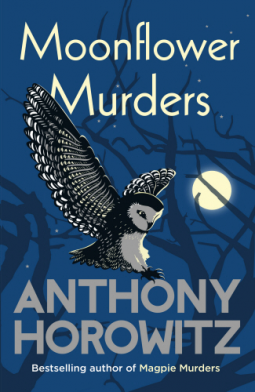
Moonflower Murders by Anthony Horowitz

A few years ago I read Anthony Horowitz’s Magpie Murders, a wonderful, imaginative novel containing a story-within-a-story – the outer one being a crime story set in the contemporary publishing world and the inner one being an entire Golden-Age-style murder mystery featuring a detective called Atticus Pünd. When I finished that book I remember feeling disappointed that there weren’t more Atticus Pünd novels to read, so I was delighted to find that Horowitz’s latest book, Moonflower Murders, is written in the same format.

Both books stand alone so it’s not essential to have read Magpie Murders before starting Moonflower Murders (although there are a few references in this one to the events of the previous book). At the beginning of the novel, we rejoin Susan Ryeland who is now running a small hotel in Crete with her boyfriend, Andreas. It’s not quite the idyllic life Susan had hoped for, though, and just as she is beginning to long for her old career in publishing, two guests approach her with an intriguing proposition.

Their names are Lawrence and Pauline Treherne and they run a hotel of their own in England, where a murder took place eight years ago. Stefan Codrescu, one of the hotel employees, was found guilty of the murder, but the Trehernes’ daughter, Cecily, has always believed him to be innocent. Now Cecily has disappeared, just after telling her parents that she had uncovered a clue in an Alan Conway novel called Atticus Pünd Takes the Case which proves that the wrong man had been charged with the crime. Knowing that Susan was the editor who worked on the Atticus Pünd novels in her publishing days, the Trehernes have come to ask for her help. What was the clue Alan Conway hid within the pages of his novel? Is Stefan innocent or guilty? And what has happened to Cecily?

After several chapters in which Susan begins to investigate the events of eight years earlier and how they could be connected with Cecily’s disappearance, we have the pleasure of reading the whole of Atticus Pünd Takes the Case, a detective novel dealing with the murder of a famous actress. Although this story-within-a-story is enjoyable in its own right, at first it’s not clear how it is linked to the murder at the Trehernes’ hotel, but Susan’s knowledge of how Alan Conway’s mind worked helps her to pick out possible hints and clues. I certainly didn’t manage to solve the mysteries – either the one in the Pünd story or the one in the framing story – myself, but I enjoyed watching everything unfold.

I didn’t love this book quite as much as Magpie Murders, probably because I already knew what to expect so it didn’t feel as original, but it was still hugely entertaining and, like the previous novel, packed with word games and other little puzzles cleverly woven into the text. And of course, as an Agatha Christie fan I adore the Atticus Pünd stories in both books, which are such perfect homages to Christie herself. As we have been told that the fictional author Alan Conway apparently wrote a whole series of Atticus Pünd novels, I hope Anthony Horowitz will give us the opportunity to read at least one more of them!

Thanks to Random House UK for providing a copy of this book for review via NetGalley.
This is book 12/20 from my 20 Books of Summer list.

The Sentence is Death by Anthony Horowitz

I loved The Word is Murder, Anthony Horowitz’s first book to feature the detective Daniel Hawthorne, so when I heard that there was going to be a second book I couldn’t wait to read it. I didn’t have to wait too long, as this one has been published only a year after the first, and I’m pleased to report that I enjoyed it just as much, if not more.

When high profile divorce lawyer Richard Pryce is found bludgeoned to death with an expensive bottle of wine, the culprit seems quite obvious. Just days earlier, Pryce had been threatened by a client’s ex-wife who poured a glass of wine over his head in a restaurant. Surely that can’t be a coincidence? But Pryce has plenty of other enemies, whose identities come to light as investigations continue. Could one of them have wanted him dead? And what is the significance of the numbers painted on the wall near Pryce’s body? As this is clearly a more complex case than it seemed at first, ex-police detective Hawthorne is asked to assist with solving the crime.

Having worked with Hawthorne on his previous mystery in The Word is Murder, author Anthony Horowitz reluctantly agrees to team up with him again and document the progress of the investigations in a second book, The Sentence is Death. Hawthorne is supposed to be the hero of the book, but this time Anthony decides to do some detecting of his own in the hope of reaching the solution first. Can he solve the mystery before Hawthorne does?

If this sounds confusing, I should explain that, as in the previous novel, Horowitz is a character in his own book. The Anthony in the story is clearly based on the author himself – he frequently discusses his career as a novelist and screenwriter and refers to his wife and his publisher by name – yet he interacts with fictional characters, takes part in fictional storylines and struggles to solve the mystery the real Horowitz has created. I think it’s a clever concept and great fun, though not everyone will agree – it’s probably something you’ll either love or you won’t.

It’s not really necessary to have read the first book before starting this one as the mysteries are entirely separate. Like the first, this is a strong, well-constructed mystery with plenty of clues but plenty of red herrings as well. I didn’t manage to solve it (I confess that I allowed myself to be distracted and misled by every one of those red herrings) but I was happy to be kept in suspense and wait for Hawthorne – or Anthony, of course, if he got there first – to explain it all for me.

However, I would still recommend reading both books in order if you can, so that you can watch the progression of Anthony’s relationship with Hawthorne. Hawthorne is no more pleasant or likeable now than he was when we first met him in The Word is Murder, and he is still every bit as much of an enigma, but we do pick up a few new bits of information about him here, with some glimpses of his home and his life away from his detection work. I think he’s a great character, for all of his flaws, and I love his partnership with the fictional Anthony.

When I read the first novel I found the details of Anthony’s publishing and television career a slight distraction from the main plot, but in this book they seemed to form a more intrinsic part of the story and I liked that aspect much more. Horowitz seems to be having fun at the expense of his fictional self, as Anthony stumbles from one disaster to another; I particularly enjoyed the opening scenes on the set of Foyle’s War and a later scene involving the theft of a book – and I’m curious to know whether the literary fiction author Akira Anno was based on a real person (although if she was, I doubt her true identity will ever be revealed).

I loved this book – and the good news for Horowitz and Hawthorne fans is that there’s going to be a third.

Thanks to Century for providing a copy of this book for review via NetGalley.
The Word is Murder by Anthony Horowitz

One bright spring morning Diana Cowper walks into a funeral parlour to arrange her own funeral. Six hours later she is dead, strangled in her own home. It can’t be a coincidence…can it? Detective Inspector Daniel Hawthorne – who is technically no longer with the police but still assists with particularly challenging cases – is called in to investigate. This is to be an investigation with a difference, however, because Hawthorne has enlisted the services of author Anthony Horowitz to write a book about the case.

Horowitz has never written a true-crime book before and admits to being much more comfortable when writing fiction such as his Sherlock Holmes sequel The House of Silk or the Alex Rider young adult series. It is with some reservations, then, that he agrees to write Hawthorne’s story, but as he accompanies the detective while he interviews suspects and searches for clues, Horowitz is drawn into the investigation despite himself.

The two have very different visions for their book; Horowitz believes in using artistic licence to tell a story that people will want to read, but Hawthorne is adamant that he should report only the facts, leaving nothing out that could be of significance. The author also tries in vain to get to know the detective, to shape him into a character who will stand alongside Holmes and Poirot, but the other man remains frustratingly enigmatic:

“Well, if I was going to write about you, you’d have to tell me. I’d have to know where you live, whether you’re married or not, what you have for breakfast, what you do on your day off. That’s why people read murder stories.”

“Is that what you think?”

“Yes!”

He shook his head. “I don’t agree. The word is murder. That’s what matters.”

I started to read The Word is Murder with very high hopes, having loved Horowitz’s previous novel, Magpie Murders (one of my favourite books of last year). I wasn’t disappointed; this is another great book! In fact, like Magpie Murders – but in a different way – it is almost two books in one. We have the story of Horowitz and his relationship with Hawthorne and then we have the murder investigation itself. I’m aware that I’ve said very little so far about the latter – and I’m not going to say much more, other than that it is a very clever, tightly plotted mystery with plenty of clues, suspects and red herrings. Thanks to Hawthorne’s insistence on everything being written down, most of the clues are there from the beginning and the rest are at least revealed early enough for us to guess the solution before Horowitz does. I have to admit, though, that I was slow to put them together and didn’t come close to solving the mystery!

I should probably make it clear that Diana Cowper is a fictional character – she wasn’t really murdered six hours after arranging her own funeral and Hawthorne, who is also fictional, wasn’t really brought in to investigate. Anthony Horowitz, however, is obviously a real person and so The Word is Murder is a curious blend of fiction and non-fiction. He is not the first author to use themselves as a character in their own novel, but I’m not sure if anyone else has done it in quite the same way!

Although the passages in which Horowitz describes his various writing projects, his appearances at book festivals and his views on literary agents are a bit of a distraction from the central plot at times, his main role in the story is as a sort of Watson-style sidekick, and this aspect of the novel works very well. As for Hawthorne, he has quite an unpleasant personality, being humourless, secretive, pedantic, and – to Horowitz’s disgust – homophobic, but I found him a fascinating character, precisely because he is so unattractive. They are an unlikely pairing but there is plenty of potential here for more Hawthorne/Horowitz mysteries, I think – I would certainly be happy to read them, anyway!

Thanks to the publisher, Random House, for providing a copy of this book for review via NetGalley.