Pictures at an Exhibition by Camilla Macpherson

Pictures at an Exhibition In 1942 the National Gallery in London launched its ‘Picture of the Month’ scheme. Each month one of the masterpieces that had been hidden away to protect them from bombing raids during the war would be brought out of storage and put on display. Daisy Milton, who is working in London as a typist, decides to go along every month to look at the paintings in the hope that it will give her something to look forward to and help her get through the days until the war is over. After each visit to the gallery she writes a letter to her friend Elizabeth in Canada, describing the painting and how it made her feel.

In the present day we meet Claire and her husband, Rob. When Rob’s grandmother, Elizabeth, dies she leaves him a box containing the letters she received from Daisy throughout the war. A recent tragedy has almost destroyed Claire and Rob’s marriage and Claire finds some comfort in reading Daisy’s letters and going to look at the paintings once a month just as Daisy did. As the months go by and Claire finds herself drawn into Daisy’s world she starts to see some parallels between Daisy’s life in the past and her own life in the present.

I enjoyed Pictures at an Exhibition, but although I was interested in both the wartime and modern day storylines I did prefer the wartime one because I found Daisy a much more appealing character than Claire. For a long time Claire annoyed me because she seemed so self-absorbed and unwilling to move on with her life. I had more sympathy for Rob, who came across as a kind, considerate husband who was doing his best to make their marriage work and starting to run out of patience. As Claire’s story unfolded I started to warm to her a bit more, but I would still rather have spent more time with Daisy.

My favourite thing about this novel was having the opportunity to learn about the paintings that were displayed in the National Gallery during the war. Each chapter of the book begins with a QR code that you can scan with your phone (if you have the right sort of phone) and it will take you directly to the painting, or you can look them up online yourself later if you prefer – they are all easy to find on the National Gallery website. Some were very famous paintings that I was already familiar with, such as The Arnolfini Portrait by Jan van Eyck and The Hay Wain by John Constable, but there were others I knew nothing about. It was a fascinating experience to view each of these paintings first through Daisy’s eyes and Claire’s, then to be able to look at them myself and see things in them that I might not have thought of otherwise.

Thanks to the author for sending me a review copy of this book.
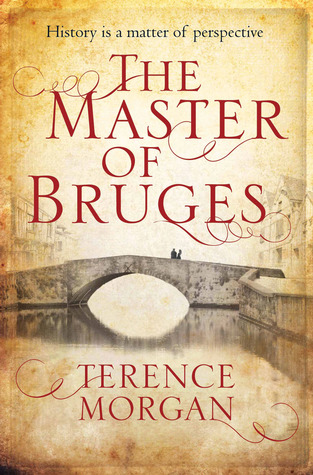
The Master of Bruges by Terence Morgan

The Master of Bruges The Master of Bruges is presented as the fictional memoirs of the 15th century artist, Hans Memling. In December 1464, following the death of his master, the Flemish painter Rogier van der Weyden, Hans travels to Bruges where he works at the Burgundian court, painting portraits of the nobility. As an artist, Memling is naturally a very observant, perceptive person and can offer the reader some insights into both the politics of the period and the lives and personalities of the people he meets in Bruges.

One night two strangers calling themselves ‘Ned and Dick Plant’ come to seek refuge at Memling’s house and Hans finds himself drawn into the drama and intrigues of the Wars of the Roses, the conflict between England’s House of York and House of Lancaster. And when several years later he is invited to England and renews his acquaintance with Ned and Dick, he becomes caught up in one of history’s greatest mysteries: the disappearance of Edward IV’s sons, the Princes in the Tower, who many people believe were murdered by their uncle, Richard III.

Before reading this book I had heard of Hans Memling but was not familiar with his work. The only one of his paintings I knew anything about was his triptych The Last Judgment, which featured a portrait of the banker Tommaso Portinari being weighed in St Michael’s scales, and was captured by the Danzig pirate Pauel Benecke as it was being shipped to Italy. The only reason I was aware of this anecdote was because it formed a minor plot point in Dorothy Dunnett’s House of Niccolo series (specifically, in To Lie with Lions and Caprice and Rondo). Luckily, many of Memling’s paintings can be seen online and I can guarantee that you’ll want to look at them as you read. There are also some short chapters interspersed throughout the novel in which Hans shares with us his views regarding artistic technique, perspective, focus, colours, and some of the tricks artists use to please their sitters, and I enjoyed reading these. As well as being fascinating to read, these chapters are relevant to the story as Memling’s descriptions of his techniques are either directly or indirectly linked to aspects of the plot.

I thought the first part of the novel, which details Hans’ early days as an artist, worked very well but not the second part, after he travels to England. I was interested in learning about Hans and his portraits and I was also interested in the Richard III story – it was the way the two were combined that didn’t work for me. Despite the Wars of the Roses being one of my areas of interest in historical fiction, I think I would have liked this book more if it had continued to tell the story of Memling’s life in Bruges rather than changing focus halfway through to concentrate on the mystery of the Princes in the Tower.

I don’t expect historical novelists to always stick rigidly to the facts, otherwise they would be writing non-fiction rather than fiction, but this particular book stretches credibility too much for me. I appreciated the author’s note at the end of the book, but I wished it had given more information on exactly which aspects of the story were based on fact and which were fictional. As far as I can tell there is no evidence to suggest that Hans Memling ever came to England or had any involvement with the Plantagenets. I also found it hard to believe Morgan’s theories regarding what happened to the two princes (especially a plan of Edward IV’s to have them declared illegitimate), though they were certainly very imaginative ideas. I was happy enough with the characterisation of Richard III, though – he is one of my favourite historical figures and I am definitely of the opinion that he has been unfairly treated by history, so it was good to see him portrayed in a more positive light in this book.

Because of the problems I’ve noted above, I can’t say that I loved The Master of Bruges, but I’m glad I kept reading to the end as there were some big surprises within the final chapters. I think as long as readers are aware that this book does not always give an entirely historically accurate account of the period and that it sometimes takes a more speculative approach to what might possibly have happened, it can be enjoyed as something refreshingly different and fun.