Madensky Square by Eva Ibbotson

I felt a sudden longing to record…to retain…my everyday life here in Madensky Square. I shall remember my tragedies, my follies and my joys – everyone remembers those. But what of the ordinary things, the little happenings? What of the ‘dailiness’ – who has a care for that?

I think this is the first Eva Ibbotson book I’ve read. I say ‘think’ because it’s possible that I’ve read one or two of her children’s books (Which Witch? sounds very familiar), but this is definitely the first time I’ve read one of her adult or young adult books. Ibbotson is an author I’ve been wanting to try for a long time as so many of the bloggers I follow keep mentioning how much they love her. Madensky Square isn’t one that I’ve heard much about so probably wouldn’t have been the one I would have chosen to start with, but Amazon were offering it as their Kindle Daily Deal a few weeks ago and I couldn’t resist!

The book is set in Austria just a few years before the start of the First World War. Our narrator, Susanna Weber, is a dressmaker with a small but busy shop on Vienna’s Madensky Square. At the beginning of the novel, Susanna tells us that for the next twelve months she is going to keep a journal recording the lives of her friends, her customers and the other inhabitants of Madensky Square. She starts her story in the spring of 1911 and in the pages that follow we meet and get to know the people who populate Susanna’s world.

Being a dressmaker gives Susanna the opportunity to meet a wide range of people from different walks of life. She hears all of their gossip and becomes involved in the various dramas taking place in each of their lives. There’s Frau Schumacher, for example, who already has six daughters and whose husband is hoping for a son to inherit his timber business; how will he react if their next child is another girl? Then there’s Nini, Susanna’s Hungarian assistant, who is an anarchist and needs to decide whether her political beliefs are more important than her chance of love. Others include the Countess von Metz, a proud, sharp-tongued old lady who still loves buying dresses despite living alone and in poverty, the beautiful and very religious Magdalena Winter, and the eccentric Professor Starsky, an expert in Reptile Diseases. There are a large number of characters, but they are all so different and described in so much depth I never had any difficulty remembering who they all were. Some did feel a bit stereotypical (particularly the plain and awkward ‘bluestocking’, Edith Sultzer, and the fat butcher, Herr Huber) but I could overlook that as they were still so well-written and memorable. Even Rip the dog, whose owner sends him out every day with a little purse tied around his neck to buy the newspaper, has a distinct personality of his own!

Susanna herself is a lovely, warm person who others frequently look to for help and advice. However, her own life is no less interesting and complicated than that of any of the other characters I’ve mentioned. She has experienced a lot of sadness and loss in her past, but I don’t want to give too much of her personal story away as it’s only revealed to the reader slowly as the book progresses. Of all the other storylines in Madensky Square, my favourite was the one involving Susanna’s relationship with Sigismund Kraszinsky, a young Polish orphan. Sigi is a talented pianist and his uncle has brought him to Vienna in the hope of furthering his career as a musician, which unfortunately comes at the expense of allowing him to have a normal childhood. The story of how Susanna befriends this lonely, nervous little boy and tries to bring some happiness into his life is one of the most moving of the novel’s many subplots.

I loved reading the descriptions of Madensky Square itself, with its fountain, café and statue of Colonel Madensky, as well as the countryside, the opera houses and all the other places Susanna visits; I especially enjoyed reading about Susanna and Sigi’s trip to the magical Grottenbahn in Linz! I was satisfied with the way the book ended too – it wrapped things up nicely for all the characters we had been following in so much detail and had grown to love and care about over the course of the novel. There are happy endings for some of them, but not for others, which is realistic and more effective than if there had been a fairytale ending for everyone.

I loved this book and I’m hoping that maybe those of you who are Eva Ibbotson fans can tell me which of her books I should try next?
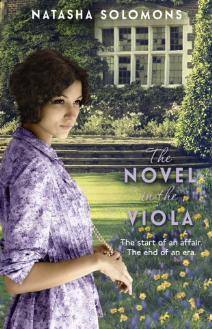
The Novel in the Viola by Natasha Solomons

I love reading fiction set during World War II and The Novel in the Viola is one of the best I’ve read for a while. The story begins in 1938 when we meet nineteen-year-old Elise Landau, a girl from a rich Austrian family (her mother, Anna, is a successful opera singer and her father, Julian, a famous author). Until now, Elise has lead a secure and comfortable life but that’s all about to change because the Landaus are Jews, and with Europe on the brink of war Austria is no longer a safe place to live. And so Elise is sent away from her home in Vienna and travels alone to Tyneford House, a mansion on the south coast of England, where she will work as a maid for Mr Rivers and his son, Kit. Her parents have remained in Austria while they await American visas and they promise to send for Elise as soon as possible – but as the war continues, she begins to wonder if they’ll ever be reunited.

The portrayal of life in an English country house forms a big part of the story, with insights into the class system, social conventions of the time, and the relationships between servant and master. Elise has to get used to working as a parlour maid after spending most of her life having servants of her own. Her background makes it difficult for her to fit in with the other servants at Tyneford but her status as a maid and a Jewish refugee prevents her from being accepted by some of the Rivers’ upper class friends. Elise is a wonderful character and I enjoyed following her as she settled into her new life – I thought Natasha Solomons displayed a real understanding of what it was like to be newly arrived in an unfamiliar country, feeling homesick and struggling with the language and the culture.

There are lots of beautiful, atmospheric descriptions of the Dorset countryside and coast which gave me a true feel of what it was like to live there during the Second World War. The story also looks at the effects the war had on the village of Tyneford and the house itself. The author’s note at the end of the book was very interesting and explained how Tyneford was based on a real place that became a ghost town because of the war.

There are so many other things I could say about this book – there’s the secret of the ‘novel in the viola’ itself, and I haven’t even mentioned yet the romantic storyline which develops as Elise begins to fall in love with someone she meets at Tyneford. But I don’t want to spoil this book for you, so I’ll just say that The Novel in the Viola was a real pleasure to read, a great story with just the right balance of sadness and humour. And I thought the way the book ended was perfect – the only problem was that I had grown to care for Elise and the others so much I didn’t want to leave them behind.

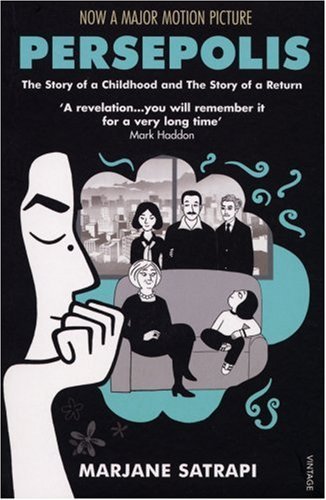
Review: Persepolis by Marjane Satrapi

This is the first graphic novel I’ve read. There, I’ve admitted it. I can’t explain why it has taken me so long to read one. It’s not that I think they’re childish or ‘not real literature’ or anything like that; it had just never occurred to me to read them and until I started blogging I didn’t even realise how popular they were. When I did decide I’d like to try one I thought a graphic memoir might be the best to start with and as I’d seen Persepolis reviewed on so many blogs it seemed a good choice. And it was, because I loved it.

This edition is actually two books in one: The Story of a Childhood and The Story of a Return. They can be bought separately but you really need to read the first book before the second.

These two books are the memoirs of Marjane Satrapi. In The Story of a Childhood she tells us what it’s like to be a child growing up in Iran during the 1970s and 80s. Due to the Islamic Revolution and the Iran-Iraq War, Iran becomes an oppressive and often dangerous place to live, particularly as Marjane develops into a rebellious teenager. Her concerned parents eventually decide that the safest option is to send their daughter away to start a new life in Europe.

Before beginning this book, I didn’t know very much at all about Iranian history and politics. I found that seeing things through a child’s eyes was fascinating and informative. Marji is an intelligent, imaginative girl and like all children she’s always curious and full of questions, so for someone who knows very little about Iran, this book offers an opportunity to learn along with Marji.

In the second volume, Marji is living in Austria, struggling to adapt to life in a country with an entirely different culture. This second book is more about the personal problems she faces with relationships, drugs and money and although I had a lot of sympathy for the situation she was in, I didn’t enjoy reading this book as much as the first one. I did find it more interesting towards the end when she finally returns to Iran several years later and finds she has as much trouble fitting back into her old life as she’d had fitting into life in Austria.

Although this was definitely a new experience for me, I was quickly able to forget that I was reading a ‘graphic novel’ and become absorbed in Marjane Satrapi’s story. The simple, stark black and white drawings were perfect and made it easy to understand what was happening. Rather than just illustrating the text, the pictures played an equally important part in telling the story.

I enjoyed this book much more than I expected to. It was a powerful and moving story, with some moments of humour too. So, if you are also new to graphic novels and unsure where to start, I have no hesitation in recommending this one to you!