I hinted earlier this year that I had a new project planned where I would be reading (or re-reading) some of Shakespeare’s plays and following them with modern retellings or books inspired by those plays. With that in mind, I included some Shakespeare on my current Classics Club list and I’ve decided to begin with a re-read of Othello. Although Othello is not one of my favourite plays, it’s a special one for me because it was the first I read for myself outside of the ones we read at school.
 The play begins in Venice with the discovery that Othello, a general in the Venetian army, has secretly married Desdemona, the daughter of the senator Brabantio. His ensign, Iago, hates Othello because he has promoted another man, Cassio, to lieutenant rather than himself. With the help of Roderigo, a young Venetian gentleman who is in love with Desdemona, Iago vows to take his revenge. As the action moves to Cyprus, he does this by convincing Othello that Desdemona and Cassio are having an affair, using lots of psychological manipulation – and a carefully planted stolen handkerchief.
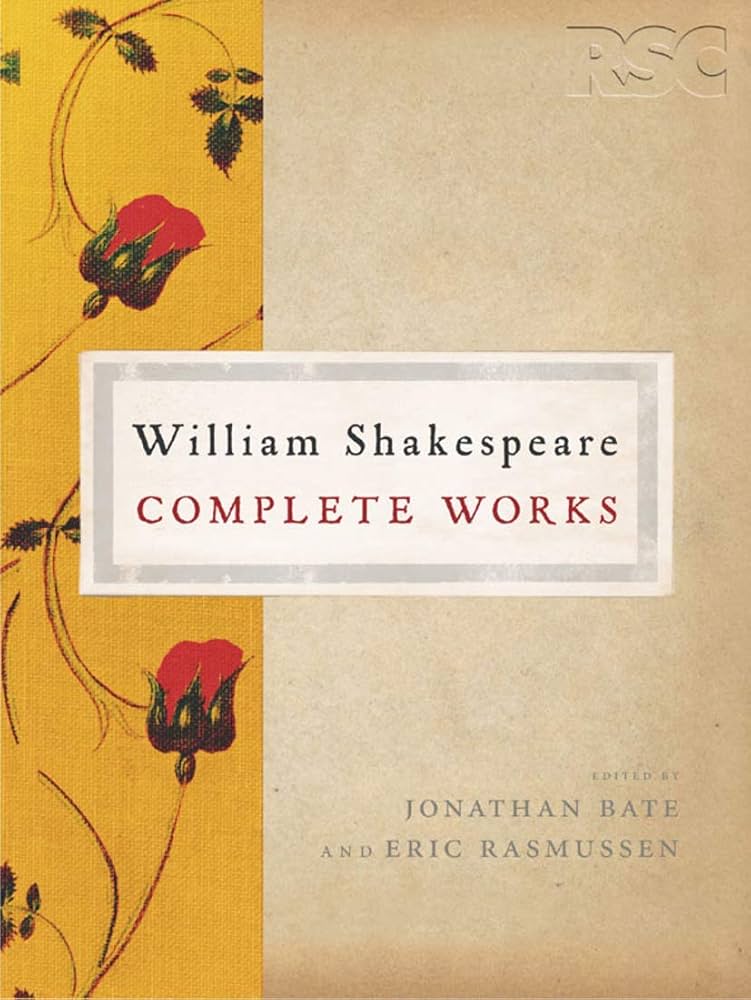
Rather than reading the play in a standalone edition, I read it in my RSC Shakespeare: Complete Works, a book I would recommend (apart from it being physically difficult to hold). It contains detailed introductions to each play, key facts, photographs from RSC stage productions and definitions/glossaries at the bottom of each page of text. The introduction to Othello helps to put the play into context, looking at Shakespeare’s main source for the play, the 1565 novella “Un Capitano Moro” (“A Moorish Captain”), by Giraldi Cinthio, and discussing how audiences at the time would have viewed a Moorish, or Muslim, character like Othello.
Othello has a relatively simple plot, which makes it easier to follow than some of his other plays (which doesn’t mean it has no depth, of course, but the complexities are in the psychology and in trying to understand Iago’s motivations rather than in following the story itself). The main themes are also quite obvious: jealousy – first Iago’s jealousy of Cassio, who gets the position he believes should have been his, and then Othello’s jealousy, which comes about through Iago’s manipulations; trust – both lack of trust and misplaced trust; racism and prejudice – does Othello have underlying insecurities due to his race and age that lead him to doubt Desdemona (a younger white woman) and fall for Iago’s lies so easily?
I also noticed how little humour there is in this play. There’s a brief appearance by a clown figure in Act III who delivers some puns and wordplay, but otherwise there’s not much light relief even in comparison to Shakespeare’s other tragedies. As ever, though, there are words and phrases from the play that have become part of everyday speech:
“I will wear my heart upon my sleeve”
“The green-eyed monster”
“One that loved not wisely but too well”
“A foregone conclusion”
There are probably more that I missed!
Retellings
I don’t think I’ve read any Othello retellings yet, although I’ve read books that reference it in some way. Farewell, the Tranquil Mind by RF Delderfield takes its title from a line from the play (“Farewell the tranquil mind! farewell content!”), while in Agatha Christie’s The Rose and the Yew Tree, which I read earlier this year, the narrator, Hugh, directly refers to Othello several times throughout the book and reflects on Iago and his motives.
I’ve just started to read Naomi Kelsey’s new novel Pale Mistress, which is about Bianca, a minor but important character in the play.
Here are some other books about or inspired by Othello. Have you read any of them? Do you know of any more?
New Boy by Tracy Chevalier
Chasing the Stars by Malorie Blackman
I, Iago by Nicole Galland
Desdemona by Toni Morrison
Iago by David Snodin
Dom Casmurro by Machado de Assis

