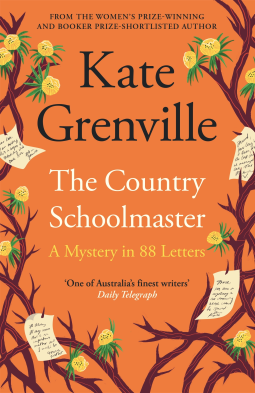
 This book wasn’t what I was expecting at all. It was listed as fiction on NetGalley but feels much more like non-fiction, although I can understand why the author and publisher could be hesitant to describe it that way as there is a lot of imagination involved! Regardless of the label, I found it absolutely fascinating.
Kate Grenville begins by describing a visit she made to the NSW State Archives to research her mother’s life. During this visit she came across a file relating to Currabubula Public School and was immediately intrigued by a collection of letters written by or about the teacher Joseph Connor implying that he was abusive towards the children. Deciding to dig deeper, Grenville read all eighty-eight letters in the file, dating from the 1880s to 1890s, changing her mind back and forth about Connor with each new piece of information. Were the allegations against him true or was he the victim of a vendetta pursued by a group of parents for reasons of their own?
Stories floated up but then sank again. Characters came forward as one thing but on a second look turned into something else. Meanings took shape, then evaporated. My sympathies, like a school of fish, wheeled towards Joseph Connor. With the next letter, they gathered, regrouped, wheeled the other way.
Currabubula is a rural village in New South Wales where Kate Grenville’s grandmother, Sarah Catherine Maunder, grew up (her story is told in Restless Dolly Maunder). In 1884, Joseph Connor was appointed sole teacher of Currabubula Public School, responsible for up to seventy children at a time. The recent Public Instruction Act had made school attendance compulsory in NSW and teachers willing to go and work in small rural communities were in high demand. Grenville’s first impression of Connor, as she worked through the letters and other documents in the file, was of “a straightforward, honest fellow doing his guileless best”, a man trying to educate children in an overcrowded classroom, having to virtually beg for money from the Department of Public Instruction to purchase new chairs or get the toilets cleaned, while also dealing with the needs of his own rapidly growing family.
Some of the complaints against Connor seem malicious and spiteful, but others are more convincing. Grenville examines the complaints, along with the responses given by Connor and the School Inspector and the outcomes of inquiries and court hearings and tries to decide what was really going on. Was he really beating the children and punishing them excessively? Was it true that he was keeping livestock in the schoolyard where the children played? Was he being unfairly strict in enforcing the rules regarding non-attendance? With no evidence beyond the documents in the file, Grenville tries to read between the lines, studying the choice of words and phrases and filling in the gaps by imagining how the people involved may have felt.
Grenville doesn’t reach any real conclusions about Connor or any of the mysteries surrounding him – for example, the cause of a rift with his eldest daughter Bridie, also a teacher, is never revealed – but she encourages us to form our own opinions from the limited clues available. She explains in her author’s note that due to the assumptions she makes about Connor and the other residents of Currabubula and the possible theories she builds around them, she decided to change the names of Joseph Connor and the other key players in the story.
I think how much you enjoy this book will depend on whether you’re interested in historical research, archival information and interpreting sources. It won’t appeal to everyone, but for the right reader it’s a wonderful read. I loved it, partly for the glimpses into the history of education in Australia and the daily lives of people in a small village like Currabubula, and partly for the exploration of how stories can be made from a mixture of fact and fiction.
Thanks to Canongate for providing a copy of this book for review via NetGalley.


This sounds like an interesting read and I like what you’ve said about how it makes you think about how stories can be shaped by a mix of fact and fiction. I can see some readers being frustrated by the lack of clear cut answers but this really sounds like the kind of read where it would feel dishonest to give any of those. Lovely review.