Rule Britannia by Daphne du Maurier

I love Daphne du Maurier; whenever I pick up one of her books I know I’m guaranteed a good read. Although this one was not as good as some and I can certainly understand why it’s one of her less popular books, it still kept me gripped for all 300+ pages. I’m pleased I can say that because, having read other opinions on this book, I was concerned that it might be the first du Maurier novel that I wouldn’t like.

Published in 1972 her final novel, Rule Britannia, imagines that the UK has broken away from Europe to form an alliance with the US. This new nation will be known as USUK. The first twenty-year-old Emma knows about this is when she wakes up one morning to find that the tranquil corner of Cornwall where she lives is now under American occupation – there’s an American warship in the harbour, American marines stationed in the area and roadblocks on the routes leading in and out of the town. Already the Queen is visiting the White House and the President is preparing to come to Buckingham Palace. Despite reassurances from the government that the formation of USUK is essential for Britain’s economic and military stability, Emma’s family, friends and neighbours begin to grow increasingly concerned about the exact nature of the alliance and the effect it will have on their previously peaceful lives.

It can’t happen here, thought Emma, it can’t happen here, that’s what people in England have always said, even in wartime when they were bombed, because they were all together on their own ground. Not any more.

Although the story unfolds from Emma’s perspective, the real heroine of the story is her seventy-nine-year-old grandmother, Mad (short for Madam – unless I missed it, we aren’t told her real name), who is a retired actress. Mad and Emma live together with Mad’s six adopted boys whose ages range from three to nineteen, all of whom have suffered some form of tragedy in their early lives. Mad, even in her old age, is a strong-minded, independent woman who is determined to defend her home and family no matter what, and she plays an important part in Cornwall’s resistance to the occupying forces. But although Mad and her family believe they have been invaded, I should point out that we’re told the majority of British people are very happy with the alliance and that it’s only a small percentage of the population who are rebelling against it.

As with most Daphne du Maurier novels, this one does have some suspenseful and unsettling moments. I know from my past experience of her work that nothing is ever quite as it seems and I was wondering what surprises and twists she might have in store for the reader – but unfortunately I found the way the book ended slightly disappointing because I felt there was a lot more she could have done with the story. Another thing I didn’t like was the fact that one of Mad’s adopted sons, three-year-old Ben who happens to be black, appeared to have been included simply as an excuse to make racist jokes. The book was a product of the 1970s I suppose, but these comments are offensive rather than funny. These negative points, along with the overall strangeness of the book, stopped me from enjoying it as much as I’ve enjoyed her other books. It doesn’t compare to her best work and if you’re new to Daphne du Maurier I would suggest starting somewhere else.

The House on the Strand by Daphne du Maurier

Dick Young is at a turning point in his life. He has recently left his job at a London publishing firm and needs to decide what he wants from his future. He’s been offered another job in New York and his American wife Vita wants him to accept it, but Dick’s not so sure. When his friend Professor Magnus Lane invites him to stay at his farmhouse in Cornwall for the summer, he agrees, looking forward to a few days of peace before Vita and his two stepsons join him. But when Dick arrives at Kilmarth, Magnus convinces him to take part in a secret experiment: he has developed a new drug which allows the user to travel back in time – and he wants Dick to test it for him…

Choosing to begin 2011 with a book by one of my favourite authors was the right decision. The House on the Strand is a strange and unusual book which blends historical fiction, science fiction, time travel and psychology. I loved it! In fact, it might even make my best of 2011 list at the end of the year. Although Rebecca is still my favourite Daphne du Maurier book, this one ties with The Scapegoat as my second favourite. It actually has a very similar mood and feel to The Scapegoat even though the plots of the two books are entirely different. Both books have a male narrator and both have themes of identity and escaping from reality.

I enjoy reading about time travel and this book took a slightly different approach to the question of time travel than any other book I’ve read. Rather than physically going back in time, it’s only Dick’s mind that travels while his body stays in the present – and as you can imagine, this has some disastrous and embarrassing results. The 14th century world that Dick witnesses when under the influence of the drug seems completely vivid and real to him, yet he’s unable to interact with any of the people he meets. He feels a special connection with Roger Kylmerth, steward to the Champernoune family, and also with the beautiful Isolda Carminowe. As Dick’s fascination with Roger and Isolda grows, he spends more and more time in the past and becomes increasingly dependent on the drug.

Du Maurier wrote this book in the late 1960s when psychedelic drugs such as LSD were at the height of their popularity and the drug which Magnus invents seems to be very similar to what I’ve read about LSD. As Dick becomes psychologically addicted to the drug, he gradually grows more distant and withdrawn and his relationships with his family start to suffer. His life in the present is portrayed as dull and boring in comparison to the vivid events of the 14th century and when seen through Dick’s eyes, Vita and her two sons are unlikeable and obnoxious. To me though, they were normal, reasonable people who were trying to make sense of their husband and stepfather’s bizarre behaviour.

Despite my own interest in history and historical fiction, I didn’t find the 14th century subplot particularly compelling. The story wasn’t very strong and there were too many characters with similar names who all seemed to be married to their cousins, which made it very difficult to keep all the relationships straight. I was constantly turning to the family tree at the front of the book and still couldn’t remember who was who. My advice to anyone reading The House on the Strand would be not to worry too much about following the 14th century story. By far the most interesting part of the book is the part which takes place in the present.

There were only one or two other negative points. First of all, I was disappointed that we didn’t get to know Magnus better, as I thought he was potentially the most interesting character in the book. Secondly, du Maurier made a point of describing the landscape and the locations of the various 14th century farmsteads and manor houses in great detail. I know this was supposed to show us how the appearance of the landscape had changed over the centuries (which is quite important to the plot), but I found it confusing and even by referring to the map at the front of the book, I couldn’t seem to build a picture in my mind of what the area looked like. Apart from these minor complaints though, I loved this book.

I’ve now read around half of du Maurier’s books. The good news is that I still have the other half to look forward to!

Review: The Scapegoat by Daphne du Maurier

What would you do if you came face to face with yourself? That’s what happens to John, an Englishman on holiday in France, when he meets his exact double – a Frenchman called Jean de Gue.  John agrees to go for a drink with Jean but falls into a drunken stupor and wakes up in a hotel room to find that Jean has disappeared, taking John’s clothes and identity documents with him!

When Jean’s chauffeur arrives at the hotel, John is unable to convince him of what has happened – and ends up accompanying the chauffeur to Jean de Gue’s chateau, where the Frenchman’s unsuspecting family assume that he really is Jean de Gue.  Naturally, they expect him to continue running the family glass-making business and arranging shooting parties – things that John has absolutely no experience in.  Before long, it starts to become obvious that Jean is using John as a scapegoat; Jean’s family and business are both in a mess and he wants someone else to have to deal with them.

Throughout the book, I was forced to revise my opinions once or twice about what was really going on. If everything in the book is supposed to be taken literally, then we need to suspend belief at times: could two men really be so identical that even their mother, wife and daughter can’t tell the difference? There is also another way to interpret the story, one which goes deeper into the psychology of identity – I won’t say any more about that here, but if you have read the book this theory may have occurred to you too.

As usual, du Maurier’s writing is wonderfully atmospheric. She has a way of making you feel as though you’re actually there in the hotel room in Le Mans, the grounds of Jean de Gue’s estate in the French countryside and Bela’s antique shop in the town of Villars.

When John first arrives at the de Gue chateau, every member of the household is a stranger to him but we (and John) are given enough clues to gradually figure out who each person is and what their relationship is to Jean de Gue.  From the neglected pregnant wife and the hostile elder sister to the resentful younger brother and the religious ten-year-old daughter, every character is well-drawn and memorable.

Another thing I love about Daphne du Maurier’s writing is her ability to always keep the reader guessing right to the final page (and sometimes afterwards too).  This was a fascinating and unusual story, one of my favourite du Maurier books so far.

Highly recommended

Pages: 320/Publisher: Virago Press (Virago Modern Classics)/Year: 2004 (originally published 1957)/Source: Library book

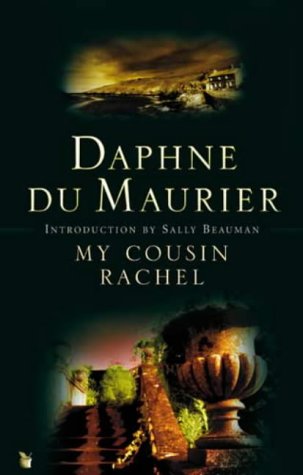
Review: My Cousin Rachel by Daphne du Maurier


This is the second Daphne du Maurier book I have read this month.  I hope eventually I’ll have time to read all of them because so far none of her books have disappointed me.

Like I’ll Never Be Young Again, which I read at the beginning of May, My Cousin Rachel is written in the first person from a male perspective. Also as in I’ll Never Be Young Again, the male narrator is a naïve, immature man who I found it difficult to sympathise with. His name is Philip Ashley, a twenty-four year old Englishman who has been raised by an older cousin, having lost both his parents at an early age. Philip and his cousin Ambrose have a very close relationship and Philip is left confused and jealous when Ambrose suddenly marries a woman he meets in Italy. This woman happens to be another cousin of theirs – their cousin Rachel.

Early in the novel, Ambrose dies and Rachel returns alone to the Ashley estate in England. At first, Philip is convinced his cousin Rachel was responsible for Ambrose’s death, but after meeting her he’s not so sure…

My Cousin Rachel is often compared with Daphne du Maurier’s most famous book, Rebecca, and although the two books are very different in many ways, I can see the reasons for the comparisons. The books share some common elements, including the estate in Cornwall (based on du Maurier’s own home, Menabilly) and the mysterious, secretive woman, but the biggest resemblance is in the atmosphere the writing conveys. Daphne du Maurier is one of the most atmospheric writers I know of. Whether she’s writing about the streets of Florence or the coast of Cornwall she always manages to convey a mood perfectly suited to the location and draws you completely into the world she has created. My Cousin Rachel has a strong feeling of foreboding, where from the beginning you know something bad is going to happen and you’re just waiting to see what it is.

Throughout the book, my opinion of Rachel was constantly changing. It was hard to form an accurate idea of what Rachel was like, as we only really saw her through Philip’s eyes and he was not a reliable narrator. Another thing that added to the vagueness and uncertainty of the story was that we were never told exactly when it was taking place. It was obvious that the book was set in the 19th century, but which decade? And what was the name of the Ashley estate? Unless I missed it, we weren’t told that either. It seems to be quite typical of Daphne du Maurier to withhold information from us in this way – after all, in Rebecca we aren’t even told the narrator’s name!

There are a lot of loose ends and questions left unanswered at the end of the book, which is something that often bothers me, but in this case I didn’t mind. I liked the way there were aspects of the story that could be interpreted in several different ways. I expect it would have been a good book to read with a group, as the ambiguity would lead to some interesting discussions and theories.

Recommended

Pages: 304/Publisher: Virago Press (Virago Modern Classics 491)/Year: 2008 (originally published 1951)/Source: Library book

Review: I’ll Never Be Young Again by Daphne du Maurier

I’ll Never Be Young Again was Daphne du Maurier’s second novel, written when she was only twenty three years old. It’s different from the other books of hers that I’ve read so far. It doesn’t have the suspense or the gothic feel of some of her other works – this is more of a psychological, character-driven book. It’s the story of Richard, a young man who has grown up in the shadow of his famous father, and his struggle to find his own identity. I’m not really a fan of ‘coming-of-age’ novels, but I’m glad I chose to read this one. It certainly seems to be one of her least well known novels –  and I was concerned that this might mean it wasn’t very good. Well, I can tell you that it is good and I enjoyed it a lot more than I was expecting to.

The book opens with Richard – or Dick as he prefers to call himself – standing on a bridge, preparing to jump. Immediately the reader is intrigued, wondering what has happened to drive him to suicide.  At the last minute Dick feels a hand on his shoulder – this is Jake, a complete stranger who saves his life and becomes his closest friend. The first half of the book follows the adventures of Dick and Jake as they leave England and sail to Scandinavia together in search of a new life. The second half is the story of Dick’s relationship with Hesta, a girl he meets in Paris.

The whole book is written in the first person from Dick’s perspective, which is significant as it was apparently the first time Daphne du Maurier wrote from a man’s point of view – and I thought she captured the male voice perfectly. The only problem I had was that I just didn’t like Dick very much. I found his immaturity and whining very irritating – although I understood that the point of the book was to follow his development from an insecure, selfish youth into a sensible, mature adult. Eventually he does begin to grow up and want different things out of life, but this comes too late in the book for me to be able to warm to him. However, the book is so well-written I could still enjoy it even with such an unsympathetic narrator. Her writing is absolutely beautiful and quite dreamlike, as she lets us get right inside Dick’s head and share his thoughts and emotions. There are also some vivid descriptions of the mountains and fjords of Norway and the other places that the characters visit, particularly Paris with its cafés and boulevards.

This would probably not be the best Daphne du Maurier book for a newcomer to begin with, but it’s a good choice for someone who wants to venture away from Rebecca and read one of her less popular novels. A word of warning, though – if you’re going to read the Virago Modern Classics edition, leave the introduction until last as it gives away the entire plot, including the ending (this is good advice with any book – I’ve learned from experience never to read the introduction first).

This is my first book for the Daphne du Maurier Challenge hosted by Chris at Book-a-rama. I wasn’t planning to take part in this challenge until I discovered my local library had almost all of her books. I’m looking forward to reading some more of her work during the next year, as there are still a lot of her books I haven’t read yet. This book also counts towards the 1930s challenge as it was a contemporary novel published in 1932 and set in 1930s Europe – and also the Typically British challenge.

Pages: 304/Publisher: Virago Press (Virago Modern Classics 515)/Year: 2005 (originally published 1932)/Source: Library book

Fiendish Fridays #6: Mrs Danvers

Fiendish Fridays is hosted here at She Reads Novels, profiling some of our favourite literary villains. You can see a complete list of previous Fiends and suggest one of your own here.

This week’s Fiend is a controversial one – she is often cited as one of literature’s greatest female villains, but some people don’t consider her to be a villain at all. What do you think?

#6 – Friday 19 March 2010: Mrs Danvers

Name: Mrs Danvers

Appears in: Rebecca by Daphne du Maurier

Who is she? Mrs Danvers is the housekeeper at Manderley, the house where Maxim de Winter lived with his wife Rebecca before her tragic death. When Maxim brings home his second wife whom he has met in Monte Carlo, Mrs Danvers is not happy!

What is she like? The character was famously portrayed by Judith Anderson who received an Oscar nomination for her role in the 1940 Alfred Hitchcock film. In the book she is described as ‘someone tall and gaunt, dressed in deep black, whose prominent cheek-bones and great, hollow eyes gave her a skull’s face, parchment-white, set on a skeleton’s frame’.

What makes her a Friday Fiend? She does her best to make the second Mrs de Winter unwelcome at Manderley by constantly undermining her confidence and making her the target of some cruel tricks, causing her to feel inferior to Rebecca in every way.

Redeeming features: Her devotion and loyalty to Rebecca even after her death can be seen as an admirable quality and is the reason for her behaving the way she does.

Have you read Rebecca? What do you think about this week’s Friday Fiend?

Review: The Rendezvous and Other Stories by Daphne du Maurier

The Rendezvous and Other Stories is a collection of short stories written by Daphne du Maurier. Some of them are among the earliest examples of her writing and most of them, as you would expect if you’ve ever read any of du Maurier’s work before, are slightly disturbing and unsettling. She takes some quite ordinary situations and ordinary, flawed people, and adds undertones of suspense and drama.

Many of the stories are just 10-20 pages long – perfect if you don’t have a lot of time, although in most cases I would have preferred them to be longer and more developed. My favourite story from the collection was No Motive, in which a private detective investigates an apparently motiveless suicide. I felt it could easily have been expanded into a full length detective novel, though it worked well as a short story too. The other one that really stood out for me was Split Second, in which a woman goes out for a walk one afternoon and returns home to find strangers living in her house. This story had a touch of the supernatural about it, as did Escort, which describes a ship leaving port during World War II and being rescued from a submarine attack by a mysterious sailing ship.

I liked the three stories I’ve just mentioned, as well as The Closing Door and La Sainte-Vierge, but there were too many of the others that I just didn’t enjoy very much. However, it was still interesting to read them and see how good Daphne du Maurier’s writing was even in the early stages of her career.

Genre: Fiction – Short Stories/Pages: 288/Publisher: Virago/Year: 2005/Source: Library book