Dubliners by James Joyce

I read Dubliners at the end of July but haven’t had a chance to post my thoughts on it until now as my 20 Books of Summer reviews had to take priority. This is not my first experience of James Joyce’s work as I have read one of his novels, A Portrait of the Artist as a Young Man, but that was about twenty years ago and I can remember very little of it now except a long and vivid description of the horrors of hell! Not being a fan of experimental writing, Ulysses and Finnegans Wake have never appealed at all, but Dubliners sounded much more accessible.

First published in 1914, this is a collection of fifteen short stories. Apparently they are arranged so that the first three are about children, the next few about young adults and the rest about older characters – although I didn’t notice this while I was reading and wasn’t aware of it until after I’d finished the book. Each story provides a snapshot of Dublin life in the early part of the 20th century and I found each one interesting for the insights it gave me into the people, society and culture of that time and place. However, they are not the sort of stories I personally prefer; I like them to have a beginning, middle and end, like a novel in shorter form, but many of the stories in Dubliners are more what I would describe as character sketches and others introduce ideas that are not fully developed, leaving the reader to decide for themselves what might happen next.

I’m not going to discuss all fifteen of them here and I don’t think I would have much to say about some of them anyway, but one I particularly liked was Eveline, about a young woman who made a promise to her dying mother to keep the family home together. Now she has fallen in love with a sailor who wants her to go with him to Buenos Aires and she must choose between keeping her promise and staying at home with her abusive father or seizing her own chance of happiness. I also enjoyed The Dead, the longest and most developed story in the book – almost a novella – in which a man makes an unexpected discovery about his wife at a Christmas party, while the snow falls outside. This has been described as one of the greatest stories in the English language and although I wouldn’t go that far myself, I did find it the most intriguing and satisfying story in this collection.

The other themes and topics Joyce includes in Dubliners range from religion, politics and Irish nationalism to poverty, loneliness and marriage. Together they paint a portrait of a city and its people, often bleak and miserable, but that’s how life would have been for some of these people, I suppose. Although most of the stories feel incomplete and leave a lot open to interpretation, I’m still glad I read them.

This is book 32/50 from my second Classics Club list.
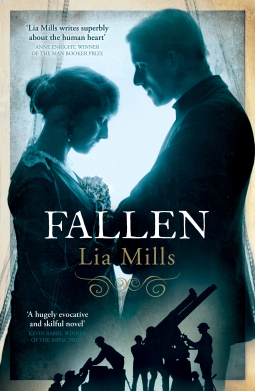
Fallen by Lia Mills

Liam Crilly is one of the ‘fallen’ – one of the many young men to be killed in action on the battlefields of World War I. When the tragic news reaches his family in Dublin, they each try to come to terms, in their different ways, with the terrible loss they have suffered. For his twin sister, Katie, losing Liam is like losing a part of herself and now all she has left of him are memories and the letters he sent home from the Western Front. Denied the chance to continue her education at university because her parents don’t believe it’s necessary, Katie finds solace in assisting Dorothy (Dote) Colcough, a friend and scholar, with the research for a new book she is writing.

Through Dote, Katie meets Hubie Wilson, an army officer who had fought with Liam in France and is now recovering at home after losing a hand. Katie is desperate to learn anything she can about Liam’s last days and Hubie is pleased to have found someone who is willing to listen to him talk about his traumatic experiences. Then, just as a relationship is beginning to form between the two of them, another violent conflict breaks out: the Easter Rising of 1916. Now, Katie’s priority is to keep her friends and family safe as armed insurrectionists take to the streets of Dublin with the aim of establishing an Irish Republic.

We actually learn very little about the Easter Rising itself – what lead to it, the politics behind it, how it ended or what the outcome was – and as this is not a subject I know much about myself, I was left feeling a bit lost and confused. However, I think that was probably intentional; the focus of the book is on the ordinary people of Dublin and how they coped with the violence going on around them in the city. Written from Katie’s point of view, she has a limited knowledge of what is happening behind the scenes, but describes to the reader the things she can see and hear for herself: the gunshots, the roadblocks, the looting of shops, the smashed windows and the fires burning in the streets. I couldn’t help thinking that she seems to move very easily from one part of the city to another, considering how dangerous it was supposed to be, but otherwise these sections of the novel feel vivid and real.

The personal side of the story was of less interest to me, which I think is because of the choice of Katie as narrator. I just didn’t find her a particularly engaging character; she’s a woman in her twenties, but her narrative voice makes her seem much younger – and I wasn’t really convinced by the romance with Hubie either. Some of the other characters appealed to me more, such as Liam’s grieving fiancée, Isobel, who feels shut out by the Crilly family after Liam’s death, and Katie’s new friends Dote and May, two unconventional women who are trying to live their lives the way they want to live them. I was sorry we didn’t spend more time with these characters, as I think their stories would have interested me more than Katie’s!

Fallen was selected as the One Dublin One Book choice for 2016, an initiative which encourages people to read a book connected with the Irish capital every April. I’m obviously very late with this one, but I can see why it was chosen, for the unusual perspective it offers on such an important event in Dublin and Ireland’s history.

Book 50/50 read for the 2021 Historical Fiction Reading Challenge.

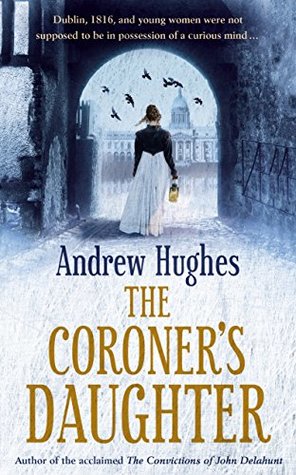
Andrew Hughes: The Coroner’s Daughter

I found so much to love in The Coroner’s Daughter! A strong, resourceful heroine with a passion for science; an interesting historical setting – 19th century Dublin; and a twisting, turning mystery to keep me guessing. Just like Andrew Hughes’ first novel The Convictions of John Delahunt, which I read and loved a few years ago, this is another great book which manages to be both highly entertaining and darkly atmospheric.

The story takes place in 1816, known as the ‘Year Without a Summer’. The city of Dublin is shrouded in fog and when a frosty July is followed by snow in August, people are at a loss to explain what is going on. Eighteen-year-old Abigail Lawless, however, has conducted her own research into the phenomenon, linking the unseasonable weather to a volcanic eruption on the other side of the world. As the coroner’s daughter, Abigail has always possessed a natural curiosity for anything scientific – and is particularly interested in her father’s work, performing autopsies to establish the cause of death.

When a young servant in a neighbouring household is accused of murdering her newborn baby – and is found dead before the inquest can be held – Abigail is sure there is more going on than meets the eye. She easily discovers the identity of the maid’s lover, but this is only the beginning. The strict religious sect known as the Brethren has been increasing in size and power since their influential leader, Mr Darby, arrived in Dublin the previous year. As she continues to investigate, assisted by her father’s young Scottish apprentice, Ewan Weir, Abigail becomes convinced that the Brethren are connected with the death of the maid and her baby. But who else might be involved? And if Abigail becomes too deeply involved herself, could she be putting her own life in danger?

I really enjoyed The Coroner’s Daughter. I think I preferred John Delahunt as the plot seemed more original and unusual, but this book is excellent too. I loved following Abigail around the Dublin of 1816 which, thanks to the gloomy and oppressive weather, is a very atmospheric setting. Our heroine’s investigations take her to a variety of locations from the Lying-In Hospital at the Rotunda to the smart terraced houses of Fitzwilliam Square and a clockmaker’s workshop on Abbey Street – and all of these are vividly described. Although it’s quite a dark story, it’s written with a lot of humour, which was obvious from the very first sentence: For my eighteenth birthday, Father promised me the hand of a handsome young man, which he duly delivered mounted in a glass bell-jar. First sentences can be so important and that one captured my attention immediately!

I found the scientific aspect of the novel particularly interesting. The story takes place at a time when the fanatical religious views of groups such as the Brethren are coming into conflict with the work of scientists such as the astronomer Professor Reeves, a friend of Abigail’s father. As a woman, Abigail faces additional obstacles, as is seen when she is forced to submit one of her reports to a scientific journal under her father’s name in order to get published, and again when she is the only female member of the audience at an astronomy lecture given by Professor Reeves. Mr Lawless does try to encourage his daughter to be more ‘feminine’ but at the same time, not having any sons, there’s the sense that he is only too pleased to have someone to share his knowledge and passion with!

Now I’m hoping Andrew Hughes will write more books about Abigail Lawless. She’s a great character and the way the novel ended makes me think that she could easily be brought back for a sequel. If not, I will look forward to reading whatever he writes next.

Thanks to the publisher for providing a copy of this book for review.

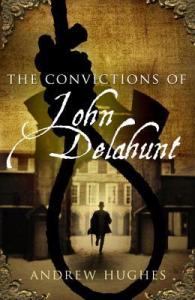
The Convictions of John Delahunt by Andrew Hughes

The Convictions of John Delahunt Imagine you’re a poor student at Dublin’s Trinity College in the 1840s. You’re newly married and living with your wife in a squalid tenement, cut off from friends and family. The future looks bleak, so when the authorities at Dublin Castle suggest that you become an informer, it seems to be the perfect solution. You will be rewarded well for any information you can give them leading to a conviction…and if you could just manage to witness a few murders, your money troubles could be over!

This is the situation in which our narrator finds himself in this wonderfully moody and sinister historical crime novel, The Convictions of John Delahunt. As the novel opens, John is sitting in a prison cell awaiting his death. We’re not sure exactly what he has done, except that it appears to involve the murder of a child. As he begins to write his final testimony, we are taken back to the origins of John’s dangerous career as an informer and discover how and why this young student of natural philosophy has been sentenced to hang.

Andrew Hughes is also the author of a non-fiction book about the residents of Dublin’s Fitzwilliam Square, Lives Less Ordinary, and so he has been able to draw on his knowledge of the city’s history to make John Delahunt’s world feel authentic and real. Because of the circles in which Delahunt moves, the focus is on the darker side of society – workhouses, grave robbing, illegal abortions, rat-killing and laudanum addiction are all explored. Dublin’s streets and alleys, taverns and parks, courtrooms and drawing rooms are all vividly described and although the language the author uses is modern enough to be accessible and easy to read, it never feels out of place with the Victorian setting.

John Delahunt himself is an intriguing narrator, though not always entirely reliable. He is certainly not easy to like – one of his first actions in the book is to tell a lie to the police that leads to a friend being found guilty of a crime he didn’t commit – yet I could still feel for him when things didn’t go according to plan and when he saw his life beginning to disintegrate around him.

A large part of John’s story revolves around his relationship with his wife, Helen, who is another interesting character – although we never get to see things from her perspective as John is narrating in the first person. At first Helen seems to be on the same wavelength as her husband, attending a hanging with him and even helping him to compile a list of friends, family and neighbours to inform on. Later in the book she experiences a personal tragedy and after this she seems to undergo a change, though because we only see her through John’s eyes, her true thoughts and emotions are not very clear.

I loved this dark and atmospheric book and was completely gripped by John Delahunt’s fascinating story (based on true events, by the way). A word of advice to potential readers – don’t start reading it in your lunch break at work or in bed when you need to be up early the next day, as you may find that you really don’t want to put it down!

Thanks to the publisher for providing a review copy via NetGalley