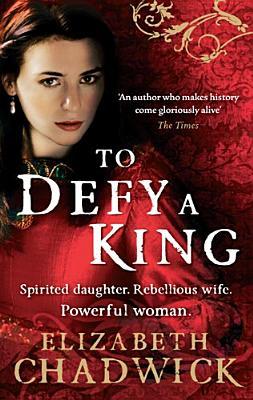
To Defy a King by Elizabeth Chadwick

Why are some reviews so much easier to write than others? This one has been sitting half-finished in my drafts folder since the end of July, waiting for inspiration which has never really arrived. This is no reflection on the quality of the book, which I enjoyed as much as all the other Elizabeth Chadwick books I’ve read, but for some reason I’ve had trouble thinking of what I want to say about it.

Anyway, To Defy a King is the story of Mahelt Marshal, the daughter of William Marshal, Earl of Pembroke and hero of two of Chadwick’s previous novels, The Greatest Knight and The Scarlet Lion. At the age of fourteen Mahelt is married to Hugh Bigod, the son of the Earl of Norfolk, and goes to live with her new family at Framlingham Castle. The Bigods have connections with King John through Hugh’s half-brother, William Longespée, who is also a half-brother of the King. As King John’s relationship with his noblemen slowly worsens and the country descends into war and political turmoil, the Bigod and Marshal families find themselves on opposite sides of the conflict. Mahelt must try to decide where her allegiances lie – with the family she was born into or with the Bigods and the husband she loves?

A few weeks before reading this book, I had read Here Be Dragons by Sharon Penman which covers much of the same period and this was useful as it meant I already had an understanding of some of the history. But where Here Be Dragons gives us a more balanced view of King John, seen through the eyes of his daughter Joanna as well as from the perspective of his many enemies, with this book we are given a very negative portrayal of the King. Anyone who tries to defy him, as Mahelt Marshal does, could be putting themselves and their family in serious danger.

Mahelt is a strong and independent person, who sometimes refuses to behave in the way a woman might be expected to behave during this period, yet she doesn’t feel too ‘modern’ or out of place in her medieval setting. Longespée is another great character and one of my favourites. He is in a difficult position, torn between his loyalty to the King and his relationship with his Bigod family. His rivalry with his half-brother Hugh leads him to do some cruel and insensitive things, but by the end of the book we see that he is not completely beyond redemption and I was happy with the way his character developed.

Although this book is set after The Greatest Knight (which I read last year and can recommend) I don’t think it’s necessary to have read that one first. I haven’t read the sequel to The Greatest Knight, The Scarlet Lion, yet but didn’t feel I had missed anything that was essential to my understanding of this book. There are also two other books I haven’t read, The Time of Singing, which tells the story of Roger Bigod, Hugh’s father, and A Place Beyond Courage, the story of William Marshal’s father, John. While reading the previous novels would help you become more familiar with the backgrounds of some of the characters, To Defy a King is easy enough to follow as a stand-alone novel and is one of my favourite Elizabeth Chadwick books so far.
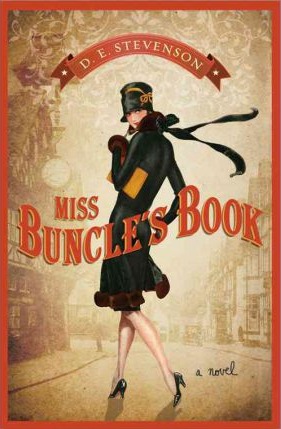
Miss Buncle’s Book by D.E. Stevenson

When Barbara Buncle finds herself short of money she dismisses the idea of keeping hens and decides to write a book instead. Not having much imagination she finds she can only write about people and places that she knows. Drawing her inspiration from her friends and neighbours in the village of Silverstream, she writes her first novel and has it published under the pseudonym of John Smith. When Disturber of the Peace turns out to be much more successful than Miss Buncle could ever have dreamed, it’s inevitable that the residents of Silverstream will eventually read it and recognise themselves within its pages. But how will they feel about the way they are represented in the book and what will happen if they discover who John Smith really is?

Delightful, charming, warm, cosy – those are the type of words I would use to describe Miss Buncle’s Book. Written in the 1930s, D.E. Stevenson captures perfectly the atmosphere of life in a small English village at that time – a place where everybody knows everybody else, where freshly baked breakfast rolls are delivered to the villagers every morning, where people meet for tea parties or musical evenings and gossip with the neighbours over the garden fence. The book is filled with a variety of interesting characters, all with their own quirks and eccentricities. Some of the most memorable include the formidable Mrs Featherstone Hogg, who is enraged by the unflattering way she is depicted in Miss Buncle’s book and leads the campaign against John Smith; Mr Hathaway the vicar and the scheming Vivian Greensleeves who has her eyes on his money; and the retired and lonely Colonel Weatherhead who faces a yearly battle with the Bishop.

Most of the inhabitants of Silverstream make an appearance in Disturber of the Peace and although Barbara Buncle takes the precaution of changing their names (Weatherhead becomes Waterfoot, for example, Miss King and Miss Pretty are renamed Miss Earle and Miss Darling, and Mr Fortnum becomes Mr Mason), she describes their personalities so accurately it’s not surprising that they were able to work out who the book was about! It was fun to see how they each reacted to discovering themselves in Miss Buncle’s story and having all their flaws exposed to the world.

I sent a copy of Miss Buncle’s Book to another blogger as a Secret Santa gift a couple of years ago because I thought it sounded wonderful, and when I saw that it was available through Netgalley I couldn’t wait to finally read it for myself. But although I did like it, I didn’t love it as much as I had hoped I would and as much as most other readers seem to have done. It was an enjoyable, relaxing read with lots of gentle humour and old-fashioned charm, but it lacked that special spark that would have lifted it from being a very good book to a great one. For me, this is a book that sounded better than it actually was, though I would still recommend it as a great way to escape from the stress of life for a while!

I received a review copy from Sourcebooks via Netgalley

Lion of Alnwick by Carol Wensby-Scott

Set in the 14th century during the reigns of Edward III and Richard II, Lion of Alnwick tells the story of Henry (Hal) Percy, 1st Earl of Northumberland. The novel begins in the year 1357 and ends in 1409, covering all the major events of Hal’s adult life including his marriage to Margaret Neville, sister of his bitter enemy and rival Northern lord, his conflict with John of Gaunt, the Duke of Lancaster, and his relationship with his son Harry “Hotspur” Percy.

Before I say any more about this great historical fiction novel, I should point out that this book has now sadly gone out of print, but for anyone who loves fiction set in medieval England it is definitely worth reading if you can manage to find a copy. Please don’t let the cover (pictured above) put you off – it has to be one of the worst covers I’ve ever seen and is really not representative of the quality of the story!

I can’t remember how this book first came to my attention, but the reason it appealed to me is because I only live an hour away from Alnwick and have been there several times (usually to visit the castle, the gardens or Barter Books) so I was attracted by the mention of Alnwick in the title. There are so few books that focus on the north east of England that whenever I do come across one I always feel I should read it (though of course, with this novel being so epic in scale, the action is not just confined to Northumberland but also sweeps down to York and Westminster and across to Wales).

The story concentrates on Hal, his son Harry, and their respective wives, Margaret Neville and Elizabeth Mortimer, but we also meet lots of other fascinating characters, most of them real historical figures of the period. One of the most intriguing characters, I thought, was Hal’s enemy from over the border in Scotland, Archibald Douglas, known as The Black Douglas. His rivalry with Hal is a recurring theme throughout the novel and I looked forward to all of their encounters. I also thought the characterisation of Richard II as a young and incompetent king unable to command the respect of his men while bestowing gifts and titles on his favourites, was very well done.

The author does seem to assume that the reader already has a good knowledge of the period; the history becomes very complex and detailed, so this is the type of historical fiction novel I would recommend only to readers who really do love history! It’s such a shame this book is out of print; it was very well-written and well-researched, maybe not as much fun to read as a Sharon Penman or Elizabeth Chadwick novel, but almost as good. If you’re interested in reading this book I would suggest trying to get a copy of this one and the other two in the trilogy (Lion Dormant and Lion Invincible) as soon as you can, before they become impossible to find!

In a Treacherous Court by Michelle Diener

There are already so many historical fiction novels set in the Tudor court that for a book to stand out from the others the author really needs to find a new way to approach the subject. Michelle Diener’s In A Treacherous Court is refreshingly different because it features two interesting but little-known historical figures – John Parker and Susanna Horenbout – both of whom really existed, yet aren’t characters that you would usually find in Tudor novels. Despite having read a lot of books set during this period, I had never come across either of these people until now.

Susanna Horenbout is a Flemish artist who travels to the court of Henry VIII in 1525 to become the king’s illuminator. During the journey to England, a man dies on board the ship and Susanna is at his side as he whispers his dying words, a secret message that he wants her to deliver to the King. It seems that someone is afraid of what Susanna may have learned, because as soon as she arrives in England an attempt is made on her life. One of the King’s most trusted courtiers, John Parker, Yeoman of the Crossbows, has been sent to meet the ship and after discovering how much danger Susanna is in, he vows to protect her while at the same time trying to unravel a plot that could threaten Henry’s throne.

In a Treacherous Court is the first in a series and after reading this one, I think both Susanna Horenbout and John Parker have a lot of potential as characters. As historians know so little about their lives, it gives the author some freedom to create exciting adventures for them without being too restricted by what really happened (the story does stick to the historical facts where possible though, and there is an author’s note at the end of the book that explains which parts of the novel are based on truth and which are purely fictional). I did find the romance between Susanna and Parker a bit hard to believe as it all seemed to happen so quickly, but who can say whether or not their relationship might really have developed the way it did in the novel?

The plot is very fast-paced with lots of action in every chapter which makes the story fun to read, although I thought the constant murder attempts and attacks on Susanna did become a bit repetitive. This book is definitely at the lighter end of the historical fiction spectrum, but it’s certainly an entertaining read with some original ideas that give it a different feel from most of the other Tudor court novels I’ve read.

I received a review copy of In a Treacherous Court from Simon & Schuster

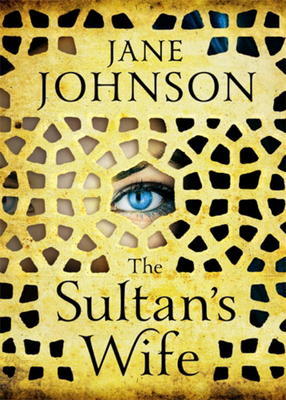
The Sultan’s Wife by Jane Johnson

The Sultan’s Wife is set in Morocco in the year 1677 and is narrated by two different characters. The first is Nus-Nus, a eunuch slave in the palace of the Sultan Moulay Ismail and the second is Alys Swann, an Englishwoman who has been captured at sea by corsairs and given to the Sultan as a gift. Amidst the dangers and conspiracies of Ismail’s court, Nus-Nus and Alys form a friendship and try to help each other survive.

I haven’t read any of Jane Johnson’s previous novels and chose to read this one purely because the setting sounded so interesting. I’ve never read a novel set in 17th century Morocco and I fell in love with the setting from the very first chapter. Everything was described so vividly, I wasn’t surprised to find that the author lives in Morocco herself and has already written two other books set in the same country. I learned so many fascinating little facts about Moroccan history and culture and about the building of the historic city of Meknes (which was intended to rival Versailles). There are also a few chapters where the action moves to England and the court of Charles II in Restoration-period London. It was interesting to be shown the English court through the eyes of Nus-Nus and to see the ways in which it was both different and similar to the Moroccan court. But although there are lots of descriptions of food, clothing, furnishings etc, the pace of the story never slows down and there’s always something happening.

Nus-Nus and Alys are fictional characters but Moulay Ismail, the Sultan, was a real person and is considered to be one of the cruelest rulers in history (one of his nicknames is ‘the bloodthirsty’). This is something that Jane Johnson portrays very convincingly – based on some of the things he does in this novel, living in his household must have been a terrifying experience! Nus-Nus and the other slaves and courtiers are constantly in fear of their lives, knowing that they are at the mercy of his whim, and they have learned to be extra careful when they see him dressed in yellow as this indicates he’s in a particularly murderous mood. Ismail’s wife, Zidana, is also portrayed as a villain; a jealous, scheming person who uses poisons and witchcraft to attack her enemies.

Of the two narrators, I didn’t find Alys Swann a very memorable character but I did really like Nus-Nus. In fact, he was the main reason why I enjoyed this book as much as I did. Nus-Nus was captured from his Senufo tribe as a young man and before coming to the Sultan’s palace had spent some time assisting a British doctor who taught him to read and write and to speak English. These skills make him invaluable to both Ismail and Zidana and are the reason why he’s in a position where he’s able to befriend and help Alys. As a black slave and a eunuch, Nus-Nus is often treated unkindly by other members of the court, but still has a lot of dignity and courage. I thought he was a wonderful character.

The story does touch on some controversial subjects including slavery, racism and prejudice, torture and cruelty (some of the things described in the novel are very brutal and characters lose their lives in some gruesome ways) but I thought everything was handled sensitively. The only criticism I really have is that Alys didn’t have a very distinctive voice; sometimes she didn’t sound any different from Nus-Nus and I didn’t immediately realise the narrator had changed. Apart from that, The Sultan’s Wife was exciting, informative and swept me away to another time and place, which is what I’m always looking for in historical fiction. I loved it!

Thoughts on finishing the Lymond Chronicles

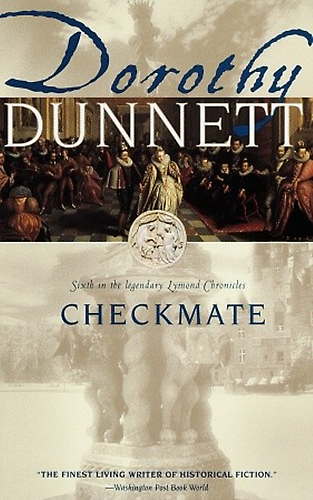
I apologise for abandoning my blog this week – I’ve been very busy both at work and at home, and any spare time I did have was devoted to finishing Dorothy Dunnett’s Lymond Chronicles. Because I read the final two books, The Ringed Castle and Checkmate so close together, rather than posting separate ‘reviews’ I decided to combine both books into the same post, along with some comments on the series as a whole.

Let’s start with the fifth book in the series, The Ringed Castle. After all the praise I’ve bestowed on the first four books it’s difficult to find new words to describe how I felt about this one, so suffice to say that it was as wonderful as the others. Russia is one of my favourite settings for historical fiction so I liked that aspect of the book, though I was equally interested in the chapters set at the Tudor court.

As with the previous novels, there’s a lot of history in this book – in the Russian sections we learn about Ivan IV, the Cossacks and the Crimean Tartars, and in the English sections we find ourselves at the centre of the conspiracies and political intrigue surrounding Queen Mary I and the future Elizabeth I. We also meet John Dee, the famous astrologer and mathematician, who is always interesting to read about, as well as another historical figure I knew nothing about: the explorer Richard Chancellor. Chancellor’s work with the Muscovy Company and as a navigator form quite a big part of the plot and I’m glad I’ve been able to learn something about his life and career. The final voyage of the Edward Bonaventure was so sad and one of the most memorable parts of the book for me.

Oh, and I loved the scene in the Hall of Revels, which finally led to the ‘Anvil Moment’ Aarti has been telling me about. And yes, it was worth waiting for!

When I started Checkmate, it was with a mixture of excitement at finding out how Lymond’s story would end and also sadness at the thought of reaching the end of the series. I was hoping to make the final book last as long as possible, but of course I couldn’t and it actually took less time to read than any of the others. In a series of unputdownable books, I found this one the most unputdownable of them all! I admit to having to cheat once or twice and flip forward a few pages, which is something I usually try not to do, but knowing from the previous books that Dorothy Dunnett had no qualms about killing off major characters, sometimes the suspense was just too much to bear.

Having said that, this wasn’t my favourite of the six books. There were parts that I loved – the chase through the streets of Lyon, the hilarious Hotel de Ville banquet, as well as finally learning the truth about Lymond’s birth – but overall I enjoyed some of the earlier books more. Still, I thought Checkmate was a great conclusion to the series and it was good to see so many of the characters from the previous books brought together in this one, including the return of Jerott, Marthe and one of my favourites, Archie Abernethy. And after The Ringed Castle, in which Lymond becomes more isolated than ever from his family, I was glad that Sybilla and Richard played such a big role in this book (it’s been fascinating to follow all the ups and downs of the relationship between Richard and Francis).

I’d like to finish by saying that I agree with all the Dorothy Dunnett readers who have been commenting on my previous Lymond posts – this is the best series of historical fiction novels I’ve ever read and I can see why so many of you have been re-reading them for decades because I’m sure I’ll be doing the same. And for anyone who has yet to read these books, I can promise you that although they’re not the easiest of reads, it’s definitely worth making the effort and getting to know Francis Crawford of Lymond, one of the most complex, charismatic, fascinating characters you’re ever likely to meet in literature. Working through the six books of the Lymond Chronicles has been one of the greatest experiences in my lifetime of reading.

Great Expectations by Charles Dickens

Despite my love of Victorian literature, Charles Dickens has never appealed to me as much as other 19th century writers and until recently the only Dickens novel I had actually read was A Christmas Carol. A couple of years ago I decided to give him another chance and although I still don’t think Dickens will ever be one of my favourite Victorians, I’m pleased to say that my opinion of his work is rapidly improving with every book of his I read!

Great Expectations is narrated by Pip, a young orphan who is brought up by his sister and her husband, Joe Gargery, a blacksmith. Near the beginning of the book two important incidents occur: first Pip meets an escaped convict in the graveyard near his home, and then soon after this he is invited to visit the eccentric Miss Havisham who lives at Satis House. When Pip unexpectedly receives a large sum of money he moves to London to become a gentleman and leaves his old friends behind. But who is the mysterious benefactor and will Pip’s ‘great expectations’ really change his life for the better?

I won’t go into the plot in any more detail for two reasons: firstly, because I suspect many of you will already be familiar with the story even if you haven’t read the book, and also because I wouldn’t want to spoil any of the surprises and plot twists the novel contains. But as well as the wonderful plot, Great Expectations is also full of strong and memorable characters. Miss Havisham, hidden away in her ruined mansion wearing her wedding dress, is probably the one most people will think of when they think of this book, but from the convict Abel Magwitch and Pip’s best friend Herbert Pocket to the lawyer Mr Jaggers and Miss Havisham’s adopted daughter Estella, the book is full of unforgettable characters. I posted a few weeks ago about one of my favourites, Joe Gargery, and how sad it is to see the way Pip’s relationship with Joe changes after he is given his great expectations.

If you’ve never read any Dickens before, I think this might be a good place to start. I’ve read four of his other novels (A Christmas Carol, Bleak House, Our Mutual Friend and The Mystery of Edwin Drood) and in comparison to some of those, I thought this one was much easier to read and understand. And I loved all the observations on life and human nature that Dickens scatters throughout his writing, like this:

“That was a memorable day to me, for it made great changes in me. But, it is the same with any life. Imagine one selected day struck out of it, and think how different its course would have been. Pause you who read this, and think for a moment of the long chain of iron or gold, of thorns or flowers, that would never have bound you, but for the formation of the first link on one memorable day.”

Or this:

“So, throughout life, our worst weaknesses and meannesses are usually committed for the sake of the people whom we most despise.”

Now I just need to decide which of Dickens’ books I should try next. I have three of his novels on my list for the Classics Club: David Copperfield, A Tale of Two Cities and Oliver Twist. Have you read any of those or is there another one you would recommend?