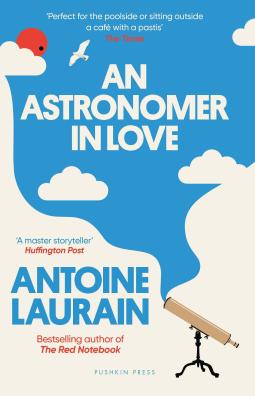
 Translated by Louise Rogers Lalaurie and Megan Jones
I’ve been aware of Antoine Laurain’s books for years but this is the first one I’ve read. It was originally published in French in 2022 as Les caprices d’un astre and is now available in an English translation from Pushkin Press. I’m counting it towards this year’s Read Indies month, hosted by Karen of Kaggsy’s Bookish Ramblings, which celebrates books published by independent publishers.
An Astronomer in Love is a dual timeline novel. One thread of the story is set in contemporary Paris, where divorced estate agent Xavier Lemercier has found an old telescope in a property he’s sold. He discovers that the telescope once belonged to the 18th century astronomer Guillaume Le Gentil, but he’s reluctant to give it to a museum and takes it home so he and his eleven-year-old son can use it to look at the night sky. Setting up the telescope on the terrace of his apartment, Xavier tests it out by looking at the nearby buildings – and is intrigued when he spots a woman on her balcony with what appears to be a zebra. Who is she and why would she have a zebra living in her apartment? Xavier is determined to find out!
In a second narrative which alternates with the first, we meet Guillaume Le Gentil as he sets out on a voyage to India in 1760, hoping to observe the transit of Venus across the face of the sun. Unfortunately, due to delays and bad weather, he misses the transit and decides to stay in that part of the world until the next one eight years later. The novel describes his adventures during this period and the people and wildlife he encounters.
Guillaume Le Gentil is a real historical figure and the expedition covered in the novel really happened. It was fascinating to read about his visits to Madagascar, the Philippines, Pondicherry and the Isle de France (now Mauritius), and his observations of creatures such as flying fish, giant tortoises, ring-tailed lemurs, and even dodos, which would be considered extinct just a few years later. I think Guillaume’s story would have been interesting enough to fill a whole book on its own, but I felt that I didn’t get the chance to know him on a personal level as much as I would have liked, because we kept having to leave him behind to return to Xavier in the modern day.
Xavier’s timeline is linked to Guillaume’s in several ways, the telescope being just one of them. Sometimes a word, phrase or thought, or a sighting of a particular bird or animal will lead seamlessly from one narrative to the other. It’s difficult to explain what I mean, but it’s cleverly done and works well. Although, as I’ve said, I would have been happy to stay with the historical timeline all the way through, Xavier’s story was also entertaining, apart from a strange episode involving terrorism that felt out of place. There’s a romance for both main characters too – and Venus, of course, is the goddess of love, so there’s some symbolism there, with the transit of Venus playing an important part in both threads of the novel.
Antoine Laurain’s other books all sound intriguing and I liked this one enough to want to try another one. If you’ve read any of them, which would you recommend?






 She Reads Novels