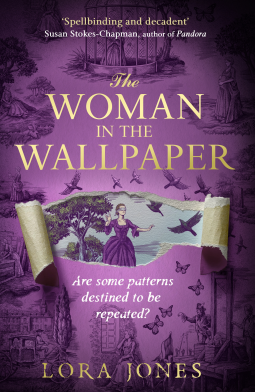
The Woman in the Wallpaper by Lora Jones

The French Revolution is a fascinating subject and I’ve read several novels set during that period. The Woman in the Wallpaper, Lora Jones’ debut novel, is another and is written from the unusual perspective of two sisters working at a wallpaper factory in northern France.

Sofi and Lara Thibault are the daughters of a stonemason who dies suddenly under tragic circumstances early in the book. In need of work to support themselves, the sisters and their mother move to Jouy-en-Jouvant, a town near Paris, where all three have been offered employment at the Oberst factory. The factory produces wallpaper with a unique design featuring a woman thought to be the late Mrs Oberst, who died several years ago and may or may not have been murdered. As they settle into their new jobs, both girls are drawn to Josef Oberst, the heir to the factory, but Josef is soon to be a married man, with an aristocratic young wife due to arrive from Versailles.

With political turmoil brewing in France, Sofi finds herself caught up with the revolutionaries and longs to play a part in shaping her country’s future. Lara, however, has other things to worry about – like the resemblance between herself and Mrs Oberst and the way incidents from her own life seem to be replicated in the pictures on the factory wallpaper. Meanwhile, Josef’s new wife, Hortense, discovers that as a member of the aristocracy she could be in the most danger of them all as the revolution picks up pace.

I enjoyed The Woman in the Wallpaper, although I wish authors would stop writing in present tense! I’ve never read a book set in a wallpaper factory before and it was fascinating to read about the process of making the paper and preparing the coloured pigments, as well as the work carried out in the printhouse, where the designs are carved onto the wooden blocks which are then coated with ink and pressed onto the paper. The parts of the novel dealing with the French Revolution are also interesting. Some of the key events, such as the storming of the Bastille and the arrival of the guillotine, are included, but the main focus is on the role of women and how the Revolution seemed unlikely to bring about the level of change they were hoping for.

The novel is narrated by both of the Thibault sisters and at first, even though the name of the narrator is given at the start of each chapter, I found myself forgetting which one I was reading about as their voices felt very similar. Later in the book, as their stories began to diverge, the two became easier to distinguish and this wasn’t a problem anymore. Lara is the gentler, quieter, more mature sister but Sofi, the impetuous younger sister, was my favourite. However, there’s also a third narrator – Hortense, Josef’s selfish, entitled wife from Versailles. Hortense makes no attempt to adapt to the changes in society or to endear herself to the people of Jouy; in one memorable scene, she deliberately hosts an elaborate birthday party for her pet dog, knowing that peasants are starving and workers are protesting. I thought perhaps I would warm to her as the book went on, but that didn’t happen – I found her cruel and heartless right to the end.

As for the central mystery surrounding the images in the wallpaper and their connection with Lara’s life, I found it easy to guess what was really going on, but it was still quite unsettling! This is an impressive first novel and I hope Lora Jones will be writing more.

Thanks to Sphere for providing a copy of this book for review via NetGalley.

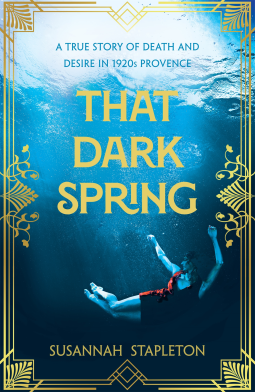
That Dark Spring by Susannah Stapleton

One of my resolutions for 2025 was to read more non-fiction books, so I’m ashamed to say this is only my second one this year. Oh, well – I still have more than seven months to add a few more to that total. I would also like to widen the range of topics I normally choose to read about and try something different, but for now, with That Dark Spring, I have stayed within one of my usual areas for non-fiction – true crime.

The crime in question is the murder – or could it be suicide? – of Olive Branson, an Englishwoman in her forties found dead at her farmhouse in a village in Provence. This happens in April 1929, when she is discovered submerged in a water tank outside the house, a bullet wound between her eyes and a revolver nearby. The local policeman and doctor conclude that Olive shot herself, but not everyone is happy with this verdict. Back in England, Olive’s wealthy, influential cousin demands that the case be reopened, so one of France’s top detectives, Alexandre Guibbal, is summoned from Marseille to investigate.

It’s an intriguing mystery! Could Olive really have lifted the heavy cistern lid, lowered herself in and shot herself – with her left hand, despite evidence suggesting that she was right-handed? Guibbal doesn’t think so and quickly turns his attentions to François Pinet, believed to be a lover of Olive’s for whom she had changed her will to leave him the Monte Carlo Hotel, which she had recently purchased. As evidence mounts up against Pinet, he insists that he is innocent and is defended by many of the villagers who are keen to support ‘one of their own’. There’s eventually a trial, but even then a lot of questions are left unanswered. Susannah Stapleton can’t – and doesn’t – give us those answers, leaving us to draw our own conclusions and try to decide what really happened.

I enjoyed That Dark Spring overall, although it took me a while to get into it due to the amount of background information provided in the first half of the book: a history of the village of Les Baux and the Baussenc people; an account of Olive’s early life and her career as an artist; detailed descriptions of the two rival hotels in Les Baux; and a long and (as far as I could tell) irrelevant biography of the poet Frédéric Mistral. Some padding is to be expected in books of this type, of course, but I found that I only became fully engaged with the story when it returned to the central crime. There are some points that wouldn’t be out of place in a detective novel, such as where Guibbal consults an astronomer in an attempt to decide exactly when darkness fell on the night of the crime or where Pinet tries to use the sighting of a car as an alibi and becomes entangled in his own lies.

It’s frustrating that we still don’t know the truth behind Olive’s death and probably never will. If Pinet was innocent and we assume that suicide was unlikely, that must mean someone else got away with murder – but who was it? Stapleton doesn’t really steer us into one way of thinking or another; she just provides the facts and some possible theories for us to consider. She suggests that the police may have been so determined just to pin the blame on somebody that they ignored or failed to collect important evidence, leaving Pinet’s fate up to the lawyers and the jury.

Stapleton has drawn on a number of primary sources and includes excerpts from Olive Branson’s diaries and letters throughout the text, giving it a more personal touch. There are also notes at the end, a bibliography and a list of Olive’s exhibited artworks. I had never heard of Olive until now, so it’s good to have learned a little bit about her. I’ll have to go back and read Susannah Stapleton’s other book – The Adventures of Maud West, Lady Detective.

Thanks to Picador for providing a copy of this book for review via NetGalley.

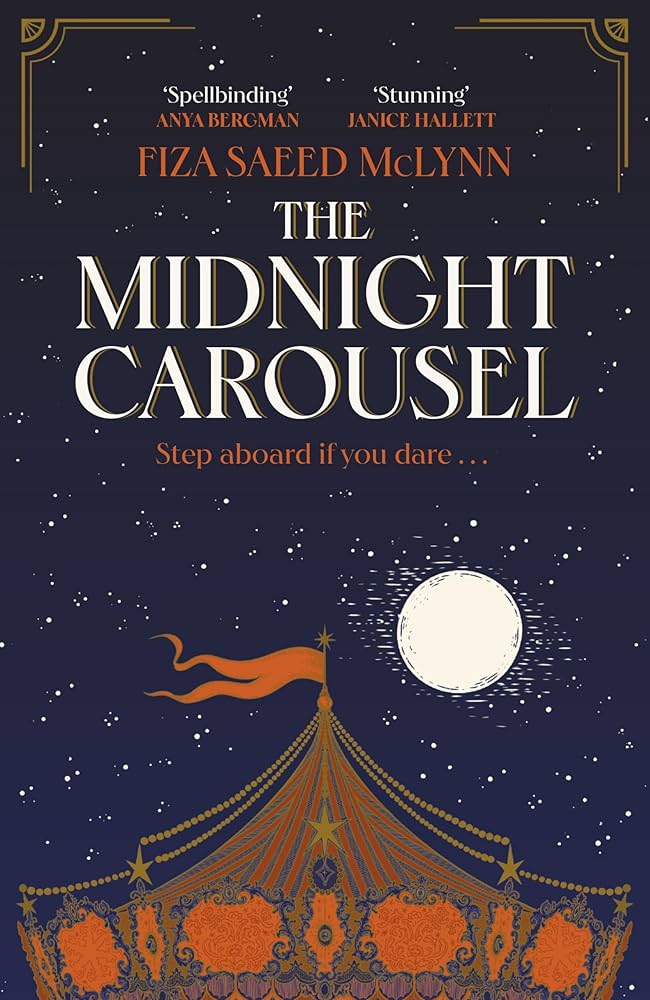
The Midnight Carousel by Fiza Saeed McLynn

Whenever you decide to read a book by an author who’s new to you, you never really know what to expect and there’s always a risk you won’t like it, particularly when it’s a debut novel like this one. Fortunately, I loved The Midnight Carousel from the beginning; it’s such an original, unusual story that I was completely captivated by it.

The carousel of the title is built in 1900 by Gilbert Cloutier for the Grand Exhibition in Paris. Gilbert is struggling to come to terms with his grief over the recent loss of his young son, so he decides to add some special features to the carousel in memory of the boy. This is the last thing he does before disappearing without trace. Over the years that follow, the carousel gains a sinister reputation when it becomes linked with further disappearances and Detective Laurent Bisset is asked to investigate. He thinks he has caught the culprit, but several years later history begins to repeat itself, leaving Laurent questioning whether he has made a terrible mistake.

Meanwhile, in England, Maisie Marlowe is being raised by abusive foster parents in Canvey Island, Essex. Maisie has no idea who her real parents are and the only things that sustain her through this miserable period of her life are her friendship with her foster brother and a picture of a beautiful carousel that she found on the beach. Eventually, an aunt comes to rescue her and takes her to live in the home of Sir Malcolm Randolph where she has just taken a job as housekeeper. Due to an unexpected sequence of events, Maisie ends up emigrating to America with Sir Malcolm where they open an amusement park in Chicago with a magnificent carousel as the star attraction – the exact same carousel as the one in Maisie’s picture and the same one that was built at Gilbert Cloutier’s factory in Paris.

When the disappearances begin again, Laurent Bisset is sure there must be a connection with the earlier incidents in France, so he travels to Chicago determined to uncover the truth this time. Here he crosses paths with Maisie, bringing the two threads of the novel together. I loved both characters and was interested in their personal stories – Maisie’s Dickensian childhood and her incredible change of fortune and Laurent’s dedication to making amends for his past mistakes – but I also enjoyed watching their relationship develop as they come together over the mystery of the carousel.

The mystery element of the book is not so much a whodunit as a howdunit. How can people be disappearing into thin air while riding the wooden jumping horses? Is the carousel itself haunted? Did Gilbert Cloutier place a curse on it? Is someone somehow snatching people from the horses without being seen? Although there were a few clues that I thought could and should have been noticed by Laurent and the police, I can also understand how they could have been missed. When we eventually get some answers, they are both clever and creepy and what I found particularly unsettling is that all through the book I never really knew whether I was reading magical realism or something with a more human explanation. The eerie atmosphere, along with the fairground setting, kept reminding me of Erin Morgenstern’s The Night Circus, but I think this is a better book.

I thoroughly enjoyed The Midnight Carousel and loved getting to know Laurent, Maisie and the secondary characters – I particularly liked Mrs Papadopoulos the dairy seller and Madame Rose the fortune-teller. I’ll certainly be putting Fiza Saeed McLynn on my list of authors to look out for in the future.

Thanks to Michael Joseph for providing a copy of this book for review via NetGalley.

Spitting Gold by Carmella Lowkis

In Charles Perrault’s fairy tale about two sisters, Diamonds and Toads, a fairy rewards the good sister with the ability to spit gold and punishes the bad sister with the curse of spitting toads. This is the premise at the heart of Carmella Lowkis’ new novel, Spitting Gold, a tale of two very different sisters living in 19th century Paris.

It’s 1866 and Baroness Sylvie Devereux has settled into a respectable married life, but a visit from her younger sister, Charlotte Mothe, threatens to ruin both her marriage and her reputation. For several years, Sylvie and Charlotte had worked together as spiritualists, conning grieving victims out of large sums of money, but Sylvie has promised her husband that those days are behind her and her sister is no longer part of her life. Now, though, Charlotte is begging Sylvie to join her for one last job and Sylvie finds it impossible to refuse, knowing that Charlotte needs the money to pay their father’s medical bills.

Several members of the wealthy de Jacquinot family believe they are being haunted by the spirit of a great-aunt, who was brutally murdered during the French Revolution, leaving behind a hidden treasure. The Mothe sisters agree to help lay the ghost to rest and begin to use every trick and deception at their disposal to convince the family that they are making contact with the spirit. Everything seems to be going well, until the ghost appears to start targeting the sisters themselves. Is the de Jacquinot house really haunted or is there another explanation for what is happening?

There seems to be a current trend for historical novels about mediums and séances; I can think of several I’ve read just in the last year or so, including Lucy Barker’s The Other Side of Mrs Wood and Ambrose Parry’s Voices of the Dead. What makes this one different is the structure and the idea of using two sisters to give alternate views of the same story – the first half of the book is narrated by Sylvie and the second half by Charlotte. I’m not sure how well this worked for me; it was interesting to see things from two such different perspectives, but by the time Charlotte’s narrative began I had become so absorbed in Sylvie’s story I struggled to adjust to a change of narrator.

Apart from the references to the French Revolution, I felt that the book lacked the strong sense of time and place I prefer and at times I even forgot that I was reading a story set in 19th century Paris and not Victorian London. I did love the good sister/bad sister theme, though – while at first it seems obvious that Sylvie is the good one and Charlotte the bad, as the novel continues we learn that things are not that simple and that we shouldn’t rely on just one point of view to give us the full picture. As a debut novel it was quite entertaining, with some interesting twists; I’m not sure whether I’ll read more books by Carmella Lowkis, but I could be tempted!

Thanks to Doubleday for providing a copy of this book for review via NetGalley.

Book 19/50 for the Historical Fiction Reading Challenge 2024

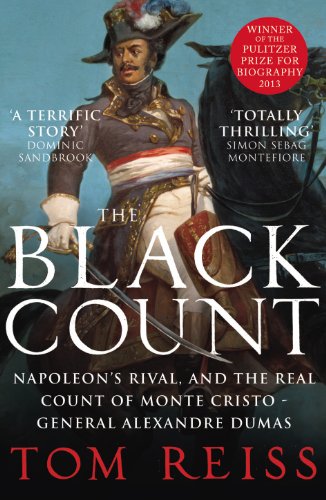
The Black Count by Tom Reiss

My second non-fiction review this month, The Black Count is a biography of General Thomas-Alexandre Dumas, father of the French author Alexandre Dumas. I’ve always loved Dumas’ novels (he’s most famous for The Three Musketeers and The Count of Monte Cristo, one of my all-time favourite books), so The Black Count appealed to me as soon as I heard about it on its publication in 2012. I’ve no idea why it has taken me so long to actually pick it up and read it!

Thomas-Alexandre Dumas, usually referred to in the book as Alex, was born in 1762 in the French colony of Saint-Domingue (now Haiti) in the Caribbean. He was the son of a French aristocrat, the Marquis Alexandre Antoine Davy de la Pailleterie, and a freed slave woman, Marie-Cesette Dumas. After the death of his mother, the young Alex, along with his three siblings, was temporarily sold into slavery by his father in order to pay their passage back to France. Eventually the Marquis bought Alex back (but not the other three children, who remained in slavery and are lost to history) and took him home to France where he was educated in fencing, horse riding and all the other skills befitting the son of a nobleman.

When the Marquis remarried, however, Alex was left to fend for himself and he joined the French military, taking his mother’s surname of Dumas. Playing an important role in the French Revolutionary Wars, he quickly rose through the ranks and by the age of thirty-two was General-in-Chief of the French Army of the Alps, commanding 53,000 men. Later, on a campaign to Egypt, Alex clashed with another powerful general, Napoleon Bonaparte, and from there his career took a downward spiral. Today, Napoleon remains one of the most well known historical figures of all time, but Alex Dumas has been largely forgotten. The Black Count is an attempt to give Dumas the attention he deserves and make his story known to a modern audience.

General Alex Dumas was clearly a fascinating man, yet I have to be completely honest and say that I was slightly disappointed by this book. It was described as a thrilling real life adventure story, as exciting as one of Dumas’ novels, which I think raised my expectations too high. For me, there was too much focus on military history, with details of campaigns, battles and tactics, along with lots of general information on the French Revolution, with Alex Dumas himself being pushed into the background for large sections of the book. Of course, other readers will find this much more interesting than I did, but military life is never going to be one of my personal favourite subjects to read about and I have read about the Revolution many times before. I did quite enjoy the chapter about the Army of the Alps, though, where Alex and his men scaled the icy cliffs of Mont Cenis to capture a mountain pass; as Reiss points out, the cold must have come as a shock to a man who grew up in the Caribbean!

All of Alex Dumas’ achievements are very impressive, but most impressive of all is the fact that he was able to rise as high as he did as a person of colour in the 18th century. In some ways it was the perfect time and place for him to succeed because it was a surprisingly tolerant period in French history; a century later racial prejudices and the removal of rights for black people would have prevented him from reaching the same heights. At the time of Alex’s arrival in France, however, a decree known as the Code Noir was in place which gave freed slaves the same rights and privileges as white people. Add to that Alex’s renowned strength, courage and leadership skills and it’s easy to see how he was able to accomplish so much and even rival Napoleon for a while.

Tom Reiss occasionally tells us about his visits to museums and archives where he saw documents and paintings which informed his writing of the book. He also draws on a large number of other sources, which are listed at the end in a bibliography, the most notable being the writings of Alexandre Dumas (the author), who wrote about his father in his memoirs and several of his other non-fiction books. Reiss also suggests that some famous scenes from Dumas’ novels were based on his father’s adventures – for example, in 1799 Alex was captured and thrown into a dungeon in the Kingdom of Naples for two years, something which surely inspired the imprisonment of Edmond Dantès in The Count of Monte Cristo.

Although I expected to love The Black Count more than I did, I do feel that I’ve learned a lot from it, both about France in the second half of the 18th century and about Alex Dumas himself. He was an amazing man and deserves to be better known; I’m sure this book, in the twelve years since it was published, will have gone some way towards achieving that.

Farewell, the Tranquil Mind by RF Delderfield

Farewell the tranquil mind! Farewell content!
Farewell the plumed troops and the big wars
That make ambition virtue! O, farewell!

These lines from Othello inspired the title of Ronald Frederick Delderfield’s 1950 novel about a period of history that was anything but tranquil – the French Revolution. Having loved Delderfield’s A Horseman Riding By trilogy (which begins with Long Summer Day), I’ve been keen to read more of his books. This one wouldn’t necessarily have been my first choice – it’s currently out of print and with very few reviews online – but I came across a copy in a charity shop and thought I would give it a try.

Farewell, the Tranquil Mind is narrated by David Treloar, a young man from a family of Devon smugglers. From an early age, David has been different from the other male Treloars; while his brothers work with their father, bringing in shipments of contraband cargo, David stays at home and helps his mother run the family farm, Westdown. He is also the only one who has learned to read and write, having been taken under the wing of the agent, Saxeby, who introduces him to French politics through Thomas Paine’s Rights of Man. However, when a smuggling operation goes wrong and an exciseman is shot dead, the blame falls on David and he is forced to flee England.

Arriving in France in the middle of the Revolution, he is befriended by André Lamotte, the nephew of a Parisian wigmaker and perfumier known as Papa Rouzet. It is through his friendship with André and the Rouzet family that David becomes involved with various revolutionary groups including the Brissotins and the Cordeliers – and falls in love with Charlotte, Rouzet’s niece. With the situation in France becoming increasingly dangerous, David and Charlotte consider escaping to England – but not only is David still wanted for the murder of Exciseman Vetch, the English also now suspect him of being a French spy.

I found this book interesting, but certainly not as enjoyable as the Horseman Riding By trilogy, and I can see why it hasn’t been reissued like most of his other novels. The blurb made it sound quite exciting – and it is, in places, but in between there’s lots of exposition and political detail and this slows the plot down, making it less entertaining than I’d expected. Despite having read other books set during the French Revolution, I had to concentrate to keep track of all the different groups and who was on which side. It wasn’t just a case of royalists versus republicans; within the republican movement there were many separate factions – as well as the two I’ve mentioned above, there were Jacobins, Girondins, Montagnards, Dantonists and several others, each with their own ideas on the goals of the Revolution and how the country should be run.

I liked David, but I felt that Charlotte’s role in the book was too small and understated for me to get a clear sense of who she was or what she was like and this meant that I didn’t feel fully invested in the romance element of the book. It’s disappointing when I think of how well defined even the minor characters were in the other books of Delderfield’s I’ve read. This novel was written very early in his career, though, which maybe explains why it doesn’t feel as accomplished. It’s worth hunting down and reading if you’re particularly interested in learning more about the political side of the French Revolution, but otherwise probably not the best place to start with Delderfield! I’m still looking forward to reading more of his books and would welcome any suggestions as to which one I should read next.

This is book 18/50 read for the 2023 Historical Fiction Reading Challenge.

The Scapegoat by Daphne du Maurier (re-read) – #DDMReadingWeek

This week HeavenAli is hosting another of her Daphne du Maurier Reading Weeks, assisted by Liz who is collecting the links this year. As you may know, du Maurier is one of my favourite authors; I have now read all of her novels and short story collections at least once and some of her non-fiction (I attempted to rank them all in this post, just for fun). For this year’s Reading Week I’ve decided to re-read her 1957 novel The Scapegoat, which is one I particularly loved when I first read it back in 2011 (here’s my original review). I’ve wanted to read it again ever since, not just because I enjoyed it so much, but also because I formed a theory about what was actually happening in the book and I was curious to see whether I would feel the same way on a second read. I’ll discuss this later in this post, but don’t worry – I’ll include a spoiler warning for those of you who haven’t read the book yet.

The novel opens in Le Mans where our narrator, John, an English academic, is on holiday. When he meets a man who looks and sounds just like him at the station, he feels an instant connection with him and after spending the evening drinking and talking, he accompanies the other man back to his hotel room. He learns that his new friend is a French count, Jean de Gué, and that they have something else in common – they are both depressed and dissatisfied with life, John because he is lonely and has no family, Jean because he has a large family, all of whom are causing him problems. As the night wears on, John falls into a drunken stupor and when he wakes up the next day his companion has disappeared, taking all of John’s clothes and possessions with him and leaving his own in their place.

When Jean’s chauffeur arrives, ready to drive him home to his château in the French countryside, John begins to protest, explaining that there has been a mistake – but then, on an impulse, he decides to take this opportunity to leave his old life behind for a while and continue to impersonate Jean de Gué. On reaching Jean’s château, John finds that nobody suspects he is an impostor and he is able to take Jean’s place within the family. He also begins to understand why Jean had said his family life was so difficult – there are all sorts of tensions and conflicts between various members of the family and to make things worse, the de Gué glassworks is facing financial ruin. It’s up to John to put things right, if he can.

I enjoyed this read of The Scapegoat as much as my first. If you take everything at face value, of course, it requires a huge suspension of disbelief. Not only do John and Jean look completely identical, so much so that not even Jean’s mother, wife or daughter guess the truth, but they also sound exactly the same (and John’s French is so fluent that nobody suspects a thing). Is this likely? Of course not, but it provides du Maurier with her starting point for this fascinating novel and it’s perfectly possible to just accept the plot for what it is and enjoy the story. After all, it’s no more ridiculous than the book that apparently inspired this one – Anthony Hope’s The Prisoner of Zenda. And as always with a du Maurier novel, you can expect beautiful descriptions, a strong sense of place and interesting, if not necessarily very likeable, characters.

*My Scapegoat theory (includes spoilers)*

When I first read this book in 2011, I found myself beginning to wonder – what if John and Jean weren’t doubles after all? What if there was only one man, with multiple personalities (now known as dissociative identity disorder)? It makes so much more sense to me that Jean, feeling that he has made a mess of his life, has created a new identity to deal with the problems he has caused for himself. At the end of the book, when everything has been resolved, he has no further need of John and although it’s not clear exactly how much Jean has learned and how he will manage his relationships and business affairs in the future, he feels that he can now cope on his own. He tells John that he has emptied John’s bank account, sold his flat and furniture in London and resigned John’s position as university lecturer – in other words, destroyed John altogether, because John never really existed and is no longer necessary.

After finishing the book on that first occasion, I remember looking at other reviews and being surprised that almost nobody else had mentioned that any of this had occurred to them too. I accepted that I must have misunderstood the whole book; however, the Daphne du Maurier website quotes a letter written by Daphne herself regarding The Scapegoat which seems to support my interpretation. Her reference to ‘that man’s nature’ doesn’t really make sense to me if there were actually two separate men in the book.

“Every one of us has his, or her, dark side. Which is to overcome the other? This is the purpose of the book. And it ends, as you know, with the problem unsolved, except that the suggestion there, when I finished it, was that the two sides of that man’s nature had to fuse together to give birth to a third, well balanced.”

On reading the book for a second time, I have been paying closer attention and looking for subtle clues and hints. There are just three main obstacles in the way of my theory. First, there’s Jean’s dog, César, who is hostile towards John and the only member of the household who seems to sense that something is wrong. However, when Jean and John meet up again at the end of the book, Jean explains that John hasn’t been whistling to César in the correct way and this is why he hasn’t been obeying his commands. Also, during a scene in a hospital, we are told that Jean is blood group O and John is blood group A – but as it’s John himself who tells us this I don’t think it can be taken as conclusive evidence of anything. The only thing I can’t manage to explain away is that when Jean calls the château to inform John that he’s coming home, it’s a servant who answers the phone and tells John that someone wants to speak to him. If it wasn’t for this one moment, I would have been nearly convinced that I was right!

I did find plenty of things to support my theory, including the fact that, when speaking to Jean’s family for the first time, John finds that the ‘tu‘ form of French comes naturally to him, although he’s never used it before; the way John muses that Jean’s ‘inner substance was part of my nature, part of my secret self’; and in particular, the whole conversation he has with Jean’s mistress, Béla, in Chapter 12.

‘You said something a while ago about taking stock of oneself,’ I said. ‘Perhaps that’s just what I’ve been doing, over a period of time, and it came to a head that evening in Le Mans. The self I knew had failed. The only way to escape responsibility for failure was to become someone else. Let another personality take charge.’

‘The other Jean de Gué,’ she said, ‘the one who’s been hidden for so long beneath the surface gaiety and charm, I’ve often wondered if he existed. If he’s going to emerge, he’d better do so now. Time’s getting on.’

What do you think?

*End of spoilers*

Overall, after finishing my second read of the book, I think probably the way everyone else has interpreted it is the correct way, but du Maurier does like to be ambiguous and I enjoyed looking below the surface and dissecting the different layers! It really is a fascinating novel and still one of my favourites by du Maurier. Now I just need to find time to revisit some of her others!