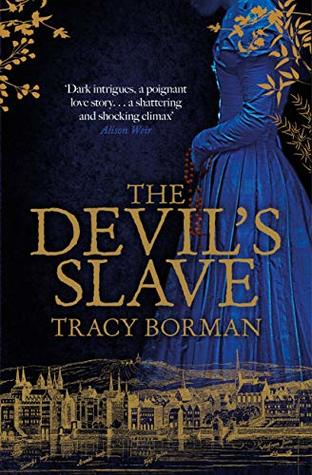
 Almost a year ago, I read Tracy Borman’s The King’s Witch for last year’s 20 Books of Summer challenge; now the second novel in the trilogy is available and has become my fourth book for this year’s 20 Books of Summer!
In The King’s Witch we met Frances Gorges, a young 17th century noblewoman whose knowledge of the healing properties of herbs and flowers leads to accusations of witchcraft. The book ends shortly after the foiling of the Gunpowder Plot, in which Frances has become embroiled, and The Devil’s Slave picks up the story just a few months later, in April 1606.
Following the dramatic events that brought the previous novel to a close, Frances has retreated to her family’s estate, Longford in Wiltshire, to mourn the loss of the man she loved and give birth to their child. But Longford is now in the hands of her hostile brother, Edward, and is no longer the safe place she remembers. When she receives a proposal of marriage from Thomas Tyringham, the king’s ‘Master of the Buckhounds’, who agrees to raise her young son as his own, she accepts, although she doesn’t think she will ever be able to love again. Promising to stay out of any more political or religious intrigue, Frances tries to settle into her new life at Tyringham Hall – but it is not long until she and Thomas are drawn back to court and Frances finds herself caught up in a new Catholic conspiracy.
I loved this book; the reservations I had about the first one (mainly the slow pace at the beginning and the story being not quite what I’d expected) were not problems this time and I was engrossed from the first page. This is such a fascinating period of history, yet being sandwiched between the end of Elizabeth I’s reign in 1603 and the Civil Wars of 1642-1651, it often tends to be overlooked. There’s so much going on in this novel – the court of James VI of Scotland and I of England appears to be a hotbed of plotting and scheming, and with her Catholic background and previous connections with the Gunpowder conspiracists, Frances is right at the heart of it all. It’s never clear who can and can’t be trusted and Tracy Borman does an excellent job of showing how dangerous life at court is, particularly for a woman like Frances whose previous actions have already aroused suspicion.
When I read The King’s Witch, I felt surprised that the witchcraft element wasn’t as strong as the title had made me expect. This time, I had different expectations. I knew that it wasn’t going to form a very big part of the story, although it is always there in the background; every time Frances uses her skills to help someone who is ill or dying, you know that someone could be watching and remembering, storing away the information to bring up at a later date and use it against Frances and her family. Halfway through the novel we see Frances visiting Belvoir Castle, home of the Earl of Rutland, and there are hints that some of the castle servants are involved in witchcraft. Tracy Borman states in her author’s note that this will be brought to life in the third novel, so I’m looking forward to that!
Although Frances Gorges was a real person, very little is known about her, so not everything that she does in the novel is based on historical fact. However, we also meet some well-known figures of the period, ranging from Sir Walter Raleigh (imprisoned in the Tower of London for the duration of the novel), the king’s two sons Prince Henry and the future Charles I, and Arbella Stuart, a possible claimant to the throne. I was intrigued by the characterisation of Robert Cecil – he had been very much the villain of the previous novel but in this one there is a suggestion that there may be another side to him! I also loved Thomas Tyringham (who also really existed) and was pleased to see that Frances’s feelings towards him grew warmer as time went by.
The way the book ended made it clear that there is more trouble ahead for Frances, but I hope there will be happiness too. I can’t wait to see what Tracy Borman has in store for her in the third book in the trilogy.
Thanks to Hodder & Stoughton for providing a copy of this book for review via NetGalley.

This is book 4/20 of my 20 Books of Summer.
 She Reads Novels