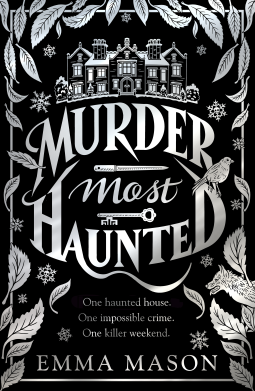
Murder Most Haunted by Emma Mason

Fifty-five-year-old Midge McGowan is retiring after thirty years as a police detective and her colleagues have given her a very unusual retirement gift: a ticket to spend the weekend before Christmas in a haunted house. The reason? The tour company, Haunting Holiday Excursions, is run by a former police officer, John Rendell, and HR get discounted tickets. Midge doesn’t want to go, especially as it will mean leaving behind her wife, Bridie, who is having chemotherapy, but Bridie persuades her that she’ll be fine for a few days and that it will be a good experience for Midge.

Soon, Midge finds herself getting off the bus at Atherton Hall with a small group of other guests: Dr Mortimer and his invalid wife, Gloria; Noah, who hosts a paranormal podcast; and Rona, a pop star in remission from a drug addiction. The bus driver, Harold, also ends up staying at the Hall with them after heavy snow leaves the roads impassable and cuts them off from the rest of the world. Almost as soon as they arrive, the guests begin to experience sightings of the White Lady of Atherton Moor drifting around the grounds of the estate, although not everyone believes they have truly seen a ghost. When their host, Rendell, is found dead in the bath, however, they have to decide whether ghosts are the culprits or whether there’s a human killer on the loose.

This is the book I thought A Ghost Hunter’s Guide to Solving a Murder was going to be! Unlike that other book (which was good, but not as advertised), this one has an actual ghost hunter in it, in the form of Noah who arrives with his cameras and recording equipment hoping to get new material for his podcast. The book also has an interesting and unusual detective character in Midge, who is quickly dismissed – sometimes very cruelly – by the others as an overweight, middle-aged woman with no fashion sense and no social skills. It was great to see her come into her own and find her own identity away from the slightly overpowering Bridie.

Apart from Midge, the other characters feel like stereotypes at first: Noah, the ‘woke’ young person who clashes with Harold, the racist, sexist older man; Rona, the shallow pop star with a wild lifestyle; the domineering doctor and his fragile wife who takes to her bed at the first sign of danger. However, most of these people turn out to have secrets or hidden depths and aren’t quite what they appear to be on the surface.

The murder mystery element of the book is interesting; Midge never seriously considers Noah’s theory that ghostly activity is responsible, but even she has to admit that there are some spooky similarities between the murders taking place in the present and those described in an old diary belonging to the Atherton family doctor. My only criticism is that I found the killer and the motive too easy to guess, so wasn’t surprised at all when the solution was revealed. Still, this was an entertaining novel and the good news is that it’s the first in a series, with the second Midge McGowan mystery coming next year!

Thanks to Bantam for providing a copy of this book for review via NetGalley.

Book 5 for RIP XX

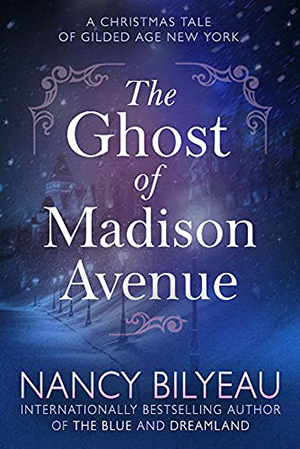
The Ghost of Madison Avenue by Nancy Bilyeau

Christmas is always a good time to read ghost stories, I think! This one is even set in December – and is also a novella, which makes it a good choice if you’re looking for something quick to read over the Christmas holidays.

The story takes place in New York in December 1912. Helen O’Neill is part of an Irish-American family from the Bronx and since being widowed several years earlier she has been living with her two older brothers. Helen is determined not to be a financial burden on her family and has been working at the Metropolitan Museum of Art where she has proved to have a talent for restoration. She’s so good at it, in fact, that she catches the attention of the librarian Belle da Costa Greene, who entices her away from the museum with the offer of a job in the private library of the financier J.P. Morgan.

Starting work at the Morgan Library on Madison Avenue, Helen is captivated by the beautiful building with its thick bronze doors, marble rotunda and exquisite murals. But in the street outside, she sees something even more memorable – a young woman in old-fashioned dress, inappropriate for the cold winter weather, who suddenly disappears without trace. As the days go by, Helen has several more encounters with this strange girl whom only she seems able to see. Eventually, she begins to ask herself whether the girl could be a ghost and if so, is she trying to tell Helen something?

Even without the supernatural element, The Ghost of Madison Avenue is a fascinating piece of historical fiction. Morgan, of course, was a real person and his library on Madison Avenue can still be visited, but so was Belle da Costa Greene, a woman I’d never heard of but who seems to have led an interesting life. As I read, I kept thinking that she really deserved a novel of her own, then I discovered that at least two have already been written! They are The Personal Librarian by Marie Benedict and Victoria Christopher Murray and Belle Greene by Alexandra Lapierre.

As a ghost story, I thought the book was less successful. Not all ghost stories are scary (and not all need to be), but I didn’t find this one even a little bit eerie. It’s more of a story about Helen’s grief – she has never really come to terms with her husband’s death – and laying to rest the ghosts of her past so that she can finally move on with her life. I also found the book too short to be completely satisfying. A longer novel would have allowed Bilyeau to expand on some of the other topics she touched on, such as the aes sidhe of Irish mythology, and Helen’s relationship with her sister Bernadette, who has become a nun.

Still, I enjoyed this book and it didn’t take long to read! I’ve now read everything currently published by Nancy Bilyeau and will look forward to her next book in the Genevieve Planché series, hopefully coming next year.

Book 54 for the Historical Fiction Reading Challenge 2024

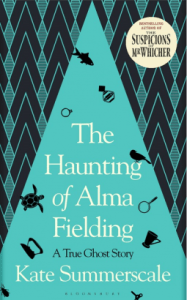
The Haunting of Alma Fielding by Kate Summerscale

I’ve had mixed experiences with Kate Summerscale’s books so far: I loved The Suspicions of Mr Whicher, liked The Wicked Boy and gave up on Mrs Robinson’s Disgrace after a few chapters. I didn’t know what to expect from The Haunting of Alma Fielding, then, but I hoped it would be another good one!

Like Summerscale’s others, this is a non-fiction book based on a true story, in this case the story of an ordinary thirty-four-year-old woman, Alma Fielding, who becomes the centre of paranormal activity in her London home. The book follows Nandor Fodor of the International Institute for Psychical Research as he investigates Alma’s claims, desperately hoping that this time – after being disappointed by a long line of frauds – he has finally come across a genuine haunting.

At first, having witnessed for himself the smashed glasses, spinning teacups, moving furniture and broken eggs, Fodor is convinced that a poltergeist is at work in the Fielding household. The more he learns about Alma’s abilities, which include producing live animals out of thin air and transporting herself from one area of London to another, the more intrigued he becomes…until, eventually, he begins to have doubts. Is this a real paranormal phenomenon he is investigating or is Alma haunted by something very different?

I found some parts of this book fascinating. Although I was sure Alma must have been involved in some sort of elaborate hoax and that there must have been logical explanations for the things she claimed were happening to her, I didn’t know exactly what she was doing or how she was doing it. I was amazed to see the lengths Alma went to in her efforts to prove that her psychic abilities were real and the lengths Fodor and the other ghost hunters went to in their efforts to verify them. Some of the methods they used to investigate Alma’s claims were quite harmless, such as conducting word association tests, but others were intrusive and cruel, and although I didn’t like Alma it made me uncomfortable to read about the way she was treated – particularly as Fodor believed that her powers were the products of various traumas she had suffered earlier in life.

At times, Summerscale widens the scope of the book to put Alma’s story into historical context, to discuss the influence of novels and films of that period, and to look at some of the other things going on in society at that time. The ‘haunting’ and the investigation took place in 1938, when the world was on the brink of war and Summerscale suggests that people were turning to spiritualism as a distraction:

The ghosts of Britain, meanwhile, were livelier than ever. Almost a thousand people had written to the Pictorial to describe their encounters with wraiths and revenants, while other papers reported on a spirit vandalising a house in Stornoway in the Outer Hebrides, and on a white-draped figure seen gliding through the Hawker aircraft factory in Kingston upon Thames. The nation’s phantoms were distractions from anxiety, expressions of anxiety, symptoms of a nervous age.

However, although I found plenty of things to interest me in this book, I did have some problems with it. I felt that it became very repetitive, with endless descriptions of Alma’s various manifestations and detailed accounts of the researchers’ experiments. I thought Summerscale also devoted too much time to anecdotes about other alleged psychics and spiritualists, which didn’t really have much to do with Alma. It seemed that Alma’s story on its own wasn’t really enough to fill a whole book, so a lot of padding was needed.

I didn’t like this book as much as Mr Whicher or The Wicked Boy, but Kate Summerscale does pick intriguing topics and I’ll look forward to seeing what she writes about next.

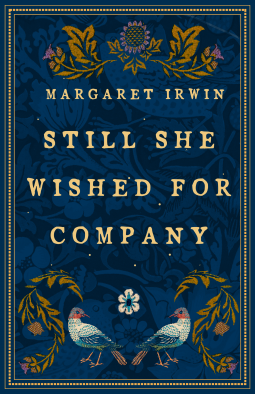
Still She Wished for Company by Margaret Irwin

Times past, times present, or times to come, were they not all one, if he had the power to make them so?

Part ghost story, part time-slip fantasy and part historical fiction, Margaret Irwin’s first novel from 1924, recently reissued with a pretty new cover, is a wonderful, dreamlike read.

Jan Challard is a young woman living in 1920s London and trying to find her place in the new society which has emerged from the aftermath of the First World War. Life seems to be going well, but Jan feels restless: she is bored with her office job, bored with the nice, suitable young man who wants to marry her, and haunted by a face in a portrait – a Gentleman Unknown, who seems to be following her everywhere she goes.

In 1779, we meet another bored young woman: seventeen-year-old Juliana Clare, the youngest daughter of an aristocratic family with an estate in Berkshire. Juliana spends her days walking in the gardens of Chidleigh House and writing in her journal, while waiting for something more exciting to happen and remembering a line from her favourite childhood fairytale: “…still she sat and still she span, and still she wished for company”. Company does eventually arrive, but perhaps not in the way Juliana had expected.

First, following the death of Lord Chidleigh, Juliana’s eldest brother Lucian returns after a long absence to take up his father’s title and his inheritance. Stories of the wild, debauched lifestyle Lucian has been leading have reached the family and he receives a frosty welcome at Chidleigh House. Juliana is the only one who is happy to see him and as the brother and sister grow closer, something strange begins to happen: the centuries separating Juliana’s life from Jan’s seem to dissolve and merge. Jan can see Juliana and Juliana can see Jan, but which of them is the ghost and which of them is real?

This is a very short novel, but just the right length for the story – or stories – being told, and it really doesn’t need to be any longer. Jan’s story frames Juliana’s and is confined to a short section at the beginning of the book and another at the end; Margaret Irwin appears to be more comfortable writing about the eighteenth century (a period she obviously knew well and knew how to bring to life) and most of the novel concentrates on Juliana. I couldn’t help comparing this to most of the dual time-period books being written today, where I usually find that far too much time is spent on a weaker present day narrative, leaving me impatient to get back to the more interesting historical one. The structure of Still She Wished for Company is much more effective, in my opinion, as I could become fully immersed in Juliana’s story without being pulled out of it after every few chapters.

The book is beautifully written, with the same elegant prose and powerful descriptive writing I’ve loved in the other Margaret Irwin novels I’ve read. There are no obvious anachronisms, no dialogue that feels jarringly wrong for the time period…it was just a pleasure to read! The eighteenth century storyline on its own could have been the basis for a compelling novel, but the addition of the ghost story/time travel elements make it something special, particularly as they are handled so well that they feel almost believable. It’s a lovely, magical read and just the sort of thing I was in the mood for at the moment!

Thanks to Agora Books for providing a copy of this book for review via NetGalley.

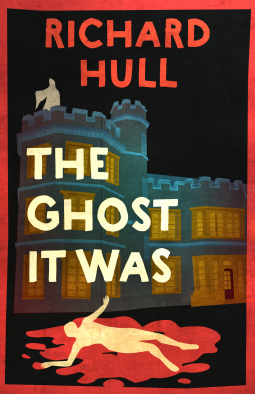
The Ghost It Was by Richard Hull – #RIPXV

I’ve enjoyed several of Richard Hull’s novels over the last few years – particularly The Murder of My Aunt and Left-Handed Death – and with Halloween quickly approaching, The Ghost It Was (first published in 1936) sounded like a good one to read next.

The novel begins with aspiring journalist Gregory Spring-Benson trying to get a job as a newspaper reporter. Having failed to impress the editor, Gregory is given new hope when he comes across a badly written article about James Warrenton’s purchase of the supposedly haunted Amberhurst Place. James Warrenton happens to be his uncle – his very rich uncle – and perhaps if Gregory goes to visit him in his new home he will be able to gather material for a much more interesting article that will help to launch his career in journalism. If he can also persuade Uncle James to leave him as much money as possible in his will, even better!

On his arrival, however, Gregory finds that he is not the only one hoping to secure his inheritance; three other nephews and a niece have also descended upon the house in an attempt to ingratiate themselves with their uncle. But while the cousins are busy plotting and scheming against each other, the ghost of Amberhurst Place makes an appearance at the top of a tower. Deaths soon follow, but is the ghost responsible or is there a human culprit?

Although all of the books I’ve read by Richard Hull so far have been very different, unlikeable characters seem to be the one thing they have in common! This worked very well in The Murder of My Aunt, where the characters were so horrible they were funny, but in this book they are just thoroughly unpleasant and not much fun to spend time with at all. I could easily have believed that almost any of them was the murderer and didn’t really care which of them was. It didn’t help that after a strong opening, introducing us to Gregory Spring-Benson and describing his ordeals at the newspaper office, the narrative then jumps around between the other cousins, the butler, a clergyman and some Scotland Yard investigators. We barely see Gregory after this and I felt that the novel lost focus through trying to involve too many different characters at once.

The ghost story aspect of the novel is well done – not at all scary, but it adds some atmosphere and makes it more difficult to work out exactly how the murders are being carried out. Despite the unpleasant characters and the lack of focus I’ve mentioned, it’s quite an enjoyable mystery to try to solve and the denouement, when it comes, is unusual and unexpected. Instead of tying everything up for the reader, Hull leaves us to make up our own minds and to decide whether we’ve correctly interpreted what we have been told. Not a favourite Hull novel, then, but still worth reading and I will continue to explore his other books.

Thanks to Agora Books for providing a copy of this book for review via NetGalley.

This is my second book read for this year’s R.I.P. Challenge.

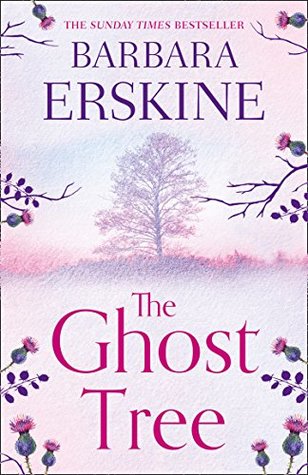
The Ghost Tree by Barbara Erskine

I’m finding that I usually like the sound of Barbara Erskine’s books much more than I like the books themselves! I thought Sleeper’s Castle was an enjoyable read, but I’ve had very mixed feelings about the others that I’ve tried, even Lady of Hay, which I’d heard so much about. Still, when I saw her latest novel, The Ghost Tree, in the library, I couldn’t resist picking it up.

Like most of Erskine’s other books, this one is set in two time periods and includes elements of the supernatural which link them together. In the present day we meet Ruth Dunbar whose father has just died, leaving her his house in Edinburgh. On arriving at the house, she is surprised to find that it is already occupied by a stranger who tells her his name is Timothy and that he has been caring for her father during his final months. According to Timothy, it is actually he and not Ruth who will inherit the house – and although Ruth’s lawyer assures her this is not the case, it seems that Timothy is not prepared to give up his claim.

As she begins to sort through her parents’ possessions, Ruth finds a collection of old diaries and letters written in the 18th century by Thomas Erskine, an illustrious ancestor of her mother’s. Thomas led an eventful, dramatic life and Ruth quickly becomes captivated by his story, but when she starts to think she can see Thomas standing beside her as she reads, the boundary between past and present seems to have been broken.

The Ghost Tree, as the title would suggest and as I have hinted above, is a ghost story, so I am counting it towards the R.I.P. XIII challenge. Thomas himself, as Ruth’s many times-great-grandfather, is no threat to Ruth, but he is not the only ghost who finds his way into the 21st century – there is another, who is a much more menacing and evil presence. Ruth (as seems to be a standard requirement of a Barbara Erskine heroine) just happens to have several friends and acquaintances who are experts in the paranormal and she enlists their help in dealing with her ghostly visitors. As far as ghost stories go, I didn’t find it either particularly scary or very atmospheric, but if you enjoy reading about séances, exorcisms and other aspects of the supernatural, you will probably find a lot to interest you here.

The narrative switches between past and present throughout the novel and as usual it was the historical one that I found most compelling. Thomas Erskine is a real life ancestor of Barbara Erskine’s and she has based his story on what we already know about him and on her own research into his life. Born in Edinburgh in 1750, he served in the Navy in the Caribbean and later joined the army, before returning to Britain to concentrate on a career in politics and the law. You can easily find a wealth of information about him online if you’re interested in knowing more, but if you’re thinking about reading The Ghost Tree you might prefer to read the novel first before looking up all the facts. Personally, I think there would have been enough material for a whole book just about Thomas and his adventures, without needing to involve ghosts or anything else!

I had other problems with the modern day sections of the book. For a start, the villains (one of whom is Timothy, the man contesting Ruth’s inheritance) are stereotypical and lack the sort of nuance and depth I prefer – and I quickly lost patience with the way Ruth and her friends repeatedly put themselves at risk, despite knowing how dangerous the villains were. There’s also an unpleasant storyline involving some cases of ghostly rape, which added very little apart from shock value.

This book was a bit of a disappointment, especially after enjoying Sleeper’s Castle so much, but at least I found Thomas Erskine’s story interesting, so I didn’t feel that it had been a waste of time. I just wish we could have spent more time with Thomas and less with Ruth and the ghost hunters! Can any Barbara Erskine fans tell me whether there are any of her earlier books that I might enjoy more, particularly any that spend a more substantial amount of time in the past or that use the supernatural elements more convincingly?

This is my fourth book read for the R.I.P. XIII challenge (category: supernatural).

Historical Musings #19: The Halloween edition

Historical Musings October is here and has brought with it (in my part of the UK at least) a change in the weather, longer, darker nights and a distinctly autumnal feel. With Halloween just a few weeks away, I thought it would be fun to give this month’s Historical Musings post a seasonal theme! I would love to hear about any historical novels you’ve read which deal with any of the following subjects:

  • Witches and witchcraft
  • Magic (black or white)
  • Ghosts and hauntings
  • Vampires/zombies/werewolves/monsters or other supernatural beings of any kind

My suggestions:

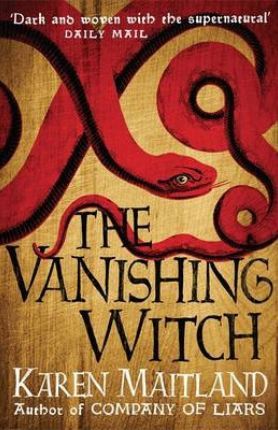
The Vanishing Witch Karen Maitland is one of the first authors to come to mind when I think about this type of historical fiction. The Vanishing Witch is set during the time of the Peasants’ Revolt and features both ghosts and witchcraft; at the beginning of each chapter is a spell, a piece of folklore or a superstition, which I thought was a nice touch! The Raven’s Head, set in the early 13th century, is a darker novel with a strong supernatural element. I haven’t read her other books yet, but am about to start her new one, The Plague Charmer.

Although I didn’t particularly enjoy it, Katherine Howe’s The Physick Book of Deliverance Dane (also published as The Lost Book of Salem) deals with the Salem witch trials. It’s a dual time-frame novel but is set at least partly in the past so I’m including it here.

For those readers who are interested in witches and witchcraft but prefer a gentler read, I can recommend The White Witch by Elizabeth Goudge and Thornyhold by Mary Stewart. The first is set during the English Civil War while the latter is set in the 1940s (but published in 1988, which is why I’m classing it as historical here). There’s also Susan Fletcher’s Corrag (also published as Witch Light), a beautifully written novel about the Glencoe Massacre of 1692; the main character and her mother have both been accused of witchcraft due to their knowledge of herbs and healing.

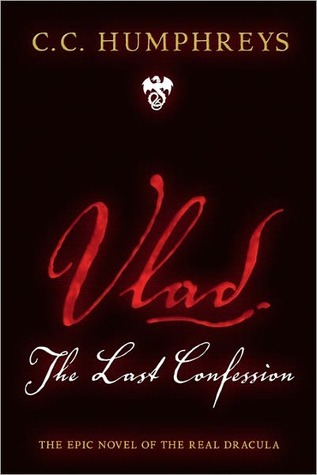
Vlad the Last Confession C.C. Humphreys has written a novel called Vlad: The Last Confession, which tells the story of Vlad the Impaler, the fifteenth century Prince of Wallachia who is thought to have provided at least part of the inspiration for Bram Stoker’s Dracula. This is not actually a vampire novel, but because of the Dracula connection and the dark atmosphere I’m including it here anyway.

There are also two ghostly novels by John Harwood that come to mind: The Séance, a gothic mystery set in Victorian England, and The Ghost Writer, which includes four genuinely chilling short ghost stories supposedly written by a fictitious author in the 1890s.

Finally, there’s Deborah Harkness’s All Souls Trilogy, in which our hero and heroine are a vampire and a witch. The first book, A Discovery of Witches, is set in the present day but in the second, Shadow of Night, we travel back in time to 16th century Europe. I’m not sure about the third book as I haven’t read it yet.

Have you read any of the books I’ve mentioned here? Can you think of any other historical fiction novels with a ghostly/witchy/magical feel?