For the Most Beautiful by Emily Hauser

For the Most Beautiful “For the most beautiful”. These are the words inscribed on a golden apple presented by Paris, Prince of Troy, to the goddess Aphrodite whom he has chosen over her rivals, Hera and Athena. In return, the goddess rewards Paris with Helen of Sparta, the most beautiful woman in the world – but unfortunately, Helen is already married. Not surprisingly, her husband, Menelaus, is enraged by the theft of his wife and sends the mighty armies of Greece, led by his brother King Agamemnon, to the shores of Troy to bring her back.

The story of the Trojan War is one that has been told many times before and with which a lot of readers will already be familiar before picking up Emily Hauser’s debut novel, For the Most Beautiful. However, this book retells the story from a feminine perspective and focuses on two female characters – Krisayis and Briseis – who both have important roles to play yet have not been given much attention in other versions such as Homer’s Iliad.

Krisayis (whose name is usually spelled Chryseis) is the daughter of a Trojan priest and companion to Cassandra, a princess of Troy. As the novel begins, we learn that Krisayis is in love with Cassandra’s brother, Troilus, and that, much against her wishes, she is about to become a priestess devoted to the god Apulunas. Our other main character, Briseis, is a princess of Lyrnessus who has unexpectedly found love with her husband Mynes, despite growing up under the shadow of a prophecy which seemed to rule out the possibility of happiness. With the onset of war, the lives of both young women are thrown into turmoil; their paths cross while held captive in the Greek camp, but will they be able to change fate and save Troy?

I found For the Most Beautiful a very enjoyable read. I think it was probably aimed at a younger audience but there was enough depth to keep an adult reader happy too. Having only read two or three other novels about Troy (including Madeline Miller’s The Song of Achilles and Judith Starkston’s Hand of Fire) I found that while I knew the basic outline of the story, a lot of it was new to me and the approach the author took made it feel fresh and original. It was interesting to see how Emily Hauser interpreted the characters of not just Krisayis and Briseis but also Achilles, Patroclus, Paris, Hector, Cassandra and others.

The stories of our two heroines unfold in alternating chapters and I thought these sections of the book were well written and emotionally engaging (both Briseis and Krisayis suffer the death of a loved one and then face further ordeals and difficult decisions after their capture by the Greeks). However, these chapters are interspersed with short scenes in which we witness the gods on their mountain observing and manipulating the lives of the mortals below – and this is the one aspect of the book which really didn’t work for me. The writing style in these sections is quite different – the language feels much more modern and the tense changes from past to present – and the gods come across as bored, shallow and petulant. I think I can see what the author was trying to do here and I’m sure other readers will enjoy the light-hearted, comedy feel of these scenes, but it just made me impatient to get back to Briseis and Krisayis!

After finishing this book, I was pleased to discover that it’s the start of a new Golden Apple trilogy. Greek mythology is not a subject that particularly interests me, but I was still captivated by For the Most Beautiful and am looking forward to reading another two books by Emily Hauser.

I received a copy of this book from NetGalley for review.

Hand of Fire by Judith Starkston

perf6.000x9.000.indd In this wonderful combination of historical fiction and Greek mythology, Judith Starkston reimagines events from the Iliad, telling the story of the Trojan War through the eyes of Briseis, a woman who plays an important role in Homer’s epic despite being only briefly mentioned. In Hand of Fire, Briseis is finally given the attention she deserves.

At the beginning of the novel, Briseis is a young priestess of the healing goddess Kamrusepa, but is sadly unable to prevent her own mother from dying. There is more sadness to follow for Briseis when she is married off to Mynes, a prince of Lyrnessos, and finds him to be a violent and abusive man. Sustained by the compassion of her elderly nurse, Eurome, and by visions of the handsome, half-immortal Greek warrior, Achilles, the turning point comes when the city of Lyrnessos falls to the Greek army and Briseis is taken captive. How can she reconcile her love for Achilles with her new position as slave?

Hand of Fire surprised me; I really didn’t expect to enjoy it quite as much as I did. I love reading historical fiction but tend not to choose books set in the ancient world. I often find that I have trouble identifying with the characters – I sometimes feel that even the non-mythological ones seem more like mythological beings than real people. That was not a problem here: this is a very human story with characters I could love and care about. Briseis herself is a great protagonist and I liked her from the beginning. She has great strength and resilience, all the more impressive when you consider everything she has to endure – the loss of her mother, marriage to a man who treats her badly, personal tragedy in the face of war, life as a captive slave, and her tumultuous relationship with Achilles.

Achilles is more difficult to understand. His personality is complex and conflicted; in battle he is a fierce, mighty warrior gripped by an unstoppable rage, but when he is alone with Briseis we see the gentler, more sensitive side of his nature. Of the secondary characters, there are two in particular that I found very well developed and memorable. One is Eurome, Briseis’ elderly maid, a caring, warm-hearted person and a devoted friend Briseis can trust and rely upon. The other is Patroklos, the beloved companion of Achilles, the only person apart from Briseis who is able to quell his rage.

This is a novel that has been thoroughly researched, which is evident from Judith Starkston’s author’s note in which she describes her reasons for writing this story, the things she discovered during the writing process and the decisions she needed to make. She does an excellent job of drawing on her knowledge of the period to create a convincing picture of what life may have been like for a woman who lived during the Bronze Age. The history of medicine is something I’ve always found very interesting, so I enjoyed the parts of the book that describe Briseis’ work as a healer (which consists mainly of using herbs and magical rituals as unlike her brother, Iatros, she is unable to study to be a physician).

Even for a reader like myself who only has a limited knowledge of Ancient Greece and hasn’t actually read the Iliad, I found this novel very accessible and easy to follow. I appreciated the fact that the author takes the time to flesh out the background to the story and doesn’t just assume that every reader will be familiar with the time period and the mythology. I was also pleased to find that there’s not too much emphasis on the battle scenes! This is Briseis’ story and the focus is on her personal life and on her relationships with Achilles, Mynes and the others. I really enjoyed spending time in her world and will be looking out for more novels from Judith Starkston in the future.

Hand of Fire tour graphic I read Hand of Fire as part of a Fireship Press Virtual Book Tour. You can find the tour schedule here.

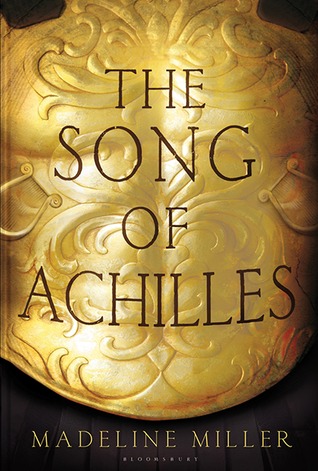
The Song of Achilles by Madeline Miller

The Song of Achilles is a retelling of the Iliad, told from the perspective of Patroclus, Achilles’ best friend and lover. Patroclus, the son of Menoetius, is only a child when he is exiled and sent to Phthia to live with King Peleus and his son, Achilles. Achilles is destined to become the greatest warrior of his generation and when he goes to Mount Pelion to receive training from the centaur, Chiron, Patroclus joins him there. As the years go by the bond between Achilles and Patroclus strengthens and their friendship develops into love, despite the attempts of Achilles’ mother, the sea goddess Thetis, to separate them.

The Trojan War begins when Helen, the wife of Menelaus of Sparta, is abducted by Paris of Troy. Both Achilles and Patroclus are part of the Greek army who set out to defeat the Trojans and return Helen to her husband. I’ll stop there because if you already know the story, you’ll know what happens to Patroclus and Achilles – and if you don’t, then I won’t spoil it for you.

I used to be fascinated by Greek mythology as a child but as the years have gone by I’ve read very little on the subject, so I began this book hoping that it would be good enough to reawaken my interest in it. I haven’t read The Iliad and could only remember a few basic facts about the Trojan War that I learned at school, so I was worried I might find it difficult to follow the plot. Well, this wasn’t a problem because Madeline Miller made it all very accessible and understandable. I was surprised to find that I actually knew more than I thought I did and recognised the names of a lot of the heroes and gods who appeared in the novel. But although the Trojan War and the events leading up to it are an important part of the story, the real focus is on the relationship between Achilles and Patroclus. Their love story was really beautifully written and filled with emotion and although the second half of the book didn’t sustain my interest as well as the first half did, I thought the final few chapters were particularly moving.

Achilles and Patroclus each have qualities that the other comes to value and admire. Achilles is handsome, talented and brave; Patroclus is quiet and loving. They both also have flaws: Patroclus often feels insecure while Achilles is sometimes too proud. It’s perhaps because they’re so different that they complement each other so well. I thought writing from the viewpoint of Patroclus was a good choice because it allowed us to see Achilles through the eyes of someone who loved him and also because, as a sensitive and observant narrator, he could give us interesting insights into the other characters as he met each of them for the first time, including Agamemnon, Briseis, Thetis, Ajax and my favourite, Odysseus.

I would recommend this novel to people like myself who only have a basic knowledge of Greek mythology (or none at all) as well as people who have already read The Iliad and are much more familiar with the story than I am. The Song of Achilles has something to offer both groups of readers. I’m still not sure that this is a subject I’m ever going to be passionately interested in, but after reading this book I do feel more enthusiastic about reading other novels based on Greek mythology.

The Song of Achilles was the winner of this year’s Orange Prize. I haven’t read any of the others on the shortlist because none of them really appealed to me, but having read this one I’m sure it was a deserving winner.