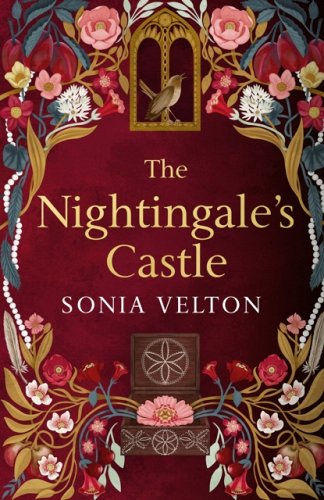
The Nightingale’s Castle by Sonia Velton

Countess Erzsébet Báthory (often anglicised to Elizabeth Bathory) has found her way into vampire folklore as one of the possible inspirations behind Bram Stoker’s Dracula. Known as the Blood Countess for her habit of bathing in the blood of her victims to retain her youthful appearance, she and her servants were accused of murdering hundreds of Hungarian peasant girls, making her one of the most notorious serial killers in history. In her new novel The Nightingale’s Castle, Sonia Velton reimagines Erzsébet’s story and looks at the woman behind the legends.

The novel opens in Hungary in 1610 and introduces us to fifteen-year-old Boróka, who has been raised by an adoptive father in the foothills of the Carpathian Mountains. When members of the Countess’s household arrive at Boróka’s cottage looking for girls to come and work at Čachtice Castle, she is initially reluctant to go, but her father persuades her that it would be dangerous not to accept. And so Boróka soon finds herself in a carriage heading up the hill towards the castle and a new way of life.

Within the walls of Čachtice Castle, there are other girls like Boróka working as seamstresses, cooks and kitchen maids under the watchful eyes of the Countess’s personal staff, whom Boróka finds to be excessively cruel and vindictive. She struggles to settle in, but when she and Erzsébet Báthory eventually cross paths Boróka becomes a favourite of the Countess’s, which gives her some degree of protection. Then come the accusations of murder and torture and Boróka must try to make sense of what has really been going on in the castle and whether or not the allegations could be true.

I had heard of Erzsébet Báthory before starting this novel, but knew very little about her, so it was good to have the opportunity to learn more. Of course, this is fiction and obviously Sonia Velton will have had to use her imagination to flesh out the plot and characters, but I could see from her very detailed author’s note at the end of the book that she has carried out a lot of research and tried to put some theories together that fit the historical facts. This version of Báthory’s character is more sympathetic than the way she is usually portrayed and the servants who are arrested along with her, particularly Dorottya Szentes and Ilona Jó, are the real villains here. I would probably need to read some non-fiction on the subject before I could say whether I agreed with this or not.

Despite Erzsébet Báthory’s association with vampire legends, there are no vampires in Velton’s novel and for the most part this is a straightforward work of historical fiction. However, there’s a subplot involving a magical rosewood box which I thought seemed out of place; I felt that the book either needed more fantasy elements or none at all. Apart from that, I found The Nightingale’s Castle an interesting read and I’m sure other people will appreciate that little touch of magical realism more than I did.

This is Sonia Velton’s third novel. I haven’t read The Image of Her, which seems to be a contemporary thriller set in Dubai, but I enjoyed her first book, Blackberry and Wild Rose, about a community of Huguenot silk weavers in 18th century London. She does pick interesting subjects and settings for her novels, so I’ll look forward to seeing what she writes next.

Thanks to Abacus for providing a copy of this book for review via NetGalley.

Book 23/50 for the Historical Fiction Reading Challenge 2024
The Angel Makers by Patti McCracken

I don’t read a lot of true crime, but the title, cover and blurb of this one all intrigued me. Subtitled The True Story of the Most Astonishing Murder Ring in History, the book narrates in dramatic detail the tale of a group of serial killers in a Hungarian village who murdered over a hundred men during a fifteen year period. The killers were all women and their ringleader was a midwife known as Auntie Suzy.

The village of Nagyrév, a farming community in central Hungary, may seem an unlikely centre of crime, but actually it’s easy to understand why the events described in the book happened where and when they did. The murders took place between 1914 and 1929, a time when Hungary was in a state of political turmoil and preoccupied with war and its aftermath. The government didn’t have the money or resources to look into reports of suspicious deaths in a small rural village. Not only did Nagyrév have no police presence, but also no doctor, meaning that Auntie Suzy, with her limited medical knowledge, was the person to whom everyone turned for help with their own and their family members’ health problems. This put Suzy in a position of power, made stronger by the fact that she was the one who dictated to the clerk the causes of death to be put on the death certificates.

Auntie Suzy’s method was poisoning; she would soak sheets of flypaper in water to leave a residue of arsenic which could then be fed to the victim in small doses until they eventually became ill and died. Women came to buy bottles of Suzy’s potion for all sorts of reasons: maybe they had an abusive husband, an unwanted child they couldn’t feed or an elderly father they’d become tired of and wanted dead. Suzy herself would sometimes have reasons for wanting the murder to take place – if a wealthy woman was widowed, for example, she would then be free to marry Suzy’s own son, or perhaps a house would become vacant that Suzy could take for herself.

In The Angel Makers, Patti McCracken tells the story of Auntie Suzy and the other female poisoners of Nagyrév in a style that is as easy to read as fiction. In fact, the whole book feels much more like a novel than a work of non-fiction; I liked this as it made it easy to get to know the characters and follow what was happening, but it wasn’t what I’d expected and it may not appeal to readers who prefer their non-fiction to be more formal and academic. There’s a section of notes at the end of the book and a bibliography, but apart from occasional extracts from newspaper articles or other documents, McCracken doesn’t interrupt the flow of the story to provide any commentary of her own. She has also anglicised the names of most of the people in the book – Auntie Suzy’s real name was Zsuzsanna Fazekas.

One thing that struck me about this case was how easily the crimes could have been stopped and the culprits brought to justice, yet they were allowed to continue for many years because the authorities either didn’t have the resources to investigate or just didn’t seem interested. The poisonings were an open secret in Nagyrév and Suzy and the other women grew more and more confident over time, hardly bothering to cover up their actions. You can feel sorry for some of the women, pushed into arranged marriages at a time when divorce was not an option, but others were committing murder for cruel or petty reasons. Suzy, as the ringleader, was particularly complacent and unrepentant about the deaths she was causing and her behaviour is quite chilling to read about. However, McCracken seemed to have an obsession with Suzy’s weight; the constant descriptions of her chubby hands, fat feet and waddling walk quickly became very repetitive and unnecessary.

The Angel Makers is a fascinating story and I would probably recommend it to people who have enjoyed Kate Summerscale’s books such as The Suspicions of Mr Whicher, although the informal style won’t be to everyone’s taste. Despite some flaws I found it entertaining and informative and feel that I’ve not only gained some knowledge of a very unusual ring of criminals but also some insights into life in Hungary between the wars and the various elements that enabled crimes like these to take place.

Thanks to Mudlark for providing a copy of this book for review via NetGalley.

Rákossy by Cecelia Holland

Cecelia Holland’s many historical novels cover a wide range of time periods and settings. So far I have only read two of them: City of God, a story of Rome and the Borgias, and Hammer for Princes, set in 12th century England in the period known as the Anarchy. My third Holland novel, Rákossy, takes place in Hungary during the Ottoman Wars of the 1520s. Not having read many books set in Hungary, I was looking forward to something different and to learning something new.

The title character is János Rákossy, a Magyar border lord trying to protect his lands from the threat of Turkish invasion. He is disappointed with the lack of help from the rest of Europe whom he feels are leaving Hungary to fend for itself and he knows he can’t rely on the support of his neighbouring barons either. All he can do is continue to negotiate treaties, train his knights, carry out raids, try to build alliances, and do whatever else is necessary to defend his castle and his people.

Rákossy is not the sort of man who is easy to like. He is ruthless, cold, cynical and violent towards both men and women. As another character says of him:

“The people in the village think that he sold his soul to the Devil for a charmed life and fortune in battle. The Turks, I’m told, believe so too. I think it’s possibly the only point of agreement between them.”

He does have some good qualities – he’s clever and shrewd and his courage is not in question – but he is certainly not someone I could consider to be a hero. This seems to be normal for a Cecelia Holland protagonist, though; I had similar feelings about Nicholas in City of God and Fulk in Hammer for Princes. She seems to excel at deliberately creating characters who are unappealing, morally ambiguous and whose motives are not always clear. But at least if her central characters are not very likeable, they are still interesting and complex.

Of the other characters in the novel, two stand out. One is Denis, Rákossy’s brother, a sensitive man who prefers books to warfare and doesn’t always approve of or agree with Rákossy’s actions. The other is Catharine de Buñez, believed to be an illegitimate daughter of the King of Aragon, who marries Rákossy early in the novel. As far as I can tell, most of the major characters in the book are fictional, although the story is based on fact, giving us an idea of the situation on the Hungary-Turkey border leading up to the Battle of Mohács in 1526. If you know what the outcome of that battle is going to be, it does affect how you might view Rákossy’s negotiations and military preparations throughout the novel, but either way you can admire what he is trying to do for his country.

I didn’t find this book particularly enjoyable, mainly because I thought it was very bleak and also because it didn’t seem to have any sort of plot beyond a string of raids and battles. It was one of Cecelia Holland’s earliest novels, though – published in 1967 – and based on the others I’ve read I think they do get better. I don’t think she’ll ever become a favourite author as her writing lacks the warmth and emotion I prefer, but I’m still looking forward to reading more of her books because her subjects and settings all sound so intriguing. I have a NetGalley copy of The Soul Thief, which is about to be reissued by Canelo, so I will be reading that one next.

Love and Treasure by Ayelet Waldman

Love and Treasure In Love and Treasure, Ayelet Waldman traces the fate of a single item – a necklace with a peacock pendant – and uses it to tell the story of Hungary’s Jewish communities before and after the Holocaust. Spanning a period of one hundred years, the novel is divided into three separate stories, but there are links between all three and the peacock pendant plays an important role in each one.

The novel begins in 2013 with a conversation between Jack Wiseman and his granddaughter, Natalie, when he admits to her that the necklace she wore on her wedding day thinking it was her grandmother’s did not actually belong to her grandmother at all. The real owner, he says, is unknown, but he would like Natalie to find her and give the pendant back.

We then move back in time to Salzburg in 1945 where Jack is serving in the US army. He is given the responsibility for guarding the Hungarian Gold Train, a train containing the confiscated personal belongings of thousands of Hungarian Jews (paintings, watches, furs, cameras and other objects) but while he does his best to protect its contents he is forced to watch as his fellow army officers ‘borrow’ one item after another. When Jack’s days in charge of the train come to an end, he himself steals one of its treasures – the peacock pendant – because it reminds him of Ilona, a Jewish girl from the Hungarian town of Nagyvárad whom he has grown close to during his time in Salzburg.

Returning to 2013, Natalie is beginning her search for the original owner of the pendant – a search which will take her to Budapest where she joins forces with Amitai Shasho, an Israeli art dealer on a special mission of his own. This takes us into the final section of the book, set in 1913 Budapest and telling the story of a psychoanalyst and one of his patients, a young Hungarian suffragette whose strong views lead to her father wanting her treated for insanity.

Of the three main sections of the novel I think my favourite was the first one, the story of Jack and Ilona. Ilona is a survivor of the concentration camps and through her character, Waldman explores the lives of the Displaced Persons who lost their homes and their families during the war. I thought she did an excellent job of showing what it may have felt like to be a Jew displaced in Europe after the war had ended. I cared about Jack and Ilona in a way that I never really came to care about Natalie and Amitai, so I was sorry to leave them behind when I reached the end of the first section and moved on to the second.

I also enjoyed the final part of the book: narrated by the psychoanalyst, Dr Zobel, this is the only section to be written in the first person rather than the third, and I thought his narrative voice was very strong and distinctive – just what I would expect from a man of his profession in 1913.

I found Love and Treasure a very interesting read because it introduced me to subjects I knew little or nothing about. The Hungarian Gold Train, for example, really existed, yet it’s something I had never read about before and I thought it was fascinating. While the book didn’t really affect me emotionally as much as I would have expected from a novel about the Holocaust, the fact that it was so intriguing from an historical perspective made up for it.

Love and Treasure tour banner

I read this book as part of the Love and Treasure Historical Fiction Virtual Book Tour. For more reviews, interviews and guest posts please see the tour schedule.

The Invisible Bridge by Julie Orringer

The Invisible Bridge begins in 1937 and follows the fortunes of three Hungarian Jewish brothers – Andras, Tibor and Matyas Levi – as they try to survive in a Europe torn apart by World War II. At the beginning of the book, Andras is preparing to leave Budapest and go to Paris to study architecture. Soon after his arrival in France, Andras meets Klara Morgenstern, a woman nine years older than himself, a ballet teacher with a teenage daughter. Andras and Klara fall in love, but Klara has secrets in her past – secrets that she would prefer not to share with Andras.

Andras and Klara’s story is played out against a backdrop of wartime Paris, Budapest, Ukraine and parts of the Hungarian countryside. The complex relationship between Andras and Klara is always at the heart of the novel but to dismiss this book as just another romance is unfair because it’s so much more than that.

Despite reading a lot of novels set during World War II, this is the first one I’ve read that is told from a Hungarian perspective. Hungary was allied with Germany which meant this story approached things from a slightly different angle than most other books I’ve read about the war and as I knew almost nothing about the role Hungary played, I was able to learn a lot from this book. And of course, because Andras and his family are Jews the novel is very much from a Jewish viewpoint. We see how it grew increasingly dangerous to be a Jew living in wartime Europe and how the Levi family became desperate to escape to safety. And when eventually Hungary finds itself under German occupation, we see that the Hungarian Jews fared no better than Jews elsewhere in Europe.

I enjoyed this book but it wasn’t perfect. There were times when I thought the balance between the romance storyline and the war aspect wasn’t quite right. And some of the characters needed more depth. I really liked Andras at first as he was a character who was easy to like and sympathise with, but as the story went on I started to find him a little bit too perfect and after spending more than 600 pages with him I wished he’d had a few flaws just to make him more interesting. I also think it would have been a nice touch if part of the book had been written from another character’s point of view. Not really a criticism of the book – I just think it would have added another dimension to the story and with the book being so epic in scope, the opportunity was there to do this.

The biggest problem I had with the book was the length! I’m usually quite happy to immerse myself in a long book but unlike some stories which do take a long time to tell, I thought this one could easily have been a lot shorter. My attention started to wander somewhere in the middle of the book when a lot of time was spent describing Andras’s life in the forced labour service (Jews were no longer allowed to serve in the actual Hungarian army but instead were expected to do jobs such as felling trees and clearing minefields) but things did pick up again over the last hundred pages.

In fact, the final section of the book, with its descriptions of life in Budapest towards the end of the war is so compelling and filled with so much tension, it made it worth sticking with the book through the less interesting chapters in the middle. And of course, I was genuinely worried for some of the characters so I had to keep reading to make sure they survived to the end of the book! I thought Orringer did a good job of keeping us in suspense wondering who would live or die and despite the few minor negative points I’ve mentioned above, I loved The Invisible Bridge.