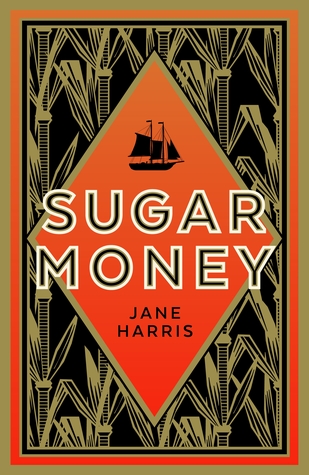
Sugar Money by Jane Harris

When I discovered that there was a new Jane Harris book coming out last year, I couldn’t wait to read it. It had been a long time since the publication of her last one, Gillespie and I, in 2011, but I could still remember how much I loved that book – and her previous one, The Observations, which I read a few months later. I’m not sure why it has taken me until now to get round to picking up Sugar Money, then, but it’s probably just been a combination of too many other books to read (as usual) and a fear that, after anticipating a third Jane Harris book for so long, I might be disappointed by it.

While Gillespie and I and The Observations are both set in 19th century Scotland, Sugar Money takes us to a very different time and place: the Caribbean in the year 1765. Our narrator, teenage Lucien, and his older brother Emile were brought up on the island of Grenada before being taken to nearby French-controlled Martinique as slaves. Their French masters need more workers to labour on the sugar plantations, so the brothers are entrusted with a secret mission: to return to Grenada, once also a French colony but now ruled by the British, and bring a group of forty-two slaves back to Martinique.

Emile and Lucien are the obvious choices to be given this task, with their prior knowledge of Grenada and its people, as well as Lucien’s ability to speak English. It’s not going to be easy, though; there is no guarantee that they will be able to persuade the slaves to join them, when they cannot offer freedom but only the exchange of one master for another – and even if the slaves do agree to come, will they be able to escape from the island without being caught?

Sugar Money, however unlikely it may seem, is based on real historical events which are described in the Afterword at the end of the book. The true story of slaves being involved in the smuggling of other slaves is certainly an interesting idea to base a novel around. Jane Harris grew up in Scotland and she highlights both the Scottish and English involvement in the slave trade, as well as drawing comparisons with slavery in the French colony of Martinique. She doesn’t shy away from describing the brutality of slavery and there are some quite graphic details of the ways in which slaves are treated by their masters and the horrific punishments given to them for the most minor of ‘crimes’, but she writes about all of this in a matter-of-fact sort of way, showing us the evils of slavery without preaching about it, which is something I liked and found quite effective.

I also loved the relationship between Emile and Lucien. Lucien has all the enthusiasm and sense of adventure you would expect in a boy of his age and, of course, it sometimes leads him into danger. Emile, who is much older and wiser, protects him as far as he can, but understandably loses patience at times, while Lucien admires and respects his big brother but doesn’t always understand his actions! I liked them both, but we naturally feel closer to Lucien because he is our narrator. Jane Harris really excels at giving her narrators strong, distinctive voices of their own. To immerse us more fully in the Caribbean of the 18th century, she has Lucien narrate in a sort of Creole mixed with French and English, and an explanation for his unusual speech is given towards the very end of the book. He couldn’t be more different from Bessy Buckley and Harriet Baxter, the narrators of her previous two novels!

I found this a very entertaining read, but it didn’t impress me quite as much as the other two Jane Harris novels. It works well as an adventure novel (Robert Louis Stevenson is mentioned as an inspiration in the acknowledgements), but it lacks all the clever twists and turns that I loved in Gillespie and I. It has impressed the judges of the Walter Scott Prize for Historical Fiction, though, and has been included on this year’s shortlist. The winner will be announced in June; if Sugar Money wins, I’ll be very happy for Jane Harris, but as I haven’t read the rest of the shortlist yet I don’t know whether there’s another book that is more deserving.

The Observations by Jane Harris

After I read (and loved) Gillespie and I, I knew I would have to find a copy of the first book by Jane Harris, The Observations, as soon as possible. Luckily my library had a copy so I didn’t have to wait too long to read it! I found this book just as entertaining and enjoyable as Gillespie and I, which puts Jane Harris firmly on my list of favourite authors.

The Observations is set in Scotland during the 19th century. Bessy Buckley, a young Irish girl, is on the run from her troubled past when she arrives at the estate of Castle Haivers near the village of Snatter. The lady of the house, Arabella Reid, offers her a job as maid and Bessy jumps at the chance. But Bessy is puzzled by the series of bizarre tasks which Arabella orders her to perform – and when she discovers that a previous maid, Nora, may have died under suspicious circumstances, it becomes obvious that things at Castle Haivers are not quite what they seem.

The Observations is a long book but was so gripping I read it in half the time it would normally take me to read a book of similar length. What makes this novel so different from all the others I’ve read set in the Victorian era is Bessy Buckley herself. Bessy is a fabulous character and narrator: funny and witty, poorly educated but bright and intelligent, tough and outspoken yet sensitive and warm hearted. When you first begin to read you might come across some unusual language and slang, not to mention some unconventional grammar and punctuation, but don’t worry about that – it’s all part of Bessy’s unique voice and her narration was a delight to read. The only thing that irritated me slightly was seeing numbers written as figures rather than words (1/2 instead of ‘half’, for example).

The relationship between Bessy and her mistress forms a big part of the story, but there are a few other interesting sub-plots, as well as the story of Bessy’s own childhood which emerges slowly throughout the book. There are shades of other Victorian novels, as well as some elements of the gothic novel and the ghost story, but the overall result is something completely original. The one criticism I have is that, after a very strong start, the story seems to lose momentum in the second half and the ending was slightly disappointing in comparison to the rest of the book.

Finally, I want to say how impressed I am that Jane Harris could take two such different narrators as Bessy Buckley and Harriet Baxter (from Gillespie and I), who are complete opposites in almost every way imaginable, and make them both so convincing! That’s a sign of a talented author in my opinion.

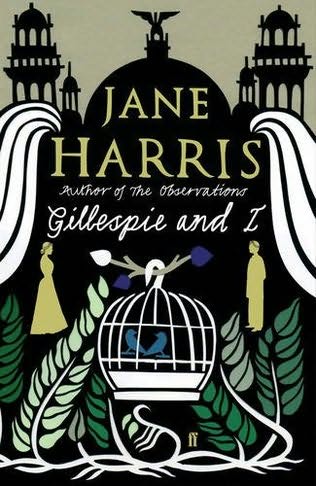
Gillespie and I by Jane Harris

I was lucky enough to win a copy of Gillespie and I through LibraryThing Early Reviewers but even if I had paid the full price for this book I would have considered it money well spent. I thought it was brilliant. It seems I’m one of the few people not to have read the first book by Jane Harris, The Observations, and I’m not sure how I managed to miss that one as it sounds like something I would love. I’ll certainly go back and read it now that Jane Harris has been brought to my attention.

But this post is about Gillespie and I. Or, I should say, Gillespie and Harriet Baxter. We first meet Harriet in 1933 as an elderly woman looking back on her life and promising to share with us her recollections of Ned Gillespie, a talented artist who was never able to fulfil his true potential. Harriet then proceeds to tell us the story of her acquaintance with the Gillespie family, whom she met in the 1880s during a trip to Scotland to visit the International Exhibition in Glasgow. She quickly becomes a friend of Ned, his wife Annie, and the other members of the family – but then disaster strikes and the lives of Harriet and the Gillespies are thrown into turmoil.

After a leisurely start, the story soon picked up pace and became very gripping. But as well as the compelling plot there were many other things that made this book such an enjoyable read. I connected immediately with Harriet’s sharp, witty and observant narrative voice. The other characters were vibrantly drawn, though the only one who never really came to life for me was Ned himself, which was the only disappointment in an otherwise excellent book. I also loved the setting. I’ve read many, many books set in Victorian London and it made a refreshing change to read one set in Victorian Glasgow instead.

Halfway through the story something happened that made me start to question everything I’d read up to that point – and even after I’d finished the book I still had questions. I was very impressed by how cleverly Jane Harris managed to control what I believed and didn’t believe at various points in the novel. I can’t really explain what I mean without spoiling the story but suffice to say there are some stunning plot twists that leave you wondering whether things are really as they seem – and this doesn’t happen just once, but several times throughout the second half of the book. At times it even felt like a Victorian sensation novel to me, which probably explains why I enjoyed it so much! Gillespie and I has been one of my favourite reads so far this year.

New book arrivals

As a change from all the book reviews I’ve been posting recently I thought I’d share with you some of the new books I’ve acquired in the last couple of weeks.

Touch by Alexi Zentner – I’ve already finished reading this novel about a Canadian gold mining town and I would highly recommend it – it’s beautifully written with some haunting imagery and elements of magical realism.

Here Be Dragons by Sharon Penman – I bought this secondhand copy for myself because I loved The Sunne in Splendour and want to try another of Penman’s books. This one is set in 13th century Wales.

The Report by Jessica Francis Kane – I’ve seen so many positive reviews of this book recently and am interested in learning more about the Bethnal Green tube disaster.

The Map of Time by Felix Palma – This book is set in Victorian London and features characters such as H.G. Wells, Jack the Ripper and Bram Stoker. This really sounds like something I should love, so I hope it lives up to my expectations.

Gillespie and I by Jane Harris – I was delighted to win a copy of this book from LibraryThing Early Reviewers. I haven’t heard much about it but it looks and sounds wonderful.

Have you read any of these?