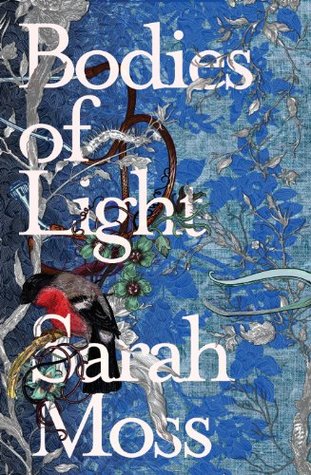
Bodies of Light by Sarah Moss

This is the first book I’ve read by Sarah Moss, an author I had never really thought about trying until I saw so much praise for her latest novel, Ghost Wall, last year. Bodies of Light is apparently loosely linked to an earlier book, Night Waking, but I didn’t feel that I’d missed anything by reading this one first.

The setting for Bodies of Light is Victorian Manchester where, as the novel opens, a newly married couple – Elizabeth and Alfred Moberley – are moving into their new home. Even this early in their marriage, there are clues that suggest they might not be very happy together; Alfred is a painter who appreciates the finer things in life while Elizabeth is passionate about social reform and women’s rights. Their two daughters, Alethea (Ally) and May, grow up trying to please both parents, being asked to model for their father’s latest portrait one day and accompanying their mother on one of her missions to help women in Manchester’s poorest areas the next.

I really enjoyed the first half of this book; after a slow start I found that I had become completely drawn into the lives of the Moberley family. Each chapter starts with a description of a portrait painted by Alfred or one of his circle, giving an idea of what will follow in the pages to come, and I thought that was a nice touch. As the novel progresses and the children grow older, we see that Elizabeth, despite her good deeds in public, can be a harsh and unloving mother; to explain this, Sarah Moss spends some time at the beginning of the book showing us what made her the way she is, focusing on Elizabeth’s relationship with her own mother and the depression she suffered after Ally’s birth.

The second half of the novel is devoted mainly to Ally, as she goes to London to study medicine at the first medical school to accept female students. She is pushed into this career path by her mother, who believes very strongly that women – particularly ‘fallen women’ – should be entitled to request treatment from a female doctor and who likes the idea of her own daughter becoming one of these doctors. Ally is an intelligent young woman who loves learning, so she throws herself into her studies, but there is always a sense that she is doing this mainly to make her mother happy – and yet, whatever she does, it seems that Elizabeth is never happy.

I felt so sorry for Ally, who self-harms and suffers from nightmares as she is growing up, longing for some comfort and compassion from her mother but receiving only criticism and impatience instead, told that she has no right to complain about anything ‘because there is always someone else worse off.’ Interestingly, her younger sister May, who has the same upbringing, doesn’t seem to suffer from Ally’s anxiety-related problems, possibly due to the fact that Ally, as the eldest, has always felt under more pressure.

Once Ally had left home to begin her medical studies, I found the story a bit less compelling but still interesting. It certainly made me appreciate the educational opportunities that are open to women today and how difficult it must have been for those who were among the first to try to enter a field dominated by men. This is a fascinating book and I do like Sarah Moss’s writing, so I now want to read the sequel, Signs for Lost Children, as well as the earlier Night Waking, which I think tells some more of May’s story.

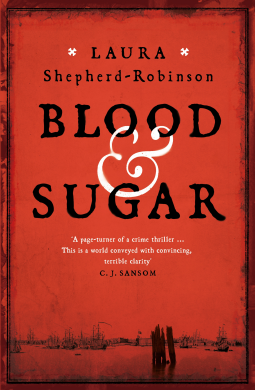
Blood & Sugar by Laura Shepherd-Robinson

This new historical mystery – Laura Shepherd-Robinson’s first novel – deals with one of the darkest subjects in our history. Set in 1781, it follows the investigations of former army officer Captain Harry Corsham into the disappearance of his friend, the lawyer and abolitionist Tad Archer. It seems that Tad had been about to uncover a secret that, once exposed, could damage the reputations of those involved in the British slave trade. Could someone have killed Tad to prevent him from telling what he knows?

Captain Corsham is determined to find out what has happened to his friend, but to do so he will need to continue Tad’s enquiries into a shocking incident which took place onboard a ship carrying slaves across the Atlantic. This brings him into conflict with some very powerful men who could destroy his hopes of a political career. But Harry Corsham is a man with principles and even when he, like Tad before him, begins to receive threatening letters and warnings, he refuses to walk away until he has discovered the truth.

There are many things I liked about Blood & Sugar. The setting and atmosphere are wonderful; with the action taking place partly in London, where Harry Corsham lives with his wife, Caro, and their young son, and partly in the nearby slaving port of Deptford, we see Harry move between both locations in search of answers to his questions. I loved the contrasting descriptions of Deptford, from the elegant homes of the wealthy slave merchants to the notorious dockside alleys with their brothels and opium dens.

We also meet a wide range of characters from very different backgrounds, including magistrates, politicians, mayors and surgeons, prostitutes, innkeepers, sailors and servants. Many of the latter group are black, which is interesting because I think we tend to forget (or are not aware of) how many black people there were living in eighteenth century Britain. It is estimated that there were more than twenty thousand in London alone, yet they rarely appear in fiction set during that period. As for the slavery aspect of the story, there are parts that are not easy to read, as you can probably imagine – particularly when we hear about what happened on the ship, something which is based on a real incident. But unpleasant as it is, we can’t ignore the fact that slavery did happen and I think it’s important that we remember and learn from it.

I was very impressed with this book at the beginning. I liked Laura Shepherd-Robinson’s writing, the mystery seemed intriguing and I was starting to draw comparisons with one of my favourite historical crime authors, Andrew Taylor. However, as the plot continued to develop, I thought it became far too complicated and I struggled to remember who had said what to whom and what the various motives of the characters were. Towards the end, there were so many threads to tie up that everything seemed to take forever to be resolved (and there were one or two revelations which added very little to the overall story and weren’t really necessary, in my opinion). I also felt that as there were so many characters to keep track of, they really needed to be better defined – instead, I thought they were thinly drawn and not very memorable.

I’m disappointed that I didn’t enjoy this book as much as I thought I would at first, but I still think there were more positives than negatives and as this is the author’s first novel I would be happy to read more.

Thanks to Pan Macmillan for providing a copy of this book for review via NetGalley.

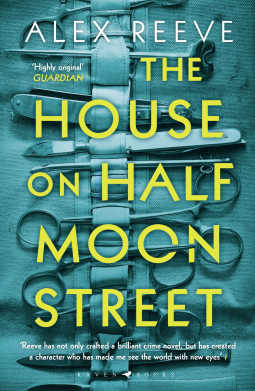
The House on Half Moon Street by Alex Reeve

The House on Half Moon Street is both an interesting historical crime novel set in Victorian London and a sensitive exploration of what it means to be transgender in a less enlightened time. This is apparently the first in a planned series and I will certainly be looking out for the next one.

Our hero, Leo Stanhope, is a coroner’s assistant in 1880s London. As the novel opens, the body of a man washed up by the Thames has been brought to the hospital where Leo works. Identified as Jack Flowers and believed to have fallen into the river accidentally, the man’s death seems to be an unfortunate tragedy, but not something which affects Leo personally. However, the next body to arrive is that of a woman – a woman who happens to be the love of Leo’s life, Maria Milanes, and who appears to have been murdered.

Before her death, Maria was a prostitute at a brothel on Half Moon Street, but that didn’t matter to Leo. He loved her and knew that she loved him. Maria was one of the few people he had trusted with his secret, one of the few people who knew that Leo Stanhope was born Charlotte Pritchard. Now Maria is gone and Leo vows to find out who has killed her. Joining forces with pie maker Rosie, Jack Flowers’ widow, he begins to uncover some links between both deaths – but at the same time he must ensure that his own secret is not uncovered, because the truth could have serious consequences.

On one level, as I’ve said, this is a compelling and well-constructed murder mystery. Although I found the pace a bit slow at times, I did enjoy watching Leo move around Victorian London, looking for clues in the Half Moon Street brothel, playing chess with his friend Jacob and word games with his landlord’s daughter in the pharmacy where he lodges, or paying a visit to the midwife and abortionist Madame Moreau, whom he hopes may be able to shed some light on the situation. All of these people and locations are vividly described and all play their part in Leo’s investigations.

Leo himself is easy to like and to warm to; he narrates his story in the first person, letting us into his mind and his heart. I know things are not perfect for transgender people today and that they still face a lot of prejudice, obstacles and challenges, but I can hardly imagine how difficult life must have been for people like Leo who lived more than a hundred years ago. I admired him for his courage in being true to himself and not just continuing to be someone he was not; I was sorry for the sacrifices he’d had to make in adopting his true male identity and the lack of support he received from those he should have been able to rely on; and I was afraid for him too, because he is in such a vulnerable position.

I should warn you that due to the nature of the story, the type of mystery it is and Leo’s vulnerability, the novel does become very dark in places. Although I didn’t find it unnecessarily graphic or violent, there are still a few scenes which are quite disturbing. The Victorian era was certainly not the safest time in which to live if you were seen as different in any way. I’m sure Leo will have more ordeals to go through as the series progresses, but I hope there will be some happiness in store for him too.

Thanks to Raven Books for providing a copy of this book for review via NetGalley.

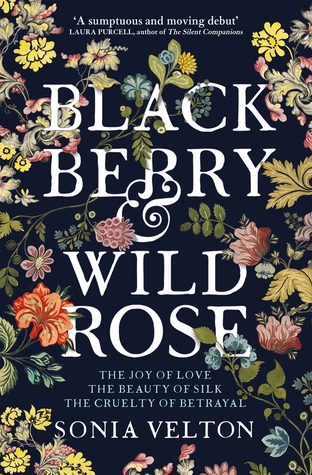
Blackberry and Wild Rose by Sonia Velton

It’s 1768 and Sara Kemp has just arrived in Spitalfields, the London parish which has become home to a thriving community of Huguenot silk weavers. Sara is full of hope and optimism, ready to start a new life, but before she’s had time to get her bearings she finds herself the victim of a cruel trick which leaves her with no choice other than to live and work in a notorious brothel.

In a much more respectable house nearby lives the master weaver Elias Thorel and his wife Esther. Their marriage is not a loving or happy one, but Esther has been trying to take an interest in her husband’s work and has discovered an aptitude for designing floral patterns. There’s nothing she wants more than to see one of her own designs woven in silk, but Elias is scornful and refuses to acknowledge her talent. Still determined to turn her dreams into reality, Esther approaches the journeyman weaver who has been using the loom in the Thorels’ attic to weave his master piece.

Two women leading very different lives – but their paths cross when Esther is distributing Bibles in the poorer areas of Spitalfields and sees Sara being abused by her madam outside the brothel. Soon Sara is working as a lady’s maid in Esther’s household, but how will she repay Esther for her act of kindness?

I was drawn to Blackberry and Wild Rose by the beautiful cover – and the mention of an 18th century setting and the comparisons to Jessie Burton and Tracy Chevalier made me want to read it even more. Of course, none of those things guaranteed that I would like the book, but I’m pleased to say that I did!

First of all, there are the fascinating details of weaving, of using looms, designing patterns, and everything else involved in creating beautiful figured silk. At the beginning of the novel, Esther knows very little of any of this – she only knows that she wants to see her designs brought to life – but she learns a lot from the weaver she befriends, and her enthusiasm (and, I think, the author’s) comes through very strongly:

By the time the candle had burned down to a waxy stump, the thinnest sliver of iridescent silk clung to the heddles. ‘I can’t believe it,’ I breathed. I was finally looking at the very beginning of a silk made to a pattern I had designed. My own creation. ‘How long will it take to finish it?’

I could feel Esther’s excitement and pride as her silk took shape, as well as her disappointment and anger at her husband’s lack of support. Through the stories of Esther’s weaver friend Bisby Lambert and some of the other Spitalfields weavers, we also learn about some of the issues and challenges the industry faced and how the workers had to fight for their rights against unscrupulous masters and the threat of cheap imports from abroad.

An even more engaging aspect of the book is the relationship between the two main characters, Esther and Sara, whose narratives alternate throughout the novel. At first, Esther feels sorry for Sara, as she would for any woman driven to prostitution, and she wants to do what she can to help. Once Sara is there, in the Thorel household, however, their relationship is an uneasy one and Esther begins to wonder whether she has done the right thing in bringing Sara into her home:

She was like a cat sidling in uninvited and looking about. You don’t want to turn it out straight away so you offer it a scrap of food. The next thing you know it’s curled up on your favourite chair, watching you with unblinking elliptic eyes.

As for Sara, she quickly becomes aware that Esther’s life is not as perfect as it seems and that she is hiding some secrets of her own. While a friendship does form between the two women, they are not entirely comfortable around each other and neither is quite sure whether the other can be trusted, which makes for a tense and exciting story! The plot kept me gripped throughout the book and although I thought I could predict how it would end, I was wrong and the ending was actually much more realistic than I’d expected. This is an impressive debut novel and I hope to read more from Sonia Velton in the future.

Thanks to Quercus for providing a copy of this book for review via NetGalley.

I am counting this book towards the What’s in a Name? challenge (a book with a fruit or vegetable in the title).

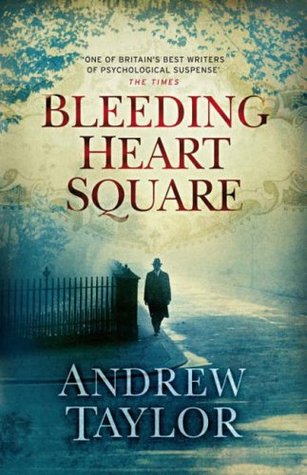
Bleeding Heart Square by Andrew Taylor

Andrew Taylor is one of my favourite authors of historical mysteries and after reading his latest one, The Fire Court, earlier this year, I remembered that I still had Bleeding Heart Square to read.

The novel opens in London in 1934 with Lydia Langstone, stepdaughter of the wealthy Lord Cassington, walking out on her violent and brutal husband. Armed with her copy of Virginia Woolf’s A Room of One’s Own, Lydia heads straight for Bleeding Heart Square, home to her father, Captain Ingleby-Lewis. The Captain isn’t entirely respectable and neither is the address, but Lydia doesn’t care – she just needs somewhere to stay until she can build a new, independent life for herself.

Another new resident of Bleeding Heart Square is Rory Wentwood, a young man who has recently returned from India to find that his girlfriend, Fenella, is no longer interested in marrying him. Rory still cares about Fenella, though, and when he hears about the disappearance of her aunt, Philippa Penhow, several years earlier, he decides to uncover the truth. The house at Bleeding Heart Square had belonged to Miss Penhow until she signed it over to the current owner, Joseph Serridge, before supposedly going to live in America. Rory has his doubts and has taken a room in the house so that he can investigate further.

When a number of foul-smelling parcels addressed to Mr Serridge begin to arrive at Bleeding Heart Square, the residents are both disgusted and intrigued. The packages contain rotten hearts neatly wrapped in brown paper and are obviously intended as a message to Mr Serridge – but who is sending them and why? What really happened to Philippa Penhow? And why is a policeman watching the house? Lydia teams up with Rory to try to find the answers, while doing her best to avoid her abusive husband.

Bleeding Heart Square is a mystery novel, but it is also a fascinating portrayal of life in 1930s London, with a particular focus on the rise of the fascism movement in Britain. One of the most memorable scenes in the book involves a meeting of the British Union of Fascists which descends into chaos when a few brave voices dare to question the party’s policies and are forcibly removed by Oswald Mosley’s black-shirted supporters. I found this aspect of the book interesting because of course with World War II on the horizon, fascism would soon become forever associated with Hitler and Mussolini and not something decent people would want to be part of – but here we see respectable people taking Mosley’s views seriously and considering giving him their support. It’s frightening to think of how different things could have been, and also still frighteningly relevant today.

Despite the 1930s setting, however, I thought the plot and the characters seemed much more suited to the Victorian period – there was a definite Dickens influence and in fact Bleeding Heart Yard appears in Little Dorrit. If you removed the fascism storyline, the rest of the novel could easily have been set in the 19th century; I was taken by surprise every time somebody got into a car as I felt it should have been a horse and carriage!

I liked both Lydia and Rory and found their personal stories so interesting that the central mystery felt almost secondary – although I was intrigued from the start by the brief diary entries and the comments by an unknown narrator that open every chapter. What will we learn from the diary and who is the narrator talking to? The ending of the book, in which the truth is revealed, was unexpected, but maybe there were clues from the beginning if I had been paying more attention!

Bleeding Heart Square isn’t my favourite of Andrew Taylor’s books – that would be The American Boy – but I did enjoy it and now that I’ve read all of his historical mysteries I’m wondering which of his other books I might like. Any recommendations are welcome!

This book counts towards the R.I.P. XIII challenge (category: mystery).
I am also counting it towards the What’s In a Name? challenge – a book with a shape in the title.

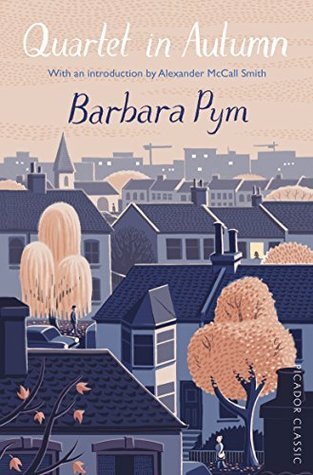
Quartet in Autumn by Barbara Pym #1977Club

This is my second choice for this week’s 1977 Club (hosted by Simon and Karen) and the third book I’ve read by Barbara Pym. Having so far read only Excellent Women and Less Than Angels, I was surprised by how different Quartet in Autumn is. It’s a much darker, sadder, more poignant novel and, although I did like it, I found it a little bit depressing.

The ‘quartet’ are two women and two men – Letty, Marcia, Edwin and Norman – who work together in the same office in 1970s London. They are four very different people with different personalities, but they have two things in common: they are all in their sixties and they all live alone. Although Pym never specifies exactly what their jobs involve, it is implied that the four of them have been sharing an office for several years and have an understanding of each other’s personal circumstances and living arrangements. Despite this, and despite their loneliness, they never do anything together outside of working hours – they eat lunch separately and then go their separate ways again at the end of the day.

We learn very little about Norman, except that people consider him an ‘odd little man’ and that his social life consists solely of dentist appointments and occasional visits to see his brother-in-law, whom he dislikes. Edwin, a widower, is sometimes invited to stay with his married daughter and grandchildren, but otherwise tries to keep himself busy by taking part in as many church activities as possible. The two men seem to play slightly smaller roles in the novel, at least until halfway through when the women retire (not to be replaced) and the quartet is reduced to a duo.

Letty has always planned to move to the countryside with her friend Marjorie after her retirement, but when the unthinkable happens and Marjorie gets engaged, she is left facing a future in an old people’s home instead. But it’s Marcia who is the most tragic character – Marcia who has had surgery for breast cancer and looks forward to her trips to the hospital as ‘holiday treats’, who has developed an obsession with hoarding empty milk bottles in the garden and who attracts the unwelcome attention of a concerned social worker.

A book about four lonely people doing meaningless, unappreciated jobs and looking for ways to fill boring, empty lives does not make the most uplifting of reads, but Pym still manages to sprinkle some humour into the story and to leave us with the sense that there is some hope for our characters after all. Letty, at least, seems to want things to change and to be willing to take the first steps towards bringing about those changes.

Despite the sad, melancholic feel of the book, I think it is my favourite so far by Barbara Pym. Her observations are both witty and sensitive and I found myself really caring about Letty, Norman, Marcia and Edwin. Another good choice for 1977 Club and now I’m looking forward to reading Jane and Prudence, the other Pym novel I have on my shelf.

The Fire Court by Andrew Taylor

This is the second in Andrew Taylor’s new historical mystery series set during and after the Great Fire of London. The first book, The Ashes of London, set in 1666, deals with the Fire itself and the devastation it causes, as well as introducing us to our protagonists – James Marwood, son of a Fifth Monarchist, and Cat Lovett, daughter of a regicide involved in the execution of King Charles I. It’s not completely necessary to have read The Ashes of London before beginning The Fire Court as they both work as standalone mysteries, but I would still recommend it.

In The Fire Court, we watch as London begins to rebuild in the aftermath of the Great Fire. With so much of the city destroyed, so many homes and businesses burned to the ground, there’s a lot of rebuilding to be done! Naturally, this gives rise to disputes between landlords and tenants, and disagreements as to how land should be redeveloped and who is responsible for paying for it. A special court is established to deal with all of this: the Fire Court.

At the beginning of the novel, James Marwood’s elderly father dies after falling beneath the wheels of a wagon in a London street, but not before he has time to tell James about a horrific discovery he made in one of the chambers of the Fire Court – the body of a murdered woman, with blood on her yellow gown. At first, Marwood dismisses these claims as the ramblings of an old, ill man, but when he begins to investigate he comes across some clues which suggest that maybe his father was telling the truth after all.

Marwood wants to find out more, but it seems that his employers – Joseph Williamson, the Under-Secretary of State, and William Chiffinch, Keeper of the King’s Private Closet – would prefer him to leave things alone. He can’t walk away now, though; he’s already much too deeply involved. Others have become caught up in the mystery too, among them Cat Lovett who, following the events of the previous novel, is now living in the household of her cousin Simon Hakesby, the architect – and another young woman, Lady Jemima Limbury, whose marriage, it appears, is based on lies and deceit. All of these people have a part to play in the mystery that unfolds and none of them know who to trust.

I enjoyed The Ashes of London, but I thought The Fire Court was even better. The plot was a complex, interesting one and with the focus on lawyers and court cases, it reminded me at times of CJ Sansom’s Shardlake novels, which I love. Being the second book in the series, I felt that both main characters – Marwood and Cat – are starting to feel more fully developed now. I sympathised with Marwood’s conflicting feelings for his father and the dilemma he faces when he is forced to choose between his two masters, Williamson and Chiffinch. As for Cat, she continues to be in a dangerous position should her true identity be discovered, so she has taken the name Jane Hakesby and is pretending to be her cousin’s servant. In her situation, you would think it would be a good idea to keep a low profile, but with her courageous and fiery personality, she does nothing of the sort! I really like the way the relationship between Marwood and Cat is progressing; it has taken a while, but they are beginning to trust each other and work together.

There are some interesting secondary characters in this book too, ranging from Marwood’s servant, Sam, who lost a leg in the wars against the Dutch, to the sinister Lucius Gromwell, in whose room the murdered woman was found. I particularly enjoyed reading about Jemima Limbury: her background and lifestyle are very different from Cat’s but the situation in which she finds herself is no easier to endure.

I’m looking forward to reading more books about James Marwood and Cat Lovett – and am assuming that there are going to be more, as they are being marketed as ‘a series’ which would suggest that there won’t just be two! Meanwhile, I still need to read my copy of Bleeding Heart Square, the only historical mystery by Taylor that I still haven’t read!