Recent reads: The Drums of War; Ashes in the Snow; Ithaca

I’m falling behind with my reviews again, so here are my thoughts on three recent reads – all very different books.
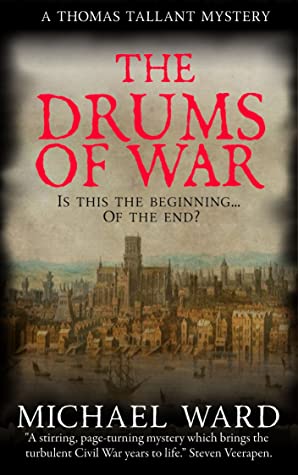
The Drums of War is the third in Michael Ward’s Thomas Tallant mystery series, continuing the story begun in Rags of Time and The Wrecking Storm. It also works as a standalone novel, so don’t worry if you haven’t read the first two in the series.

This third novel opens in London in 1642. With the divisions between King and Parliament becoming greater, England is rapidly heading towards Civil War and spice merchant Thomas Tallant and his friends are being forced to choose sides. Soon Tom finds himself assisting the Puritan leader John Pym in his search for a consignment of stolen gunpowder being smuggled out of London by Royalist forces. Meanwhile, Elizabeth Seymour is carrying out investigations of her own as she sets out on the trail of a mysterious jewel thief. Although Tom and Elizabeth are separated for most of the book and I missed their interactions, I did find both storylines interesting, particularly Elizabeth’s as she suffers a personal trauma and begins to fall back into some of her former bad habits as a result!

As with the first two books in the series, real historical figures appear alongside the fictional ones and as well as John Pym and the commander of the London Trained Bands, Philip Skippon, we also meet the scientist and physician William Harvey and are reacquainted with the intriguing Lucy, Countess of Carlisle. In the second half of the novel, the focus moves away from the mystery-solving for a while to concentrate on the events of the Civil War, particularly the battles of Edgehill and Brentford. This aspect of the story was of less interest to me, but that’s just down to personal taste (I’m not really a fan of battle scenes) and I still found this an enjoyable novel overall.

~

Ashes in the Snow is Oriana Ramunno’s debut crime novel, written in Italian and translated into English by Katherine Gregor. The book is set in Poland during World War II and begins with a young boy, Gioele Errera, finding the body of an SS officer in the snow. The man appears to have choked on an apple, but it soon seems that there is more to his death than that and German criminologist Hugo Fischer is summoned to investigate. Finding the murderer will not be easy, particularly as the dead man’s wife seems reluctant to cooperate, but Gioele agrees to help – if, in return, Hugo will help him to find his family from whom he has become separated.

This is a beautifully written and translated novel but not an easy one to read because, as we quickly discover, Gioele has a twin brother and the two of them have become subjects of the infamous Josef Mengele’s experiments. Of course this sort of thing is not supposed to be pleasant to read about, but I wasn’t really prepared for the level of detail Ramunno goes into in describing this and other parts of Gioele and Hugo’s stories. Hugo is an interesting and likeable character, a man suffering from a degenerative illness who must keep his condition a secret to avoid becoming a target of the Nazi regime himself. He’s an unusual detective and the crime element of the novel works well, but this book wasn’t for me.

~
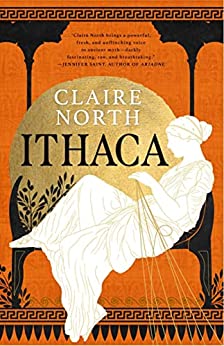
Ithaca by Claire North is the latest of many Greek mythology retellings based on the events surrounding the Trojan War. What makes this one different from the others I’ve read is that it focuses on the story of Penelope as seen through the eyes of the goddess Hera.

It has been seventeen years since Penelope’s husband Odysseus, King of Ithaca, sailed away to war with Troy and although the war is now over, she and her son, Telemachus, are still awaiting his return. Penelope is kept busy running the kingdom with the help of her women, while also trying to defend the island of Ithaca from raiders and fend off the attentions of the crowd of suitors who have descended upon her home in the hope of marrying her if Odysseus never comes back. Meanwhile, Penelope’s cousin Clytemnestra has fled to Ithaca looking for somewhere to hide after murdering her husband, Agamemnon.

Ithaca is quite a long novel and moves at a slow pace; it’s the first in a planned trilogy and Claire North takes her time setting the scene and introducing the characters. I liked the choice of Hera as narrator; she provides a different perspective on a well-known story and I enjoyed her observations of the mortal world and her interactions with other goddesses such as Athena. However, it does mean we are kept at a distance from Penelope herself, which could explain why I found it difficult to form any kind of connection with her – or with any of the other characters. For that reason, I don’t think I’ll be continuing with the second book. Claire North writes beautifully but I needed more than that to sustain my interest and I preferred Margaret Atwood’s The Penelopiad – I didn’t love that one either, but it was a shorter and more memorable read.
Mystery and intrigue in the seventeenth century

Looking at the historical fiction I have read so far this year, it seems that the 17th century is displacing the Tudor, Victorian and early 20th century periods as the most common historical setting for my reading. Here are my thoughts on two more 17th century novels I’ve read recently, both of them historical mysteries.

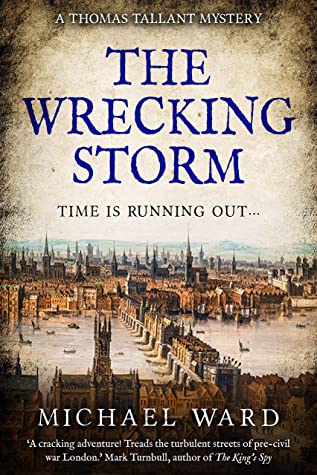
The Wrecking Storm is the second book in Michael Ward’s Thomas Tallant series, following the adventures of a London spice merchant’s son in pre-civil war England. You could read this book without having read the first one, Rags of Time, but if you do read them in order you’ll have a better understanding of the background of the characters, their relationships and the political situation in England at that time.

The novel opens in 1641 with the murder of two Jesuit priests, one of whom was known to have been in hiding in a building close to the Tallant warehouse on the banks of the River Thames. Thomas Tallant’s friends, Member of Parliament Sir Barty Hopkins and Robert Petty of the Merchant Adventurers, ask for Tom’s help in catching the culprit, but before investigations have progressed very far, Tom finds that his own family has become the next target. Joining forces again with another friend, Elizabeth Seymour, Tom must find out who is responsible before the family business is ruined or one of the Tallants is killed.

I enjoyed the mystery element of the book and was surprised when the truth was revealed as I’d had no idea who was behind the attacks on the Tallant family! It was nice to see Elizabeth play such a big part in the investigations; her intelligence, puzzle-solving skills and interest in science and mathematics make her a better detective than Tom himself and her observations and suggestions prove invaluable to the solving of the mystery. I was particularly intrigued by her encounters with Lucy, Countess of Carlisle, a real historical figure who was also involved in political conspiracies during the civil war (and who I’ve discovered may have been the inspiration for Milady in The Three Musketeers).

As with the first book, the historical context was as interesting as the mystery. The story unfolds during the sitting of the Long Parliament, the execution of the Earl of Strafford and Charles I’s attempt to arrest five Members of Parliament in the House of Commons. The conflict between King and Parliament is mirrored by the turmoil on the streets of London where opposing political and religious groups and unruly mobs of apprentices are creating a dangerous and unsettling atmosphere.

The Wrecking Storm is a short, fast-paced read; I think I slightly preferred the longer Rags of Time, but both books are entertaining and I hope to meet Tom and Elizabeth again soon.

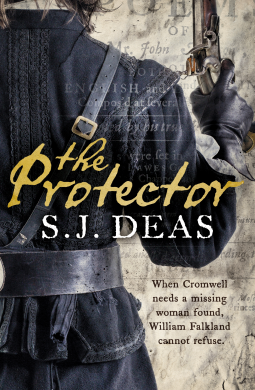
The Protector by SJ Deas is a sequel to The Royalist, which I read several years ago and enjoyed. This second book was published in 2015 and there have been no more in the series since, which is disappointing but it seems the author has moved on to other things.

Anyway, The Protector continues the story of William Falkland, a former Royalist soldier who has reluctantly found himself in the service of Oliver Cromwell. It’s 1646, the First Civil War is over (the Second will begin within two years), and Henry Warbeck, Cromwell’s man, has again approached Falkland to ask for his assistance with another investigation. Anne Agar, sister of John Milton, the epic poet and writer of political pamphlets, has disappeared and Cromwell believes she has been abducted by Royalists in an attempt to convert the pro-Parliamentarian Milton to their cause.

Falkland is less than enthusiastic about taking on this mission; after four years of war he no longer feels any strong allegiance to either side and just wants to go home to his wife and children. However, that’s easier said than done, as he returns to find his house abandoned and his family missing, with no idea where they have gone or why they have left. Hoping that Cromwell will help him to locate his own family in return for tracking down Anne, Falkland sets out on her trail – but the biggest obstacle in his way turns out to be Milton himself, who takes an instant dislike to Falkland and is unwilling to cooperate.

As well as being an interesting and compelling mystery novel, The Protector is also quite a sad and poignant portrayal of the human cost of war, with families left divided, destroyed and separated once the fighting ends. William Falkland is a sympathetic and tragic hero as, lost and lonely, he begins the hunt for Anne Agar while despairing of ever finding his own beloved Caro. I was pleased to see him team up again with Kate Cain (whom we first met in The Royalist), but at the same time I was glad that Deas doesn’t push them into a romance, leaving us in no doubt that William is still devoted to Caro and the children and will continue his search unless and until there is no hope left. I enjoyed this book nearly as much as the first one and would love to know what the future holds for William Falkland, but sadly it looks as though we’re not going to find out.

~

Have you read either of these books – or any other good historical mysteries set in the 17th century?

Books 29 and 30/50 read for the 2021 Historical Fiction Reading Challenge.

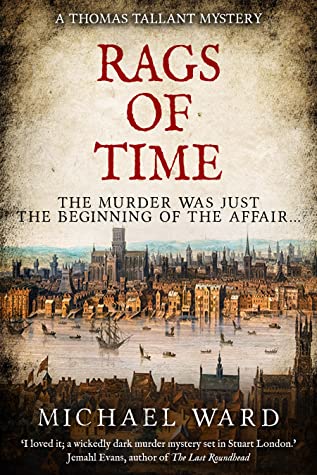
Rags of Time by Michael Ward

I love a good historical mystery, so I’m pleased to have had the opportunity to read Rags of Time, the first in a new series set in the 17th century during the final years of the reign of Charles I. Based on how much I enjoyed this book, I will certainly be looking out for the next one.

The story begins in 1639 with Tom Tallant, a young spice merchant, returning to London from India only to find that he has become implicated in a murder investigation. Wool merchant Sir Joseph Venell has been found dead in a meadow near his home in Kensington and it seems that Tom is the main suspect. Then another murder takes place, this time in the Tallant household, casting further suspicion on Tom. In order to clear his name, Tom must try to identify the real murderer – and for that he will need the help of Elizabeth Seymour, an intelligent and unusual young woman with an interest in astronomy and an addiction to gambling.

“The murder was just the beginning of the affair”, it says on the front cover of the book, and that is quite true because although Rags of Time at first appears to be a straightforward murder mystery, it soon becomes apparent that the murder is only one aspect of the story and for a while takes second place to an equally fascinating subplot involving a printing press and the distribution of seditious pamphlets. Remember that this is all taking place during an eventful and turbulent period of history, a time of tension between King and Parliament and unrest on the streets:

‘Each day and week we suffer treasonable talk on the street, attacks on our churches, seditious street-preachers, scandalous pamphlets on every corner and finally this…mutinous gangs of Apprentice Boys!’

I loved the recreation of 17th century London; there’s such a strong sense of time and place (without becoming overly descriptive) and with so much going on it’s the perfect backdrop for Tom’s adventures. Yet one of my favourite parts of the story relates to something taking place overseas – the ‘tulip mania’ sweeping Amsterdam in the 1630s and the notion of windhandel, or ‘trading in promises’.

As for the mystery itself, once everything starts to come together towards the end of the book, there are plenty of twists and turns and when the solution was revealed I was completely taken by surprise! I think there were probably a few clues but I didn’t pick up on them and didn’t guess either the culprit or how and why the murders were carried out. Although most of the focus of the novel is on Tom, I was pleased to see that Elizabeth also contributes to the solving of the mystery; I wasn’t sure I would like her at first and it took me a little while to warm to her, but I think she’s a character with a lot of potential, as is Tom himself. I hope to meet them both again soon!

Thanks to the author for providing a copy of this book for review.

Book 4/50 read for the Historical Fiction Reading Challenge.