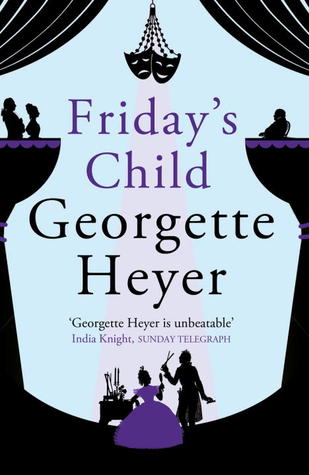
Friday’s Child by Georgette Heyer

This Heyer novel was published in 1944 and as it’s a particularly lively and humorous one, I expect it provided her wartime readers with some welcome escapism. It’s still an entertaining read in the twenty-first century too and although it hasn’t become a favourite, I did enjoy it.

“Friday’s child is loving and giving” says the famous rhyme and that is how the heroine of the novel, seventeen-year-old Hero Wantage, is described by her friends. As an orphan treated as a poor relation in her cousin’s household, Hero’s marriage prospects are not good and she is facing a future as a governess when she receives a surprise proposal from her childhood friend, Lord Sheringham. Hero is under no illusions that Sheringham – or Sherry, as he is known – is actually in love with her; she knows that he needs to marry in order to receive his inheritance and that he has already been rejected by the beautiful Isabella Milborne. It will be a marriage of convenience only, but even this is so much more than Hero could ever have hoped for that she has no hesitation in accepting.

Hero may be young and naïve, but Sherry is only a few years older and no more mature. He has no intention of changing his lifestyle just because he now has a wife, so he continues his reckless spending, gambling and womanising without considering the bad example he is setting for Hero. I don’t think it’s spoiling too much to say that Sherry does gradually come to love and appreciate his wife, but not without a lot of misunderstandings and ‘getting into scrapes’ along the way! And when he does eventually admit to himself how he really feels about Hero, will he have left it so late that he risks losing her to another man?

Although the relationship between Hero and Sherry is at the heart of the novel, with both characters slowly developing and maturing as time goes by, there is also a secondary romance which involves Isabella Milborne (known as the Incomparable) and George, Lord Wrotham, a passionate, hot-headed young man who is always ready to fight a duel. George, along with Gil Ringwood and Ferdy Fakenham, forms Sherry’s little circle of friends – and they become Hero’s friends too, providing most of the humour in the book as they give her some dubious guidance in the social etiquette of Regency London and try to help her out of the disastrous situations she finds herself in.

Friday’s Child has just about everything you would expect from a Heyer novel: duels, card games, gambling, balls and parties, elopements and attempted elopements. It reminded me of two of her other books, The Convenient Marriage and April Lady, which also have storylines revolving around a newly married couple learning to love each other. Although I enjoyed this book much more than April Lady, The Convenient Marriage is my favourite of the three, mainly because I preferred the hero in that one, the Earl of Rule. I do tend to prefer her older, wiser heroes rather than the young, irresponsible ones like Sherry. I also thought this book felt slightly longer than it really needed to be and the constant misunderstandings became a bit repetitive towards the end.

There are other Heyer novels that I’ve liked better than this one, then, but her books are always a lot of fun to read and this is no exception. There are plenty of funny moments, usually involving Sherry’s three friends (I particularly loved the hilarious Ferdy). I have The Corinthian, An Infamous Army and Faro’s Daughter to choose from for my next Heyer. If you have read them, which one would you recommend I read first?

Snowdrift and Other Stories by Georgette Heyer

I always love spending time in Georgette Heyer’s world; with duels, masked balls, elopements, high-stakes card games and lively period slang, her novels provide perfect escapism – and based on this collection, so do her short stories. Originally published as Pistols for Two in 1960, Snowdrift and Other Stories contains eleven of Heyer’s tales of Regency romance and adventure plus three additional stories not included in the earlier book.

I found these stories so enjoyable and so much fun, it was tempting to read them all at once, but instead I decided to just dip in and out, reading one or two at a time over the course of a few weeks. This was probably a good idea as many of the stories in the book are very similar, so better in smaller doses, I think! In particular, there are several that deal with young couples eloping with various family members in pursuit and a series of misunderstandings ensuing along the way – and also several involving duels, fought with either pistols or swords, and never quite going according to plan. Most of the stories have a twist or two, which are usually easy for the reader to predict, but come as a complete surprise to the characters!

I don’t want to discuss all fourteen stories here, but I can honestly say that I liked all of them – some more than others, of course. Some of my favourites included Bath Miss, in which a gentleman agrees to escort the daughter of a family friend home from school in Bath, but finds that the girl is not quite what he’d expected; The Duel, which follows a young lady who goes in search of the disreputable Lord Rotherfield to beg him not to shoot her brother; and Hazard, where a nobleman ‘wins’ a friend’s sister in a drunken game of dice and is horrified when he wakes up the next day and finds himself on the way to Gretna Green. Another which stood out, although it wasn’t one I particularly loved, was Night at the Inn. Unlike the others, which are all romances of various types, this one is more of a suspense story in which three guests arrive at a lonely inn one dark, foggy night.

As for the three extra stories – Pursuit, Runaway Match and Incident on the Bath Road (all from the 1930s, I think) – they are very entertaining too, although they suffered slightly from being placed at the end. Speaking as someone who is not usually a fan of short stories, I did really enjoy this book. I prefer her full length novels but, as I’ve said, if you just want a small dose of Heyer – or maybe if you’ve never read her before and don’t want to commit to anything longer – I would recommend giving Snowdrift a try.

Thanks to Sourcebooks for providing a copy of this book for review via NetGalley.

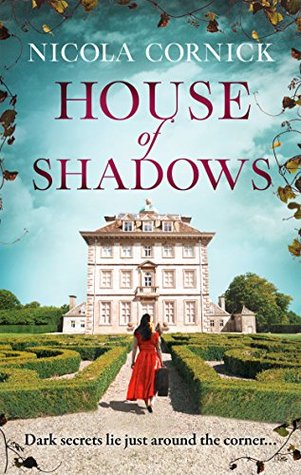
House of Shadows by Nicola Cornick

After reading Nicola Cornick’s time-slip novel The Phantom Tree earlier this year, I was hoping for an opportunity to read her previous book, House of Shadows – and my chance came when I spotted it on the shelf on a recent visit to the library. Although House of Shadows doesn’t include physical time travel in the same way that The Phantom Tree does, it still features storylines set in different time periods with several close links between them. It’s not my favourite of the two books, but I did enjoy it.

It’s difficult to know where to begin writing a summary of a book like this, so I’ll start in the modern day where we meet artist and glass-engraver Holly Ansell who has just received a desperate call from her niece, telling her that her father (Holly’s brother Ben) has disappeared. Heading straight for the old Mill House in Ashdown, Oxfordshire, where Ben was last seen alive, all Holly is able to learn is that prior to his disappearance he had been researching his family tree and had discovered the diary of Lavinia Flyte, a 19th century courtesan.

Hoping for clues that will lead her to Ben, Holly begins to read Lavinia’s journal and quickly finds herself caught up in the memoirs of a brave, resourceful young woman who once lived at nearby Ashdown House. But before we can understand the links between Lavinia and the Ansell family, we have to go further back in time, to the 17th century, to follow the story of Elizabeth Stuart, known as the Winter Queen. The daughter of James I of England and VI of Scotland, Elizabeth was briefly Queen of Bohemia, through her marriage to Frederick V. However, it is her relationship with the soldier William Craven which provides the connection to the other two threads of the novel.

All three storylines are interesting and I’m sorry I can’t say too much about any of them without straying into spoiler territory. What I can say is that there are two objects which play an important role in each of the time periods – a mysterious crystal mirror and a priceless jewel known as the Sistrin Pearl, both believed to possess magical powers and said to have been used in the divination and prophecies of the Knights of the Rosy Cross. It seems that Frederick and Elizabeth really are thought to have possibly had some involvement with the Knights, so this aspect of the novel is not as far-fetched as it may sound – although I’m assuming the mirror and jewel themselves, or at least their powers, are fictional.

The Elizabeth sections of the novel were my favourites, partly because I know so little about her and partly because I enjoy reading about 17th century Europe. As far as I can tell, there is no real evidence to prove whether William Craven was romantically involved with Elizabeth, but they certainly knew each other and the story Nicola Cornick weaves around them is maybe not beyond the realms of possibility. Lavinia’s diary entries set in Regency England also held my attention – although they are quite brief, compared with the longer chapters devoted to Holly and Elizabeth, she is a vividly written character with a strong voice. I did also like Holly, but I found the contemporary storyline the least interesting – possibly because most of the action takes place in the historical sections, while Holly has more of a passive role, trying to piece together the stories of the other two women.

Ashdown House in Oxfordshire, the house at the heart of the novel and the one pictured on the front cover, really exists; it is now owned by the National Trust and Nicola Cornick volunteers there. It’s always nice to discover that the setting for a novel you’ve been reading is based on a real place – I’ve made a note to try to visit it if I’m in that part of the country.

Nicola Cornick has written several other books, but they seem to be more conventional historical romances, so I think I’ll wait and hope that she writes more that are similar to this one and The Phantom Tree!

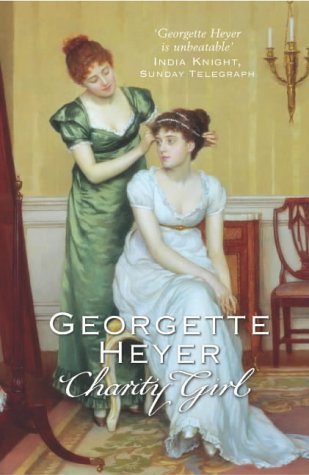
Charity Girl by Georgette Heyer

charity-girl Continuing to work through my library’s selection of Heyer novels, I came home last Saturday with both her earliest book and one of her last. The first one I decided to read was Charity Girl, which was published in 1970, towards the end of Heyer’s career. It doesn’t seem to be one of her more popular Regency romances; I’ve seen other readers describe it as a recycling of Sprig Muslin and The Foundling, but that wasn’t a problem for me as I haven’t read either of those yet. While I did find a lot to enjoy, though, I would agree that this isn’t one of her best.

The hero of Charity Girl is Viscount Desford who, as the novel opens, is being berated by his father for not marrying his childhood friend, Henrietta Silverdale, and providing him with grandchildren. Desford and Hetta have been insisting for years that, although they are the best of friends, they are not in love – and nothing has changed now that they are both in their late twenties. Following this uncomfortable interview with his father, Desford goes to visit family and ends up attending a party at which he meets a vulnerable young girl called Charity – or Cherry – Steane.

Cherry’s mother is dead and her father has abandoned her, leaving her at the mercy of an aunt and cousins who treat her like a servant. The next day, Desford encounters Cherry walking along the road to London with a suitcase, determined that she is running away from her aunt. Unable to persuade her to go back, Desford accompanies her to London to find her grandfather, Lord Nettlecombe. However, the old man is away from home, so Desford turns to Hetta Silverdale for help. Cherry goes to stay with the Silverdales while he continues to look for her grandfather and absent father, but people soon begin to talk – why is Desford so concerned for Cherry’s welfare? Has he fallen in love at last?

I found Charity Girl an entertaining read, as have been all of the Heyer novels I’ve read, with plenty of the witty dialogue, peppered with Regency slang, which I love in her work. There are some funny scenes too, especially whenever one of Cherry’s disreputable family members makes an appearance. Despite this, though, Charity Girl has not become a favourite Heyer. I liked Desford, but he isn’t a particularly strong or memorable hero, and instead of having so much focus on his search for Cherry’s family, I would have preferred more time spent on his interactions with Cherry and Hetta. I couldn’t tell, at first, which of them was going to be his love interest and, when it eventually became clear, I didn’t feel that I’d seen enough of them on the page together.

Still, I didn’t think this was a bad book at all, so I don’t want to sound too negative about it. I have just started to read the other Heyer novel on my library pile – The Black Moth – and am so far finding it very different from this one!

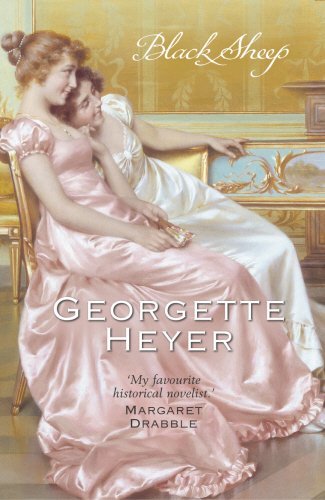
Two from Georgette Heyer: Regency Buck and Black Sheep

It’s been a while since I read anything by Georgette Heyer and I still have a lot of her books to get through, so I had a nice surprise a few weeks ago when I found two on the library shelf that I hadn’t read yet: Regency Buck and Black Sheep. Neither of these were near the top of my list of Heyer novels to look out for, but I was still pleased to have the opportunity to read them – and I’m even more pleased to say that I enjoyed both.

regency-buck-heyer Published in 1935, Regency Buck was the first of Heyer’s many novels to be set in the Regency period. It follows the adventures of Judith Taverner and her younger brother, Sir Peregrine (Perry), who have recently been orphaned and, under the terms of their father’s will, have been left under the guardianship of his friend, the fourth Earl of Worth. Leaving their home in Yorkshire, the brother and sister set off for London to meet the Earl. It proves to be a more eventful journey than they expected when they have an unpleasant encounter with an arrogant nobleman on the road. Imagine their horror when they discover that this nobleman is none other than Julian St John Audley, who has inherited the title of Earl of Worth from his father and is therefore their new guardian!

Judith is a strong, independent young woman who is used to doing as she pleases; on arriving in London she sets about making a name for herself by refusing to conform to the conventions of society, but Worth has other ideas as to how she should behave. Unable to see eye to eye with her guardian, Judith is grateful for the friendship and support of her cousin Bernard, with whom she has just become acquainted for the first time. Soon, though, Judith has more important things to worry about. It seems that someone is trying to murder Perry – but who can it be?

Although I had my suspicions as to Worth’s true motives, Heyer misleads us so much that we can’t be completely sure whether he is the hero or the villain. I would usually like this type of character, but Worth just never endeared himself to me; I found him unnecessarily patronising and I really felt for Judith and Perry every time they were forced into yet another humiliating conversation with him. I did like Judith – she’s an intelligent, outspoken and rebellious heroine – and I thought Perry was amusing, with all his youthful enthusiasms! As usual, Heyer’s recreation of the Regency period is vivid and immersive and although the main characters are fictional, there are also some real historical figures who make an appearance in the story. I loved the portrayal of the famous dandy Beau Brummell, particularly in the scene where Judith meets him for the first time – a case of mistaken identity!

Regency Buck is set in London and Brighton, which gives it a slightly different feel from the second of the two books I read, Black Sheep, which is set in Bath…

black-sheep At twenty-eight and still single, it is looking unlikely that Abby Wendover will ever marry. Instead, she is concerning herself with the love affairs of her seventeen-year-old niece, Fanny, whose romance with the handsome, dashing Mr Stacy Calverleigh has become the talk of Bath. Although Fanny’s other aunt, Selina, has been taken in by Stacy’s charms, Abby is convinced he is nothing more than a fortune hunter and determines to free Fanny from his clutches. However, when Stacy’s uncle, Miles Calverleigh – the ‘black sheep’ of the family – also arrives in Bath, Abby finds herself drawn into a relationship which is considered even more unsuitable than Fanny’s!

Black Sheep, published in 1966, is a later Heyer novel. It’s one of my favourites so far and that is largely because of its wonderful hero and heroine. I loved both Abby and Miles and found myself looking forward to every scene they were in together. They feel like two people who really would have liked and understood each other, rather than characters who are just being forced together for the sake of the plot – there’s a genuine chemistry between them and the dialogue really sparkles! I liked the fact that Abby is a little bit older than the average Heyer heroine (she reminded me in some ways of Anne Elliot in Persuasion); she’s a sensible, mature woman whose romance with Miles is of a very different nature than Fanny’s with Stacy.

As I said at the start of this post, I enjoyed reading both of these novels. I was particularly relieved to find that I liked Regency Buck as it doesn’t seem to be a very popular book with Heyer fans! I probably wouldn’t recommend that one to readers new to Heyer, though; of these two, I think Black Sheep would be a much better place to start.

Have you read either of these? What are your favourite Heyer novels?

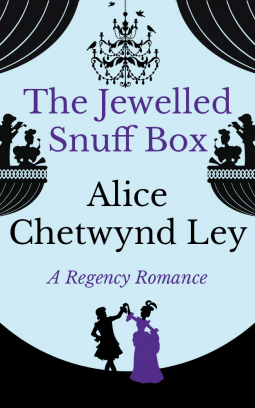
The Jewelled Snuff Box by Alice Chetwynd Ley

Alice Chetwynd Ley is an author whose name was completely new to me when I came across this book on NetGalley a while ago, but seeing it described as “an intriguing Regency romance, perfect for fans of Georgette Heyer and Jane Aiken Hodge” made me both curious and wary. I love Georgette Heyer and enjoyed the one Jane Aiken Hodge book I’ve read (Watch the Wall, My Darling), so I hoped the comparison would be accurate. My verdict, having now read The Jewelled Snuff Box, is that there are definitely some similarities and although Ley’s writing is not as good as Heyer’s, this is an entertaining novel in its own right.

the-jewelled-snuff-box Our heroine, Jane Spencer, is a young woman who has fallen on hard times since her beloved father’s death and, determined not to be a burden on her relatives, she has decided to find work and support herself. She is on her way to London to take up a new position as a lady’s companion when her coach is forced to stop during a snowstorm. Getting out to walk, Jane discovers a man unconscious in the snow and believing him to be the victim of an attack, she and her fellow passengers take him to the nearest inn to recover.

When he regains consciousness, the stranger claims to be suffering from amnesia and can’t remember who he is, the only clue to his identity being an ornate snuff box covered in jewels which had been found next to his body. After the weather improves and they can resume their journey, Jane, who is beginning to form a bond with the mysterious stranger, offers to see her lawyer in London on his behalf in the hope that he will be able to help. Once they reach London, however, Jane is disappointed to find that her new friend has disappeared, leaving her in possession of the snuff box – which contains a compromising letter from a lady hidden in a secret compartment.

Sorry that her relationship with the unknown gentleman has come to an end, Jane leaves the box with her lawyer and continues to the home of her new employer, the Earl of Bordesley, where another shock awaits her: the Earl’s young wife, for whom she will be working as a companion, is none other than Celia Walbrook, a girl Jane knew at school. Jane remembers Celia as a snob and a bully and it seems that nothing has changed. It’s through Celia, though, that the stranger comes back into Jane’s life – but not in the way that she would have hoped!

With a plot based heavily on misunderstandings, the reader is always one step ahead of the characters. I never doubted how the book was going to end – the question was not so much whether our hero and heroine would get together, as when they would get together and how. And as with most older romantic novels (The Jewelled Snuff Box was published in 1959) there’s an air of innocence surrounding Jane’s relationship with her mystery man – nothing graphic or explicit!

The pages of The Jewelled Snuff Box are filled with men with quizzing glasses and (obviously) snuff boxes, people riding in carriages, mentions of the Bow Street Runners and Beau Brummell, but on the whole I didn’t find the recreation of the time period quite as convincing as I do when I read a Heyer novel. The dialogue lacks the sparkling wit and humour of Heyer’s too, but the plot and characters feel similar – Francis, the Earl of Bordesley, made me think of some of some of Heyer’s ‘older husbands with younger wives’ such as Rule from The Convenient Marriage and Cardross from April Lady. Jane, however, is more like a Mary Stewart heroine: sensible, intelligent, brave and resourceful – and used to making her own way in the world.

The Jewelled Snuff Box was a short, quick read, written in a style I found very comforting and easy to read. It’s the sort of novel which sweeps you away into its world without requiring too much concentration or effort from the reader. It’s not a particularly deep or insightful novel and not a particularly original one, but not all books need to be, do they? I enjoyed it anyway and would definitely consider reading more of Alice Chetwynd Ley’s books.

Margaret Kennedy Day: Troy Chimneys

Margaret Kennedy Day

My first taste of Margaret Kennedy’s writing came in 2014 when I read The Constant Nymph as part of a reading week hosted by Jane of Beyond Eden Rock. I enjoyed it – enough to want to read more of her work – but I had a feeling that there might have been another book that would have been a better choice. And I was right. For Jane’s second Margaret Kennedy celebration I decided to read Troy Chimneys – and it was the perfect book for me!

Troy Chimneys Troy Chimneys is set in Regency England and tells the story of one man with two very different sides to his personality. To society he is ‘Pronto’, an ambitious young politician who is always charming, obliging and eager to please. To his family and close friends he is simply Miles Lufton, quiet, serious and inclined to disapprove of Pronto and his actions. Lufton thinks of Miles and Pronto almost as two separate people and his inability to reconcile his public persona with his private one will lead to disappointment and tragedy.

The story of Miles Lufton and Pronto unfolds when one of his descendants – a gentleman living in the Victorian era – decides to amuse himself by delving into his family history. After corresponding with some Irish cousins, he receives a set of letters, journals and memoirs and begins to piece together the details of his ancestor’s life. There may have been hints in the correspondence at the beginning of the book as to the course Miles Lufton’s life would take; I’m not sure because once I started reading his own account in his own words, the framing story started to fade away and I was there, in the England of the early 19th century, experiencing events through the eyes of Miles and Pronto.

Although Lufton’s memoirs do touch on Pronto’s career in politics, the focus is mainly on Miles’ personal life: his family background; the rural community in which he grows up and the relationships between the different classes of people who live there; his time at university; the friendships he forms with the eccentric Ludovic, Lord Chalfont, and with an American farmer called William Hawker; his romantic entanglement with a young French girl and his later love for Caroline Audley. There are funny moments, but sad ones too and because Kennedy makes us care so much for Miles, we share in his emotions and feel for him when things don’t turn out as he had hoped.

Troy Chimneys Vintage I was so impressed by the writing and by Margaret Kennedy’s grasp of the period (or periods, as there are really two) in which the story takes place. The Victorian letters felt authentic and Miles Lufton’s own narrative style felt so much like the voice of a Regency gentleman that I could easily forget I was reading a book written in the 1950s and by a woman. Kennedy never overwhelms the reader with period details, yet there is never any doubt as to the eras in which the novel is set.

I am nearly at the end of this post and still haven’t even mentioned the Troy Chimneys of the title! Troy Chimneys – the name comes from the French Trois Chemins, meaning Three Lanes – is a house in the Wiltshire countryside which Miles buys but doesn’t actually live in himself. He plans to retire there when he is older, after he has achieved all there is to achieve in politics and can say goodbye to his alter ego forever. It’s going to be a house for Miles, not for Pronto: a representation of the life he really wants to lead and the kind of person he really wants to be.

In case I haven’t made it clear enough, I loved this book! It’s nothing like The Constant Nymph and that makes me even more curious about the rest of Margaret Kennedy’s novels.