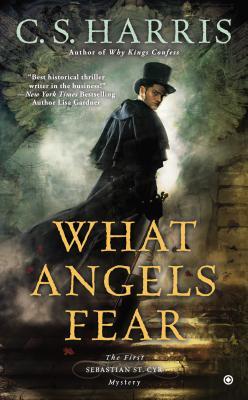
What Angels Fear by CS Harris

What Angels Fear When I made my list for this year’s RIP challenge, I decided to give priority to books I’ve been wanting to read for a while rather than search out new titles. What Angels Fear, the first in CS Harris’ Sebastian St. Cyr mystery series, is one of those books. I can’t remember where I first heard about this series but I know it has been recommended to me several times over the last few years and did sound like something I would enjoy. There are now ten books in the series, which is slightly overwhelming, especially as I’m already in the middle of so many other series, but I thought it was time I at least gave the first one a try.

What Angels Fear is set in London in 1811. With King George III suffering from mental illness, the Prince of Wales is preparing to start his period as Regent and members of the two main political parties, the Whigs and the Tories – who are strongly divided over issues such as Britain’s role in the Napoleonic Wars – are hoping to gain positions of power and influence in the newly-established Regency.

At the beginning of the novel, Sebastian St. Cyr, Viscount Devlin, returns from fighting a duel to discover that he has become a suspect in a murder investigation. A beautiful young actress, Rachel York, has been found dead on the steps of a church altar and evidence found at the scene has implicated Sebastian. Determined to clear his name, Sebastian decides to investigate the murder himself. As he delves deeper into the circumstances surrounding Rachel’s death, more and more people are drawn into the mystery, including a French spy, an Italian artist and a London street urchin, as well as some of the country’s top politicians and even members of Sebastian’s own family.

I’m pleased to say that I enjoyed What Angels Fear enough to want to read the next book in the series. I didn’t love it, but I found it very entertaining with a good mixture of mystery, political intrigue and romance (Sebastian’s love interest in this book is an actress whose stage name is Kat Boleyn). Harris captures the atmosphere of the Regency period very well, although I occasionally came across a choice of word that didn’t feel quite right. It was probably a mistake to read this book immediately after finishing April Lady as there are few authors who bring the Regency to life as convincingly as Georgette Heyer!

I haven’t really warmed to Sebastian yet, but I’m hoping that will eventually happen if I continue with the series. He is certainly an intriguing character: Harris gives him an interesting past, with five years spent in the army, some family secrets which are only hinted at in this book, and some unusual abilities (he has quick reflexes and very acute eyesight and hearing, which according to the author’s note are signs of Bithil Syndrome, although I couldn’t seem to find out whether this is a real condition or not). Because so many things are left unresolved at the end of this first novel, I’m sure there’s still a lot more to learn about Sebastian and I’m curious to see how his character develops.

What Angels Fear was a good start not only to my reading for the RIP challenge, but also to a new series. Now I’m looking forward to the second Sebastian St. Cyr novel, When Gods Die.
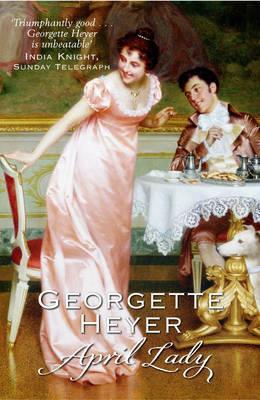
April Lady by Georgette Heyer

April Lady I first tried to read April Lady five years ago but didn’t get very far with it, so when it was one of the ten books I chose at random for my Ten from the TBR project I didn’t feel very enthusiastic about trying it again. It seems, though, that it had probably just been the wrong book at the wrong time (I was very new to Heyer then and had previously only read The Talisman Ring) and on my second attempt I found it much more enjoyable.

April Lady is one of Heyer’s Regency romances – although the couple in this novel are already married at the beginning of the book and the romantic aspect of their story centres around learning to love and trust each other. Nell Irvine, our heroine, is only seventeen when she marries the Earl of Cardross in what she believes to be a marriage of convenience. Nell does love her husband, but he is much older than she is and – as her new sister-in-law informs her – he has had a mistress until very recently, so Nell isn’t sure exactly why he has chosen to marry her.

Cardross (Giles) is also very rich, but his new wife has no experience of managing money and quickly finds herself in trouble. Cardross helps her to pay off her debts, but when Nell discovers another outstanding dressmaker’s bill that she had forgotten about she decides to keep it hidden from her husband. She is sure he will be angry with her and the last thing she wants is for him to think she only married him for his money. To make matters worse, Nell has also been giving money to her brother, Dysart, to cover his gambling debts and she knows Giles won’t be happy about that either!

April Lady follows Nell as, with the help of Dysart, she tries to obtain the three hundred pounds she needs to pay the dressmaker – while ensuring that her husband is kept in blissful ignorance. It’s obvious to the reader from the beginning that Giles does love Nell and that all they need to do is talk to each other, but each is unaware of the other’s feelings and their lack of communication leads to a whole series of misunderstandings. But Nell is not the only woman with a secret in the Cardross household. Her young sister-in-law, Letty, is determined to marry the man she loves, Jeremy Allandale…but Giles disapproves. Will Letty be tempted to elope against her brother’s will?

This book reminded me very much of an earlier Heyer novel, The Convenient Marriage, which I read about a year ago. It seemed to me that the characters of Nell, Cardross and Dysart (and the relationships between them) were very similar to Horry, Rule and Pelham in The Convenient Marriage and large parts of the plot were almost the same too, right down to a scene in which Nell’s carriage is held up by highwaymen on the way to a ball. However, I didn’t find April Lady as entertaining to read as The Convenient Marriage; the dialogue wasn’t as funny and although Nell didn’t annoy me as much as Horry did, I preferred Rule to Cardross and Pelham to Dysart. Maybe I would have felt differently about this book if it had been the one I’d read first, as I found it difficult not to make comparisons.

I did enjoy April Lady but I didn’t love it and I wouldn’t rank it very highly on my list of Heyer novels read so far. I still have plenty of her books left to read, though, including some that I’m particularly looking forward to as I know they’re big favourites with Heyer fans. I’m also wondering if I could find time to read another one of her mysteries before the end of October for this year’s RIP challenge, having enjoyed Envious Casca a few years ago.

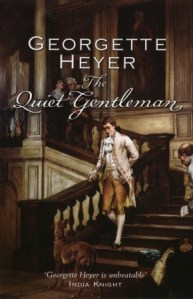
The Quiet Gentleman by Georgette Heyer

The Quiet Gentleman When Gervase Frant, 7th Earl of St Erth, returns to his family estate of Stanyon Castle after fighting in the Peninsular War, he doesn’t receive quite the welcome he’d hoped for. His cousin Theo seems pleased to see him but his stepmother and younger half-brother, Martin, give the impression that they would have been happier if he’d never come home at all. Soon after his arrival, a series of accidents start to befall the Earl – but are they really just accidents or are they attempts on his life?

I still have a lot of Georgette Heyer’s books left to read (I haven’t even read half of them yet) but this is one of my favourites so far. It’s probably not what most people would consider a typical Heyer novel, being more of a mystery than a romance, but I think that’s one of the reasons I enjoyed it so much. I didn’t find the mystery particularly difficult to solve (there were really only two or three people who could have had a motive for wanting St Erth dead) and I guessed the culprit quite early in the book, but this didn’t affect my enjoyment of the story as there was still a chance that I could have been wrong! I think this would be a good book to re-read as I’m sure there must have been lots of little clues that I missed.

The romantic element may not be as strong in this book as in some of Heyer’s others but it is still there and I actually thought it was all the more convincing for being slow, subtle and understated. In fact, it’s so slow, subtle and understated that even the hero and heroine don’t acknowledge their love for each other until near the end of the book, although it was obvious to me that they were perfectly suited. She is my favourite type of heroine – intelligent, sensible and practical – and the only problem is that we don’t see enough of her as she tends to stay in the background throughout most of the novel. This is in contrast to the other main female character, a lively, pretty girl who has every man from miles around fighting over her (sometimes literally).

While I’m on the subject of female characters, I should also mention St Erth’s stepmother, the Dowager Countess, who could almost have come straight from the pages of a Jane Austen novel! As for the men, the Earl himself is another great character: with his calm, softly-spoken manner and slim build, fair hair and love of fashion he may at first appear to be ‘nothing but a curst dandy’ as Martin describes him, but his family soon discover that appearances can be deceptive and that there is much more to Gervase than meets the eye.

I loved the setting too. Most of the action takes place within Stanyon Castle (a mansion complete with ‘Great Halls, Minstrels’ Galleries, Armouries, Towers and Moats’) and in the surrounding Lincolnshire countryside – which proves to be a very dangerous place for the Earl! The setting, together with the air of mystery, is what made this book feel slightly different from most of the other Heyers I’ve read (I thought there were some similarities with Cousin Kate, though that one is more gothic). However, there are still all the other elements you would expect to find in one of her Regency novels: balls, horses and carriages, fencing, men with snuff boxes and quizzing glasses, women dressed in satin and lace – as well as the usual humour and witty dialogue.

Now I’m wondering which of Heyer’s novels I should read next. I still have so many to choose from it can sometimes feel overwhelming!

The River of No Return by Bee Ridgway

The River of No Return If you met Nick Davenant you would probably think he was a normal, unremarkable young man, enjoying life in 2013 as the owner of a dairy farm in Vermont, whose biggest worry is a visit from the cheese inspector. But once, Nick Davenant was Lord Nicholas Falcott, Marquess of Blackdown, an English aristocrat who fought in the Napoleonic Wars.

With an enemy soldier about to kill him on a Spanish battlefield one fateful day in 1812, Nick jumps forward almost two hundred years into the future and finds himself waking up in the twenty-first century. Here he learns that he is now a member of ‘the Guild’, a secret society of time travellers like himself. With the help of the Guild, Nick is able to adapt to modern life and accepts that there can be “no return”. Then one day Nick receives a letter from the Guild summoning him to London, where he is informed that they are going to break their own rules and send him back to his own time on a very special mission…

Back in the nineteenth century again, Nick meets his old friend, Julia Percy, who lives at nearby Dar Castle. In Nick’s absence Julia’s grandfather, the fifth Earl of Darchester, has died and her greedy, brutal cousin Eamon has become the new Earl. Grandfather had a very unusual ability: he could manipulate time, and Julia appears to have inherited this special gift. And when she discovers that Eamon is searching for the Talisman, an object he believes will give him the power to control time, Julia decides not to tell anybody about her secret talent.

I’ve always enjoyed books with a time travel element and The River of No Return is one of the most original and imaginative I’ve read for a long time. This is a time travel novel where the manipulation of time forms a big part of the plot – jumping forwards in time, jumping backwards in time, freezing time, speeding time up and slowing time down. However, after Nick’s initial jump into the future and then back again, which all takes place during the first third of the novel, we don’t actually see much movement between the centuries. The majority of the story is set in Regency England, a world where people travel by horse and carriage, where girls look forward to going to London for the Season, and where the Corn Bill is being debated in Parliament. As a fan of historical fiction who enjoys reading about the Regency period, I was very happy about this and in fact, it wasn’t until Nick left the modern day behind and returned to the past that I really found myself being pulled into the story.

The book did feel a bit too long and I thought there were too many lengthy conversations about the mechanisms of time travel, but overall, after a slow start, I thought this was a great debut novel – not purely science fiction, fantasy, romance or historical fiction, but a mixture of all four. The ending felt very abrupt and left me wanting to know more, so I hope Bee Ridgway is planning a sequel. I would happily read more of Nick and Julia’s adventures.

I received a copy of this book from the publisher via Netgalley for review.