A Gentleman in Moscow by Amor Towles

a-gentleman-in-moscowIn 1922, Count Alexander Ilyich Rostov is brought before a Bolshevik tribunal and found guilty of the crime of being an ‘unrepentant aristocrat’.  Once a recipient of the Order of Saint Andrew, member of the Jockey Club and Master of the Hunt, the Count is now considered a Former Person and is sentenced to live out the rest of his days under house arrest in his current place of residence, Moscow’s Metropol Hotel.  Forced to leave his luxury suite and move his possessions to a tiny room in the attic, the Count refuses to let his spirit be broken and decides to make the best of his situation, continuing with his daily routines as far as he is able without leaving the building.

With the help of Nina, a nine-year-old girl in a yellow dress, the Count explores the hidden corridors, rooms and staircases of this magnificent old building, and later he finds some fulfilment in working as a waiter at the hotel’s grandest restaurant, the Boyarsky.  Although it’s never nice to lose one’s freedom, there are certainly worse places to be held prisoner than the Metropol Hotel.  But what truly sustains the Count as the years and decades go by are the friendships he forms with the other hotel employees, guests and visitors.

The Count develops a close bond with Emile and Andrey, the two men who work alongside him in the restaurant, he embarks on a romance with a glamorous actress, comes to value the help and advice of the hotel seamstress, and debates politics, poetry and philosophy with friends old and new.  But the most moving of his relationships, in my opinion, is the one with Sofia, who comes to the Metropol as a child and grows to think of the Count as a father.  The Count is an educated, cultured, intelligent man, but he also has a good imagination and a playful sense of humour and I loved watching as he and Sofia devised their own games to entertain themselves and help pass the time.

Spending most of his adult life under house arrest, the Count is largely insulated from whatever is happening in the outside world, but through the people who pass in and out of his life he is able to keep up with current affairs.  This allows the author to provide the reader with some commentary on Soviet-era Russia and to put the Count’s story into historical context.  The balance between the political and the personal is about right and despite the length of the book, I was never bored.

I had been looking forward to reading A Gentleman in Moscow since seeing it appear on several people’s best-of-year lists at the end of 2016.  Now that I’ve had the chance to read it for myself, I can understand all the praise that has been bestowed on it and although I don’t think I would describe it as an absolute favourite, I did find it a lovely, enjoyable story.  I loved getting to know the Count and I’m sure that if you choose to read this book you’ll love him too.

The Bear and the Nightingale by Katherine Arden

the-bear-and-the-nightingale I was drawn to this book first by the cover – and then by the mention of Russian fairy tales and folklore. It seemed a little bit different from the usual books I read and I hoped it would prove to be an enchanting, magical read, perfect for the winter months.
The story is set in the 14th century in Lesnaya Zemlya, a village in northern Rus’.  The village is home to Pyotr Vladimirovich who, since losing his beloved wife in childbirth several years earlier, has lived alone with his five children and their elderly nurse, Dunya. The youngest child, Vasilisa (or Vasya, as she is known), is becoming wild and rebellious and it is partly because of the need to provide a mother figure for her that Pyotr decides to marry again. Unfortunately, though, his new wife – Anna – turns out to be a wicked stepmother who dislikes and distrusts Vasya and believes she can see demons hiding all over the house.

Vasya, who has inherited special abilities from her mother, can also see Anna’s ‘demons’, but she knows that they are not evil spirits – they are household guardians watching over the people of Lesnaya Zemlya. When Father Konstantin arrives in the village, believing he is on a mission from God to stamp out the old traditions and beliefs, the powers of the household spirits begin to fade. Harvests start to fail, winters seem colder and harder than ever before and the evil forces that lurk in the forest grow stronger. Can Vasya find a way to protect her family and restore happiness and prosperity to the village?

The Bear and the Nightingale is a story steeped in Russian myth, legend and fairy tale. Although I loved fairy tales as a child, I seem to have missed out on most of the Russian ones, but that wasn’t a problem at all – and I was surprised to discover how much I was actually familiar with. I particularly enjoyed being reminded of the story of Frost which Dunya is telling the children as the novel opens:

“But what did he look like?” Olga demanded.

Dunya shrugged. “As to that, no two tellers agree. Some say he is naught but a cold, crackling breeze whispering among the firs. Others say he is an old man in a sledge, with bright eyes and cold hands. Others say he is like a warrior in his prime, but robed all in white, with weapons of ice. No one knows.”

Frost, or Morozko to give him his Russian name, is an important presence throughout the whole novel, although he only appears to the characters on a few occasions and we are made to wait until near the end of the book before his true significance becomes clear. Other aspects of the story are slow to unfold too – such as the role of the Bear and Nightingale of the title – which is why I’m not going to say any more about the plot or the characters, even though I would love to! I would prefer to leave some of the novel’s secrets and surprises for you to discover for yourself.

What I will mention is the setting, which I loved. Most of the action takes place in and around Vasya’s village, with lots of vivid descriptions of the harsh living conditions and the bleak, relentless winter weather, but there are also a few sections set in Moscow at the court of the Grand Prince Ivan II. I have very little knowledge of 14th century Russia (or Rus’, as the region was known at that time) so I wasn’t sure how much of this was based on fact, but as this is historical fantasy I tried not to worry too much about that.  I was more interested in the portrayal of the conflict between the old ways and the new, the changing beliefs of the people and the loss of old traditions.

The Bear and the Nightingale is apparently the first in a trilogy – I hadn’t been aware of this when I first started to read, but on reaching the end of the book I was happy to discover that there will be another two and that the next one will take us away from the forests of Rus’ and into medieval Moscow. I hope we won’t have to wait too long for it as I’m looking forward to it already!

Thanks to the publisher Del Rey for providing a copy of this book via NetGalley for review.

A Country Doctor’s Notebook by Mikhail Bulgakov

A Country Doctors Notebook A Country Doctor’s Notebook is the book that was selected for me in the last Classics Club Spin. I was happy when I discovered that I would be reading this one, not only because it’s much shorter than most of the others on my Classics Club list, but also because I loved Bulgakov’s The Master and Margarita which I read four years ago in 2011. I knew this book was going to be very different from The Master and Margarita, but I hoped I would still enjoy it…and I did.

A Country Doctor’s Notebook is a collection of semi-autobiographical short stories originally written in Russian in the 1920s (the edition I read uses Michael Glenny’s English translation from 1975). Like the protagonist of this book, Mikhail Bulgakov was a ‘country doctor’. After graduating from Kiev University he became a physician and from 1916-1918 he worked at a small hospital near a remote village in the province of Smolensk.

The fictional doctor in the book, Vladimir Bomgard, is clearly based on Bulgakov himself and in the first story we see him as a young, newly-qualified doctor of twenty-four arriving at Muryovo Hospital, a full day’s drive from the nearest town. He is pleased to find that the hospital is clean and well equipped, but with no practical experience and nobody to turn to for advice (apart from a feldsher, or partly-qualified assistant, and two midwives) the thought of bearing sole responsibility for the lives of his patients terrifies him.

During his first weeks and months at Muryovo, the country doctor faces all sorts of problems for which his university education had completely failed to prepare him. With no electricity, no telephones, poor roads, the risk of being cut off from the world during snowstorms, and the ignorance of peasants regarding simple medical matters, life at Muryovo is primitive and isolated. Most of all, the young doctor lives in fear of encountering a strangulated hernia, a case of peritonitis or a difficult birth and he comes to dread hearing a knock on the door in the middle of the night.

“It’s not my fault,” I repeated to myself stubbornly and unhappily. “I’ve got my degree and a first class one at that. Didn’t I warn them back in town that I wanted to start off as a junior partner in a practice? But no, they just smiled and said, ‘You’ll get your bearings.’ So now I’ve got to find my bearings. Suppose they bring me a hernia? Just tell me how I’ll find my bearings with that?”

As the book progresses the doctor slowly begins to gain confidence and discovers that true knowledge comes with experience.

It was fascinating to read about conditions in a remote Russian hospital at the start of the twentieth century and the medical procedures and treatments that were used. I had a lot of sympathy for the doctor, being thrown in at the deep end with so little experience and being expected to operate on patients with no supervision and no advice other than illustrations in his textbooks. If you’re squeamish I should probably warn you that some of the operations he performs are described in full, gory detail (the tracheotomy particularly sticks in my mind). But this is also a book with a lot of humour and there are some very funny moments as the doctor panics, guesses and muddles his way through each crisis.

As I mentioned above, I read the Michael Glenny translation which I was quite happy with and found perfectly readable. I enjoyed all of the stories in A Country Doctor’s Notebook and I’m so pleased the Classics Spin motivated me to pick up this book at last.

The Idiot by Fyodor Dostoevsky

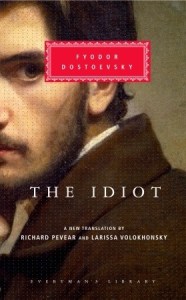
The Idiot The Idiot was the book chosen for me by the Classics Club Spin earlier this month. I have to confess I wasn’t thrilled when I saw that this was the book I’d have to read but, as so often seems to happen with my spin books, I ended up enjoying it much more than I’d expected to. This wasn’t my first experience of Dostoevsky’s work; I’ve tried twice to read Crime and Punishment and both times gave up after a few chapters. Luckily, I’ve had more success with The Idiot!

The ‘idiot’ of the title is Prince Lev Nikolaevich Myshkin, a young man who, as the novel opens, is returning home to Russia after spending several years at a Swiss clinic receiving treatment for his epilepsy. On the train to St Petersburg he meets for the first time the man whose fate will become entwined with his own: Parfyon Semyonovich Rogozhin. Rogozhin is passionately in love with the beautiful but self-destructive Nastasya Filipovna, who has suffered a series of misfortunes that have led to her being labelled a ‘fallen woman’.

With no family of his own in the city, the prince introduces himself to the Epanchins, to whom he is distantly related. This family consists of General Epanchin, his wife Elizaveta, and their three daughters, Alexandra, Adelaida and Aglaya. As the story progresses, Myshkin becomes romantically involved with both Nastasya Filipovna and Aglaya Epanchin, but his inability to read between the lines and understand that people don’t always say what they really mean leads to trouble in his relationships with both women. His path will also cross again and again with Rogozhin’s, but while the prince pities Nastasya and hopes to save her from herself, Rogozhin’s love is of the violent and obsessive kind.

The intensity of Rogozhin’s personality is very different from the prince’s own gentle, peaceful nature. In fact, Myshkin seems to possess such simplicity of character, to be so trusting and gullible, so incapable of dealing with the subtleties of St Petersburg society that people think he must be an idiot. Of course, Myshkin is not really an idiot – that is, he doesn’t lack intelligence – but he is what Dostoevsky himself described as a portrayal of a ‘completely beautiful human being’. He is a genuinely good, kind-hearted person, but ironically it’s his goodness and his willingness to always see the best in people that are his weaknesses when it comes to negotiating complex social situations and dealing with people who are less honest than himself.

The edition of The Idiot that I read was the one pictured above, published by Everyman’s Library and translated by Pevear and Volokhonsky. This would maybe not have been my first choice of translation (this is the third of P&V’s Russian translations I’ve read and I’ve decided I’m not really a fan) but this is the book I already had on my shelf so it made sense to at least try it. Having said that, I found their translation of this particular book perfectly readable – though with a few strange word choices – and I’m sure I would still have found The Idiot a challenging read regardless of who it was translated by!

To clarify what I mean by ‘challenging’, I didn’t have any problem actually following the plot and understanding what was going on. This is really more of a character-driven novel than a plot-driven one anyway. Although I found it quite absorbing and was never bored, the pace is uneven and there are some long diversions in which various characters discuss religion or politics or philosophical ideas. Three chapters, for example, are devoted to a long confessional letter written by Ippolit, a young man who is dying from consumption – however, I thought this was one of the most powerful and moving sections of the book.

What I did struggle with at times was trying to interpret the actions and motivations of the characters, particularly the two main female characters, Nastasya and Aglaya. I won’t attempt an analysis of those two characters here, except to say that they are both so complex I’m not surprised the unsophisticated, unworldly Myshkin found it difficult to understand what they were really saying to him!

I enjoyed The Idiot a lot more than I thought I would, but I know I would have to read it again to be able to fully appreciate it. I don’t think I would want to do that in the near future but I will certainly try Crime and Punishment again and maybe The Brothers Karamazov as well.

The Lost Souls of Angelkov by Linda Holeman

The Lost Souls of Angelkov Linda Holeman is an author I discovered by chance five years ago when I picked up one of her books, The Moonlit Cage, in the library. I enjoyed it and went on to read two more of her novels, In a Far Country and The Saffron Gate, which I also loved. All three are long, engrossing historical fiction novels with fascinating settings including 19th century Afghanistan and India and 1930s Morocco. The Lost Souls of Angelkov was published in Canada in 2012 and I was disappointed to find that it was not being published in the UK…but Traverse Press came to the rescue a few weeks ago when they contacted me with the news that an ebook version is now available to UK and US readers.

The Lost Souls of Angelkov is set in Russia in 1861, the year serfdom is abolished by Tsar Alexander II. The emancipation of the serfs leads to huge changes in Russian society as the serfs try to adapt to their new freedom while their former owners struggle to manage their huge estates with nobody to work the land. One of these landowners is the fictional Count Konstantin Mitlovsky who owns the estate of Angelkov in the Province of Pskov.

One day the Count and his young son, Mikhail (Misha), are out riding when they are attacked by a group of Cossack horsemen. Ten-year-old Misha is kidnapped and Konstantin himself is wounded. As the Count’s health deteriorates, it is left to his wife, Antonina, to take control of the situation and continue the search for their missing child. Antonina, however, is an alcoholic and seeks comfort in drink, finding it difficult to cope with what has happened. And so she turns to the only two people she feels she can trust – her maid, Lilya, and the estate steward, Grisha, neither of whom are quite what they seem…

I’m so pleased that I’ve now had the opportunity to read The Lost Souls of Angelkov, because I enjoyed it as much as the other Linda Holeman books I’ve read. I wasn’t sure I was going to like it at first, though. Antonina is a very flawed character (as are most of the others in the novel) and I found her reactions to her son’s kidnapping very frustrating! On the other hand, people don’t always behave the way we would like or expect them to and as the story progressed I started to become aware of the reasons for Antonina’s behaviour. In an arranged marriage to a man old enough to be her father, her married life has been unhappy and lonely, and because of the lack of freedom available to women of her time she is unable to pursue her dream of playing the piano professionally. As I learned more about Antonina’s background I began to understand and have sympathy.

The stories of not only Antonina but also Grisha and Lilya unfold gradually through flashbacks and this helps to explain the complex relationships between the three of them. I think getting to know these three characters and discovering the truth about their pasts was actually a lot more interesting than the storyline of Misha’s kidnapping! There were a few coincidences that I couldn’t quite believe and I also found the ending a bit dissatisfying (not all of the characters had the happy endings I was hoping for), but The Lost Souls of Angelkov was still a great read. I didn’t have much previous knowledge of Russian serfdom and the challenges facing the serfs and landowners after emancipation, so I loved that aspect of the story.

I hope I won’t have to wait too long for a chance to read Linda Holeman’s next book, but meanwhile I should go back and read The Linnet Bird, the only one of her earlier novels I haven’t read yet.

Thanks to Traverse Press for sending me a copy of this book for review.

Empress of the Night by Eva Stachniak

Empress of the Night This is a follow up novel to The Winter Palace, a novel about Russia’s Catherine the Great which I read in 2012. I remember having a few problems with The Winter Palace so I wasn’t sure whether to read this book or not, but I do love Russian historical fiction and in the end I couldn’t resist. Looking back at my review of The Winter Palace, which was narrated by a fictional character, Varvara, I had said that I would have preferred a book written from Catherine’s perspective. That is exactly what Eva Stachniak has done in Empress of the Night, so I was interested to see whether that would help me to enjoy this book more than the first.

The novel has an unusual structure, beginning on the final day of Catherine’s life in 1796. She has just suffered from a stroke and in the hours that follow she looks back on her life in the form of flashbacks and memories. Occasionally we return to the present to see how Catherine and the people around her are trying to deal with what has happened. By the time she takes her last breath we have watched the whole of Catherine’s story unfold, from her early days in Russia at the court of the Empress Elizabeth to the final years of her own reign.

Although this is the second of Eva Stachniak’s Catherine the Great books, the two could be read in either order (for this reason the publishers are describing it as a ‘follow up’ rather than a ‘sequel’). For anyone who hasn’t yet read The Winter Palace, this book (or the first part of it, anyway) covers some of the same events, including the young Catherine’s arrival in Russia as the Princess Sophie of Anhalt-Zerbst, intended bride of the Empress Elizabeth’s nephew, Peter, and her relationship with her friend and spy, Varvara. If you have already read The Winter Palace, however, you are seeing everything from a different perspective this time.

Catherine the Great was a fascinating woman but she is not someone I’ve read about in any depth before and this meant that I really learned a lot from this book. But while major events such as Russia’s war with the Ottoman Empire, the Pugachev Revolt and the creation of the Legislative Commission are discussed, Catherine devotes much more time to remembering her relationships with her various lovers. And there are a lot of them! Her marriage to Peter III was not a happy one and ended with his assassination in 1762 after which Catherine succeeded him to the throne. She was romantically involved with many other men, including Serge Saltykov, Stanislaw Poniatowski (the future king of Poland), Grigory Orlov, and her favourite lover, Grigory Potemkin.

More interesting than the love affairs, for me at least, were the descriptions of Catherine’s family life. It was so sad that her son, Paul, was taken from her by the Empress Elizabeth and allowed to spend very little time with his mother so that in later life he is somebody she barely knows and doesn’t like. But Catherine has warm, loving relationships with several of her grandchildren, particularly Alexander and Alexandrine.

Empress of the Night - UK cover The style of the writing in this book seemed to me to be very different from The Winter Palace – it’s very fragmented and probably what you could describe as ‘stream-of-consciousness’. The disjointed narrative meant that at first I struggled to really get into the story and connect with Catherine, but on reflection I can see that a woman who had just had a stroke and knew that she was dying probably would be confused and incoherent. It would have been nice to have been given some dates, though, because I found it difficult to measure the passing of time and would have liked to have had some idea of when various events were taking place and of how old Catherine was.

I didn’t find this a particularly ‘easy’ read because of the way the narrative jumped around and I think maybe The Winter Palace is my favourite of the two books after all, but I did enjoy learning more about this important and powerful woman.

~

Empress of the Night is available now published by Bantam in the US or by Traverse Press as an ebook only in the UK. Both covers are pictured above. I received a copy for review from Bantam via NetGalley.

The Secret Countess by Eva Ibbotson

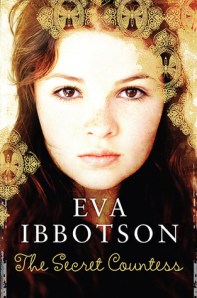
The Secret Countess The Secret Countess (also published as A Countess Below Stairs) is set in 1919 and the title character is Anna Grazinsky, the daughter of a Russian count and countess. During the Russian Revolution, she and her mother and brother are forced to flee their home in St Petersburg for safety in England, but on the journey they lose their remaining family jewels and arrive in England with nothing. Determined to get a job so that she can help to support her family, Anna finds a position as a maid at Mersham, the estate of the Earl of Westerholme. With Selena Strickland’s The Domestic Servant’s Compendium as her guide, she settles into her new job and earns the respect and friendship of the other servants, who are unaware that she is a countess.

The young Earl, Rupert Frayne, is returning to Mersham for the first time since leaving to fight in the First World War and has announced that his fiancée, Muriel Hardwicke will soon be joining him. At first the Fraynes, their friends and their servants are pleased with the news of Rupert’s forthcoming marriage because Muriel is a rich heiress and her money means that the future of Mersham will be safe. But while Rupert is awaiting Muriel’s arrival, he notices the new Russian housemaid and finds himself falling in love.

It was not hard to predict what was going to happen in The Secret Countess! From the beginning it was obvious how it was going to end, but that didn’t make the book any less enjoyable. After finishing the dark and disturbing Gretel and the Dark I wanted something light and gentle to read next and this book was the perfect choice. I thought it was a lovely story with a magical, fairy tale quality and an old-fashioned feel (the book was first published in 1981 but could have been much older than that). The romance between Anna and Rupert is a subtle, understated one and doesn’t ever really dominate the story, but I never doubted that there would be a happy ending and that they would somehow overcome the obstacles in their path.

While my preference is usually for books that are less predictable and with characters that are more complex and nuanced (most of the characters in this book are either completely ‘good’ or completely ‘bad’ with nothing in between) that didn’t really bother me this time. Anna could easily have been one of those sickening heroines who is too good to be true – she’s beautiful, generous, sweet, kind and loving – but I couldn’t help liking her anyway. In the same way, the character who turns out to be the villain of the novel is horrible in every way, yet perfect in the context of the story. Another of the strengths of this book is its wonderful supporting characters. My favourite was the Honourable Ollie Byrne, the little girl who loves life despite its unfairness towards her, but all of the others are given a distinctive personality of their own too – even Rupert’s dog, Baskerville.

If I’ve understood correctly, this book was originally written as a book for adults but has now been repackaged to appeal to YA readers. I honestly think this is a book that could be equally enjoyed by both adults and younger readers and it would be a shame if anyone missed out on reading it because it has been marketed in a certain way. This is only the second book I’ve read by Eva Ibbotson (the other was Madensky Square) and I’m pleased that I still have so many of her other books to explore!