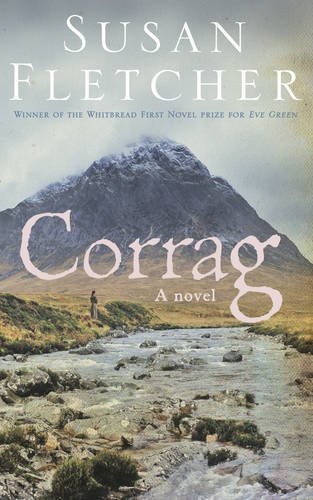
Corrag by Susan Fletcher

I first became aware of this book when Boof of The Book Whisperer said it was one of her favourites. I’ve been curious to see why she loved it so much and now that I’ve read it I agree that it’s a great book, although I didn’t think so at first.

In Corrag Susan Fletcher looks at one tragic moment in Scotland’s history – the Glencoe Massacre of 1692 in which thirty-eight members of the MacDonald clan were murdered by English soldiers and forty more died of exposure as they tried to escape. The story is narrated by Corrag, a young woman who has been branded a witch and sentenced to death for her involvement with the MacDonalds and the part she played in trying to prevent the massacre. As Corrag sits in her cell awaiting her death, she is visited by Charles Leslie, an Irish clergyman and Jacobite who is trying to find evidence to prove that the Protestant King William III was responsible for what happened at Glencoe.

Corrag tells Charles Leslie about her childhood in the north of England and the day her mother, who had also been accused of witchcraft, told her to ride into Scotland, where she believed she would be safe. With only her grey mare for company, Corrag rode “north and west” and made a new home for herself near the valley of Glencoe. Here she met the people of the MacDonald clan and experienced true friendship and love for the first time in her life. As Leslie listens to Corrag’s memories he begins to learn the truth about the Glencoe Massacre and at the same time is forced to change his own preconceived ideas about Corrag herself.

I wasn’t sure about this book when I first started reading. I actually put it down after the first chapter and decided it wasn’t for me. But then something made me pick it up a few days later and try again. Corrag’s narrative style is so unusual and original, it took me a few chapters to get used to it but after that I started to fall in love with the beautiful, lyrical writing. The writing style gives the book a very strong sense of time and place and I felt as if I was really listening to a voice from the past. Corrag is also very observant and appreciates the little details of life that most of us would never even notice. I loved seeing the beauty of the Highlands through her eyes as she rode through Scotland on her grey mare.

Each chapter of Corrag’s story is followed by a letter written by Charles Leslie to his wife at home in Ireland, telling her about his experiences in Scotland and how his opinions about Corrag are changing as he learns more about her life. Corrag of course has not done anything to deserve the accusations of witchcraft; she’s an innocent woman who loves the natural world and has a knowledge of herbalism and healing, like her mother before her and like many other innocent women who were burned at the stake. And yet no matter how hard things get for Corrag and how much cruelty she experiences at the hands of other people she remains a loving, kind-hearted person and never loses her faith in human nature.

Corrag is a beautiful, moving story and I’m so glad I didn’t give up on it.

Note: This book has also been published under the titles of Witch Light and The Highland Witch.

The Observations by Jane Harris

After I read (and loved) Gillespie and I, I knew I would have to find a copy of the first book by Jane Harris, The Observations, as soon as possible. Luckily my library had a copy so I didn’t have to wait too long to read it! I found this book just as entertaining and enjoyable as Gillespie and I, which puts Jane Harris firmly on my list of favourite authors.

The Observations is set in Scotland during the 19th century. Bessy Buckley, a young Irish girl, is on the run from her troubled past when she arrives at the estate of Castle Haivers near the village of Snatter. The lady of the house, Arabella Reid, offers her a job as maid and Bessy jumps at the chance. But Bessy is puzzled by the series of bizarre tasks which Arabella orders her to perform – and when she discovers that a previous maid, Nora, may have died under suspicious circumstances, it becomes obvious that things at Castle Haivers are not quite what they seem.

The Observations is a long book but was so gripping I read it in half the time it would normally take me to read a book of similar length. What makes this novel so different from all the others I’ve read set in the Victorian era is Bessy Buckley herself. Bessy is a fabulous character and narrator: funny and witty, poorly educated but bright and intelligent, tough and outspoken yet sensitive and warm hearted. When you first begin to read you might come across some unusual language and slang, not to mention some unconventional grammar and punctuation, but don’t worry about that – it’s all part of Bessy’s unique voice and her narration was a delight to read. The only thing that irritated me slightly was seeing numbers written as figures rather than words (1/2 instead of ‘half’, for example).

The relationship between Bessy and her mistress forms a big part of the story, but there are a few other interesting sub-plots, as well as the story of Bessy’s own childhood which emerges slowly throughout the book. There are shades of other Victorian novels, as well as some elements of the gothic novel and the ghost story, but the overall result is something completely original. The one criticism I have is that, after a very strong start, the story seems to lose momentum in the second half and the ending was slightly disappointing in comparison to the rest of the book.

Finally, I want to say how impressed I am that Jane Harris could take two such different narrators as Bessy Buckley and Harriet Baxter (from Gillespie and I), who are complete opposites in almost every way imaginable, and make them both so convincing! That’s a sign of a talented author in my opinion.

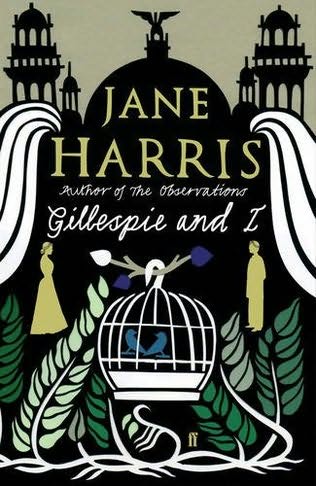
Gillespie and I by Jane Harris

I was lucky enough to win a copy of Gillespie and I through LibraryThing Early Reviewers but even if I had paid the full price for this book I would have considered it money well spent. I thought it was brilliant. It seems I’m one of the few people not to have read the first book by Jane Harris, The Observations, and I’m not sure how I managed to miss that one as it sounds like something I would love. I’ll certainly go back and read it now that Jane Harris has been brought to my attention.

But this post is about Gillespie and I. Or, I should say, Gillespie and Harriet Baxter. We first meet Harriet in 1933 as an elderly woman looking back on her life and promising to share with us her recollections of Ned Gillespie, a talented artist who was never able to fulfil his true potential. Harriet then proceeds to tell us the story of her acquaintance with the Gillespie family, whom she met in the 1880s during a trip to Scotland to visit the International Exhibition in Glasgow. She quickly becomes a friend of Ned, his wife Annie, and the other members of the family – but then disaster strikes and the lives of Harriet and the Gillespies are thrown into turmoil.

After a leisurely start, the story soon picked up pace and became very gripping. But as well as the compelling plot there were many other things that made this book such an enjoyable read. I connected immediately with Harriet’s sharp, witty and observant narrative voice. The other characters were vibrantly drawn, though the only one who never really came to life for me was Ned himself, which was the only disappointment in an otherwise excellent book. I also loved the setting. I’ve read many, many books set in Victorian London and it made a refreshing change to read one set in Victorian Glasgow instead.

Halfway through the story something happened that made me start to question everything I’d read up to that point – and even after I’d finished the book I still had questions. I was very impressed by how cleverly Jane Harris managed to control what I believed and didn’t believe at various points in the novel. I can’t really explain what I mean without spoiling the story but suffice to say there are some stunning plot twists that leave you wondering whether things are really as they seem – and this doesn’t happen just once, but several times throughout the second half of the book. At times it even felt like a Victorian sensation novel to me, which probably explains why I enjoyed it so much! Gillespie and I has been one of my favourite reads so far this year.

Naming the Bones by Louise Welsh

In Naming the Bones, the first book I’ve read by Louise Welsh, university lecturer Dr Murray Watson takes a sabbatical from work in order to research a new book on the life of Archie Lunan, a little-known Scottish poet. Lunan drowned in a sailing accident decades earlier and his death is still surrounded by mystery. Murray’s investigations take him from his home in Glasgow to the Isle of Lismore – where he learns more about Lunan’s life and death than he could ever have imagined and begins to ask himself the question: does knowing what an artist is like as a person really add to our appreciation and understanding of their work – or is the work best left to stand on its own?

Although I did end up enjoying this book, it wasn’t really what I was expecting at all – from the blurb and the quotes on the back of the book it sounded like it would be a fast-paced thriller. Unfortunately I really struggled to get through the first half of the book – it was very slow and there were too many sub-plots that didn’t seem to add much to the story – Murray’s affair with his head of department’s wife, for example, and his estrangement from his brother. But I did like Murray as a character – I found him a likeable and wryly funny narrator who seemed to stumble from one disaster to another – and I wanted to find out what had happened to Archie Lunan, so I was happy to keep reading.

In the second half of the book, when Murray arrived on the island of Lismore, the pace started to pick up and the story became very compelling. The island with its ruined castle, abandoned cottages and ancient broch provided an atmospheric setting for this part of the novel. Welsh increased the tension with every chapter, threw in some twists and surprises (though nothing too unbelievable) and left me feeling satisfied with the way the book had ended.

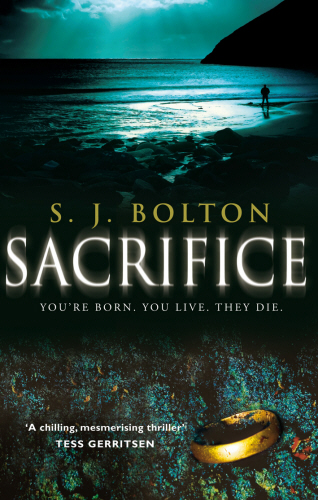
Sacrifice by S.J. Bolton

A few weeks ago I mentioned that I’d signed up for Transworld’s Great Crime Caper reading challenge. Sacrifice, the debut novel by S.J. Bolton, is the first book I received from Transworld for the challenge.

Our narrator is Tora Hamilton, an obstetric surgeon who has recently moved to the Shetland Islands with her husband, Duncan. Tora has been told that the Shetlands are ‘one of the safest places to live in the UK’, so the last thing she expects is to find a dead body in a peat bog in the field beside her new home. To make things even more shocking the body has had the heart removed and is carved with symbols which match the ancient runes on the wall in Tora’s cellar. As Tora becomes more and more determined to find out what’s going on she discovers that someone else is equally determined to put an end to her investigations.

If you’re going to read this book you should be aware that it’s very gory in places, particularly at the beginning of the novel, when Tora finds the mutilated corpse. If you can get through this part you’ll be all right because the story then becomes much less gruesome, though increasingly dark and eerie, and soon develops into a fascinating and well-structured murder mystery. Tora, with the help of police detectives Dana and Helen, uses a whole range of resources to investigate the mystery and piece information together, from medical records and birth registers to bank statements and books of folklore.

The most interesting aspect of this book for me was the Shetland setting and the exploration of Shetland myths and legends. I’ve never been to the Shetlands and have never read a book set there either, so this was something new for me, and I thought S.J. Bolton perfectly evoked the atmosphere of these remote and ruggedly beautiful islands with their jagged cliffs, flooded valleys and the Aurora Borealis illuminating the night sky.

Although the Shetlands are part of Scotland they are deeply rooted in Norse history and folklore and some of these myths and legends become integral to the story, giving it a slightly supernatural aura. There’s a scene where Tora is reading about a particular myth for the first time which really sent shivers down my spine. In fact, the whole book is genuinely quite scary. There are a few chapters that you really wouldn’t want to read if you were alone in the house at night!

On a more negative note, sometimes I felt I was being given too much information all at once when it could probably have been woven into the plot more gradually. A lot of it was also hard to believe. Tora seemed unrealistically brave, taking needless risks and sneaking around murder scenes in the middle of the night. Of course, fiction doesn’t always need to be realistic and it wouldn’t have been much of a story if Tora had reacted the way I would have done and run a mile at the first sign of danger! And none of this really mattered to me anyway because the plot was so exciting and gripping.

Sacrifice was just what I needed after reading a lot of slower paced books recently. Perfect if you’re looking for a fast-moving, atmospheric mystery with a unique setting.

Review: An Echo in the Bone by Diana Gabaldon

An Echo in the Bone is the 7th book in Diana Gabaldon’s Outlander series (or Cross Stitch as it’s known here in the UK) and takes place during the American Revolution. I’ve been following the adventures of Jamie Fraser and his time-travelling wife Claire for more than 10 years now and although this book won’t be published in the UK until 2010, I ordered it from the US Amazon site as I couldn’t wait to read it.

This review may contain spoilers if you haven’t read the previous 6 books in the series

If you haven’t read (or like me, have read but didn’t enjoy) the spin-off Lord John series, you might struggle with certain sections of this book. I would recommend reading Lord John and the Brotherhood of the Blade before beginning, as a number of characters from that book feature quite prominently in Echo. In fact, there are so many chapters (mainly in the first half of the book) devoted to Lord John, William Ransom, Percy Wainwright, Hal and Dottie, that at times this felt more like a Lord John book than an Outlander one. I do like both Lord John and William as characters though, and towards the end of the book their storylines begin to tie together with Jamie and Claire’s.

According to Diana Gabaldon, the image on the book cover is a caltrop – a weapon with four spikes each ending in a sharp point. The caltrop represents the four main storylines running simultaneously throughout the book: Jamie and Claire visiting Scotland to collect Jamie’s printing press, following the fire that destroyed their home at Fraser’s Ridge; the adventures of Jamie’s son, William, a Lieutenant in the British army; Young Ian trying to come to terms with the break-up of his marriage to Emily whilst being pursued by a vengeful old man, and Roger and Brianna following Claire and Jamie’s fate via a box of old letters.

Due to all the storylines which were taking place, the story was told from many different viewpoints – Claire, Jamie, Roger, Brianna, Young Ian, William, Lord John, Rachel Hunter (a Quaker girl who falls in love with Ian) and even one or two pages from Fergus and Jemmy’s points of view. This technique gave the book a slightly different feel to the rest of the series, though I personally preferred the style of the earlier books which were told mostly by Claire.

I know this review has so far sounded a bit negative, but there were plenty of things I loved about the book. The story was filled with bizarre coincidences and almost-forgotten characters from previous books reappearing when you least expected them, and although you had to suspend belief at times, I enjoyed this aspect of the book.

I also enjoyed the Roger and Brianna sections, as they began to read Jamie and Claire’s letters one by one in the relative safety of 20th century Lallybroch. Later in the book, though, Roger and Brianna’s story takes a more sinister turn, and they discover that they’re not quite as safe as they thought they were!

I had been looking forward to Jamie, Claire and Young Ian returning to Scotland again and being reunited with Jenny and Ian Murray – however, this didn’t happen until near the end of the book, and when they finally did get to Lallybroch, it certainly wasn’t the happy reunion I was expecting! From this point onwards, the plot suddenly started moving at a whirlwind pace. Apparently this was intentional (this section was even entitled “Reap the Whirlwind”). I think I’ll probably need to read the book again to be able to fully understand everything that was happening.

We were left with a lot of loose ends and cliffhangers, which wouldn’t be a problem if we weren’t going to have to wait another 3 or 4 years for the next book! Still, Diana Gabaldon has given us plenty to think about, as there are now an infinite number of ways in which the various storylines could progress. Although this was not my favourite in the Outlander series, I still enjoyed it and am already looking forward to Book 8!

Recommended

Genre: Historical Fiction/Pages: 820/Year: 2009/Publisher: Delacorte Press/Source: My own copy bought new