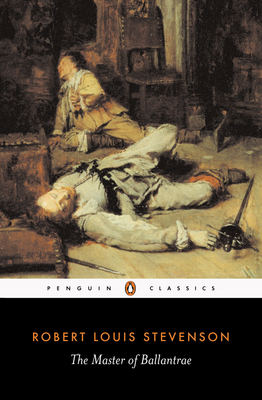
The Master of Ballantrae by Robert Louis Stevenson

The Master of Ballantrae My experiences with the work of Robert Louis Stevenson so far have been mixed. I liked Dr Jekyll and Mr Hyde, although knowing the basic plot beforehand spoiled it slightly; I gave up on Kidnapped halfway through (but would like to give it another chance); and while I did read Treasure Island as a child, it was an abridged version for children, and I have no idea what I would think of the book as an adult. I wasn’t sure what to expect from The Master of Ballantrae, then, but I’m pleased to say that I enjoyed it.

Published in 1889, The Master of Ballantrae: A Winter’s Tale is set much earlier, opening in Scotland in 1745, just before the Jacobite Rising. When news of Bonnie Prince Charlie’s arrival in Scotland reaches the Duries of Durrisdeer and Ballantrae, the family must decide what to do. There is no question of Lord Durrisdeer himself joining the rebellion, but his two sons – James Durie (the Master of Ballantrae), his eldest son and heir, and Henry, his younger brother – are both keen to go. A coin is tossed and it is decided, to Henry’s disappointment, that the Master will join the Jacobites while Henry stays at home and remains loyal to King George. This way, the family titles and estates will be safe no matter which side wins.

As history tells us, the rising will fail – and it is not long before the Duries receive reports that James has been killed. Henry becomes heir in his brother’s place and, at his father’s urging, marries the Master’s grieving fiancée, Alison. These are difficult times for Henry: his neighbours see him as a traitor for not taking part in the rising, and he knows that his father and wife will never stop mourning for James, always the favourite son. But things are about to get a lot worse for Henry – it seems that the Master of Ballantrae is not dead after all and is about to come home to Durrisdeer to take his revenge.

The Master of Ballantrae has all the elements of a typical adventure story – duels, pirates, sea voyages, buried treasure – but it is also a fascinating psychological novel about the relationship between two very different brothers. James, the Master, is the charming, charismatic brother whom everyone seems to love, yet he is also devious, scheming and manipulative. Henry is his opposite – quiet, responsible and dutiful, but less glamorous and less popular. At first it seems that this is another Jekyll and Hyde story, with one character representing good and the other evil, but it soon becomes obvious that it is not as simple as this and Henry’s personality begins to change as his obsession with his brother starts to rule his life.

We get to know these two men from the perspective of Ephraim Mackellar, a family servant at Durrisdeer, but I couldn’t help thinking that Mackellar is not a very reliable narrator. It is clear from the start that he is loyal to Henry and his narration is definitely biased towards the younger brother, but whenever he spends time alone with the Master his opinion seems to change slightly and he is able to acknowledge that the elder brother also has some good points as well as bad.

Not all aspects of The Master of Ballantrae worked as well for me as others: the purely ‘adventure’ scenes, such as the encounters with pirate ships at sea and the treasure hunts in the American wilderness, became a bit tedious, especially whenever the narration switched away from Mackellar while another narrator took his place. But I loved the central storyline and the rivalry between the two brothers; I particularly loved the Master, who may have been the devilish brother, but was so much more interesting to read about than poor Henry! I will read more by Robert Louis Stevenson, though I’m not sure whether to move straight on to one of his other books, maybe The Black Arrow, or to try re-reading Treasure Island and Kidnapped first.

Master of Shadows by Neil Oliver

Master of Shadows There were several things that drew me to Master of Shadows: the setting (the fall of Constantinople in 1453) was one, and the protagonist (the Scottish engineer, John Grant) was another. Most of all, I was curious to see what Neil Oliver’s fiction would be like. Oliver is best known as a television presenter and historian – he recently presented the BBC series Celts: Blood, Iron and Sacrifice – and although he has previously published some non-fiction, Master of Shadows is his first novel.

I have mentioned Constantinople, but much of the first half of the novel is actually set in Scotland, where the soldier Badr Khassan has come to fulfil a deathbed promise, having sworn to protect the wife and child of his friend, the late Patrick Grant. He finds Jessie Grant and young John just in time to interrupt an attempt on their lives by the men of Patrick’s enemy, Sir Robert Jardine of Hawkshaw. Pursued by the vengeful archer, Angus Armstrong, Badr and John leave Scotland and travel across Europe, making a living by fighting as mercenaries. Along the way they meet a mysterious female warrior called Lena who is also a target of the same group of Scots and who is hiding some important secrets regarding her own identity and John’s.

Eventually John arrives in Constantinople, one of the final strongholds of the Byzantine Empire, now under threat from the mighty Ottoman army. As the Emperor Constantine XI prepares to defend his city and Sultan Mehmet II gathers his forces outside the walls, two more characters come to the forefront of our story: Prince Constantine, the Emperor’s crippled son, and Yaminah, the girl he loves. The lives of John, Yaminah and the Prince come together during the dramatic Siege of Constantinople and the final days of the Byzantine Empire.

Master of Shadows is a combination of history, adventure and romance set against a backdrop of what is surely one of the most fascinating and significant periods in Europe’s history – the collapse of one empire and the expansion of another. I thought the book was generally well written and, knowing that the author is an archaeologist and historian, I also felt confident that it would have been well researched. However, he does take some liberties with certain historical characters; I really disliked Lena’s story, although I can’t explain why without telling you who she really is and that would be a spoiler! There’s also a supernatural aspect to the novel – John Grant is able to feel the Earth moving through space and can sense the people around him without using sight or touch – but this didn’t become such a big part of the story as I’d feared at first.

I had previously encountered John Grant as a character in Dorothy Dunnett’s House of Niccolò series (under the slightly different name of John le Grant) and was quite fond of him, so I was looking forward to seeing how he would be portrayed by another author. Very little is known about the real John Grant; records show that a Johannes Grant was employed as an engineer by the Byzantine Empire and his expertise in counter-tunnelling prevented the Turks from invading Constantinople from under the walls. He was originally thought to have been German but more recent research suggested that he was actually Scottish. This lack of historical information has allowed Neil Oliver to create a whole backstory for John to explain how he came to be in Constantinople. The character is quite different from the one in Dunnett’s novels, but I did still like him (although I found it irritating that he is always given his full name of John Grant, sometimes multiple times in the same paragraph, and is never just referred to as John).

Master of Shadows is an interesting first novel – I particularly liked the Scottish chapters near the beginning and the romance between Prince Constantine and Yaminah – but there were too many little things that didn’t work for me. As well as the Lena storyline and the supernatural element I’ve mentioned above, there’s a lot of jumping around in time which makes it slightly difficult to follow what is happening. I’m not sure whether I’ll read any more of Neil Oliver’s fiction, but I might try one of his non-fiction books instead.

Review copy provided by the publisher via NetGalley.

The Heart of Midlothian by Sir Walter Scott

The Heart of Midlothian In 2012 I read my first Walter Scott novel, Ivanhoe, and was surprised by how much I enjoyed it. Having found Scott less difficult to read than I’d expected, I decided to add another of his books to my Classics Club list and something drew me to this one – possibly memories of the Scottish football results being announced on the television on a Saturday afternoon (Heart of Midlothian is the name of an Edinburgh team).

The novel – which predates the football team, being published in 1818 – takes its title from the Old Tolbooth Prison in Edinburgh, which was in the heart of the county of Midlothian. Scott based his plot on two real historical events: the Porteous Riots of 1736 and the story of a young woman who walked all the way to London to obtain a royal pardon for her sister who had been wrongly charged with infanticide. In Scott’s version, the young woman’s name is Jeanie Deans and she lives on a dairy farm at St Leonard’s Crags with her father, Davie, a strict Cameronian (a Presbyterian faction).

Jeanie’s younger sister, Euphemia – known as Effie – is in the Tolbooth facing the death penalty, having been accused of giving birth in secret and murdering her newborn child. Jeanie is sure Effie is innocent, but with no witnesses to the pregnancy or the birth and no way to prove what happened to the baby, she is guilty in the eyes of the law. If Jeanie would only tell the court that she had known her sister was pregnant, Effie could be freed, but she is unwilling to tell a lie and instead she decides to go to London to ask Queen Caroline for a pardon. Armed with a letter of introduction to the Duke of Argyll and some money borrowed from an admirer, the Laird of Dumbiedikes, Jeanie sets off on foot to save her sister’s life.

The first half of the novel sets the scene, describing a riot that breaks out in Edinburgh during a protest over the hanging of two smugglers. When Captain John Porteous orders the city guard to fire into the crowd, causing the deaths of several people, he himself is imprisoned in the Tolbooth. The prison is then stormed by a mob and Porteous is lynched and killed. These events become entwined with Effie’s story and provide the historical backdrop for the novel. The second half of the book concentrates on Jeanie’s journey to London, which includes encounters with some characters we previously met in Scotland: George Robertson, the father of Effie’s child; and Meg Murdockson and her mentally ill daughter, Madge Wildfire, two women who could hold the key to the mystery of the missing baby.

Well, The Heart of Midlothian was not the relatively easy read that Ivanhoe was! I found it much more challenging, for several reasons. First, as the novel is set mainly in Scotland, the dialogue is written almost entirely in Scots. I wouldn’t normally have a problem with this, but added to the fact that the book was written in the early 1800s, it did slow down the pace of my reading quite a lot. I find that whenever a book uses a large amount of dialect – even one you’re familiar with – a little more effort is required to read it and that was definitely the case here. If you think you might struggle with the dialect, I would recommend choosing an edition of the book with a good glossary!

Also, unlike Ivanhoe, which is a medieval adventure story packed with sword fights, sieges, villainous knights and feuding noblemen, this is a very different type of novel. While Jeanie’s personal story was gripping, I have to admit I had very little interest in the long passages describing the religious situation in eighteenth century Scotland and the discussions between Jeanie’s father, Davie Deans, and his neighbours on their different moral beliefs. I also thought the plot relied too heavily on coincidence, with Jeanie meeting people from her own small community in Scotland hundreds of miles away in England – and I felt that the final few chapters of the book were unnecessary as the story had already reached a more natural ending point.

I did enjoy parts of The Heart of Midlothian, though. Jeanie is a strong heroine who behaves with honesty and integrity throughout the novel, and although some of her choices were frustrating, I did like her. There is a romantic interest for Jeanie too – the schoolmaster, Reuben Butler – but this only forms a small part of the story. I was also interested in the descriptions of eighteenth century life and the relationship between Scotland and England in the years following the union of 1707. And there are plenty of memorable scenes, from the storming of the Tolbooth near the beginning to Jeanie’s meeting with Queen Caroline, wife of George II, towards the end.

I certainly didn’t love this book the way I loved Ivanhoe, but I’ll still read more of Scott’s novels and will hope that the next one I pick up is more to my taste than this one was!

Dacre’s War by Rosemary Goring

Dacres War It’s 1523 and ten years have passed since the armies of Scotland and England met at the Battle of Flodden, resulting in victory for the English and the death of King James IV of Scotland. With a child king (the young James V) and a regent who spends much of his time in France, Scotland lacks strong leadership and Henry VIII of England is taking advantage by ordering the destruction of Scottish border towns. The man responsible for doing this, as well as for keeping some sort of order in the lawless English and Scottish border lands is Thomas Dacre, Warden General of the English Marches.

Dacre is the most powerful man in the north, but he is also making a lot of enemies…including Adam Crozier, head of one of the leading families on the Scottish side of the border, who discovers that Dacre is to blame for the murder of his father. Crozier vows to take revenge and begins the process of forming alliances with other borderers and collecting evidence that will help to bring about the Warden’s downfall.

Dacre’s War is the sequel to After Flodden, Rosemary Goring’s first novel which describes the 1513 battle and its aftermath. I read After Flodden last year and thought it was a good book but nothing special, so I wasn’t sure whether or not to read this one. I am so glad I did decide to read it, because I loved it! The few criticisms I had of the first book (the confusing timeline and the predictability of the plot) were not problems for me this time; I thought this second book was more exciting, faster paced and just a stronger novel in general. If you have not read After Flodden yet, picking this one up first shouldn’t affect your enjoyment or understanding too much – while some of the characters are the same, it’s set ten years later and is a complete story with a beginning and an end.

About half of the story is told from the perspective of the Croziers and half from the Dacres’, although there are also a few chapters set within the Scottish and English courts. It would be easy just to accept Crozier as our hero and Dacre as our villain, but both characters are more complex than that. By allowing us to get inside Dacre’s head and see his point of view, he becomes a more fully developed character and we come to understand that, like most human beings, he is a mixture of good and bad. As well as Crozier and Dacre, there’s also an interesting cast of supporting characters, some new and some old – it was nice to see Louise and Hob again and I enjoyed watching Benoit Brenier going off and having adventures of his own.

My favourite thing about both Dacre’s War and After Flodden, though, is the setting. I love the way Rosemary Goring portrays life in the borders in the 16th century – the raids and feuds that made it such a dangerous place to live, as well as the natural beauty of the countryside. I will be happy if she revisits the world of the Croziers in a third novel, but if not then I’ll be interested to see what she chooses to write about next.

An Accidental Tragedy: The Life Of Mary, Queen Of Scots by Roderick Graham

An Accidental Tragedy The death of Mary, Queen of Scots, executed in 1587, could certainly be considered a tragedy. Was it also an accidental one? Could Mary’s fate have been avoided if she had only been a different type of person and if she had made different choices in life? This is the starting point for Roderick Graham’s 2009 biography of one of Scotland’s most fascinating monarchs, which claims ‘neither to blacken her character by portraying her as a murderess of husbands, nor to sanctify her as the lonely champion of her faith, but to recount the circumstances which formed her character and to explain the events which determined her fate’.

The book begins with Mary’s birth at Linlithgow Palace in 1542 and her rapid accession to the throne when her father, James V of Scotland, died just six days later. Mary was not Scotland’s first child monarch – James V himself and all of the four kings before him also came to the throne at an early age – and the Scottish people had become used to long periods of regency. As Graham explains, this led to an increase in the power and independence of the nobility and caused division and a lack of unity.

After a marriage treaty between Mary and Henry VIII’s son, Prince Edward, was rejected by the Scots, the five-year-old queen was sent to France where she would eventually marry the French king’s heir, the Dauphin Francis. Mary grew up in France rather than Scotland and she and Francis were strongly influenced by her mother’s relatives, the Guises. This meant that when Mary returned to Scotland to rule in 1561 following her husband’s death, she had very little knowledge of the country of her birth. At a time of increasing religious and political conflict among the Scottish noblemen a strong leader was needed.

Roderick Graham does a good job of showing how poorly equipped Mary was for her role as Queen of Scots and how she was unable to provide the sort of leadership the country required. Despite the presence of three influential women in her life – her mother, Mary of Guise; the Queen of France, Catherine de’ Medici; and the King of France’s mistress, Diane de Poitiers – Mary appeared to learn very little from any of them regarding the management of court intrigue and politics. The years that followed her return to Scotland were dominated by murders, plots, rebellions and two disastrous marriages, the first to Lord Darnley and the second to the Earl of Bothwell, finally ending in her abdication and imprisonment in England.

I found it interesting that Graham had chosen to write a book about someone for whom he seemed to have so little admiration, sympathy or liking. He never misses an opportunity to compare Mary with that other queen south of the border – Elizabeth I – and to point out how much stronger, cleverer and wittier the Queen of England was. In contrast, he paints a picture of Mary as immature, incapable of making good decisions and driven by passion and emotion. I’m not sure how fair or unfair his treatment of Mary is, but despite his preference for Elizabeth, he still made me feel sad for Mary as her life drew closer to its tragic end.

An Accidental Tragedy is the first book I’ve read that is specifically about Mary, Queen of Scots. Of course, I’ve come across her in other non-fiction books about the Tudor/Elizabethan period and she has been a secondary character in some of the historical fiction novels I’ve read, but this is the first time I’ve read a comprehensive biography of her entire life. I was particularly interested in reading about this period in Scotland’s history because my favourite historical fiction series, the Lymond Chronicles by Dorothy Dunnett, is set during the first part of Mary’s reign, but this just added another layer of interest to what was already a fascinating and very readable biography.

If anyone has any other biographies of Mary to recommend, please let me know. I would love to read another one.

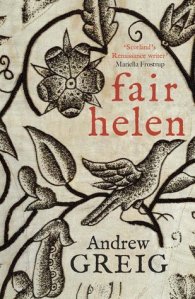
Fair Helen by Andrew Greig

Fair Helen Last year I started a little project of my own – which I don’t think I ever actually blogged about – to work through the titles shortlisted for the Walter Scott Prize for Historical Fiction since it began in 2010. So far I’ve discovered some great books including An Officer and a Spy, Harvest and The Garden of Evening Mists. This book, Fair Helen, is another one that I’ve enjoyed and might never have thought about reading otherwise.

Fair Helen, by Scottish author Andrew Greig, is a beautifully written novel based on the Border ballad, Fair Helen of Kirkconnel Lea which begins:

“O that I were where Helen lies!
Night and day on me she cries;
O that I were where Helen lies,
On fair Kirkconnel Lea.”

The ballad goes on to tell of two rivals for Helen’s love, a shot being fired and Helen falling dead into her lover’s arms. In Fair Helen, Andrew Greig offers one possible interpretation of this ballad, retelling some of its events and expanding on it to include other aspects of Scottish history and Border folklore.

In the late 16th century, when the novel is set, ‘Jamie Saxt’ (King James VI) is on the throne of Scotland, while England’s Queen Elizabeth is approaching old age with no heir of her own. Soon the two thrones will be united under James, bringing some sort of peace and order to the Border region. In the meantime, though, the Borders remain a wild and dangerous place where clans of reivers on both sides of the English-Scottish border fight and feud, steal cattle and conduct raids.

Adam Fleming, whose stepfather is ‘heidsman’ (leader) of the Flemings, has fallen in love with the beautiful Helen Irvine of Annandale. Unfortunately, Helen has already been betrothed to another man, Robert Bell, because the Irvines are keen to form an alliance with the Bell family. Adam has no intention of ending his romance with Helen and summons an old friend from his student days, Harry Langton, to help arrange their secret trysts.

Harry is the narrator of Fair Helen, looking back on the events of the past from several decades into the future, and he is the ideal person to tell the story, being Adam’s best friend and Helen’s cousin. But Harry is also working for another, more powerful patron – someone who has plans of his own for the Borders and will have no sympathy for two young lovers who get in the way of his plans.

I was surprised by how much Andrew Greig managed to pack into the story. I was expecting a tragic romance (according to the cover, the ballad is sometimes described as the Scottish Romeo and Juliet) but it was so much more than that. In fact, the story of Adam and Helen is only one part of the story, no more or less important than the Border politics, the complex feuds and alliances between the clans, and the plotting and scheming going on behind the scenes. There’s a lot happening in this book, yet the pace never feels too rushed.

I always enjoy reading about the Border Reivers, as I live quite close to the Borders (on the English side), but so far I’ve found very few novels that deal with the subject. As I read Fair Helen I kept thinking of Dorothy Dunnett’s The Disorderly Knights – some of the same Borders families appear in both books, such as the Scotts of Buccleuch, and in both there is a dramatic Hot Trod (a lawful pursuit of a raiding party). I wish more authors would choose to write historical fiction based on this fascinating time and place in history – or maybe there are lots of books already and I just haven’t discovered them yet. I do have some non-fiction books on my list for future reading!

I’ve already mentioned how beautiful Andrew Greig’s writing is but I think it deserves to be mentioned again as it really is lovely and poetic, filled with feeling and emotion. The language used is suitable for the 16th century, with no inappropriately modern phrases finding their way into the dialogue to spoil things (one of my pet hates with historical fiction). Harry’s narration is written in the Scots dialect, which also adds to the authenticity. Definitions of unfamiliar words are not given directly in the text – you can usually work them out from the context of the sentence or if not, you can look them up in the glossary at the end of the book. Unless, of course, you’re Scottish in which case it shouldn’t be a problem at all!

Andrew Greig has written six other novels as well as some non-fiction and poetry. If you’ve read any of his other books, please let me know which you would recommend.

The Testament of Gideon Mack by James Robertson

The Testament of Gideon Mack One of my favourite books of last year was James Hogg’s weird and wonderful 1824 classic The Private Memoirs and Confessions of a Justified Sinner. The Testament of Gideon Mack is a contemporary novel but when I discovered that it was inspired by The Private Memoirs and Confessions I knew I would have to read it.

Gideon Mack is the name of a Church of Scotland minister who disappears from his home in the small Scottish town of Monimaskit never to be seen again. Following his disappearance, a manuscript is found and given to a publisher; this document, which was apparently written by Gideon Mack himself, is an account of his entire life, from his childhood to the moment he sets off to climb the mountain Ben Alder – a journey from which he never returns.

As Gideon’s last testament unfolds, we are given a detailed portrait of a flawed, complex but very human character – a man who, despite not believing in God, becomes a minister like his father; a married man who would rather be married to his best friend’s wife; a man who is never happier than when he is out running alone in the woods. But when he falls into a ravine called the Black Jaws, is swept away by the river and emerges several days later claiming to have met the Devil, it seems that Gideon has lost his mind. Or has he?

Books that are a little bit unusual and quirky always appeal to me and The Testament of Gideon Mack was certainly both of those things! I found it a fascinating and imaginative story, but in the end I was slightly disappointed as it was not quite what I’d hoped it would be. Apart from a storyline involving a standing stone that mysteriously appears in the woods, and the inclusion of an eerie Scottish folktale, there was little of the gothic atmosphere the blurb and quotes on the book cover had hinted at. Gideon’s encounter with the Devil, which I’d thought would form a significant part of the plot, doesn’t take place until near the end of the book (over 250 pages in) and when it finally happened it felt like an anticlimax.

This wasn’t the dark, supernatural story I was expecting, then – and definitely not as good as Hogg’s fantastic novel, despite sharing a few plot elements – but once I’d realised that, I was able to accept it for what it was. Gideon, as I’ve already mentioned, is an intriguing character and I enjoyed watching his story unfold. The chapters in which he describes his early life, growing up as the son of a strict church minister, were my favourites. I particularly loved his account of how a television first arrived in the manse and how he would always watch the first part of Batman on a Saturday but never knew how the story ended because his father had banned television on Sundays. And as a book lover myself, it was good to see the young Gideon discover the joys of reading as he worked through the novels of Robert Louis Stevenson and Sir Walter Scott.

Although The Testament of Gideon Mack is a modern novel, published in 2006 and set in the very recent past (with contemporary references to things like the Gulf War and Scottish devolution) the writing style and the way it is structured make it feel more like a 19th century one. It’s a very similar structure to The Private Memoirs and Confessions: Gideon’s testament is presented as a long manuscript with editor’s footnotes, a publisher’s prologue describing how the document came into his possession, and an epilogue written by an investigative journalist. I couldn’t help thinking a more historical setting would have been better suited to the style of the novel – although I tend to think all novels would be better with historical settings, so other readers will probably disagree with me on that point!

So, did Gideon Mack really meet the Devil? Was he telling lies? Did he just imagine it all? And what happened when he arrived at Ben Alder? Those questions are never really answered but using the information given in Gideon’s own testament together with the statements of witnesses and people who knew him well, we are left to decide for ourselves.