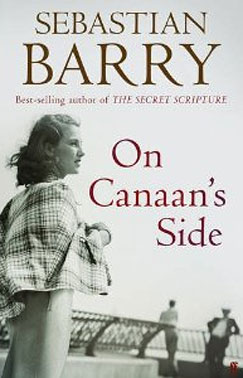
On Canaan’s Side by Sebastian Barry

“Bill is gone. What is the sound of an eighty-nine-year-old heart breaking? It might not be much more than silence, and certainly a small slight sound.”

When this year’s Man Booker Prize longlist was announced at the end of July, one of the titles that I was most looking forward to reading was this one, On Canaan’s Side. I read The Secret Scripture last year and fell in love with Sebastian Barry’s beautiful, poetic writing style. There are some similarities between The Secret Scripture and On Canaan’s Side, the most obvious one being the idea of an old woman looking back on her life, but the stories are different enough to make this book a good read too.

On Canaan’s Side is narrated by Lilly, a retired cook. At the beginning of the book she is eighty-nine years old and has just lost her beloved grandson, Bill, who has committed suicide after returning from fighting in the Gulf War. As Lilly mourns for her grandson, she begins to remember all the things that have happened in her life and over the next seventeen days she shares her memories with us.

Canaan, in the Bible, is the ‘promised land’ and the title On Canaan’s Side represents the idea that many Irish people had that America was a place where they would be safe and happy. Lilly’s story begins during her childhood in Ireland as the daughter of the superintendent of the Dublin police. She is forced to run away to America when both she and her boyfriend, Tadg Bere, find themselves the target of an IRA death sentence. However, Lilly soon discovers that even there, on ‘Canaan’s Side’, she and Tadg are still in danger. The following decades are filled with tragedy and sorrow. Lilly’s story is unbearably sad and yet her voice never becomes self-pitying; she stays a strong and resilient character until the day when her ‘eighty-nine year-old heart’ finally breaks.

At first I thought I wasn’t going to enjoy this book because the first chapter was very ‘stream-of-consciousness’ and it seemed as if it was going to be one of those novels where nothing really happens. But when I got further into the book and the story began to take shape I didn’t want to stop reading. I mentioned at the start of this post how beautifully written The Secret Scripture was and I thought Sebastian Barry’s writing was possibly even more beautiful in this book. I usually prefer books with more plot but the way Barry uses language and imagery is so stunning and mesmerising, the slow pace of the story didn’t bother me.

And it’s really not true that nothing happens: there’s murder, rape and suicide, for a start. Other themes include war (both World Wars, Vietnam and the Gulf War) and how it’s possible to survive a war physically but not mentally; identity and how sometimes we can live with people for years without really knowing who they are; important events in Irish and American history; racial tensions; love and loss.

I loved this book and although it was slow to begin with, I was soon swept away by the quality of Barry’s writing and the atmosphere his words convey. I haven’t read his previous books Annie Dunne and A Long, Long Way but as they are about Lilly’s sister and brother I really should read them soon.

The Secret Scripture by Sebastian Barry

It’s 2011, the start of a new reading year, but I still have a few reviews to post of books that I read in December 2010.  This is the first, and I’ll be posting another two later in the week before I start to discuss my 2011 reading.

The Secret Scripture tells the story of Roseanne McNulty, who has spent most of her adult life in Roscommon Regional Mental Hospital. She’s now almost one hundred years old and has decided to devote her final days to recording her life story in a secret journal. Meanwhile, the hospital is about to be closed down and Dr Grene has begun the slow process of reassessing his patients to see if they can return to the community. There’s something about Roseanne that intrigues him and he becomes determined to find out why she is there and how she came to be admitted to a mental institution.

The story is told in the form of two alternating narratives: the first is Roseanne’s Testimony of Herself in which she relates anecdotes and memories from her childhood in Sligo, Ireland, building up a picture of the events that led to her admission to the mental hospital. Roseanne is a captivating narrator with a strong, memorable voice and her story is absolutely heartbreaking; it seemed her whole life was just one tragedy after another. The second narrative is from Dr Grene’s Commonplace Book, the doctor’s account of his investigations into Roseanne’s past, as well as the details of his own troubled marriage and strained relationships. Although Dr Grene’s voice was not as strong as Roseanne’s, I still found his sections of the story interesting.

I don’t want to say too much about the plot because I think this is one of those books that will have more impact if you go into it knowing as little as possible. What I do want to tell you about is Sebastian Barry’s writing style. His style is quite unusual, very poetic in places, and it took me a few chapters to get used to it. But as the book went on, I became more and more impressed by the quality of the writing. There are so many great lines, such as when Dr Grene describes his relationship with his wife:

Now we are two foreign countries and we simply have our embassies in the same house. Relations are friendly but strictly diplomatic.

Or when Roseanne describes how her mother’s beauty has faded:

She was like a painting with its varnish darkening, obscuring the beauty of the work.

It really was beautifully written and the plot started to take second place to the gorgeous prose.

The author assumes you have some previous knowledge of 20th century Irish history. There are a lot of references to the Free State, the Irregulars, the IRA, Eamonn de Valera, the Royal Irish Constabulary and the Irish civil war, for example. I only have a basic knowledge of Irish history and although I could still follow what was happening, I think I might have got more out of the novel if I’d had a deeper understanding of the historical and political context. I also knew nothing at all about the bombing of Belfast during World War II, described here by one of the characters:

I ran like a demon along the ways, screaming I do not doubt, and saying wild prayers for the people of Belfast, and soon there were hundreds in the streets, all doing the same as me, people in their nightdresses and people naked as babes, running and screaming, and at the edge of the city we just kept going, and the waves of planes had come in behind us, all the while without mercy letting go the bombs, and an hour later or maybe more, I cannot say, I was perched on the edge of a huge dark mountain, and looked back, and Belfast was a huge lake of fire, burning, burning, the flames leaping like red creatures, tigers and such, high high into the sky…

This is just one example of Barry’s vivid imagery; I could have included a lot more.

The only thing that disappointed me about this book was a plot development towards the end that just felt too contrived and unrealistic. If it wasn’t for that one negative point, The Secret Scripture would definitely have been one of my favourite books of 2010.

Highly recommended