The Hunchback of Notre-Dame by Victor Hugo

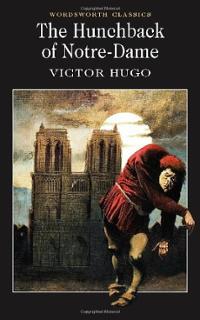
The Hunchback of Notre-Dame Or Notre-Dame de Paris, to give it its original French title and one which is much more appropriate. Quasimodo, the hunchback, has a surprisingly small role in the book while the cathedral of Notre-Dame itself is at the heart of the story, with most of the action taking place within its walls, on top of its towers or in the streets and squares below.

Set in 15th century Paris, the novel follows the stories of three tragic and lonely people. First there’s the beautiful gypsy dancer, La Esmeralda, who captivates everyone she meets with her looks, her dancing and her magic tricks. Alone in the world with only her goat, Djali, for company, she dreams of one day being reunited with her parents. Then there’s Claude Frollo, the Archdeacon, once a good and compassionate man who rescued Quasimodo as a child and raised him as his son. He becomes obsessed with Esmeralda after seeing her dancing in the Place de Grève and descends into a life dominated by lust and envy, turning away from the church and towards black magic. Finally, of course, there’s Quasimodo himself, the bell-ringer of Notre-Dame. Outwardly deformed and ugly, his kind heart and his love for Esmeralda lead him into conflict with his adoptive father, Frollo.

I read Hugo’s Les Miserables almost exactly five years ago and I really don’t know why it has taken me so long to read another of his books. I loved Les Miserables and I loved this one too, though not quite as much; this is a shorter and slightly easier read, but I didn’t find the story as powerful or emotional. It was a good choice for the R.I.P. challenge, though – the atmosphere is very dark and there are plenty of Gothic elements.

At least having had some previous experience of Hugo meant that I knew what to expect from his writing! You need to be prepared for some long diversions and chapter after chapter that has almost nothing to do with the plot or the main characters. Hugo devotes a lot of this novel to discussing Gothic architecture, the structure of the cathedral, the geographical layout of Paris and other topics which may or may not be of interest to the reader. I’m happy to admit that I didn’t read every single word of these sections (in fact, I skipped most of the chapter entitled A Bird’s-Eye View of Paris) and I don’t feel that I missed anything as a result.

The version of the book that I read is not actually the one pictured above (I just wanted a book cover to illustrate my post). I downloaded the free version from Project Gutenberg for my Kindle, which is Isabel F. Hapgood’s 1888 translation. I was very happy with it, but I’m used to reading older books and older translations; depending on your taste you might prefer a more modern translation. And just as a side note, does anyone else love books with imaginative chapter titles? There are some great ones here, including The Inconveniences of Following a Pretty Woman through the Streets in an Evening, The Effect which Seven Oaths in the Open Air Can Produce and The Danger of Confiding One’s Secret to a Goat. Much more intriguing than just numbering them 1, 2, 3!

As I’ve now read Hugo’s two most popular books, can anyone tell me if there are any others that I should read? I like the sound of Ninety-Three and The Man Who Laughs, but are they worth reading?

The Idiot by Fyodor Dostoevsky

The Idiot The Idiot was the book chosen for me by the Classics Club Spin earlier this month. I have to confess I wasn’t thrilled when I saw that this was the book I’d have to read but, as so often seems to happen with my spin books, I ended up enjoying it much more than I’d expected to. This wasn’t my first experience of Dostoevsky’s work; I’ve tried twice to read Crime and Punishment and both times gave up after a few chapters. Luckily, I’ve had more success with The Idiot!

The ‘idiot’ of the title is Prince Lev Nikolaevich Myshkin, a young man who, as the novel opens, is returning home to Russia after spending several years at a Swiss clinic receiving treatment for his epilepsy. On the train to St Petersburg he meets for the first time the man whose fate will become entwined with his own: Parfyon Semyonovich Rogozhin. Rogozhin is passionately in love with the beautiful but self-destructive Nastasya Filipovna, who has suffered a series of misfortunes that have led to her being labelled a ‘fallen woman’.

With no family of his own in the city, the prince introduces himself to the Epanchins, to whom he is distantly related. This family consists of General Epanchin, his wife Elizaveta, and their three daughters, Alexandra, Adelaida and Aglaya. As the story progresses, Myshkin becomes romantically involved with both Nastasya Filipovna and Aglaya Epanchin, but his inability to read between the lines and understand that people don’t always say what they really mean leads to trouble in his relationships with both women. His path will also cross again and again with Rogozhin’s, but while the prince pities Nastasya and hopes to save her from herself, Rogozhin’s love is of the violent and obsessive kind.

The intensity of Rogozhin’s personality is very different from the prince’s own gentle, peaceful nature. In fact, Myshkin seems to possess such simplicity of character, to be so trusting and gullible, so incapable of dealing with the subtleties of St Petersburg society that people think he must be an idiot. Of course, Myshkin is not really an idiot – that is, he doesn’t lack intelligence – but he is what Dostoevsky himself described as a portrayal of a ‘completely beautiful human being’. He is a genuinely good, kind-hearted person, but ironically it’s his goodness and his willingness to always see the best in people that are his weaknesses when it comes to negotiating complex social situations and dealing with people who are less honest than himself.

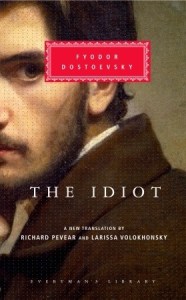
The edition of The Idiot that I read was the one pictured above, published by Everyman’s Library and translated by Pevear and Volokhonsky. This would maybe not have been my first choice of translation (this is the third of P&V’s Russian translations I’ve read and I’ve decided I’m not really a fan) but this is the book I already had on my shelf so it made sense to at least try it. Having said that, I found their translation of this particular book perfectly readable – though with a few strange word choices – and I’m sure I would still have found The Idiot a challenging read regardless of who it was translated by!

To clarify what I mean by ‘challenging’, I didn’t have any problem actually following the plot and understanding what was going on. This is really more of a character-driven novel than a plot-driven one anyway. Although I found it quite absorbing and was never bored, the pace is uneven and there are some long diversions in which various characters discuss religion or politics or philosophical ideas. Three chapters, for example, are devoted to a long confessional letter written by Ippolit, a young man who is dying from consumption – however, I thought this was one of the most powerful and moving sections of the book.

What I did struggle with at times was trying to interpret the actions and motivations of the characters, particularly the two main female characters, Nastasya and Aglaya. I won’t attempt an analysis of those two characters here, except to say that they are both so complex I’m not surprised the unsophisticated, unworldly Myshkin found it difficult to understand what they were really saying to him!

I enjoyed The Idiot a lot more than I thought I would, but I know I would have to read it again to be able to fully appreciate it. I don’t think I would want to do that in the near future but I will certainly try Crime and Punishment again and maybe The Brothers Karamazov as well.

Madame Bovary by Gustave Flaubert

Madame Bovary I read Madame Bovary during April as part of a readalong hosted by Juliana of Cedar Station and CJ of ebookclassics. It was a book I’d been thinking about reading for a while anyway so the announcement of the readalong couldn’t have come at a better time for me.

Madame Bovary is a French realist novel published in 1856. The title character, Emma Bovary, longs to experience the drama and excitement she has read about in romantic novels but she is unlikely to find it in her marriage to Charles Bovary, an unambitious country doctor. Charles loves his wife and is not unkind to her, but Emma finds him boring and her life dull and meaningless. After she and Charles attend a ball hosted by the Marquis d’Andervilliers, Emma becomes depressed and miserable; she has had a glimpse of a more glamorous world and it has left her even more disillusioned and dissatisfied with her own situation.

Charles wonders whether a move to a larger town will make her happy but Emma is no more content in their new home in Yonville-l’Abbaye than she was in the small village they’ve left behind. Seeking an escape from her unhappy existence, Emma has affairs and spends money she can’t afford, but as she becomes more reckless in both her romantic and financial entanglements, her life begins to spiral out of control.

It has been interesting to read the opinions of other readalong participants, because while I think we all agree that Emma’s behaviour is silly and self-destructive, the amount of sympathy we have for her seems to vary widely. Some readers can relate to Emma and admire her for doing something to try to change her life and find some happiness; other readers find her very selfish and annoying.

I’m one of those readers who didn’t like Emma at all, though I did have some pity for her, because I know there weren’t many options open to women in the 19th century, particularly those living in provincial areas, who wanted more from life than just to be a wife and mother. I can see why she may have felt that adultery was a way of escape and a way to find the passion she’d read about in books. I thought it was sad that Emma couldn’t even take any pleasure in her daughter (when Berthe is born, her first emotion is disappointment that the baby isn’t a boy). Later, when Berthe comes up to her hoping for affection Emma pushes the little girl away so that she falls and hurts herself. Poor Berthe – and life doesn’t get any better for her later in the book either.

I don’t think Charles was entirely blameless as he could have made more effort to understand his wife’s feelings and he was so naïve that he seemed completely oblivious to what was going on, but my sympathy was definitely with him and with Berthe more than with Emma. I noticed, though, that Flaubert himself seems to stay neutral throughout the novel, reporting on his characters’ thoughts and actions without actually passing judgment on them and telling us what we should think.

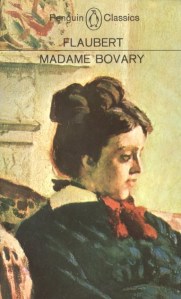
There were parts of this book that I really enjoyed, but I’ll have to be honest and say that much as I wanted to love this book I just didn’t. I think my dislike of Emma was part of the problem, but not the whole problem, as I didn’t find the writing style very engaging either. The version of Madame Bovary that I read was an older Penguin edition (pictured above) translated by Alan Russell – I had no reason for choosing this translation other than that it happened to be the one I already had on my shelf, which seemed as good a reason as any. I didn’t really have any problems with it and found it easy enough to read, but having since read that Flaubert prided himself on always searching for the perfect word, in this case it’s possible that the translation did affect my enjoyment. I didn’t like the book enough to want to read it again in a different translation to find out, though!

While this has not become a favourite classic, I’m still glad I’ve read it. If nothing else, I can now see where Mary Elizabeth Braddon’s inspiration for her novel The Doctor’s Wife came from!

Little Man, What Now? by Hans Fallada

Little Man What Now I know it’s only the middle of January and it’s ridiculously early to start talking about books of the year but I’ll be very surprised if this one is not on my list in December! I loved every minute of this funny and charming yet dark and poignant German novel from 1932.

Johannes Pinneberg (Sonny) and Emma Morschel (Lammchen) are a young German couple in their early twenties. After discovering that Lammchen is pregnant they get married and move into their first rented home together in the town of Ducherow. As they await the birth of their child (who they think of as The Shrimp), Sonny and Lammchen struggle to get by in the harsh economic conditions of 1930s Germany.

When Sonny loses his job (because his employer has discovered that he is married and no longer free to marry his daughter), he and Lammchen are forced to move to Berlin in search of work and cheaper accommodation. The trouble is, in times of high unemployment and widespread poverty, jobs are not easy to find and rents are high (and the situation isn’t helped by Sonny’s impulsive decision to surprise Lammchen with the expensive dressing-table she’d set her heart on, or Lammchen, suffering from cravings, eating all the salmon on her way home with the shopping). But while others around them lie, cheat and think only of themselves, the honest, hard-working Pinnebergs are determined to survive and to create a happy, safe environment for their new baby.

It was such a relief to find that I loved this book, as I’ve had mixed experiences with Hans Fallada’s novels in the past. Alone in Berlin, which I read in 2011, remains one of my favourite books that I’ve read since I started blogging, but the next one I picked up, A Small Circus, was a huge disappointment and put me off wanting to try any more of his books. I was hesitant to start reading Little Man, What Now? but I’m so glad I did because the problems I had with A Small Circus – the translation, the unlikeable characters, the unfamiliar politics and the fact that most of the novel was written in the form of dialogue – were not problems at all with this book. I was happy with the translation (though I wish I was able to read it in its original German), the Pinnebergs were both lovely, the politics stayed in the background and there was a good mixture of dialogue, action and description.

The book was originally published in 1932 in German as Kleiner Mann, was nun? and a successful film version followed. It’s easy to see why it was so popular, as according to the Afterword, 42% of German workers were unemployed in 1932 (compared with 22% in Britain) and many people would have been able to identify with Lammchen and Sonny. The book still feels relevant today, with many countries around the world suffering high unemployment in recent years. In 1930s Germany, the resulting poverty opened the way for the National Socialist and Communist parties. Yet the novel is far less political and far more domestic than I thought it would be at first.

As Sonny moves from job to job he meets people from a range of different backgrounds and religious or political beliefs, but he doesn’t side with or against any of them; his biggest concerns are for his wife and unborn child. This is not a story that deals with the bigger issues of the time, but about the immediate day to day struggles that ordinary people faced. Sonny is the ‘little man’ of the title, aware that he is only one of millions in the same position, but what sustains him throughout his ordeals is his love for Lammchen and his knowledge that however hard things may be he is still lucky in so many ways.

I liked both of the Pinnebergs from the beginning. I couldn’t help thinking how rare it is that we actually get to read a book about the daily lives of a couple who are happily married, rather than a book that deals with the breakdown of a marriage or one that ends with the wedding rather than beginning with it, as this one does. Sonny and Lammchen are a husband and wife who really love each other, who discuss things together and make decisions as equals. Their story feels completely realistic and the problems they face are the same problems that many young married couples will face: managing their money, finding somewhere to live, worrying about their jobs and preparing for the arrival of their first child. There’s an innocence about Lammchen and Sonny that makes them completely endearing and I think it would be almost impossible to read this book and not fall in love with them both!

While this book is available for Kindle, it seems that paperback and hardback copies of this particular Fallada title are harder to find. If you do have the opportunity to read it I hope you’ll enjoy this glimpse of 1930s German life as much as I did.

The Odyssey – translated by T.E. Lawrence

The Odyssey - Homer Ten years have passed since the Trojan War ended but Odysseus has still not returned home, having been held captive by the nymph Calypso, who has fallen in love with him. At home in Ithaca, his wife, Penelope, has found herself besieged by a large group of suitors who are hoping to persuade her to marry one of them. The suitors have taken over Odysseus’s palace and are helping themselves to his food and drink; his son, Telemachus, is desperate for them to leave but doesn’t have the courage to throw them out.

The Odyssey tells the story of Odysseus and his journey home to Ithaca – a journey involving encounters with the one-eyed Cyclops, the witch Circe, the sea monster Scylla, and the tempting music of the Sirens. But it’s also the story of Telemachus and his quest to find out what has happened to his father; of Penelope, faithfully waiting for her husband to return; and of the Greek gods and goddesses who try to help or hinder Odysseus on his travels.

I’m so happy to have finally read The Odyssey as it was one of the least appealing books on my Classics Club list, not necessarily because I was intimidated by it (well, maybe a little bit) but because I’m just not very interested in mythology. I can’t really explain why I’m not a fan; I did enjoy reading Greek myths as a child, but since then my reading has taken me in other directions. I know that probably puts me in a minority as most people seem to love mythology and have a lot more knowledge of the subject than I do!

I’ve started to read The Odyssey before but didn’t finish it so this is the first time I’ve actually read it from beginning to end. I did already know most of the story, partly from school and partly because this is the sort of story that I think many people will have at least some familiarity with even if they’ve never read it in its entirety. There were some things I wasn’t aware of, though – for example, I was surprised by how little time is actually devoted to Odysseus’s journey. This section of the epic, in which Odysseus describes his adventures and the monsters and mythical beings he outwits, is by far the most well-known section, but it actually only takes up four of the twenty-four books that make up The Odyssey. The rest of the time is spent on the suitors, Telemachus and Penelope, and what Odysseus does after he eventually returns to Ithaca.

There are lots of different themes and ideas contained in The Odyssey – storytelling, disguise and deception, temptation, and the relationship between mortals and gods are a few that I noted and I’m sure there are others that I missed. There is also a lot of focus on hospitality. It seemed a weary traveller would be made welcome wherever they went, offered food, a bath and a bed for the night.

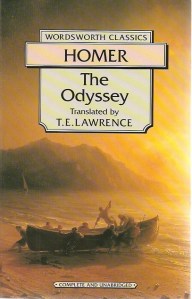
There are many different editions and translations of The Odyssey, some in verse and some in prose, but the book I read was the Wordsworth Classics edition pictured above from 1992 with a 1932 prose translation by T.E. Lawrence (better known as Lawrence of Arabia). There was no special reason why I decided to read this version, other than that I happened to have it on my shelf (I can’t remember where I got it from). I’m not sure if you can even still buy this particular translation in this edition anymore. However, this turned out to be a perfect translation for me. I know I’ve probably missed out on a lot of the beauty of The Odyssey by reading a prose version, but I don’t get on very well with narrative poems – apart from The Epic of Gilgamesh which I loved in verse form – so reading it in prose was probably a much better choice for me personally.

I have no idea how technically accurate Lawrence’s translation might be, but all I was really hoping for was something enjoyable and reasonably easy to read, and that’s what I got. I was surprised by how exciting and readable it actually was; I wonder if the fact that Lawrence himself had such an eventful life was an influence here in helping him to convey the drama of Odysseus’s adventures in such a compelling way.

I’m sorry about the lack of insight and analysis in this post. It doesn’t seem right to just ‘review’ an epic like The Odyssey as I would any other book, but that’s what I’ve had to do as I really don’t feel that there’s much I can add to everything that’s already been said about it over the centuries. It’s actually been a lot harder to write about The Odyssey than it was to read it!

Have you read The Odyssey? If I read it again, is there a translation you would recommend?

Twenty Years After by Alexandre Dumas

Twenty Years After At last! I’ve been meaning to read the sequel to The Three Musketeers for about five years now and I regret not having read it earlier as I loved it every bit as much as I expected to. I’ve done my best to avoid any big spoilers here but if you haven’t read The Three Musketeers yet you might prefer not to read the rest of this post until you have.

Twenty Years After, as you might have guessed, is set twenty years after The Three Musketeers. The political situation in France has changed during this time period: Cardinal Richelieu is dead and has been succeeded by the Italian Cardinal Mazarin, who is in league with the widowed Anne of Austria, mother of the young King Louis XIV of France. The French people are divided between Mazarin’s supporters and his opponents, the Frondeurs, who are unhappy with the way the country is being run. As Twenty Years After begins, France is close to civil war and when Mazarin meets our old friend d’Artagnan and hears of the brave exploits he has performed in the past, he asks him for help, along with his companions, the three musketeers – Athos, Porthos and Aramis.

D’Artagnan and his three friends have drifted apart over the years but he sets out to find them and invite them to join him in the Cardinal’s service. But while Porthos (hoping that Mazarin will reward him with a barony) is happy to go along with d’Artagnan, the other two have already taken the opposite side in the conflict. The story that follows is the story of how the friendship between d’Artagnan, Athos, Porthos and Aramis is tested by their differing political views and loyalties. Their work takes them to England, where King Charles I is facing capture and execution, and again they find themselves in opposition – but ultimately their loyalty is still to each other, especially when faced with a new enemy in the form of Mordaunt, the son of Milady, the previous book’s villain.

I found Twenty Years After a much more complex book than The Three Musketeers; I’m completely unfamiliar with this period of French history and even after finishing the book I’m not sure I really understood all of the historical background or exactly which of the various princes and dukes was on which side of the conflict. It’s a more mature book too – the characters are twenty years older and have different motivations and priorities, which allows Dumas to explore some different ideas and themes. But there’s still plenty of swashbuckling adventure and I definitely thought this book was just as much fun to read as the first one. As in The Three Musketeers there are some great and memorable scenes and set pieces – the scene on the scaffold during the execution of Charles I is one of the best – and I also loved the sequence of chapters describing the imprisonment of the Duc de Beaufort and his attempts to escape (which involved a trained dog, lobsters, some tennis balls and a giant pie).

The novel begins with an introduction to Cardinal Mazarin, but we don’t have to wait too long until we meet d’Artagnan again, still a lieutenant in the musketeers and dreaming of a captaincy. The other three musketeers and their servants are then reintroduced gradually one by one: first d’Artagnan’s old valet, Planchet, then Aramis with Bazin, Porthos and Mousqueton, Athos and finally Grimaud. I was a bit disappointed, though, that I had read more than 200 pages before all four of our heroes were reunited and together again in the same scene. And that was really the only problem I had with this book – the fact that throughout most of the story the four are divided into two pairs working towards different goals, with Porthos and d’Artagnan on one side and Athos and Aramis on the other.

The basic personality traits of the musketeers are the same, but they have also changed in many ways since the previous book, which is what you would expect after a gap of twenty years. D’Artagnan has matured from the naïve, passionate, brave young man we met in The Three Musketeers into a clever, cunning, quick-thinking man of forty who is now the natural leader of the group. Aramis has fulfilled his ambition of entering the church but isn’t fully committed, still being too interested in women and fighting. As d’Artagnan tells him, “when you were a musketeer you were forever becoming the abbé, and now you are an abbé you appear to me to have a strong leaning to the musketeers.”

Athos was my favourite character in The Three Musketeers but in this book he has become so honourable and saintly that I found him very frustrating at times. I still liked him but I much preferred the younger Athos of the wine cellar and the Bastion Saint-Gervais! In contrast, Porthos, who was never the brightest of the four, seems to have become even less intelligent. I’m sure he wasn’t quite as stupid in the first book! It does result in some great comedy moments though, and I do admire Dumas for making changes rather than leaving his characters static and undeveloped. It was also good to see that the musketeers’ four servants are given more personality in this book, particularly Grimaud and Mousqueton who even have some separate adventures of their own.

As I expected, Twenty Years After has definitely been one of my most enjoyable reads of the year! The Vicomte de Bragelonne awaits…

Thoughts on finishing War and Peace

War and Peace

To study the laws of history, we must change completely the object of observation, leave kings, ministers, and generals alone, and study the uniform, infinitesimal elements that govern the masses.

I wasn’t expecting to start writing this post until the end of December! At the beginning of the year I signed up for a year-long readalong of War and Peace hosted by Iris and Amy, attracted by their reading schedule which looked very realistic and manageable. I did stick with the schedule for the first few months and was enjoying being part of the group read (thank you, Amy and Iris!) but somewhere in the middle of the book I discovered that the pace wasn’t really working for me anymore. I found that I was finishing the month’s reading then forgetting about the book for a few weeks, which made it difficult to get back into the story again when I eventually picked it up to read the next month’s section. Once I abandoned the schedule and found a pace I was happy with, I flew through the rest of the book and really enjoyed it.

I didn’t think War and Peace was a particularly difficult book to read (I’m actually finding writing about it much more difficult!) and while it was certainly long, I have read other books of similar length. And yet it’s still a book that has always sounded very intimidating to me, so I felt a real sense of achievement when I reached the final page – especially after persevering through that Second Epilogue (if you’ve read it I’m sure you’ll know what I mean). If you’re wondering what War and Peace is actually about, I’m afraid I’m not going to tell you much about the plot because I don’t even know where to begin! It’s about war, of course – specifically the French invasion of Russia during the Napoleonic Wars – and the way it affects the members of several families of Russian aristocrats, not just in the army but also at home, in their domestic lives and in their interactions with each other.

I loved the ‘peace’ parts of War and Peace and getting to know Natasha, Marya and Sonya, Pierre, Nikolai and Andrei. The ‘war’ sections, however, were much more challenging for me as I often tend to struggle with battle scenes and find discussions of military tactics difficult to follow. This wasn’t helped by the fact that I had absolutely no previous knowledge of the Russian involvement in the Napoleonic Wars and to make things worse, from my point of view, there are lots of long philosophical passages in which Tolstoy spends a lot of time musing on war and its causes; for me to feel involved in what’s happening, I need to be actually ‘on the battlefield’ seeing things through the eyes of our protagonists, otherwise I just feel like a passive observer. Still, some of the book’s most moving and powerful moments occur during the war chapters. I included the following quote in one of my monthly readalong posts, but I’m copying it again here as I thought it really captured the shift from Nikolai’s view of war as something abstract and romantic to something real and harsh:

“Who are they? Why are they running? Can it be they’re running to me? Can it be? And why? To kill me? Me, whom everybody loves so?” He remembered his mother’s love for him, his family’s, his friends’, and the enemy’s intention to kill him seemed impossible.

Now, a note on the format and translation that I read. After reading mixed opinions on the various translations of War and Peace, I decided on the Kindle version of the Vintage Classics edition translated by Pevear and Volokhonsky (I wanted to avoid the Maude translation as I didn’t get on with their translation of Anna Karenina at all – though I know other readers recommend that one, so it’s just a matter of personal taste, I suppose). This P&V translation was very readable and I didn’t have any big problems with it, apart from, as I mentioned in another of my readalong update posts, not liking the way they chose to present the speech impediment of one character, Denisov. It distracted me so much I found it impossible to concentrate on what Denisov was actually saying! Also, I should point out that there’s a lot of French in War and Peace and in this edition, it is left untranslated in the dialogue with translations given at the end of each chapter. This was good as it gave an accurate understanding of how widely French was spoken by the Russian aristocracy and how its use gradually decreased as the war with France progressed, but it did mean a lot of turning back and forth was needed – and this was much more inconvenient with the Kindle than it would have been with a physical book.

Finally, some advice based on my experience with War and Peace: Reading with a friend or with other bloggers can be helpful and is a good way to stay motivated, but it’s important to find a pace you feel comfortable with. Read regularly and don’t leave the book unread for too long. If, like me, you know nothing about this period of Russian history, you might want to think about doing some background reading first to help put things into context – I didn’t and wished I had! And keep a list of the characters beside you as you read…as you would expect from a book of this length, there are a huge number of characters and it can be hard to remember who they all are. Be aware though that searching for character lists online can lead you to see spoilers you might prefer not to know about!

If you’ve read War and Peace too I would love to know what you thought of it – and if you have any more tips for future War and Peace readers please share them with us!