The Odyssey – translated by T.E. Lawrence

The Odyssey - Homer Ten years have passed since the Trojan War ended but Odysseus has still not returned home, having been held captive by the nymph Calypso, who has fallen in love with him. At home in Ithaca, his wife, Penelope, has found herself besieged by a large group of suitors who are hoping to persuade her to marry one of them. The suitors have taken over Odysseus’s palace and are helping themselves to his food and drink; his son, Telemachus, is desperate for them to leave but doesn’t have the courage to throw them out.

The Odyssey tells the story of Odysseus and his journey home to Ithaca – a journey involving encounters with the one-eyed Cyclops, the witch Circe, the sea monster Scylla, and the tempting music of the Sirens. But it’s also the story of Telemachus and his quest to find out what has happened to his father; of Penelope, faithfully waiting for her husband to return; and of the Greek gods and goddesses who try to help or hinder Odysseus on his travels.

I’m so happy to have finally read The Odyssey as it was one of the least appealing books on my Classics Club list, not necessarily because I was intimidated by it (well, maybe a little bit) but because I’m just not very interested in mythology. I can’t really explain why I’m not a fan; I did enjoy reading Greek myths as a child, but since then my reading has taken me in other directions. I know that probably puts me in a minority as most people seem to love mythology and have a lot more knowledge of the subject than I do!

I’ve started to read The Odyssey before but didn’t finish it so this is the first time I’ve actually read it from beginning to end. I did already know most of the story, partly from school and partly because this is the sort of story that I think many people will have at least some familiarity with even if they’ve never read it in its entirety. There were some things I wasn’t aware of, though – for example, I was surprised by how little time is actually devoted to Odysseus’s journey. This section of the epic, in which Odysseus describes his adventures and the monsters and mythical beings he outwits, is by far the most well-known section, but it actually only takes up four of the twenty-four books that make up The Odyssey. The rest of the time is spent on the suitors, Telemachus and Penelope, and what Odysseus does after he eventually returns to Ithaca.

There are lots of different themes and ideas contained in The Odyssey – storytelling, disguise and deception, temptation, and the relationship between mortals and gods are a few that I noted and I’m sure there are others that I missed. There is also a lot of focus on hospitality. It seemed a weary traveller would be made welcome wherever they went, offered food, a bath and a bed for the night.

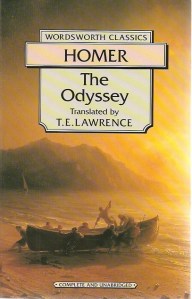
There are many different editions and translations of The Odyssey, some in verse and some in prose, but the book I read was the Wordsworth Classics edition pictured above from 1992 with a 1932 prose translation by T.E. Lawrence (better known as Lawrence of Arabia). There was no special reason why I decided to read this version, other than that I happened to have it on my shelf (I can’t remember where I got it from). I’m not sure if you can even still buy this particular translation in this edition anymore. However, this turned out to be a perfect translation for me. I know I’ve probably missed out on a lot of the beauty of The Odyssey by reading a prose version, but I don’t get on very well with narrative poems – apart from The Epic of Gilgamesh which I loved in verse form – so reading it in prose was probably a much better choice for me personally.

I have no idea how technically accurate Lawrence’s translation might be, but all I was really hoping for was something enjoyable and reasonably easy to read, and that’s what I got. I was surprised by how exciting and readable it actually was; I wonder if the fact that Lawrence himself had such an eventful life was an influence here in helping him to convey the drama of Odysseus’s adventures in such a compelling way.

I’m sorry about the lack of insight and analysis in this post. It doesn’t seem right to just ‘review’ an epic like The Odyssey as I would any other book, but that’s what I’ve had to do as I really don’t feel that there’s much I can add to everything that’s already been said about it over the centuries. It’s actually been a lot harder to write about The Odyssey than it was to read it!

Have you read The Odyssey? If I read it again, is there a translation you would recommend?

Twenty Years After by Alexandre Dumas

Twenty Years After At last! I’ve been meaning to read the sequel to The Three Musketeers for about five years now and I regret not having read it earlier as I loved it every bit as much as I expected to. I’ve done my best to avoid any big spoilers here but if you haven’t read The Three Musketeers yet you might prefer not to read the rest of this post until you have.

Twenty Years After, as you might have guessed, is set twenty years after The Three Musketeers. The political situation in France has changed during this time period: Cardinal Richelieu is dead and has been succeeded by the Italian Cardinal Mazarin, who is in league with the widowed Anne of Austria, mother of the young King Louis XIV of France. The French people are divided between Mazarin’s supporters and his opponents, the Frondeurs, who are unhappy with the way the country is being run. As Twenty Years After begins, France is close to civil war and when Mazarin meets our old friend d’Artagnan and hears of the brave exploits he has performed in the past, he asks him for help, along with his companions, the three musketeers – Athos, Porthos and Aramis.

D’Artagnan and his three friends have drifted apart over the years but he sets out to find them and invite them to join him in the Cardinal’s service. But while Porthos (hoping that Mazarin will reward him with a barony) is happy to go along with d’Artagnan, the other two have already taken the opposite side in the conflict. The story that follows is the story of how the friendship between d’Artagnan, Athos, Porthos and Aramis is tested by their differing political views and loyalties. Their work takes them to England, where King Charles I is facing capture and execution, and again they find themselves in opposition – but ultimately their loyalty is still to each other, especially when faced with a new enemy in the form of Mordaunt, the son of Milady, the previous book’s villain.

I found Twenty Years After a much more complex book than The Three Musketeers; I’m completely unfamiliar with this period of French history and even after finishing the book I’m not sure I really understood all of the historical background or exactly which of the various princes and dukes was on which side of the conflict. It’s a more mature book too – the characters are twenty years older and have different motivations and priorities, which allows Dumas to explore some different ideas and themes. But there’s still plenty of swashbuckling adventure and I definitely thought this book was just as much fun to read as the first one. As in The Three Musketeers there are some great and memorable scenes and set pieces – the scene on the scaffold during the execution of Charles I is one of the best – and I also loved the sequence of chapters describing the imprisonment of the Duc de Beaufort and his attempts to escape (which involved a trained dog, lobsters, some tennis balls and a giant pie).

The novel begins with an introduction to Cardinal Mazarin, but we don’t have to wait too long until we meet d’Artagnan again, still a lieutenant in the musketeers and dreaming of a captaincy. The other three musketeers and their servants are then reintroduced gradually one by one: first d’Artagnan’s old valet, Planchet, then Aramis with Bazin, Porthos and Mousqueton, Athos and finally Grimaud. I was a bit disappointed, though, that I had read more than 200 pages before all four of our heroes were reunited and together again in the same scene. And that was really the only problem I had with this book – the fact that throughout most of the story the four are divided into two pairs working towards different goals, with Porthos and d’Artagnan on one side and Athos and Aramis on the other.

The basic personality traits of the musketeers are the same, but they have also changed in many ways since the previous book, which is what you would expect after a gap of twenty years. D’Artagnan has matured from the naïve, passionate, brave young man we met in The Three Musketeers into a clever, cunning, quick-thinking man of forty who is now the natural leader of the group. Aramis has fulfilled his ambition of entering the church but isn’t fully committed, still being too interested in women and fighting. As d’Artagnan tells him, “when you were a musketeer you were forever becoming the abbé, and now you are an abbé you appear to me to have a strong leaning to the musketeers.”

Athos was my favourite character in The Three Musketeers but in this book he has become so honourable and saintly that I found him very frustrating at times. I still liked him but I much preferred the younger Athos of the wine cellar and the Bastion Saint-Gervais! In contrast, Porthos, who was never the brightest of the four, seems to have become even less intelligent. I’m sure he wasn’t quite as stupid in the first book! It does result in some great comedy moments though, and I do admire Dumas for making changes rather than leaving his characters static and undeveloped. It was also good to see that the musketeers’ four servants are given more personality in this book, particularly Grimaud and Mousqueton who even have some separate adventures of their own.

As I expected, Twenty Years After has definitely been one of my most enjoyable reads of the year! The Vicomte de Bragelonne awaits…

Thoughts on finishing War and Peace

War and Peace

To study the laws of history, we must change completely the object of observation, leave kings, ministers, and generals alone, and study the uniform, infinitesimal elements that govern the masses.

I wasn’t expecting to start writing this post until the end of December! At the beginning of the year I signed up for a year-long readalong of War and Peace hosted by Iris and Amy, attracted by their reading schedule which looked very realistic and manageable. I did stick with the schedule for the first few months and was enjoying being part of the group read (thank you, Amy and Iris!) but somewhere in the middle of the book I discovered that the pace wasn’t really working for me anymore. I found that I was finishing the month’s reading then forgetting about the book for a few weeks, which made it difficult to get back into the story again when I eventually picked it up to read the next month’s section. Once I abandoned the schedule and found a pace I was happy with, I flew through the rest of the book and really enjoyed it.

I didn’t think War and Peace was a particularly difficult book to read (I’m actually finding writing about it much more difficult!) and while it was certainly long, I have read other books of similar length. And yet it’s still a book that has always sounded very intimidating to me, so I felt a real sense of achievement when I reached the final page – especially after persevering through that Second Epilogue (if you’ve read it I’m sure you’ll know what I mean). If you’re wondering what War and Peace is actually about, I’m afraid I’m not going to tell you much about the plot because I don’t even know where to begin! It’s about war, of course – specifically the French invasion of Russia during the Napoleonic Wars – and the way it affects the members of several families of Russian aristocrats, not just in the army but also at home, in their domestic lives and in their interactions with each other.

I loved the ‘peace’ parts of War and Peace and getting to know Natasha, Marya and Sonya, Pierre, Nikolai and Andrei. The ‘war’ sections, however, were much more challenging for me as I often tend to struggle with battle scenes and find discussions of military tactics difficult to follow. This wasn’t helped by the fact that I had absolutely no previous knowledge of the Russian involvement in the Napoleonic Wars and to make things worse, from my point of view, there are lots of long philosophical passages in which Tolstoy spends a lot of time musing on war and its causes; for me to feel involved in what’s happening, I need to be actually ‘on the battlefield’ seeing things through the eyes of our protagonists, otherwise I just feel like a passive observer. Still, some of the book’s most moving and powerful moments occur during the war chapters. I included the following quote in one of my monthly readalong posts, but I’m copying it again here as I thought it really captured the shift from Nikolai’s view of war as something abstract and romantic to something real and harsh:

“Who are they? Why are they running? Can it be they’re running to me? Can it be? And why? To kill me? Me, whom everybody loves so?” He remembered his mother’s love for him, his family’s, his friends’, and the enemy’s intention to kill him seemed impossible.

Now, a note on the format and translation that I read. After reading mixed opinions on the various translations of War and Peace, I decided on the Kindle version of the Vintage Classics edition translated by Pevear and Volokhonsky (I wanted to avoid the Maude translation as I didn’t get on with their translation of Anna Karenina at all – though I know other readers recommend that one, so it’s just a matter of personal taste, I suppose). This P&V translation was very readable and I didn’t have any big problems with it, apart from, as I mentioned in another of my readalong update posts, not liking the way they chose to present the speech impediment of one character, Denisov. It distracted me so much I found it impossible to concentrate on what Denisov was actually saying! Also, I should point out that there’s a lot of French in War and Peace and in this edition, it is left untranslated in the dialogue with translations given at the end of each chapter. This was good as it gave an accurate understanding of how widely French was spoken by the Russian aristocracy and how its use gradually decreased as the war with France progressed, but it did mean a lot of turning back and forth was needed – and this was much more inconvenient with the Kindle than it would have been with a physical book.

Finally, some advice based on my experience with War and Peace: Reading with a friend or with other bloggers can be helpful and is a good way to stay motivated, but it’s important to find a pace you feel comfortable with. Read regularly and don’t leave the book unread for too long. If, like me, you know nothing about this period of Russian history, you might want to think about doing some background reading first to help put things into context – I didn’t and wished I had! And keep a list of the characters beside you as you read…as you would expect from a book of this length, there are a huge number of characters and it can be hard to remember who they all are. Be aware though that searching for character lists online can lead you to see spoilers you might prefer not to know about!

If you’ve read War and Peace too I would love to know what you thought of it – and if you have any more tips for future War and Peace readers please share them with us!

The Ladies’ Paradise by Émile Zola

The Ladies' Paradise The Ladies’ Paradise is only the second book I’ve read by Zola; my first was Thérèse Raquin and the two are very, very different. Au Bonheur des Dames, to give it its French title, was published in 1883 and is the story of a Paris department store, based on the real-life Le Bon Marché.

At the beginning of the novel, Denise Baudu arrives in Paris with her two younger brothers, hoping to find work in her uncle’s draper’s shop. She is disappointed to discover that he is unable to offer her a job because his shop, along with the other small shops in the street, is losing business to a new department store, the Ladies’ Paradise. The new store is able to offer a larger selection of products at cheaper prices all under one roof, and none of the smaller traders can hope to compete. Still, Denise desperately needs to earn money to support her brothers so although she understands how her uncle feels, she is pleased when she is offered a job at the Paradise.

Denise quickly finds that life as a salesgirl at the Paradise is not easy but she’s determined to succeed and overcome whatever obstacles are put in her way. And when she catches the eye of the owner of the Paradise, Octave Mouret, he soon discovers that she is a woman with morals and principles; it’s obvious that she is not going to give him any encouragement – but this only makes him want her more.

I was hoping to love this book as much as Thérèse Raquin but that didn’t happen. The Ladies’ Paradise is a book that I enjoyed, but not one that I loved. It offers some fascinating insights into both Parisian life and the rise of the department store in the late 19th century – and of course, the idea of a larger, cheaper store putting all the small, independent shops out of business is still very relevant today – but I disliked most of the characters and while the long descriptions of the silks, satins and other fabrics sold at the Paradise were beautifully detailed I did get a bit bored after a while. Maybe I just don’t like shopping enough!

However, I did find it fascinating to read about the way the Paradise was run and what it was like to work there. In some ways working at the Paradise was a very different experience from working in retail today, one of the biggest differences being that the salesgirls employed by the Paradise lived and ate on the premises and were treated almost like servants. But from a selling and marketing perspective, I was surprised to learn how modern and sophisticated Mouret’s methods were; a lot of the ideas he had for running the store, advertising its products and attracting customers are still used today (though I didn’t really like the implication that women are so easy to trick and tempt into parting with their money).

The only character I really liked was Denise. I had sympathy with all the ordeals she faced after starting her new job: having trouble fitting in with the other women, feeling that her clothes and hair weren’t right, being bullied by other employees, and worrying about making enough money to take care of her two younger brothers. I found it harder to like or care about any of the other characters (Denise’s brother, Jean, particularly annoyed me – surely he was old enough to take more responsibility for himself and his actions), though I did admire what Mouret had achieved in making the Paradise such a success.

I don’t want to sound too negative about this book because I still found a lot of things to enjoy about it, but I’m hoping the next Zola novel I read will be more to my taste than this one. Any suggestions are welcome!

The Three Musketeers by Alexandre Dumas (re-read)

The Three Musketeers One of my goals for 2013 was to re-read more of my favourite books, something I’ve been neglecting in recent years. Well, here we are in the middle of April and so far I’ve only re-read one!

The Three Musketeers may be the title, but our hero is not a musketeer when we first meet him at the beginning of the novel, in the year 1625; his name is d’Artagnan and he’s a young man from Gascony in France, on his way to Paris where he hopes to join the King’s Musketeers under the command of Monsieur de Tréville. On his arrival in Paris, d’Artagnan encounters three of the musketeers – Athos, Porthos and Aramis – in one of those wonderful openings to a book that once you’ve read you’re unlikely ever to forget.

Soon d’Artagnan and the three musketeers become the best of friends, and when d’Artagnan meets and falls in love with Constance Bonancieux, one of the Queen of France’s ladies, all four of them are drawn into the intrigue surrounding the Queen’s affair with the powerful English nobleman, the Duke of Buckingham. With the King’s advisor, Cardinal Richelieu, hoping to expose the affair, Constance, d’Artagnan and his three friends become targets of the Cardinal and his spy, the beautiful Lady de Winter. But Milady, as she is known, is hiding a secret of her own and if d’Artagnan discovers the truth, he and Constance could find themselves in even greater danger.

I first read The Three Musketeers five years ago and when I finished it I had intended to read the other books in the trilogy (the second is Twenty Years After and third is the three-volume The Vicomte de Bragelonne/Louise de la Valliere/The Man in the Iron Mask) but as so often happens other books got in the way and I never did get around to continuing with the d’Artagnan series. And so when I made my list for the Classics Club I put all of them on there – along with a re-read of The Three Musketeers as I thought it would be a good idea to remind myself of the characters and story before embarking on Twenty Years After – and anyway, I never need an excuse to re-read a book that I enjoyed so much the first time!

I love Alexandre Dumas and although The Three Musketeers is not my favourite of the three novels of his that I’ve read (that would be The Count of Monte Cristo) I still think it’s a wonderful book with some great characters. The musketeers all have such different personalities: the aristocratic, melancholy Athos, the loud, brash Porthos, the fastidious would-be priest, Aramis, and of course, the brave, passionate d’Artagnan. Everyone will be able to pick a favourite musketeer, and mine is Athos. In her recent post on The Count of Monte Cristo, Lisa compared the character of Edmond Dantes with Francis Crawford of Lymond from the Lymond Chronicles by Dorothy Dunnett (two other great fictional characters, by the way); I agree, but I can also see some of Athos’ character traits in Lymond too, especially during one of the most memorable set pieces in the book, where the four friends eat breakfast in a fortress surrounded by enemy soldiers because it’s the only place they can find to talk in private.

It seems five years is a good length of time to wait between re-reads of a book. I had forgotten enough so that I could be surprised by the twists and turns of the plot, but remembered just enough to be able to look forward to some of my favourite parts: the breakfast scene I mentioned above, the episode with the Queen’s diamond studs, and especially the sequence of chapters in the middle (entitled Porthos, The Thesis of Aramis and The Wife of Athos) which is just a joy to read. The friendship between d’Artagnan, Athos, Porthos and Aramis is so inspiring and heartwarming (all for one, one for all!) and this is why, for me, there’s a change in the tone of the book when towards the end, the focus switches from the musketeers to Milady and I don’t enjoy the final third quite as much as the first two thirds.

Now, a note on the translation. I read the Wordsworth Classics edition of The Three Musketeers which uses the first English translation by William Barrow in 1846 (I think this is also the one used by Oxford World’s Classics). I would be interested to try a newer translation, such as Richard Pevear’s, to see how it compares – and also because I’m aware that the older translations altered certain parts of Dumas’ original text because they considered it too sexually explicit for Victorian readers. I can see that some readers today would probably find the Barrow translation too literal and antiquated but I didn’t have a problem with it at all; I actually quite like the way the sentences are constructed and I think it has a certain romantic, old-fashioned quaintness about it.

I’ll be moving on to Twenty Years After very soon!

The Florentine Emerald by Agustín Bernaldo Palatchi

The Florentine Emerald The Florentine Emerald is historical fiction set in Florence during the Renaissance. The story begins in 1478 at Cardona Castle in Spain, where Mauricio Coloma is visiting his father, Pedro, who has been chained in a dungeon after being falsely accused of treason. Knowing that he is facing execution, Pedro reveals to Mauricio the truth that until recently converting to Christianity, their ancestors had been Jews. Before he is put to death he also tells his son of a valuable emerald ring hidden under a tile in the floor of their home in Barcelona and advises him to take it to Florence to sell to the Medici, the powerful Florentine family of bankers.

Arriving in Florence with the priceless jewel, Mauricio finds himself in the right place at the right time to thwart an assassination attempt on Lorenzo de’ Medici, the man who rules the Florentine Republic. As a sign of his gratitude, Lorenzo helps Mauricio establish himself in Florence. But then he meets and falls in love with Lorena Ginori, a girl whose parents are planning a more ambitious marriage for her with a man she dislikes. As the years go by, both Lorena and Mauricio have to confront some secrets from their pasts, while around them Florence is thrown into turmoil by the prophecies of the priest Savonarola and the conspiracies of those who want to cause the downfall of both Mauricio and the Medici.

This is an English translation of a Spanish novel by Agustín Bernaldo Palatchi, published by Barcelona eBooks, who if I’ve understood correctly are a spin-off of the Spanish publisher Roca Editorial and partners of Open Road Media, specialising in digital versions of Spanish and English translations. I was pleased to have the opportunity to read the ebook via Netgalley, but as I know not everyone likes or is able to read ebooks I thought it was only fair to point out that I’m not sure if or when The Florentine Emerald might be available in English in any other format.

Something I really enjoyed about this book was learning more about Renaissance-era Florence. In the fifteenth century, Florence was one of the most important centres of European trade and culture, which makes it an ideal setting for historical fiction. There were so many things happening both within Florence itself and in Europe in general during this period that had an effect on Mauricio’s story: outbreaks of plague; the voyages of Christopher Colombus; and the Spanish Inquisition and the threat to the Jews of expulsion from Florence. The first part of the novel is set during roughly the same period as Dorothy Dunnett’s House of Niccolò series which I read recently and so I was already familiar with some of the characters and events that were covered in the book (the papal alum monopoly, the Medici and Strozzi families, the Duke of Urbino and King Ferrante of Naples). This was useful as I would probably have found some of the historical details much more confusing otherwise!

I did find it a bit hard to believe that Mauricio would have been befriended by Lorenzo de’ Medici and given a position at the Medici bank almost as soon as he arrived in Florence and I had to suspend disbelief again as Mauricio immediately began to associate with Leonardo da Vinci, Christopher Columbus and so many other famous people of the period. However, this was only a small part of the story and overall I did enjoy the inclusion of so many real historical figures, especially as there were some I had previously known little or nothing about, including the philosopher Marcilio Ficino and the Dominican friar and preacher, Girolamo Savonarola who plans to reform Florentine society.

I thought the translation was generally good – the writing flowed well and I didn’t have any problems with it, except that it was maybe slightly lacking in emotion and passion. I enjoyed following the adventures of Mauricio and Lorena but something got in the way of me really being able to connect with them emotionally and whether that was due to the translation or not it’s difficult to say without having read the original. I liked the characterisation of Lorenzo de’ Medici, though, and it was interesting to read about the position of power and influence he held in Florence and the much less successful rule of his son and heir, Piero, who followed him. All of this left me wanting to read a good biography of the Medici family or even another fictional account, so any recommendations are welcome!

The Iron King by Maurice Druon

The Iron King “This is the original Game of Thrones” it says on the front cover, but anyone picking this book up hoping for an epic fantasy novel is going to be disappointed. The French novelist Maurice Druon may have been George R.R. Martin’s inspiration (I haven’t read Martin’s books so wouldn’t know how strong the influence actually is), but this is definitely not fantasy – it’s an historical fiction novel and an excellent one too. While I think it’s good that Martin’s recommendation is encouraging people to read The Iron King, I do think it was maybe a mistake for the publisher to market the book in this way, as looking through the various reviews on Amazon it seems a lot of people have not got the novel they were expecting and as a consequence The Iron King has ended up with a lower rating than it deserves.

Anyway, now that we’ve established what type of book this is, let me tell you what it’s about! Originally published in the 1950s, this is the first in the seven-volume “Accursed Kings” series and tells the story of a fascinating period of French history. The Iron King of the title is Philip IV of France, who was also known as Philip the Fair. For seven years Philip has been persecuting the Knights Templar who he wishes to destroy because of their power and riches, and he finally succeeds in having their Grand Master, Jacques de Molay, burned at the stake. But before the Grand Master goes to his death, he puts a curse on the King and his descendants – “accursed to the thirteenth generation!”

Things soon start to go badly for Philip and his family when it emerges that his sons’ wives are cheating on them with two young courtiers. Philip’s daughter Isabella, who is in a loveless marriage to King Edward II of England, sees an opportunity to bring their adultery to light, with the assistance of her ambitious and vengeful cousin, Robert of Artois, who is forming a plot of his own to reclaim his lands from his hated Aunt Mahaut. It seems that the Grand Master’s curse has been successful…

As this is a novel first published in 1955 and translated from French, it does have a very different feel in comparison to most of the historical fiction novels that are being written today and this was something I really liked about the book. Unfortunately I don’t have the language skills to be able to read it in its original French, but as far as I could tell, the translator (Humphrey Hare) has done a good job and The Iron King was one of the most entertaining historical fiction novels I’ve read for a while. There were so many interesting things to learn about – the origins of the famous ‘Tour de Nesle affair’; the demise of the Knights Templar; the community of Lombard bankers in Paris – and with a plot involving murder, torture, poisonings, court intrigue, and family feuds, there was always something happening.

Don’t worry if you know nothing about this period of French history – I had absolutely no previous knowledge of Philip the Fair and his family before reading this book but that was not a problem at all because this edition of the book makes the story easy to understand and follow. Everything you need to know regarding the historical background, the politics or the causes of feuds and disputes is clearly explained in the notes at the back of the book and the character list at the front helped me remember who everyone was and how they were related to each other. I am now looking forward to the second Accursed Kings book, The Strangled Queen. I hope the publisher will continue to reissue the rest of the series!