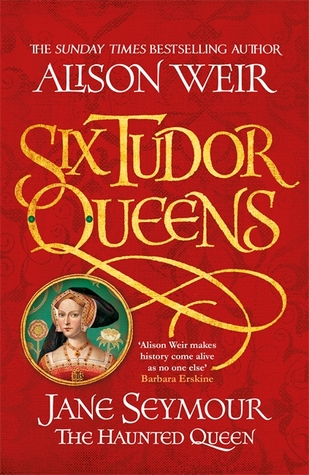
 While Prince Harry and Meghan Markle were getting married at Windsor Castle yesterday, I have spent the weekend absorbed in reading about the lives of a much earlier royal couple…Henry VIII and his third wife, Jane Seymour. Jane Seymour: The Haunted Queen is the third book in Alison Weir’s Six Tudor Queens series which aims to retell, in fictional form, the stories of all six of Henry’s wives. Having read the first two novels on Katherine of Aragon and Anne Boleyn, I have been looking forward to this new one; I’ve read about Jane less often than Katherine and Anne so I was interested in learning more about her and curious to see how she would be portrayed.
The novel begins by introducing us to Jane as a young girl, living with her parents and brothers and sisters at Wulfhall, the Seymours’ manor house in Wiltshire. For several years, Jane is convinced that she would like to become a nun but eventually she discovers that she has no true vocation for a religious life and she decides that her future lies at court instead. With the help of Sir Francis Bryan, a courtier and family friend, she obtains a place in the household of Katherine of Aragon as one of the queen’s maids-of-honour. Jane is devoted to the queen, but when Henry puts Katherine aside so that he can marry Anne Boleyn, she finds herself in the unwelcome position of having to serve Anne instead of Katherine.
When Jane catches the king’s eye, her ambitious brothers see this as an opportunity to make the Seymours the power behind the throne, while Jane herself is keen to use her new influence with Henry to help reinstate Katherine and her daughter, the Lady Mary. But then comes Anne Boleyn’s downfall and suddenly Jane, who has watched her younger sisters marrying before her and has almost given up hope of ever finding a husband herself, is elevated to the highest position of all: Queen of England, as Henry’s third wife. With only two daughters from his first two marriages, Henry is desperate for a son, but can Jane succeed where her two predecessors failed?
I have given a basic outline of the plot of The Haunted Queen in the two paragraphs above, but I’m sure none of it will be very surprising to anyone who already knows their Tudor history. Weir sticks closely to historical fact as far as possible although, as she explains in her author’s note, the information we have on Jane is limited and there are areas where she has to use her imagination and historical knowledge to fill in the gaps – for example, the possibility of Jane contemplating taking religious vows, the question of whether she could already have been pregnant at the time of her marriage to Henry, and the probable cause of her death shortly after giving birth in October 1537. There were enough new ideas and interpretations here to make this, for me, a worthwhile and compelling read.
Jane Seymour often comes across as one of the less interesting wives, particularly following Anne Boleyn, but I liked the way she was portrayed in this novel. Was Jane used as a pawn by Thomas Cromwell and her ambitious family, or was she as manipulative as they were in bringing down Anne Boleyn and taking her place as queen? Different authors and historians have different views on this, but Alison Weir’s version of Jane is somewhere between the two and I found it a realistic, convincing portrait of a quiet, compassionate young woman who did not set out to become queen but who seized the opportunity when it arose in the hope of using the power it would give her to help those she loved and to restore the ‘true religion’. Henry is depicted in quite a balanced and nuanced way too; we see a more loving side of him in his relationship with Jane, as well as his cruelty towards his previous two wives and his daughter, Mary. We also get to know some of the other characters who play a part in Jane’s story, including her brothers Edward and Thomas; I particularly liked the portrayal of Sir Francis Bryan, who is a good friend of the Seymour family, despite his reputation as ‘the vicar of Hell’.
I enjoyed reading about Jane’s early life at Wulfhall (marked by the scandal caused by her father’s affair with his daughter-in-law Catherine Fillol – something I have previously read about in Suzannah Dunn’s The May Bride) and, later in the book, her brief reign as queen, but the section in the middle which covers Henry’s attempts to divorce Katherine of Aragon and then his marriage to Anne Boleyn, was less interesting to me. This is because it’s the third time in this series that I’ve read about those same events. Obviously, the three women involved – Katherine, Anne and Jane – have very different views on the matter, but I still found it just a little bit tedious to read it all again. I was also not a fan of the supernatural elements which are suggested by the title, The Haunted Queen, but I’m sure other readers will disagree.
I am now looking forward to the fourth book in the series which will tell the story of Anne of Cleves, definitely the wife I know the least about!
Thanks to Headline Review for providing a copy of this book via NetGalley.



 She Reads Novels