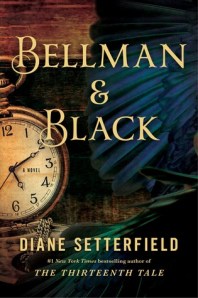
 William Bellman is ten years old when he hits a rook with his catapult and kills it. He and his friends had expected the bird to fly away before the stone hit it and are surprised to see it die. Just a small incident and William quickly moves on with his life, but as he grows older it seems that this brief moment of cruelty was much more significant than it seemed at the time.
William joins the family mill and through hard work and dedication he begins to rise in the world. As a rich, successful businessman with a wife and children he loves, life is perfect – but not for long. Soon, a series of tragic deaths start to destroy William’s happiness and he finds himself entering into partnership with a mysterious stranger dressed in black…
I found plenty of things to like about Bellman & Black but compared to Diane Setterfield’s first book, The Thirteenth Tale, it was disappointing. Although I didn’t love The Thirteenth Tale the way a lot of other readers did and consequently my expectations for this one weren’t too high, I definitely found her first book much more enjoyable than the second. Bellman & Black is packed with great, original ideas but I don’t think she was quite as successful at bringing all of these ideas together to form a satisfying story as she was with The Thirteenth Tale.
I think part of my problem with this book may have been that I just didn’t like William and felt somehow detached from him, so that even when he was going through times of tragedy and disaster I didn’t really care. And being able to care about William would have been a big advantage in a book where William was the only character who felt fully developed. Other characters come and go without the reader having a chance to get to know them properly; I thought William’s daughter, Dora, had potential but her character was never fleshed out enough for me to be able to warm to her.
Anyway, let’s move on to the things that I loved in Bellman & Black. Diane Setterfield has chosen to write about some fascinating aspects of Victorian culture and society! The first half of the book revolves around the running of a mill and we have the chance to learn about all the different areas of the textile industry, from the processes of producing and dyeing cloth to the benefits Bellman introduces to improve the welfare of his workers. In the second half of the book we explore the mourning business and the emporium William establishes in London as part of his deal with Mr Black (I kept being reminded here of Zola’s The Ladies’ Paradise).
Interspersed with William’s story are some shorter passages which discuss rooks and ravens – their appearance and behaviour, their roles in history and mythology, and every other aspect of rooks and ravens that you could possibly imagine. I’m not sure if these sections really added anything to the plot, but I liked the concept and enjoyed reading them.
Bellman & Black is described as a ghost story, though despite the Gothic touches and the foreboding atmosphere, I don’t really think I would agree with that description. William Bellman is certainly haunted, but it’s more of a psychological haunting than a physical one, so if you’re looking for a traditional ghost story you won’t find one here. This is the sort of book that will make you think and look below the surface for hidden meanings – and when you reach the final page you’ll be left to draw your own conclusions from what you’ve read.
I received a copy of this book for review via Netgalley.



 She Reads Novels