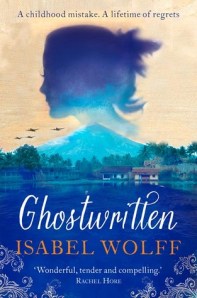
Ghostwritten by Isabel Wolff

Ghostwritten As a ghostwriter, Jenni’s job involves writing books for people who are unable or unwilling to do the writing themselves. Many of her projects include celebrity biographies and self-help guides, but some of her clients are ordinary people with extraordinary tales to tell. At a friend’s wedding she is introduced to a man who tells her about his mother, Klara, a Dutch woman who survived the Japanese internment camps in Java during World War II. Klara has said very little to her family about her wartime experiences, but as she approaches her eightieth birthday she has decided that the time has come for her story to be told. Intrigued, Jenni agrees to visit Klara at her home in Cornwall and help to put her memories down on paper.

The only problem with this new project is that the little Cornish town of Polvarth where Klara lives is a place that holds traumatic memories for Jenni, but although she is not very happy about returning to Polvarth, the temptation of hearing Klara’s story is impossible to resist. After meeting Klara and listening to her talk about her childhood, her family’s rubber plantation in Java, and the unimaginable horrors of the internment camps, Jenni is both moved and inspired. She has been going through a difficult time with her boyfriend, Rick (he wants children and she doesn’t), and she is still haunted by her own tragic past – but being with Klara gives her the strength to start facing up to her problems.

I enjoyed Ghostwritten and while I was initially drawn to it because of the Java storyline, I thought the balance of the contemporary and the historical was just right. I did prefer Klara’s storyline to Jenni’s, but ghostwriting sounds like an interesting career and I loved reading about Jenni’s work. I was also curious to find out more about the secret Jenni had spent her whole life trying to hide and her connection with a little girl called Evie who visited Polvarth years earlier in 1987.

Klara’s story, though, was fascinating, especially as I knew very little about Japanese internment camps and what conditions were like for people in Java during the war. As you would expect, some of Klara’s tales of the suffering she and the other prisoners experienced are quite upsetting to read. There are descriptions of what it was like being packed onto an overcrowded train for twenty-eight hours to be transported from one camp to another, living crammed into a house with up to one hundred other women and children, being made to stand outside in the relentless heat of the sun for hours with no shelter and nothing to drink, and worst of all finding yourself separated from a parent, a spouse or a child with no idea where they are and whether they are alive or dead.

I’ve never read anything by Isabel Wolff before, but looking at her previous work it seems that this book is a bit different from her others. I was so impressed by it. It’s not just a book about ghostwriting or Japanese internment camps, but also a book about friendship and love, about learning to forgive and to move on with life.

Ghostwritten will be published in the UK on 27th March 2014 and I hope it will be available elsewhere very soon.

The Sea Change by Joanna Rossiter

The Sea Change The Sea Change is a novel about many things: love and grief, friendship and betrayal, the devastation caused by war and natural disasters, but perhaps most importantly, the relationships between mothers and daughters.

Violet Fielding lives with her parents and her sister, Freda, in a small Wiltshire village called Imber. In the middle of the Second World War the residents of Imber are forced to evacuate, leaving the village to be requisitioned by army troops and used for military training exercises. As Violet tries to settle into a new life in a new home, she is unable to forget Imber, her childhood friends and Pete, the boy she fell in love with.

Many years later in 1971, Violet’s daughter, Alice, is travelling to India with her boyfriend, James. Alice was not on good terms with Violet when they parted; her mother disapproves of James and isn’t very happy about Alice going so far away. When they reach India, Alice and James get married, but the day after their wedding the coast of India is hit by a tsunami and Alice is separated from her new husband, who had gone out to get breakfast. As she begins to search for him – an almost impossible task, given the scale of the disaster and the number of people who are missing – Alice reflects on her life with James and thinks about what went wrong in her relationship with her mother.

The Sea Change is one of those dual time period novels I’ve complained about so much in the past, but I thought the structure worked quite well in this case. Although the two stories are set in different times and places, I could see parallels between them – in both there is a sense of loss and grief for things and people that are gone forever. I never managed to become as interested in Alice’s story as I was in Violet’s, but I did love the way the two storylines began to merge together towards the end.

I’ve read a lot of books about the war but none that have dealt with this particular aspect: the idea of an entire village that has been abandoned and the effects of this on the people who once lived there. It was so sad to read about a whole community being broken up and forced into a different way of life. The fact that Imber is a real place, still uninhabited today, makes the story even more moving. Alice’s story was also something new for me; I’ve seen images on the news, of course, showing the destruction a tidal wave can cause, but it’s not something I’ve ever read about in fiction.

There are some books that grab me from the first page and don’t let go until the end; other books are gentler and draw me in more slowly. This was one of the second type but that doesn’t mean I liked it any less. The Sea Change is a beautifully written book, filled with emotion and poignancy and a real understanding of complex relationships. There are some beautiful descriptions too, of both England and India. I would never have guessed this was Joanna Rossiter’s first novel as it feels like the work of a much more experienced author! I’m looking forward to seeing what she writes next.

Thanks to Penguin for providing a review copy of this book.

Pictures at an Exhibition by Camilla Macpherson

Pictures at an Exhibition In 1942 the National Gallery in London launched its ‘Picture of the Month’ scheme. Each month one of the masterpieces that had been hidden away to protect them from bombing raids during the war would be brought out of storage and put on display. Daisy Milton, who is working in London as a typist, decides to go along every month to look at the paintings in the hope that it will give her something to look forward to and help her get through the days until the war is over. After each visit to the gallery she writes a letter to her friend Elizabeth in Canada, describing the painting and how it made her feel.

In the present day we meet Claire and her husband, Rob. When Rob’s grandmother, Elizabeth, dies she leaves him a box containing the letters she received from Daisy throughout the war. A recent tragedy has almost destroyed Claire and Rob’s marriage and Claire finds some comfort in reading Daisy’s letters and going to look at the paintings once a month just as Daisy did. As the months go by and Claire finds herself drawn into Daisy’s world she starts to see some parallels between Daisy’s life in the past and her own life in the present.

I enjoyed Pictures at an Exhibition, but although I was interested in both the wartime and modern day storylines I did prefer the wartime one because I found Daisy a much more appealing character than Claire. For a long time Claire annoyed me because she seemed so self-absorbed and unwilling to move on with her life. I had more sympathy for Rob, who came across as a kind, considerate husband who was doing his best to make their marriage work and starting to run out of patience. As Claire’s story unfolded I started to warm to her a bit more, but I would still rather have spent more time with Daisy.

My favourite thing about this novel was having the opportunity to learn about the paintings that were displayed in the National Gallery during the war. Each chapter of the book begins with a QR code that you can scan with your phone (if you have the right sort of phone) and it will take you directly to the painting, or you can look them up online yourself later if you prefer – they are all easy to find on the National Gallery website. Some were very famous paintings that I was already familiar with, such as The Arnolfini Portrait by Jan van Eyck and The Hay Wain by John Constable, but there were others I knew nothing about. It was a fascinating experience to view each of these paintings first through Daisy’s eyes and Claire’s, then to be able to look at them myself and see things in them that I might not have thought of otherwise.

Thanks to the author for sending me a review copy of this book.

Jasmine Nights by Julia Gregson

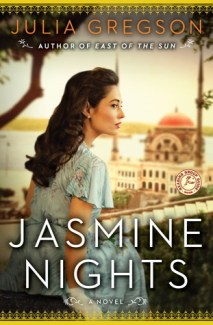
Jasmine Nights It’s 1942 and World War II fighter pilot Dom Benson is recovering in hospital after being injured in a plane crash. It is here that he meets Saba Tarcan, a talented young singer who has come to entertain the wounded soldiers in Dom’s hospital ward. Saba and Dom are instantly attracted to each other but before their relationship has a chance to develop, Saba passes an audition to join ENSA (Entertainments National Service Association) and is sent to North Africa to perform for the troops.

Soon after her arrival in Cairo, Saba is approached by the Secret Service and finds herself agreeing to spy for them. She is under strict orders not to tell anyone about her mission, but when Dom returns to action with the Air Force and is also sent to Egypt will their relationship be able to withstand Saba’s secrets?

I love reading novels set during World War II and I particularly enjoy those that approach the subject from an unusual perspective or cover aspects of the war that we don’t often hear about. Jasmine Nights does both, so it really should have been a book that I loved. Unfortunately it wasn’t. I had no problems with the style of Julia Gregson’s writing, I thought the settings – wartime Cairo, Alexandria and Istanbul – were fascinating to read about and there was certainly enough material here to form a compelling story. It just lacked that special spark that would have transformed it into a book that I could wholeheartedly recommend.

Individually, both Saba and Dom are interesting, complex characters. Despite her strict Turkish father disapproving of her choice of career, Saba is ambitious and determined to fulfil her dreams of becoming a successful singer and escaping the monotony of her life in Wales, even if it means losing contact with her family. After joining ENSA, Saba is forced to juggle her relationship with Dom, her singing career and her desire to serve her country and help the war effort. Over the course of the novel, she has to make some difficult decisions and try to decide which of these things is most important to her. Dom also has an interesting story of his own and we see him struggling to come to terms with the idea of flying again after his crash and his guilt about escaping death when some of his close friends were not so lucky.

I liked both main characters but their romance never felt very natural or believable to me. A wartime love story should be very emotional but this one left me unmoved and I would have preferred more focus on the spying storyline instead. I knew female entertainers sometimes acted as spies during the war, but I’ve never read about the subject in a novel before and this was what had initially attracted me to this book. Sadly, I found this aspect of the story disappointing too. There was a lot of build up but it seemed to take such a long time before Saba found herself in any real danger and for a book about war and espionage it was strangely unexciting, without any of the suspense and tension I would have expected.

I did enjoy the descriptions of life as part of ENSA and the variety of colourful characters Saba meets in the troupe, including Janine the dancer, Willie the comedian and one of the other singers, Arleta, who becomes a good friend of Saba’s and was probably my favourite character. But this was not enough to rescue the book for me and I just felt that there was not enough depth, not enough emotion and none of the magic I was hoping for in a book that had sounded so promising.

The Light Behind the Window by Lucinda Riley

The Light Behind the Window With 2012 coming rapidly to a close I’ve now had to accept that I’m not going to have time before the end of December to write about all of the books I’ve read this year. I still have three outstanding reviews to post from October, five from November, plus any more books that I finish in the final two weeks of this month. The good news is that I do have drafts nearly complete for most of those books, so it’s just a case of finding time to finish them. I’m going to try to post as many as possible this week and next, beginning with this one, The Light Behind the Window.

This is the third novel by Lucinda Riley. I haven’t read her first, Hothouse Flower (published as The Orchid House in America), but I enjoyed her second, The Girl on the Cliff and was looking forward to reading this one. I would describe Lucinda Riley’s books as similar to Kate Morton’s: a mixture of history, romance and suspense within a dual time-frame structure. The action in The Light Behind the Window is divided between England in the 1990s and France in the 1940s.

We begin in 1998, when we meet Emilie de la Martinieres whose mother has just died, leaving Emilie to inherit the family estate which includes a beautiful château and vineyard in the south of France. Alone in the world and not sure what to do with her inheritance, Emilie is grateful for the help of her new friend, Sebastian Carruthers, who she meets at a restaurant in the village. Sebastian is an Englishman with connections to the de la Martinieres’ château – he tells Emilie that his grandmother, Constance, had stayed there during the Second World War. After a very short time, Sebastian and Emilie marry and return to England where the Carruthers have a home in Yorkshire. Here at Blackmoor Hall, Emilie meets her new brother-in-law, Alex, who is not on good terms with Sebastian and lives in a separate wing of the house. Sebastian has nothing good to say about Alex, but as Emilie gets to know them both better she begins to wonder whether there’s more to the feud between the brothers than meets the eye.

The link between the two families – the Carruthers and the de la Martinieres – is explored further in the novel’s other storyline, which takes place in the 1940s and follows the adventures of Constance Carruthers who has been recruited by the SOE (the British Special Operations Executive) to carry out espionage in occupied France and assist the French Resistance. After she finishes her training, Constance travels to Paris on her first secret mission but things don’t go according to plan and instead of being met by her contact she ends up in the home of Edouard de la Martinieres – Emilie’s father. The past and present stories – Constance’s in the 1940s and Emilie’s in the 1990s are connected in many ways and during the course of the novel the two threads meet and become woven together. As it says on the front cover of the book, “Unlocking the past is the key to the future…”

I didn’t enjoy this one as much as The Girl on the Cliff, though it was still an entertaining read. I do like Lucinda Riley’s writing overall, but I couldn’t help thinking that the dialogue in this book felt very stilted and unnatural. I have to mention it because it was something that really grated on me, especially in the first half of the book, though by the time I was halfway through I had been swept away by the story and after that any problems with the writing were less noticeable.

Whenever I read a novel set in more than one time period I usually (though not always) find that I become more involved in one than the other. Being the lover of historical fiction that I am, it’s not surprising that it tends to be the historical storyline that I prefer and that was the case again with this book. The contemporary story felt too predictable at times and there were too many plot developments that I found hard to believe, but the wartime story was fascinating and exciting. I’ve never read anything about the SOE before and it was so interesting to learn about their work in France and what it involved.

Another aspect of the book I want to mention is that two of the main characters are Nazi officers; one of them is not much more than a stereotype and is one of the novel’s villains, but the other is portrayed more sympathetically, as someone who is not completely committed and having doubts about the Nazi regime. I thought this was an interesting perspective, but it would have been nice to have seen him actually do more to act on his concerns and I’m not sure I was really very comfortable with the way his story ended.

Despite having a few problems with The Light Behind the Window I’m looking forward to Lucinda Riley’s next book and will hopefully get around to reading Hothouse Flower at some point too!

The Conductor by Sarah Quigley

It’s 1941 and Russia is now at war with Germany. As the Nazis surround Leningrad with the aim of starving the city into submission, the composer Dmitri Shostakovich begins work on his Seventh Symphony. While other important musicians are being evacuated, Shostakovich insists on remaining to help defend his city. To his wife, Nina, the real reason he doesn’t want to leave is because he doesn’t want to be disturbed while writing his symphony and it seems to her that he is putting his music before the welfare of his family.

During the siege, the government orders that the Seventh Symphony be performed to raise the morale of the Soviet troops at the front. Since the members of Leningrad’s famous Philharmonic Orchestra and their conductor Mravinsky have already been removed from the city, the job of performing the Seventh Symphony falls to another, less highly regarded conductor, Karl Eliasberg and the second-rate Radio Orchestra. Eliasberg finally has the chance to do something great, but it’s not going to be easy…of the musicians who have stayed in Leningrad through the long, cold Russian winter some of them are dead and the others barely have the strength to lift their instruments.

Alongside the stories of Shostakovich and Eliasberg is the story of a third man, Nikolai Nikolayev, and his beloved nine-year-old daughter, Sonya. Nikolai must make the heartbreaking decision of whether to risk sending Sonya out of Leningrad on her own while he stays behind to continue his work as violinist in the orchestra.

The Siege of Leningrad was surely one of the most horrific episodes of the Second World War. This book was maybe not quite as emotional as other novels I’ve read on the same subject (The Bronze Horseman by Paullina Simons, for example) but it was still very moving. The idea of people being so hungry they’re driven to boiling down leather briefcases for protein or mixing water and hair oil to make soup, while watching as their family and friends die one by one of starvation or cold, is horrible to think about. And yet the story is not too bleak or depressing because it’s not just about war and suffering – it’s also about the power of art and music and how something good can come from even the worst circumstances imaginable.

The characters Sarah Quigley has chosen to focus on in this novel are all interesting, three-dimensional people who each have their own set of problems and obstacles to overcome during the siege. My favourite was Karl Eliasberg, the conductor of the book’s title. Based on a real person but one who we don’t know much about, the author imagines him as a shy, awkward man with low self-esteem, desperate to have his talents recognised and to be accepted by the cultural elite. Shostakovich is his idol but every time he comes face to face with him he finds himself saying the wrong things and failing to give the impression he was hoping to give. Eliasberg’s character is so well-written and believable I felt I could really understand him and empathise with him.

Despite Shostakovich being one of the central characters and the story revolving around one of his compositions, you don’t need any knowledge of classical music to enjoy this novel. However, I would highly recommend listening to the Seventh Symphony after finishing the book – it’s definitely worth it and it really adds to the reading experience. I loved this book and I have a feeling that when I make my list of favourite books of the year in December this might be one of them.

Every Secret Thing by Susanna Kearsley

Every Secret Thing is the third book I’ve read by Susanna Kearsley. I didn’t enjoy it quite as much as the other two – The Rose Garden and Mariana – but that could just be because it’s a different type of novel and didn’t include some of the elements that I loved in the others I’ve read.

Kate Murray is a Canadian journalist who has been sent to London to report on an important criminal trial. While she is there, she meets Andrew Deacon, an old man who tells her he knew her grandmother and that he has an important story to tell her. He invites Kate to come to his hotel for dinner that night, but as he begins to walk away he is hit by a car and is killed. As Kate tries to find out what the connection was between Deacon and her grandmother, more suspicious deaths occur and it seems that someone wants to stop Kate from uncovering any more information. And when Kate’s investigations lead her to Portugal, she finds herself caught up in a wartime mystery involving espionage and murder in 1940s Lisbon.

Every Secret Thing has also been published under the name Emma Cole, presumably as it is a slightly different genre to her other books and might appeal to different readers. The writing style is the same, but although this book does still have a historical storyline told through the recollections of the various people Kate speaks to, there’s no time travel, reincarnation or any of the other paranormal elements that appear in Susanna Kearsley’s other novels. I would describe this book as similar to a Mary Stewart suspense novel. I know I’ve compared Kearsley to Mary Stewart before, but I can’t help mentioning it again because she does remind me of her so much.

One of the things I found interesting about this book was the way it covered so many different aspects of World War II that I didn’t know much about. We find out what life was like for a young woman in New York City during the war, for example, and we are given some insights into what was involved in working for British secret intelligence. We also learn a little bit about all the intrigue and espionage that was taking place in Portugal throughout the war. Lisbon is such a fascinating setting for a World War II novel – as a neutral port, it was a centre of operations for spies and agents from both the Allied and Axis forces and also an important escape route for refugees.

Kate Murray is a likeable narrator but the most memorable character in the book for me was Andrew Deacon. Although he dies right at the beginning of the story, we get to know him through the memories of the other characters whose lives he touched in one way or another, including his secretary Regina Marinho, his nephew James Cavender and of course, Kate’s grandmother. The only problem I really had with this book was that I thought the plot relied too heavily on coincidences and chance meetings. One or two of these in a novel isn’t a problem but when there are too many of them everything starts to feel too convenient and unrealistic. So, not my favourite book by Susanna Kearsley/Emma Cole but I still enjoyed it and if there are going to be more books about Kate Murray I’ll be happy to read them.