The Conductor by Sarah Quigley

It’s 1941 and Russia is now at war with Germany. As the Nazis surround Leningrad with the aim of starving the city into submission, the composer Dmitri Shostakovich begins work on his Seventh Symphony. While other important musicians are being evacuated, Shostakovich insists on remaining to help defend his city. To his wife, Nina, the real reason he doesn’t want to leave is because he doesn’t want to be disturbed while writing his symphony and it seems to her that he is putting his music before the welfare of his family.

During the siege, the government orders that the Seventh Symphony be performed to raise the morale of the Soviet troops at the front. Since the members of Leningrad’s famous Philharmonic Orchestra and their conductor Mravinsky have already been removed from the city, the job of performing the Seventh Symphony falls to another, less highly regarded conductor, Karl Eliasberg and the second-rate Radio Orchestra. Eliasberg finally has the chance to do something great, but it’s not going to be easy…of the musicians who have stayed in Leningrad through the long, cold Russian winter some of them are dead and the others barely have the strength to lift their instruments.

Alongside the stories of Shostakovich and Eliasberg is the story of a third man, Nikolai Nikolayev, and his beloved nine-year-old daughter, Sonya. Nikolai must make the heartbreaking decision of whether to risk sending Sonya out of Leningrad on her own while he stays behind to continue his work as violinist in the orchestra.

The Siege of Leningrad was surely one of the most horrific episodes of the Second World War. This book was maybe not quite as emotional as other novels I’ve read on the same subject (The Bronze Horseman by Paullina Simons, for example) but it was still very moving. The idea of people being so hungry they’re driven to boiling down leather briefcases for protein or mixing water and hair oil to make soup, while watching as their family and friends die one by one of starvation or cold, is horrible to think about. And yet the story is not too bleak or depressing because it’s not just about war and suffering – it’s also about the power of art and music and how something good can come from even the worst circumstances imaginable.

The characters Sarah Quigley has chosen to focus on in this novel are all interesting, three-dimensional people who each have their own set of problems and obstacles to overcome during the siege. My favourite was Karl Eliasberg, the conductor of the book’s title. Based on a real person but one who we don’t know much about, the author imagines him as a shy, awkward man with low self-esteem, desperate to have his talents recognised and to be accepted by the cultural elite. Shostakovich is his idol but every time he comes face to face with him he finds himself saying the wrong things and failing to give the impression he was hoping to give. Eliasberg’s character is so well-written and believable I felt I could really understand him and empathise with him.

Despite Shostakovich being one of the central characters and the story revolving around one of his compositions, you don’t need any knowledge of classical music to enjoy this novel. However, I would highly recommend listening to the Seventh Symphony after finishing the book – it’s definitely worth it and it really adds to the reading experience. I loved this book and I have a feeling that when I make my list of favourite books of the year in December this might be one of them.

Every Secret Thing by Susanna Kearsley

Every Secret Thing is the third book I’ve read by Susanna Kearsley. I didn’t enjoy it quite as much as the other two – The Rose Garden and Mariana – but that could just be because it’s a different type of novel and didn’t include some of the elements that I loved in the others I’ve read.

Kate Murray is a Canadian journalist who has been sent to London to report on an important criminal trial. While she is there, she meets Andrew Deacon, an old man who tells her he knew her grandmother and that he has an important story to tell her. He invites Kate to come to his hotel for dinner that night, but as he begins to walk away he is hit by a car and is killed. As Kate tries to find out what the connection was between Deacon and her grandmother, more suspicious deaths occur and it seems that someone wants to stop Kate from uncovering any more information. And when Kate’s investigations lead her to Portugal, she finds herself caught up in a wartime mystery involving espionage and murder in 1940s Lisbon.

Every Secret Thing has also been published under the name Emma Cole, presumably as it is a slightly different genre to her other books and might appeal to different readers. The writing style is the same, but although this book does still have a historical storyline told through the recollections of the various people Kate speaks to, there’s no time travel, reincarnation or any of the other paranormal elements that appear in Susanna Kearsley’s other novels. I would describe this book as similar to a Mary Stewart suspense novel. I know I’ve compared Kearsley to Mary Stewart before, but I can’t help mentioning it again because she does remind me of her so much.

One of the things I found interesting about this book was the way it covered so many different aspects of World War II that I didn’t know much about. We find out what life was like for a young woman in New York City during the war, for example, and we are given some insights into what was involved in working for British secret intelligence. We also learn a little bit about all the intrigue and espionage that was taking place in Portugal throughout the war. Lisbon is such a fascinating setting for a World War II novel – as a neutral port, it was a centre of operations for spies and agents from both the Allied and Axis forces and also an important escape route for refugees.

Kate Murray is a likeable narrator but the most memorable character in the book for me was Andrew Deacon. Although he dies right at the beginning of the story, we get to know him through the memories of the other characters whose lives he touched in one way or another, including his secretary Regina Marinho, his nephew James Cavender and of course, Kate’s grandmother. The only problem I really had with this book was that I thought the plot relied too heavily on coincidences and chance meetings. One or two of these in a novel isn’t a problem but when there are too many of them everything starts to feel too convenient and unrealistic. So, not my favourite book by Susanna Kearsley/Emma Cole but I still enjoyed it and if there are going to be more books about Kate Murray I’ll be happy to read them.

Full Dark House by Christopher Fowler

One of the books I hope to be reading soon for the Transworld Book Group challenge is The Water Room, the second in Christopher Fowler’s Bryant and May series. As I already had a copy of the first in the series waiting to be read and I would prefer not to read them in the wrong order, I decided to read Full Dark House first. And I’m glad I did, because Full Dark House definitely has a ‘first in the series’ feel about it.

Arthur Bryant and John May are two elderly detectives who work for the Peculiar Crimes Unit, a branch of the London Metropolitan Police created to deal with unusual cases. When the PCU office is destroyed in an explosion, Bryant, who was inside the building, is presumed dead. His partner, May, who has worked with him for over sixty years, is determined to find out who killed Bryant and why.

In order to understand who may have been responsible for Bryant’s death, we are taken back in time to November 1940, when Bryant and May worked together on their very first case during the London Blitz. While bombs fell on the city night after night, the two young detectives were investigating the murders of several cast members of a controversial new play at the Palace Theatre. As the story moves backwards and forwards between 1940 and the present day, May searches for a connection between the ‘Palace Phantom’ and Arthur Bryant’s death.

With their different strengths and weaknesses, Arthur Bryant and John May complement each other perfectly and each of them approaches the investigation in his own way. Bryant has unconventional ideas, an active imagination and an interest in the paranormal, whereas May is the more logical and methodical of the two. Setting the story in two time periods sixty years apart was a good idea because it allowed us to watch the two detectives meeting each other for the first time in 1940 and to see how their relationship had developed over the intervening years. I liked both of them and am looking forward to getting to know them better throughout the rest of the series.

I loved the descriptions of black-outs, bomb shelters, rationing and other aspects of daily life in London during the Blitz – it all felt very convincing and realistic. In fact, of all the books I’ve read recently set in wartime London, this is probably the one that evokes the era best, which was something I hadn’t expected. I can tell Christopher Fowler must have researched every part of his book very thoroughly, because as well as all the little details that make his portrayal of London so believable, there are also some very detailed descriptions of the backstage layout of the theatre and lots of information on Greek mythology too.

Apart from a section in the middle of the book where the plot moved forward very slowly and nothing seemed to happen for a while, I really enjoyed my first introduction to Bryant and May. With two mysteries to solve, lots of plot twists, and a large cast of colourful characters both within the Peculiar Crimes Unit and at the theatre, Full Dark House is a great opening to the series.

The Blank Wall by Elisabeth Sanxay Holding

Every time I pick up a Persephone book I’m amazed by the diversity of the books they publish. The Blank Wall, written by the American author Elisabeth Sanxay Holding and originally published in 1947, is completely different to the others I’ve read, in terms of both plot and overall feel.

The Blank Wall is a suspense novel set during World War II. Lucia Holley is living with her two teenage children and her father in their lakeside home, while her husband, Tom, is serving in the navy somewhere in the Pacific. Her daughter, Bee, has been having an affair with an older man who Lucia considers to be entirely unsuitable. Things quickly start to spiral out of control and Lucia finds herself involved in murder, blackmail and a series of other crimes, all of which she attempts to conceal from her family. But as she desperately tries to protect her loved ones and avoid a scandal, could Lucia actually be putting herself and others in danger?

With the story being told from Lucia’s perspective, we are given lots of insights into her thought processes as she tries to cope with the disruption to her previously peaceful life. I could really feel Lucia’s fear and panic as everything seemed to be closing in around her. I didn’t always understand her actions and there were times when I felt frustrated with her because some of her decisions were clearly silly and irrational, but it was an interesting study into the way a 1940s woman of Lucia’s class and background might have reacted. It was easy to see why Lucia felt under so much pressure. She was doing her best to take care of her family during wartime and provide meals for them despite rationing and shortages, as well as trying to solve their personal problems and keep them safe – while continuing to send letters to her husband assuring him that everything at home was fine.

The pages of The Blank Wall are filled with tension and suspense. The plot is exciting and fast-paced and I could never guess what might happen next. But apart from the thrilling plot, the other strength of this book is the skilful way Holding portrays the relationships between Lucia and the other characters, particularly with her daughter Bee, the housekeeper Sybil and one of the blackmailers, Martin Donnelly, with whom she starts to form a surprising friendship. And I haven’t read many stories of the American Home Front during the war, so this was another interesting aspect of the book for me. A great story and one of my favourite Persephones so far.

The Invisible Bridge by Julie Orringer

The Invisible Bridge begins in 1937 and follows the fortunes of three Hungarian Jewish brothers – Andras, Tibor and Matyas Levi – as they try to survive in a Europe torn apart by World War II. At the beginning of the book, Andras is preparing to leave Budapest and go to Paris to study architecture. Soon after his arrival in France, Andras meets Klara Morgenstern, a woman nine years older than himself, a ballet teacher with a teenage daughter. Andras and Klara fall in love, but Klara has secrets in her past – secrets that she would prefer not to share with Andras.

Andras and Klara’s story is played out against a backdrop of wartime Paris, Budapest, Ukraine and parts of the Hungarian countryside. The complex relationship between Andras and Klara is always at the heart of the novel but to dismiss this book as just another romance is unfair because it’s so much more than that.

Despite reading a lot of novels set during World War II, this is the first one I’ve read that is told from a Hungarian perspective. Hungary was allied with Germany which meant this story approached things from a slightly different angle than most other books I’ve read about the war and as I knew almost nothing about the role Hungary played, I was able to learn a lot from this book. And of course, because Andras and his family are Jews the novel is very much from a Jewish viewpoint. We see how it grew increasingly dangerous to be a Jew living in wartime Europe and how the Levi family became desperate to escape to safety. And when eventually Hungary finds itself under German occupation, we see that the Hungarian Jews fared no better than Jews elsewhere in Europe.

I enjoyed this book but it wasn’t perfect. There were times when I thought the balance between the romance storyline and the war aspect wasn’t quite right. And some of the characters needed more depth. I really liked Andras at first as he was a character who was easy to like and sympathise with, but as the story went on I started to find him a little bit too perfect and after spending more than 600 pages with him I wished he’d had a few flaws just to make him more interesting. I also think it would have been a nice touch if part of the book had been written from another character’s point of view. Not really a criticism of the book – I just think it would have added another dimension to the story and with the book being so epic in scope, the opportunity was there to do this.

The biggest problem I had with the book was the length! I’m usually quite happy to immerse myself in a long book but unlike some stories which do take a long time to tell, I thought this one could easily have been a lot shorter. My attention started to wander somewhere in the middle of the book when a lot of time was spent describing Andras’s life in the forced labour service (Jews were no longer allowed to serve in the actual Hungarian army but instead were expected to do jobs such as felling trees and clearing minefields) but things did pick up again over the last hundred pages.

In fact, the final section of the book, with its descriptions of life in Budapest towards the end of the war is so compelling and filled with so much tension, it made it worth sticking with the book through the less interesting chapters in the middle. And of course, I was genuinely worried for some of the characters so I had to keep reading to make sure they survived to the end of the book! I thought Orringer did a good job of keeping us in suspense wondering who would live or die and despite the few minor negative points I’ve mentioned above, I loved The Invisible Bridge.

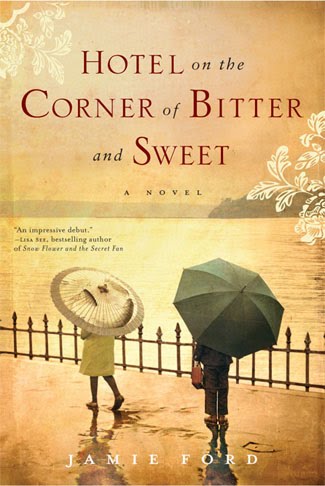
Hotel on the Corner of Bitter and Sweet by Jamie Ford

One day in 1986 Henry Lee stands outside Seattle’s Panama Hotel. The building is being renovated and has been opened up for the first time in over forty years. As Henry watches, a number of items are carried up to the street. These things belonged to the Japanese American families who were ‘evacuated’ from their homes during the second world war. They had stored their possessions in the hotel basement but never came back to reclaim them. This is an important historical discovery, but for Henry it also has personal significance as it brings back memories of one particular Japanese family and a girl called Keiko…

Henry and Keiko are both just twelve years old when they become friends in 1942. He is the only Chinese boy and she the only Japanese girl in an all-white school. Unfortunately Henry’s father disapproves of their relationship – China and Japan have been involved in conflict for years and he considers all Japanese people to be the enemy. And with Pearl Harbor still fresh in people’s minds, Japan is America’s enemy too. Henry’s parents make him wear an “I am Chinese” button when he goes out in case anyone mistakes him for a Japanese boy. When the US government decide to round up thousands of Japanese people and send them to internment camps (allegedly to stop them from spying) Henry and Keiko find themselves separated.

The story of Henry and Keiko’s love and the fate of America’s Japanese population is just one part of Hotel on the Corner of Bitter and Sweet; the book also looks at the difficult relationship between Henry and his father, racial tensions in the 1940s, the Seattle jazz scene and the importance of music in our lives. The novel is heartbreaking in places and heartwarming in others (the ‘bitter and sweet’ of the title), yet it never became too sentimental for me. It’s a lovely, tender, moving story from beginning to end, but at the same time it’s a story that helps to educate the reader about an aspect of World War II that rarely seems to be given any attention today. I feel ashamed that I knew nothing about the way Japanese American people were treated during the war and I’m pleased that this gap in my knowledge has now been rectified somewhat.

So many of the books I’ve read recently have dual timeframes. In this book the narrative is split between 1942 and 1986, but for once I found both periods equally compelling to read about. As for the characters, the good ones are very good and the bad ones are very bad, yet they still feel like real, believable people rather than two-dimensional stereotypes. I really loved both Henry and Keiko. They were characters I genuinely cared about and I felt emotionally invested in their story, rather than just being a passive observer. And someone else who deserves a mention is Sheldon, a black saxophone player who becomes a friend of Henry’s, the type of friend I think we would all like to have!

As you might have guessed by now, I really loved this book – and I think it might even be one of my favourite books of the year so far. I had added it to my wish list as soon as it started appearing on so many American book blogs a couple of years ago and now that I’ve finally had a chance to read it for myself I’m so glad it was as good as I’d hoped it would be!

The Novel in the Viola by Natasha Solomons

I love reading fiction set during World War II and The Novel in the Viola is one of the best I’ve read for a while. The story begins in 1938 when we meet nineteen-year-old Elise Landau, a girl from a rich Austrian family (her mother, Anna, is a successful opera singer and her father, Julian, a famous author). Until now, Elise has lead a secure and comfortable life but that’s all about to change because the Landaus are Jews, and with Europe on the brink of war Austria is no longer a safe place to live. And so Elise is sent away from her home in Vienna and travels alone to Tyneford House, a mansion on the south coast of England, where she will work as a maid for Mr Rivers and his son, Kit. Her parents have remained in Austria while they await American visas and they promise to send for Elise as soon as possible – but as the war continues, she begins to wonder if they’ll ever be reunited.

The portrayal of life in an English country house forms a big part of the story, with insights into the class system, social conventions of the time, and the relationships between servant and master. Elise has to get used to working as a parlour maid after spending most of her life having servants of her own. Her background makes it difficult for her to fit in with the other servants at Tyneford but her status as a maid and a Jewish refugee prevents her from being accepted by some of the Rivers’ upper class friends. Elise is a wonderful character and I enjoyed following her as she settled into her new life – I thought Natasha Solomons displayed a real understanding of what it was like to be newly arrived in an unfamiliar country, feeling homesick and struggling with the language and the culture.

There are lots of beautiful, atmospheric descriptions of the Dorset countryside and coast which gave me a true feel of what it was like to live there during the Second World War. The story also looks at the effects the war had on the village of Tyneford and the house itself. The author’s note at the end of the book was very interesting and explained how Tyneford was based on a real place that became a ghost town because of the war.

There are so many other things I could say about this book – there’s the secret of the ‘novel in the viola’ itself, and I haven’t even mentioned yet the romantic storyline which develops as Elise begins to fall in love with someone she meets at Tyneford. But I don’t want to spoil this book for you, so I’ll just say that The Novel in the Viola was a real pleasure to read, a great story with just the right balance of sadness and humour. And I thought the way the book ended was perfect – the only problem was that I had grown to care for Elise and the others so much I didn’t want to leave them behind.