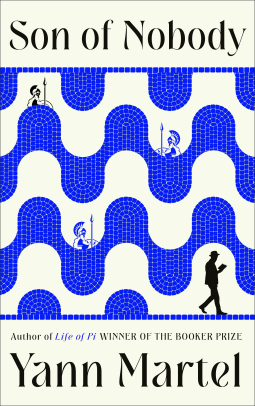
 Homer’s Iliad, the most famous account of the Trojan War, focuses on gods, heroes and great warriors – but what if there was another version, written from the perspective of the ordinary people, the ‘sons of nobody’? Yann Martel explores this idea in his new novel, the first I’ve read since Life of Pi, which I loved. I enjoyed this one as well; it’s an unusual and ambitious book, but it worked for me.
The novel is narrated by Harlow Donne, a Canadian academic whose area of interest is Greek epics. When he receives an offer to take part in a research project at Oxford University, he sees it as the opportunity of a lifetime and leaves his wife and daughter behind in Canada to travel to England alone and take up his new position. At Oxford, Harlow begins to study the Oxyrhynchus Papyri, a collection of ancient manuscripts, and comes across some fragments of what appears to be the story of a man called Psoas of Midea and an alternative account of the events of the Iliad. Psoas is not a god, a king or a hero – he’s a goatherd, a commoner, referred to in the fragments as the son of nobody. As Harlow continues to piece together and translate the fragments, a whole new epic begins to emerge, which he thinks of as the Psoad, and at the same time he becomes aware of parallels with his own life.
Each chapter of the novel begins with a section of the Psoad, which is written in verse, and is followed by Harlow’s footnotes in which he interprets what is being said and what we can learn from it. Sometimes, though, his footnotes go in a different direction and he talks about his personal life, his work at Magdalen College and his relationships with his wife, Gail, and their young daughter, Helen. Harlow sees himself as Agamemnon, King of Mycenae, who sacrificed his daughter, Iphigenia, to the gods in return for winds and then sailed off to the Trojan War for ten years, leaving his wife, Clytemnestra, behind. Like Agamemnon, Harlow has abandoned his own wife and child to go in pursuit of his own ‘Troy’, in other words his translation of the new Greek epic.
I wasn’t sure at first how I would feel about reading an imitation epic, but I think Martel does a great job of making it feel reasonably authentic, as if it could have existed even though we know it didn’t. The Psoad differs from the Iliad in many ways – for example, instead of the famous Trojan Horse there are elephants – and Harlow draws comparisons between the two in his footnotes (which I believe in the physical book version are printed across the bottom half of the page, separated by a line from the verse fragments in the top half, although you couldn’t see this formatting in the NetGalley version I read). I think you could still follow and enjoy the book with no prior knowledge of the Iliad or the Trojan War, but having at least some familiarity will help you to get more out of it.
Harlow’s personal story is also interesting as a portrayal of a man who becomes so obsessed with his work that he completely neglects his wife and daughter. I had a lot of sympathy for Gail, who can’t understand why her husband is putting a fictional story ahead of his family’s real needs and concerns. I liked Harlow less and less as the book went on, but was still moved by the traumatic events that happen in his life towards the end.
I’m sure Son of Nobody won’t be for everyone, but if it sounds at all appealing to you I would recommend giving it a try. I found it very impressive and completely different from the usual Greek retellings.
Thanks to Canongate Books for providing a copy of this book for review via NetGalley.


