 Translated by Howard Curtis
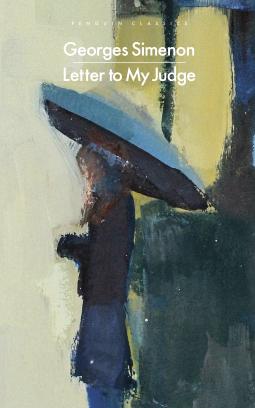
Georges Simenon is more famous for his Maigret detective series, but he also wrote a large number of standalone psychological thrillers which he described as romans durs, or ‘hard novels’, in reference to the dark, bleak atmosphere and difficult, harrowing lives of the characters. I’ve read five of them now and Letter to My Judge is the darkest so far. It was originally published in French in 1947 and is now available from Penguin Classics in a new English translation.
As the title suggests, the book is written in the form of a letter. The writer is Dr Charles Alavoine and we know from the beginning that he is in prison, having just been found guilty of murder. The Judge of the title is an examining magistrate, or juge d’instruction to use the French term, the person responsible for carrying out a pre-trial investigation and preparing the evidence. During his trial, Charles heard the Judge state that he didn’t think the murder was premeditated, so he’s decided to write him a letter proving that it really was premeditated and that he knew exactly what he was doing when he committed the crime. It may seem an odd thing to want to prove, but Charles feels that it’s important to have his full story heard by someone.
In his letter, Alavoine begins by looking back at his early days when he qualified as a doctor and bought a practice in the town of La Roche-sur-Yon in western France. We then hear about his first wife, who died in childbirth, and the arrival of Armande, who came to take care of his young daughters and ended up marrying him. Armande is a practical, capable woman who quickly begins to dominate the household, the medical practice and every aspect of her husband’s life. Charles doesn’t love her but he needs a wife and she seems to be as good a choice as any. Things change when he meets a young woman, Martine, at a station and feels a desire for her that he has never felt for Armande. Charles is determined not to lose Martine now that he has found her, but events quickly begin to spiral out of control, leading to the crime for which he will later stand trial.
With the whole book written from Charles Alavoine’s perspective, this means we get right inside the mind of a killer, which makes this an intense, uncomfortable read. Alavoine has few, if any, redeeming qualities and is an unpleasant, abusive person from beginning to end. Apparently this was a deeply personal book for Simenon, who said “I wrote it in order to rid myself of my ghosts, not to commit the same deed carried out by my protagonist”. It seems that Simenon himself, like Alavoine, treated the women in his life badly, which is disappointing to know, although he at least had enough self-awareness to write an honest, reflective book like this one. It’s definitely a very disturbing story, though, even more so than the others I’ve read by him and I’m sure the autobiographical aspect is partly responsible for that.
As well as being an unsettling book to read, it’s also quite a gripping one. Although there’s not really any mystery as we already know the outcome of Alavoine’s story from the beginning, we don’t know what led him to that point so there’s still some suspense as we watch everything unfold. It’s not my favourite of the romans durs I’ve read so far, but it’s certainly a powerful novel and not one I’ll forget easily.
Thanks to Penguin Classics for providing a copy of this book for review via NetGalley.
 She Reads Novels
I’ve only read a few of Simenon’s romans durs, and I hadn’t heard of this one, but it does sound suitable dark and compelling!
Apparently he wrote 117 romans durs, as well as all the Maigret novels! This one was a bit too dark for me, even compared to the others I’ve read, but it was still fascinating.
Unlike Kaggsy I’ve only read a couple of his romans durs but I do think he does them well compared to the mixed results from the Simenon series. One to bear in mind, perhaps, for Emma’s Paris in July event, so thanks!
I always seem to forget about Paris in July – this would be a good choice!
Which has been your favourite? I’m interested since I didn’t get on very well with the one Maigret I tried but would like to give his writing another go. . .
I think it would definitely be worth trying one of these books even if you didn’t get on with the Maigret. My favourite so far is probably The Venice Train.
Thanks!
Still have never read anything by this author, though I’ve been meaning to try one of his Maigret mysteries for years now. I’m not sure I would enjoy this one.
This is probably not the best place to start, as it’s such a dark, bleak book. I do recommend trying something by him, though!
Excellent. I’ve only read two books by Simenon (so far) but I was VERY impressed by both of them. If only I had the time to read *everything* by him. I DO like a challenge though! [grin]
He wrote hundreds of books, so that really would be a challenge! Most of them seem to be quite short, though…
Apparently 192 not including a further 200 under a variety of names! That’s IMPRESSIVE. Too much a challenge for me I think. Maybe I’d have a go at the 192 if I was 20-30 years younger!!
This sounds like a fascinating, if uncomfortable read. Im curious about how its framed being a letter in a killer’s own voice. Although knowing it has a personal feel with some of the authors darker actions is an additional layer of discomfort for sure.
All of the Simenon books I’ve read so far have been quite uncomfortable, unsettling reads but this one was particularly dark! Knowing that he had based the main character on himself was a bit off-putting as well.
I find his unpleasant personality often seeps into the Maigret books too, especially in the way he sometimes has Maigret bully and abuse women. It often surprises me that Maigret is regularly praised as a kind, understanding sort of man, and a good husband. Clearly standards have changed!
It’s disappointing when an author you like turns out to be an unpleasant, abusive person in real life. I suppose it’s one of those cases where you have to separate the art from the artist, but it’s still a bit off-putting!