 Translated by Jane B. Greene
What a strange book this is! I enjoyed it, but I’m not sure I fully understood everything the author was trying to say. It’s the first book I’ve read by Alexander Lernet-Holenia and I’m definitely now interested in reading more.
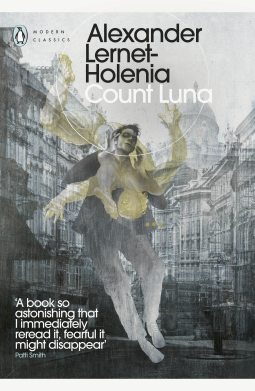
Count Luna was first published in German in 1955 (Lernet-Holenia was an Austrian author) and appeared in an English translation by Jane B. Greene a year later. It has recently been published in a new edition by Penguin Classics.
The novel begins with Alexander Jessiersky, an Austrian aristocrat, entering the Catacombs of Praetextatus in Rome, apparently in search of two French priests believed to have vanished somewhere in the underground passageways. When Jessiersky himself also fails to emerge from the catacombs, his disappearance is reported to the police, who link him with a series of incidents which occurred in Austria and are still under investigation. The rest of the book is presented as an account of Jessiersky’s life leading up to the disappearance, based on reports by the Italian and Austrian authorities.
We learn that at the start of World War II, Jessiersky is the head of a large Viennese transport company. When the company tries to purchase some land belonging to Count Luna, who refuses to sell, the board of directors come up with a plan to confiscate the land and have Luna sent to a Nazi concentration camp. Jessiersky himself is not involved in this, but does nothing to prevent it from happening – and so, when the war is over, he begins to worry that Luna has survived the camp and is coming back to take his revenge.
On one level, Count Luna could be described as a psychological thriller; told mainly from Jessiersky’s perspective, there’s a growing sense of paranoia and fear as he becomes convinced that Count Luna is following him around Vienna, watching from the shadows, breaking into his house and even trying to poison his children. Whether any of these things are true or only exist in Jessiersky’s imagination I’ll leave you to discover for yourself. The atmosphere becomes very dark and the feeling of tension increases as the novel heads towards its conclusion and Jessiersky enters the catacombs – and from this point the story becomes quite bizarre and even more nightmarish.
At 160 pages, Count Luna is a short novel, but took longer than I expected to read as there are some long, detailed digressions into subjects such as the lineage of the Jessiersky family, which need some concentration from the reader (and don’t really add a lot to the story as a whole). Apart from the references to the war, it felt more like a book written in the 19th century than one written in the 1950s. The war is a crucial part of the story, however, and I’ve seen reviews suggesting that Lernet-Holenia was drawing parallels between Jessiersky’s guilt over Luna’s fate and Austria’s own post-war guilt, which does make a lot of sense. I also think the name Luna (the moon) is no coincidence, as Jessiersky discovers that trying to escape from Luna – and therefore from his guilt – is as useless as trying to escape from the moon.
Although I didn’t love this book as much as I thought I was going to at the beginning, I did find it completely fascinating and it left me with a lot to think about.
Thanks to Penguin Classics for providing a copy of this book for review via NetGalley.
 She Reads Novels
Interestingly different! Sounds a little bit like Carlos Ruiz Zafon – especially ‘Marina’.
I’ve read one or two of Zafon’s books, but now I’m curious about Marina!
My review is here:
https://cyberkittenspot.blogspot.com/2023/09/just-finished-reading-marina-by-carlos.html
I was intrigued by the cover and it does sound strange but at 160 pages I feel tempted to give it a go! It must have been a difficult one to review, getting your thoughts in order must have been a challenge but you’ve described your reading experience very well!
Thanks – it certainly wasn’t a very easy review to write! I definitely think this book is worth reading, particularly as it’s quite short so not too big a commitment.
That sounds interesting. I haven’t heard of that book.
I hadn’t heard of it until recently either. It’s a fascinating book.
Sounds like it!
I hadn’t heard of this book either. Full marks for opting for it over easier reads. I guess that’s how you discover new favourite authors isn’t it (though not necessarily in this case)
It wasn’t an easy read, but definitely worthwhile! I doubt Lernet-Holenia will become a favourite author, but I’m planning to read more of his books eventually.
I’ve read a couple of Lernet-Holenia’s books and really want to read this one too – it sounds most unusual!!!
It’s very unusual and different – I really enjoyed it!
Oh, so intriguing, Helen, I’m hooked! As I’m currently reading two novels – one about a melancholic Hungarian travelling through Italy just before the war, the other about an Englishman about to unexpectedly find true love in Austria in the 1920s, it appears I’m in the mood for mysterious mid 20th-century European adventures!
I can definitely recommend this one, particularly as it’s quite a short novel. Now I’m curious about those two books you’re reading – I’ll be interested to hear more about them!
I am also struck by how much the packaging for Penguin Classics has changed since I was a Penguin sales rep! I was trying to read who provided the cover quote – who is Patti Smith? Surprised they couldn’t find anything better.
One of my favorite stories about the dreadful human being I worked for at Penguin involves a nonfiction book that got panned by the New York Times. One memorable quote was something like “Few passages are memorable and it is too late to think of going back to update the inaccuracies.”
On the paperback, our publisher insisted on putting, “Memorable.” The New York Times Book Review.
If I were the author or editor, I’d have been mortified, but as the National Accounts Manager, I hoped my history buyer did not remember the review and begged him to take copies for his top stores at least.
Hello, Patti Smith is a well respected author, poet and singer-song writer. But definitely an acquired.
They do look a lot different than they used to! How awful of your publisher to do that – I hope nobody remembered the review.