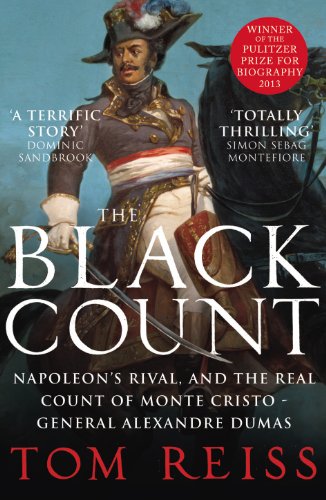
 My second non-fiction review this month, The Black Count is a biography of General Thomas-Alexandre Dumas, father of the French author Alexandre Dumas. I’ve always loved Dumas’ novels (he’s most famous for The Three Musketeers and The Count of Monte Cristo, one of my all-time favourite books), so The Black Count appealed to me as soon as I heard about it on its publication in 2012. I’ve no idea why it has taken me so long to actually pick it up and read it!
Thomas-Alexandre Dumas, usually referred to in the book as Alex, was born in 1762 in the French colony of Saint-Domingue (now Haiti) in the Caribbean. He was the son of a French aristocrat, the Marquis Alexandre Antoine Davy de la Pailleterie, and a freed slave woman, Marie-Cesette Dumas. After the death of his mother, the young Alex, along with his three siblings, was temporarily sold into slavery by his father in order to pay their passage back to France. Eventually the Marquis bought Alex back (but not the other three children, who remained in slavery and are lost to history) and took him home to France where he was educated in fencing, horse riding and all the other skills befitting the son of a nobleman.
When the Marquis remarried, however, Alex was left to fend for himself and he joined the French military, taking his mother’s surname of Dumas. Playing an important role in the French Revolutionary Wars, he quickly rose through the ranks and by the age of thirty-two was General-in-Chief of the French Army of the Alps, commanding 53,000 men. Later, on a campaign to Egypt, Alex clashed with another powerful general, Napoleon Bonaparte, and from there his career took a downward spiral. Today, Napoleon remains one of the most well known historical figures of all time, but Alex Dumas has been largely forgotten. The Black Count is an attempt to give Dumas the attention he deserves and make his story known to a modern audience.
General Alex Dumas was clearly a fascinating man, yet I have to be completely honest and say that I was slightly disappointed by this book. It was described as a thrilling real life adventure story, as exciting as one of Dumas’ novels, which I think raised my expectations too high. For me, there was too much focus on military history, with details of campaigns, battles and tactics, along with lots of general information on the French Revolution, with Alex Dumas himself being pushed into the background for large sections of the book. Of course, other readers will find this much more interesting than I did, but military life is never going to be one of my personal favourite subjects to read about and I have read about the Revolution many times before. I did quite enjoy the chapter about the Army of the Alps, though, where Alex and his men scaled the icy cliffs of Mont Cenis to capture a mountain pass; as Reiss points out, the cold must have come as a shock to a man who grew up in the Caribbean!
All of Alex Dumas’ achievements are very impressive, but most impressive of all is the fact that he was able to rise as high as he did as a person of colour in the 18th century. In some ways it was the perfect time and place for him to succeed because it was a surprisingly tolerant period in French history; a century later racial prejudices and the removal of rights for black people would have prevented him from reaching the same heights. At the time of Alex’s arrival in France, however, a decree known as the Code Noir was in place which gave freed slaves the same rights and privileges as white people. Add to that Alex’s renowned strength, courage and leadership skills and it’s easy to see how he was able to accomplish so much and even rival Napoleon for a while.
Tom Reiss occasionally tells us about his visits to museums and archives where he saw documents and paintings which informed his writing of the book. He also draws on a large number of other sources, which are listed at the end in a bibliography, the most notable being the writings of Alexandre Dumas (the author), who wrote about his father in his memoirs and several of his other non-fiction books. Reiss also suggests that some famous scenes from Dumas’ novels were based on his father’s adventures – for example, in 1799 Alex was captured and thrown into a dungeon in the Kingdom of Naples for two years, something which surely inspired the imprisonment of Edmond Dantès in The Count of Monte Cristo.
Although I expected to love The Black Count more than I did, I do feel that I’ve learned a lot from it, both about France in the second half of the 18th century and about Alex Dumas himself. He was an amazing man and deserves to be better known; I’m sure this book, in the twelve years since it was published, will have gone some way towards achieving that.
 She Reads Novels
Oh, I am so pleased that you reviewed this one! It really needs more circulation than it has had so far–I found it quite fascinating!
It seemed to get a lot of attention when it was first published but doesn’t get mentioned very often now. I’m glad I finally got round to reading it – definitely a fascinating book and a fascinating man!
This has been on my TBR for ages; it landed there as an “also available” option when I was looking in the catalogue online for the actual novel and, ever since, I’ve wanted to read it. But I do appreciate the warning that it’s perhaps not quite as thrilling as the jacket text promises: it did sound a little too good to be true. /giggles (Unless one enjoys military strategy, I suppose.)
I think other people have found it a lot more thrilling than I did! Still a fascinating story, though, and Alex Dumas does deserve more attention.
I thought this book was really interesting when I read it several years ago, especially the insight into Napoleon.
Yes, I found it really interesting too, despite getting bogged down in the military parts at times.
His life certainly sounds interesting. I can’t believe his father sold him and his siblings into slavery and then never bought the others back.
He had a fascinating life – and yes, I felt so sorry for the other Dumas children!
Excellent reminder of the Dumas ancestry, which I’d forgotten, and a pointer to the kinds of exploits he seems to have drawn on as inspiration for his fiction. I’m not sure I’d’ve been in raptures about military campaigns either but I suppose Reiss thought it essential to include all the detail he’d researched.
The military was such a big part of Dumas’ life it’s not surprising it gets so much attention in this biography, but it’s never going to be something that interests me in particular. He was a fascinating man, though, and I did enjoy the book overall.